You're spending real money across Meta, Google, TikTok, and LinkedIn. Campaigns are running, clicks are coming in, and conversions are happening. But when you sit down to answer the simple question "which campaigns are actually driving revenue?" you hit a wall. Every platform claims credit. Your spreadsheets don't tell the full story. And your next budget decision feels more like a coin flip than a confident call.
This is the reality for most marketing teams today. Traditional optimization relies on manual A/B testing, platform-native reporting that favors its own channels, and browser-based tracking that privacy changes have made increasingly unreliable. The result is a fragmented picture that makes scaling feel risky and cutting feel arbitrary.
AI powered conversion optimization changes that equation entirely. Instead of relying on gut instinct and siloed data, it uses machine learning and real-time analysis to identify what is working across every channel, recommend where to focus your budget, and feed better signals back to the ad platforms running your campaigns. The outcome is a smarter, faster, more accurate optimization loop that compounds over time.
In this article, we will break down exactly how AI powered conversion optimization works, what the core components look like in practice, and how you can start using it to make confident decisions at scale.
The Shift From Manual Testing to Machine-Driven Decisions
Let us start with a clear definition. AI powered conversion optimization is the use of artificial intelligence to analyze marketing data, identify patterns in customer behavior, and automatically recommend or execute changes that increase conversion rates across ad campaigns and landing experiences. It replaces the slow, manual process of testing one variable at a time with a system that processes thousands of data points simultaneously and surfaces what matters most.
Think about what the old approach looks like. You export data from Meta Ads Manager, pull a separate report from Google Ads, maybe cross-reference a spreadsheet from your CRM, and then try to stitch it all together manually. You adjust bids based on last week's performance. You pause campaigns that look underperforming based on surface-level metrics. You make decisions with incomplete information and then wait days or weeks to see if they worked.
AI-driven workflows operate differently. They ingest data from every connected source in real time, identify patterns across platforms that no human analyst could spot at scale, and generate actionable recommendations without the lag. The system does not need you to manually export a CSV to know that a specific audience segment on TikTok is converting at a much higher rate for a particular product category.
Three forces are accelerating this shift right now. First, multi-platform advertising has grown significantly more complex. Running campaigns across five or six platforms simultaneously creates a volume of data that manual analysis simply cannot keep up with. Second, signal loss from privacy changes has fundamentally degraded the quality of browser-based tracking. Apple's App Tracking Transparency framework and the ongoing deprecation of third-party cookies have made it harder to attribute conversions accurately using traditional methods. Third, server-side data collection has emerged as the reliable alternative, capturing conversion events directly from your server rather than relying on a browser pixel that users can block or that iOS can limit.
The marketers who are pulling ahead are not the ones working harder at manual optimization. They are the ones who have connected their data infrastructure to AI systems that can do the heavy analytical lifting, freeing them to focus on strategy and creative direction rather than spreadsheet reconciliation.
The Core Components That Make AI Optimization Work
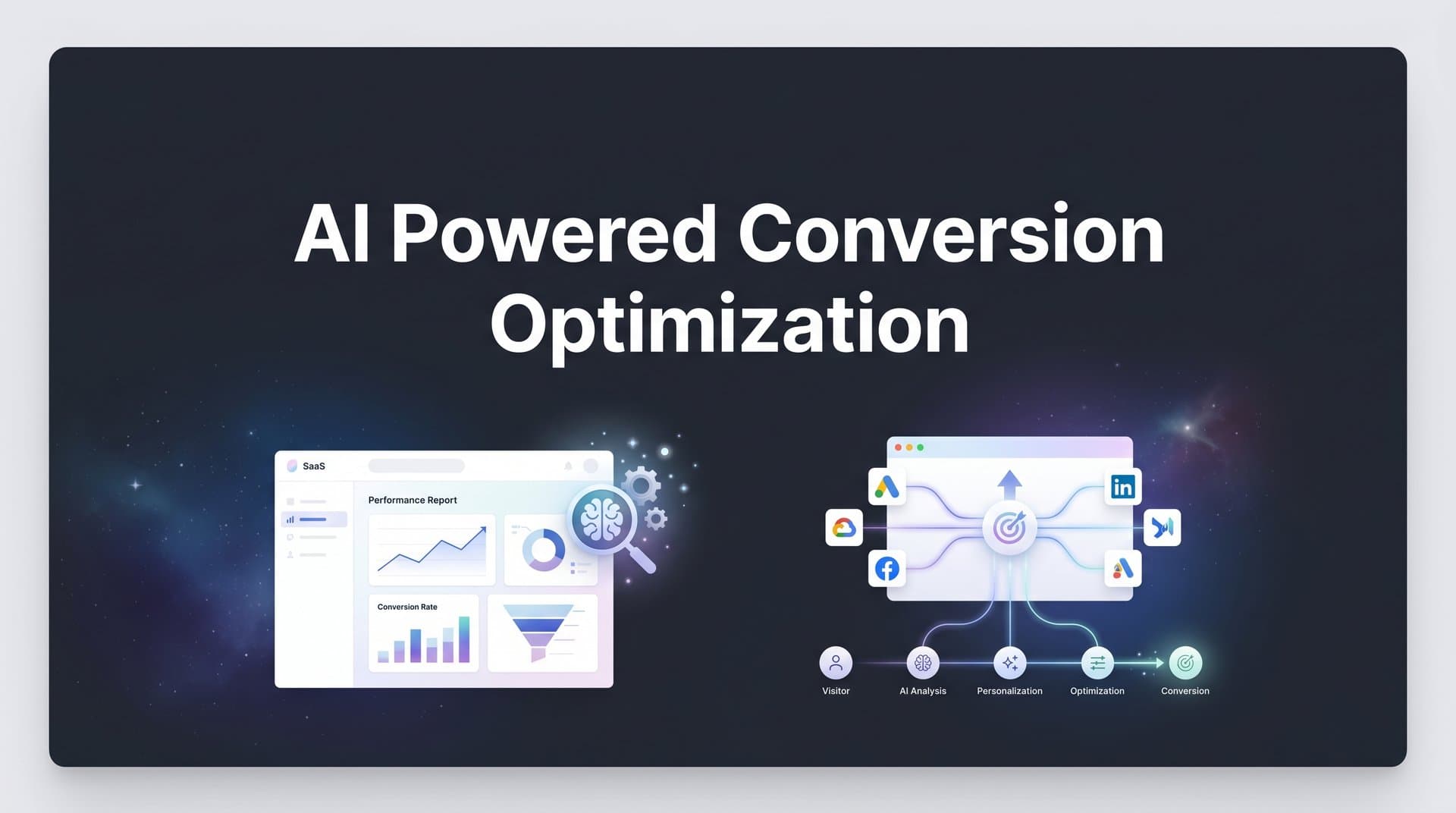
AI powered conversion optimization does not happen in a vacuum. It depends on three interconnected pillars working together: data collection, data analysis, and action. If any one of these breaks down, the entire system loses its effectiveness.
Data Collection: This is the foundation. AI can only optimize based on the data it receives, which means capturing every touchpoint in the customer journey matters enormously. That includes ad clicks, landing page visits, form submissions, CRM events, and downstream revenue data. The more complete the picture, the more accurate the optimization. Missing touchpoints create blind spots that lead to poor decisions.
Data Analysis: Once the data is flowing, AI models go to work identifying high-performing patterns across channels. This is where machine learning earns its value. It can process cross-platform performance data at a scale and speed that humans cannot match, surfacing insights like which audience segments convert most efficiently, which creative formats drive the highest-value customers, and which channels contribute most at different stages of the funnel.
Action: Analysis without action is just reporting. The third pillar is where AI optimization creates real impact: either feeding enriched conversion data back to ad platforms to improve their own algorithms, or surfacing clear recommendations to marketers about where to shift budget and what to test next.
Multi-touch attribution sits at the heart of this system. Last-click attribution, which gives full credit to the final touchpoint before a conversion, is a deeply flawed model. It ignores everything that happened earlier in the journey: the awareness ad that first introduced the brand, the retargeting campaign that re-engaged a warm prospect, the comparison content that built trust. AI needs a complete picture of the customer journey to make accurate optimization decisions. Multi-touch models, whether linear, time-decay, position-based, or data-driven, distribute credit across all contributing touchpoints and give AI a far more accurate signal to work with.
Server-side tracking plays a critical supporting role here. Browser-based tracking is increasingly unreliable because ad blockers, browser privacy settings, and iOS restrictions can prevent pixels from firing correctly. Server-side tracking captures conversion events directly from your server, bypassing these limitations and ensuring that AI receives accurate, complete data rather than a degraded subset. In a privacy-first environment, the server-side conversion tracking benefits are not optional for serious optimization. They are essential.
How AI Identifies Your Highest-Value Campaigns and Channels
Here is where AI powered conversion optimization starts to feel genuinely powerful. Most marketers have a rough sense of which channels are performing, but that intuition is usually shaped by whatever platform they spend the most time in. Platform-native reporting has a well-known bias: Meta will tell you Meta is working. Google will tell you Google is working. Both systems tend to over-attribute conversions to themselves, especially when a customer has interacted with ads on multiple platforms before converting.
An independent, unified attribution view cuts through that noise. When AI analyzes cross-platform performance data from a single source of truth, it can reveal which specific ads, audiences, and channels are truly driving revenue rather than just generating clicks or assisted conversions that each platform claims as its own. This is a key reason why underreporting conversions in ad platforms is such a widespread problem that marketers need to address.
Conversion path analysis takes this a step further. Instead of looking at individual touchpoints in isolation, AI maps the full journey from first touch to purchase and weights each interaction's contribution to the final conversion. This gives you a clear picture of how channels work together. You might discover that your TikTok campaigns rarely convert directly but consistently appear at the start of journeys that close through Google Search. Without path analysis, you would likely undervalue TikTok and over-invest in Search, missing the upstream role that awareness campaigns play.
This kind of insight directly informs budget allocation decisions. Rather than spreading spend evenly or defaulting to whichever channel has the best last-click numbers, you can scale the campaigns that genuinely contribute to revenue at each stage of the funnel. You can cut what is not working with confidence rather than anxiety, because the data backs the decision.
The difference between AI-driven attribution analysis and platform-native reporting is not subtle. It is the difference between seeing a complete map and navigating with only one corner of it visible. Marketers who rely exclusively on platform dashboards are making decisions based on partial information, and in competitive advertising environments, that gap compounds quickly.
Feeding Better Data Back to Ad Platform Algorithms
One of the most underappreciated aspects of AI powered conversion optimization is what happens when you send enriched data back to the platforms running your ads. This is called conversion sync, and it creates a feedback loop that improves ad delivery, targeting, and bidding over time.
Here is the core insight: Meta's algorithm, Google's Smart Bidding system, and similar tools on other platforms all depend on conversion signals to do their jobs. When you tell these systems which users converted and what actions they took, the algorithms use that information to find more users who look like your best customers. They adjust bids in real time based on the likelihood of conversion. They optimize ad delivery toward the audiences most likely to complete the actions you care about.
The problem is that most advertisers are sending these platforms incomplete or inaccurate conversion data. If your browser pixel is missing conversions due to iOS restrictions or ad blockers, the platform algorithm is working with a degraded signal. It thinks fewer conversions are happening than actually are. As a result, it makes suboptimal decisions about who to show your ads to and how much to bid. Understanding why conversion tracking numbers are wrong is the first step toward fixing this problem.
Conversion sync solves this by taking the enriched, verified conversion events captured through server-side tracking and sending them back to Meta, Google, and other platforms in a format their algorithms can use. The practical loop looks like this: accurate server-side tracking captures real conversions that browser pixels would have missed, AI analyzes and enriches that data to verify quality and match events to the right users, and then synced events are sent back to the platforms to improve future ad delivery.
The compounding effect of this cycle is significant. Better conversion signals lead to smarter lookalike audiences. Smarter audiences lead to higher-quality clicks. Higher-quality clicks lead to more conversions, which generate even better signals. Each iteration of the loop builds on the last, creating a performance advantage that grows over time rather than plateauing.
This is why treating conversion sync as an afterthought is a costly mistake. It is not just a data hygiene practice. It is a direct lever for improving campaign performance at the algorithmic level.
Putting AI Powered Conversion Optimization Into Practice
Understanding the theory is one thing. Getting it running in your actual marketing stack is another. Here is a practical framework for getting started without overcomplicating it.
Step one: Unify your data sources. Connect all of your ad platforms, your CRM, and your website to a single attribution system. This is the prerequisite for everything else. AI optimization cannot work if your data is scattered across disconnected tools. The goal is one system that sees every touchpoint across every channel.
Step two: Implement server-side tracking. Before you invest heavily in AI analysis and recommendations, make sure the data feeding your system is accurate. Set up server-side conversion tracking tools to capture conversion events directly, bypassing the browser limitations that degrade pixel-based data. This step is especially important if you run significant traffic from iOS devices or audiences that use ad blockers.
Step three: Use AI insights to guide budget decisions. Once your data is flowing accurately into a unified system, let AI-generated insights drive your budget allocation and scaling decisions rather than platform-native reports. Look at cross-channel attribution data to understand which campaigns are genuinely contributing to revenue and at what stage of the funnel. Tools designed for real time ad budget optimization can make this process significantly faster.
There are common pitfalls to avoid along the way. Relying on a single platform's data is the most dangerous one, for the reasons already covered. Ignoring offline or CRM conversions is another significant gap. If a lead converts through a sales call or a follow-up email sequence, that conversion needs to be captured and attributed to the campaigns that generated the lead in the first place. Learning how to track offline conversions from online ads closes this gap. Optimizing based on incomplete attribution models, particularly last-click, will consistently mislead your decisions.
One of the most accessible features of modern AI optimization tools is natural language querying. Instead of building custom reports or digging through dashboards, marketers can ask questions directly: "Which campaigns drove the most revenue last month?" or "What is my cost per acquisition on Google versus Meta for this product?" AI chat tools translate these questions into data answers instantly, making optimization accessible even for team members who are not data analysts. You do not need to be a data scientist to make smarter decisions when the right tools surface the right answers on demand.
Building a Compounding Advantage With Smarter Attribution
AI powered conversion optimization is not a one-time configuration you set and forget. It is an ongoing cycle where better data leads to better decisions, which generate better results, which in turn produce even richer data. Every improvement you make to your tracking and attribution setup makes the AI smarter. Every optimization decision informed by AI makes your campaigns more efficient. The advantage compounds.
The most important first step is evaluating your current tracking and attribution setup honestly. AI optimization is only as good as the data feeding it. If you are missing conversions, relying on last-click attribution, or working with siloed platform data, the AI recommendations you receive will reflect those gaps. Fix the data foundation first, and everything built on top of it becomes more reliable.
Looking ahead, the case for adopting AI-driven optimization now is straightforward. Advertising complexity is increasing, not decreasing. More platforms, more privacy restrictions, more fragmented customer journeys. The marketers who build accurate, unified data infrastructure and connect it to AI-powered analysis today will have a compounding advantage over those who continue to rely on manual methods and platform-native reporting.
Privacy restrictions will continue to evolve. Third-party data will become less available. The signal quality gap between marketers who have invested in server-side tracking and conversion sync and those who have not will widen. The window to build this infrastructure before it becomes table stakes is open now, but it will not stay open indefinitely.
The marketers who move first, who build the data foundation, connect the right tools, and let AI guide their optimization decisions, will be the ones scaling campaigns with confidence while others are still trying to reconcile spreadsheets and guess at what is working.
Your Next Steps Toward Smarter Campaigns
AI powered conversion optimization transforms how marketing teams make decisions, shifting the process from guesswork and gut instinct to data-driven clarity. The foundation of that transformation is accurate, complete data across every touchpoint in the customer journey. Without it, even the most sophisticated AI tools are working with one hand tied behind their back.
The path forward is clear: unify your data sources, implement server-side tracking, adopt multi-touch attribution, and use AI-generated insights to guide where you invest and what you scale. Then close the loop by feeding enriched conversion data back to your ad platforms so their algorithms can work smarter on your behalf.
Cometly is built to make exactly this possible. It captures every touchpoint from ad click to CRM event, connects your ad platforms and website in one place, and uses AI to surface the recommendations that help you scale with confidence. Server-side tracking ensures your data is accurate even in a privacy-first environment, and conversion sync feeds enriched events back to Meta, Google, and other platforms to improve their targeting and bidding in real time.
If you are ready to move beyond fragmented data and start making optimization decisions you can actually trust, Get your free demo today and see how Cometly's AI-powered attribution and analytics platform can help you capture every conversion, understand what is truly driving revenue, and scale your campaigns with the clarity that confident growth requires.