
You're running campaigns across Meta, Google, LinkedIn, and email. Conversions are coming in. Revenue is growing. But when you look at your dashboard, you see only the final click before each sale—usually a branded search or direct visit. Meanwhile, your prospecting campaigns that introduced those customers to your brand show zero conversions. Sound familiar?
This is the blind spot that costs marketers millions in misallocated budget every year. You're optimizing based on incomplete data, scaling the wrong campaigns, and potentially cutting the very touchpoints that make your bottom-funnel conversions possible.
Conversion path analysis solves this problem by revealing the complete customer journey from first touch to final conversion. Instead of crediting a single interaction, it shows you every touchpoint a customer encountered, the sequence they experienced them in, and how long the journey took. With this visibility, you can finally understand which channel combinations actually drive revenue, optimize your funnel intelligently, and make budget decisions based on reality rather than guesswork.
The Building Blocks of Customer Journeys
Conversion path analysis is the process of tracking and analyzing the complete sequence of touchpoints a customer interacts with before converting. Think of it as creating a timeline of every meaningful interaction someone has with your brand, from the moment they first discover you until they complete your desired action—whether that's a purchase, demo request, or signup.
Every conversion path contains three fundamental components. First, touchpoints: these are the individual interactions customers have with your marketing. A Facebook ad click, an email open, an organic search visit, a LinkedIn impression, a retargeting ad, a direct website visit—each represents a moment where your brand connected with a prospect. Second, conversion events: the specific actions you're tracking as success, like completing a purchase, booking a demo, or signing up for a trial. Third, the timeline: the sequence and spacing of these interactions, showing not just what happened but when and in what order.
Here's what makes this different from traditional attribution. Single-touch models assign 100% of the credit to one interaction—either the first touchpoint that introduced the customer to your brand or the last one before they converted. If someone sees your Facebook ad, clicks a LinkedIn post two weeks later, searches your brand name a week after that, and finally converts through a direct visit, last-click attribution gives all the credit to that direct visit. First-click attribution credits only the Facebook ad.
Both approaches miss the full story. The Facebook ad created awareness. The LinkedIn content built consideration. The branded search showed intent. The direct visit sealed the deal. Each touchpoint played a role in moving that customer toward conversion, and understanding their combined influence is what conversion path analysis delivers.
This matters because modern buyer journeys are complex. B2B buyers typically engage with 10-15 touchpoints before making a purchase decision. E-commerce customers might interact with your brand across multiple sessions, devices, and channels over days or weeks. When you only see the last click, you're making decisions based on a fraction of the data that actually matters.
Why Traditional Metrics Miss the Mark
Last-click attribution creates a fundamental distortion in how you understand campaign performance. It systematically undervalues every touchpoint except the final one, which means your awareness and consideration campaigns—the ones doing the hard work of introducing prospects to your brand and building interest—show zero conversions in your reports.
The result? Marketers cut prospecting budgets because they "don't convert," then wonder why their bottom-funnel campaigns suddenly stop performing. Without new prospects entering the funnel at the top, there's nobody left to convert at the bottom. You've optimized yourself into a corner by trusting incomplete data.
Modern buyer journeys compound this problem. Your customers don't follow linear paths anymore. They discover your brand on mobile during their commute, research on desktop at work, compare options on tablet in the evening, and convert on mobile the next day. They click a Facebook ad, ignore it, see a retargeting ad three days later, search your brand name, visit your site directly twice, and finally convert after reading a comparison article.
Traditional analytics tools struggle with this complexity. Cookie-based tracking breaks when customers switch devices. Platform-specific attribution only sees activity within that platform's ecosystem. Your Google Ads dashboard shows one story, Meta shows another, and your website analytics shows a third. None of them capture the complete picture.
The timeline matters too. B2B sales cycles often span weeks or months. A prospect might attend a webinar, download a whitepaper, engage with several email nurture sequences, and interact with multiple retargeting campaigns before they're ready to book a demo. If you're only looking at last-click data, you're crediting the final email that contained the demo link while ignoring the months of touchpoints that built trust and moved them toward that decision.
Conversion path analysis reveals which channel combinations actually drive revenue. You might discover that customers who see both Facebook ads and LinkedIn content convert at 3x the rate of those who only engage with one channel. Or that email plays a crucial assisted role in your funnel even though it rarely gets last-click credit. Or that your organic content attracts prospects who take longer to convert but have higher lifetime value.
This is the difference between optimizing based on what happened last versus understanding conversion paths and what actually worked. When you can see the full path, you make fundamentally different decisions about where to invest your budget and how to structure your campaigns.
Anatomy of a Conversion Path Report
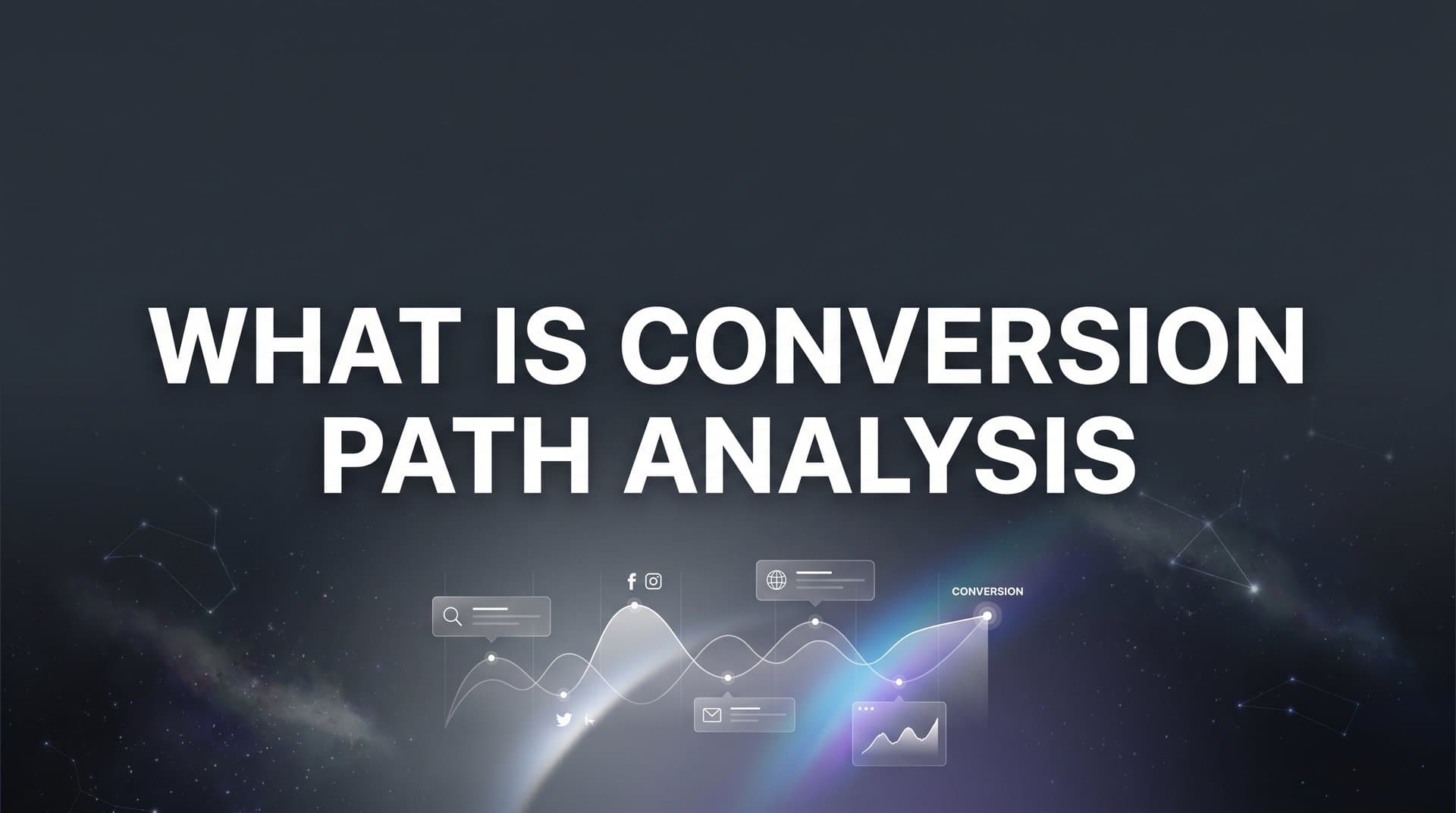
A conversion path report visualizes the complete customer journey as a sequence of interactions. Instead of seeing isolated metrics for each channel, you see the actual paths customers took: Facebook Ad → Organic Search → Email → Direct Visit → Conversion. Or LinkedIn → Google Ad → Direct Visit → Conversion. Each path shows the exact sequence, the time between touchpoints, and how many conversions followed that pattern.
Path length analysis tells you how many touchpoints typically precede a conversion. Some businesses see most conversions happen after 2-3 interactions. Others find their average customer engages 8-10 times before converting. This metric reveals the complexity of your sales cycle and helps you set realistic expectations for campaign performance.
Short path lengths (1-3 touchpoints) often indicate strong brand awareness, high purchase intent, or lower-consideration products. Someone who searches your brand name and converts immediately already knew what they wanted. Long path lengths (7+ touchpoints) suggest more complex buying decisions, higher price points, or unfamiliar brands that require multiple exposures to build trust.
Time lag analysis shows how long the journey takes from first touch to conversion. This might be hours for e-commerce impulse purchases, days for SaaS trials, or months for enterprise B2B deals. Understanding your typical conversion window helps you set appropriate attribution lookback periods and avoid cutting campaigns that are working but haven't had time to convert yet.
The distinction between assisted conversions and direct conversions is crucial for budget allocation. A direct conversion means that touchpoint was the only interaction before someone converted—they clicked your ad and immediately purchased. An assisted conversion means the touchpoint contributed to a conversion path but wasn't the final interaction.
Many high-performing channels have low direct conversion rates but high assisted conversion rates. Your prospecting Facebook campaigns might show few direct conversions but assist in hundreds of conversion paths. Your content marketing might rarely get last-click credit but consistently appears early in customer journeys. Without seeing assisted conversions, you'd incorrectly conclude these channels aren't working.
Channel groupings in path reports organize touchpoints by source: Paid Social, Paid Search, Organic Search, Email, Direct, Referral. This lets you see patterns like "Paid Social → Organic Search → Email → Direct" without getting lost in platform-specific details. You can identify which channel combinations work together most effectively and structure your campaigns accordingly.
Extracting Actionable Insights From Your Data
The real value of conversion path analysis comes from identifying patterns that inform strategy. Start by looking for high-performing path patterns—sequences of touchpoints that consistently lead to conversions. You might discover that customers who engage with both paid search and organic content convert at significantly higher rates than those who only interact with one channel.
These patterns reveal natural synergies in your marketing mix. If you notice that email frequently appears in conversion paths between an initial ad click and final conversion, you've identified email's role as a nurturing channel that moves prospects toward purchase. If retargeting ads consistently appear in paths where the first touchpoint was organic content, you've found evidence that retargeting effectively re-engages content readers.
Drop-off analysis shows where prospects disengage. If many paths include an ad click followed by nothing, your landing page experience needs work. If paths commonly include multiple website visits but no conversion, you might need stronger calls-to-action or better trust signals. If email appears in paths but conversions don't follow, your email content isn't moving people toward purchase.
These insights create opportunities for re-engagement. Build retargeting audiences based on specific path stages. Target people who visited your pricing page but didn't convert with case studies and testimonials. Reach people who engaged with top-funnel content but haven't returned with mid-funnel educational resources. Use path data to create sequential messaging that addresses the natural progression of customer questions and concerns.
Budget allocation becomes strategic when you understand each channel's role in the journey. Channels that frequently appear early in conversion paths deserve awareness-stage budget even if they don't get last-click credit. Channels that consistently appear late in paths need sufficient budget to capture high-intent prospects. Channels that assist conversions across multiple path positions are valuable throughout the funnel and deserve sustained investment.
Look for undervalued channels with high assist rates but low last-click conversions. These are often your best scaling opportunities because they're performing well but being underinvested due to traditional attribution bias. Similarly, identify overvalued channels that get last-click credit but rarely appear in paths without assistance from other channels—they might not perform as well if you cut the supporting touchpoints.
Path data also reveals customer segment differences. Enterprise customers might take longer paths with more touchpoints than SMB customers. Customers from certain industries might convert faster than others. High-value customers might engage with different content types than lower-value ones. Conducting thorough marketing analysis lets you tailor your approach to different audience segments based on their actual behavior patterns.
Implementing Conversion Path Analysis in Your Marketing Stack
Accurate conversion path analysis requires proper tracking infrastructure across all customer touchpoints. You need to capture every meaningful interaction—ad clicks, website visits, email engagements, form submissions, CRM events—and connect them to individual customers throughout their journey. This means implementing tracking that works across devices, platforms, and sessions while maintaining customer identity.
The foundation is unified customer identity. When someone clicks your Facebook ad on mobile, visits your website on desktop two days later, and converts after opening an email on tablet, your system needs to recognize these as the same person. Without identity resolution, these interactions look like three different customers and you can't build accurate conversion paths.
CRM integration connects your marketing touchpoints to actual business outcomes. When a lead becomes an opportunity, closes as a customer, or generates revenue, that data needs to flow back to your attribution system. This lets you analyze conversion paths not just for form submissions but for qualified leads, closed deals, and revenue—the metrics that actually matter to your business.
Cross-device tracking is one of the biggest technical challenges. Traditional cookie-based tracking breaks when customers switch devices because cookies are browser-specific. Someone who clicks your ad on their phone but converts on their laptop appears as two separate users in cookie-based systems. This fragments conversion paths and makes accurate analysis impossible.
Cookie limitations extend beyond cross-device issues. Safari and Firefox block third-party cookies by default. Chrome is phasing them out. Privacy regulations restrict cookie usage. Ad blockers prevent tracking scripts from firing. The result is that browser-based tracking misses significant portions of your traffic, creating gaps in your conversion paths.
Server-side tracking solves many of these accuracy issues by capturing data directly from your server rather than relying on browser cookies. When a conversion happens, your server sends that event data to your analytics platform, bypassing browser restrictions and ad blockers. This creates more reliable tracking that captures events even when client-side tracking fails.
Platform integrations connect your ad accounts, website analytics, email platform, and CRM into a unified view. Instead of manually combining data from multiple sources, automated integrations ensure that touchpoint data flows into your attribution system continuously. This eliminates data silos and gives you a complete picture of customer journeys across all channels.
Data accuracy matters more than data volume. A conversion path analysis based on incomplete or incorrect data leads to wrong conclusions and bad decisions. Invest in proper implementation, test your tracking thoroughly, and validate that events are being captured correctly before you start making strategic decisions based on the insights.
Turning Path Insights Into Campaign Optimization
Once you understand which paths lead to conversions, you can structure your campaigns to guide customers along those proven journeys. Start by creating retargeting sequences that mirror successful conversion paths. If data shows that customers who engage with educational content after clicking an ad convert at higher rates, build a retargeting campaign that serves educational content to ad clickers.
Sequential messaging becomes strategic rather than random. Instead of showing the same retargeting ad repeatedly, create a sequence that matches the natural customer journey. Show awareness content to new visitors, consideration content to engaged prospects, and conversion-focused messaging to high-intent users. Let path data inform the progression so you're delivering the right message at the right stage.
Feeding enriched conversion data back to ad platforms improves their algorithmic optimization. When you send complete conversion events that include path context—not just that a conversion happened, but which touchpoints preceded it—ad platforms can better understand what leads to success. This helps their algorithms find more customers who match high-performing path patterns.
The conversion sync between your attribution platform and ad accounts creates a feedback loop. Your attribution system sees the complete customer journey and identifies which conversions came from which ad interactions. It sends this enriched data back to Meta, Google, and other platforms, giving their algorithms better signal about what's actually working. The platforms optimize toward these better-quality conversions, improving targeting and performance over time.
AI recommendations take this further by identifying scaling opportunities based on path performance. Instead of manually analyzing every possible path pattern, AI can surface insights like "customers who see Ad Set A followed by Ad Set B convert at 2.5x the rate of other paths" or "increasing budget on LinkedIn when prospects are in the consideration stage based on their path position improves conversion rates by 40%."
These recommendations let you act on path insights without becoming a full-time data analyst. The AI continuously monitors path performance, identifies patterns, and suggests specific optimizations. You get actionable guidance like "increase retargeting budget for users who visited pricing pages" or "create a nurture sequence for prospects who engaged with case study content but haven't converted."
Budget allocation shifts from channel-level decisions to path-level strategy. Instead of asking "should I spend more on Facebook or Google?" you ask "which path patterns drive the highest ROI and how do I create more of them?" This might mean increasing Facebook prospecting budget because it starts high-value paths, while simultaneously increasing Google retargeting budget because it effectively converts Facebook-introduced prospects.
The competitive advantage comes from understanding not just what works, but why it works and how to replicate it. When you know the exact sequence of touchpoints that moves customers toward conversion, you can engineer your marketing to create those sequences intentionally rather than hoping they happen by chance.
Making Confident Decisions With Complete Data
Conversion path analysis transforms how you understand campaign performance by revealing the complete customer journey instead of isolated touchpoint metrics. When you can see which combinations of channels, content, and timing actually drive revenue, you stop making decisions based on incomplete data and start optimizing based on reality.
The marketers who win in increasingly complex multi-channel environments are those who understand the full picture. They know which touchpoints create awareness, which build consideration, and which close deals. They allocate budget based on each channel's role in successful conversion paths rather than outdated last-click metrics. They create campaigns that work together as a system rather than competing for the same attribution credit.
This isn't about adding more complexity to your analytics. It's about finally seeing clearly what's been happening all along. Your customers have always taken multi-touch journeys. Your channels have always worked together. Conversion path analysis simply makes these realities visible so you can act on them strategically.
The difference between good marketing and great marketing often comes down to data quality. When you track complete conversion paths, integrate your marketing stack, and use AI to identify optimization opportunities, you gain the competitive advantage of knowing exactly what drives results. You can scale with confidence because you're not guessing which campaigns work—you're looking at the data.
Ready to elevate your marketing game with precision and confidence? Discover how Cometly's AI-driven recommendations can transform your ad strategy—Get your free demo today and start capturing every touchpoint to maximize your conversions.