You're staring at three different dashboards. Google Analytics shows one conversion number. Facebook Ads Manager shows another. Your CRM has a third. You've spent the last hour trying to figure out which campaign actually drove that $10,000 sale that closed yesterday, but the data tells three different stories.
Sound familiar?
This is the daily reality for marketers running multi-channel campaigns. You have more data than ever before, but making sense of it feels like trying to solve a puzzle where the pieces keep changing shape. Marketing analysis is what bridges this gap—transforming disconnected data points into clear, actionable insights that guide your next move.
Understanding marketing analysis isn't just about being data-savvy. It's about knowing which metrics actually matter for your business, how to interpret what your campaigns are telling you, and most importantly, how to use those insights to make confident decisions that drive revenue.
In this guide, we'll break down what marketing analysis really means, explore the different types you need to master, walk through the practical process of turning data into decisions, and show you how to overcome the challenges that trip up even experienced marketers. By the end, you'll have a clear framework for analyzing your marketing efforts and optimizing campaigns with confidence.
The Foundation: Breaking Down Marketing Analysis
Marketing analysis is the systematic examination of your marketing data to understand what's working, identify opportunities for improvement, and guide strategic decisions. Think of it as the difference between owning a map and knowing how to navigate. You might have all the data in the world, but without analysis, you're just collecting numbers.
Here's what makes marketing analysis distinct: it's not about the data itself. It's about interpretation. You're looking for patterns, connections, and insights that answer specific business questions. Which ad creative resonates with your target audience? What's the actual cost of acquiring a customer through each channel? Where are potential customers dropping off in your funnel?
Many marketers confuse marketing analysis with marketing analytics, but they're different pieces of the same puzzle. Marketing analytics refers to the tools, methods, and technologies you use to collect and measure data. Marketing analysis is what you do with that data—the thinking, interpreting, and decision-making that follows.
The core purpose of marketing analysis is connecting your marketing activities to tangible business outcomes. It's not enough to know that your Facebook campaign generated 5,000 clicks. You need to understand how many of those clicks turned into qualified leads, how many leads became customers, and whether the revenue from those customers justified the ad spend.
This connection between activity and outcome is where most marketers struggle. Your ad platforms want to take credit for conversions. Your organic channels claim their share. Your email campaigns point to their open rates. But without proper analysis, you're left guessing which channels actually deserve credit—and more importantly, which ones deserve more budget.
Effective marketing analysis answers three fundamental questions: What happened? Why did it happen? What should we do about it? These questions form the foundation of data-driven marketing, where every budget decision, campaign adjustment, and strategic pivot is backed by evidence rather than intuition.
Five Types of Marketing Analysis Every Marketer Should Know
Different business questions require different analytical approaches. Here are the five types of marketing analysis that form the backbone of data-driven campaign management.
Campaign Performance Analysis: This is where most marketers start. You're measuring how individual campaigns perform across channels, examining which ad creatives drive engagement, which audiences convert at the highest rates, and which messaging resonates with your target market. Campaign performance analysis goes beyond surface metrics like impressions and clicks. You're digging into conversion rates, cost per acquisition, and ultimately, return on ad spend. The goal is identifying patterns—understanding that video ads outperform static images for cold audiences, or that certain value propositions convert better on specific platforms.
For a deeper dive, see our guide to ad campaign performance analysis methods.
Customer Journey Analysis: Modern customers rarely convert on their first interaction with your brand. They might see a Facebook ad, visit your website, read a blog post, receive an email, click a Google ad, and then finally convert. Customer journey analysis tracks these touchpoints from first click to final conversion, revealing the path customers actually take. This type of analysis is crucial because it challenges assumptions. You might think your Google Search ads are your primary revenue driver, but customer journey analysis might reveal they're actually the final touchpoint in a journey that started with organic social media weeks earlier.
Competitive Analysis: You're not operating in a vacuum. Competitive analysis involves benchmarking your marketing efforts against industry standards and direct competitors. What channels are they prioritizing? What messaging angles are they using? How do their conversion rates compare to yours? While you won't have access to competitors' internal data, you can analyze their ad creative, landing pages, content strategy, and visible market positioning. This analysis helps you identify gaps in your strategy and opportunities to differentiate your approach.
Channel Attribution Analysis: This is perhaps the most critical—and most complex—type of analysis for paid advertisers. Channel attribution analysis determines which marketing channels deserve credit for conversions. The challenge is that different attribution models tell different stories. Last-click attribution gives all credit to the final touchpoint. First-click attributes everything to initial discovery. Multi-touch models distribute credit across the entire journey. Understanding attribution helps you allocate budget intelligently rather than over-investing in channels that appear to convert but are actually just capturing demand created elsewhere.
ROI and Budget Analysis: At the end of the day, marketing exists to drive business results. ROI and budget analysis calculates the actual return on your ad spend and helps optimize budget allocation across campaigns and channels. This goes beyond simple ROAS calculations. You're examining customer lifetime value, comparing acquisition costs across channels, identifying which campaigns attract high-value customers versus one-time buyers, and determining the optimal budget distribution that maximizes overall revenue.
Each type of analysis serves a specific purpose, but they're most powerful when used together. Campaign performance analysis might show that a specific ad is generating lots of conversions, but attribution analysis could reveal those conversions would have happened anyway through other channels. Customer journey analysis might show a long, complex path to purchase, prompting you to adjust your budget analysis to account for delayed conversions.
The Marketing Analysis Process: From Data to Decisions
Having the right analytical frameworks means nothing without a clear process for applying them. Here's how to move from scattered data to confident decisions.
Step 1: Define Clear Objectives and KPIs
Before you open a single dashboard, ask yourself: What question am I trying to answer? Too many marketers dive into data without a clear objective, leading to what we call analysis paralysis—drowning in metrics without gaining actionable insights.
Your objective might be: "Which ad creative drives the highest conversion rate for our premium product?" or "What's the true customer acquisition cost across all channels?" or "Where in our funnel are we losing the most qualified leads?" Each question requires different data sources and analytical approaches.
Once you've defined your objective, establish the key performance indicators that will help you answer it. KPIs should be specific, measurable, and directly tied to business outcomes. If your objective is understanding true acquisition cost, your KPIs might include cost per lead by channel, lead-to-customer conversion rate, and customer lifetime value. If you're optimizing creative performance, you'd focus on click-through rate, landing page conversion rate, and cost per conversion by creative variant.
Step 2: Collect and Consolidate Data
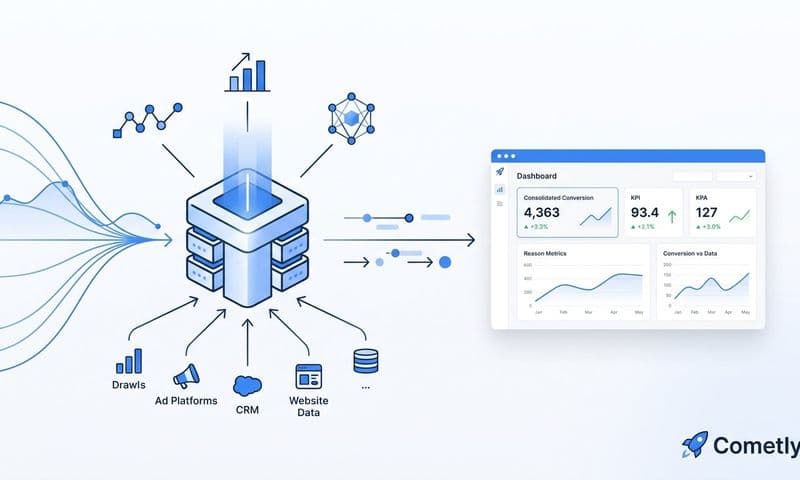
This is where the rubber meets the road. You need to gather data from every relevant source—ad platforms, website analytics, CRM systems, email marketing tools, and any other channel where customer interactions occur.
The challenge is that these systems rarely communicate with each other naturally. Your Facebook Ads Manager doesn't know what happened after someone clicked your ad. Your CRM doesn't know which marketing channel brought in each lead. Your website analytics can track visits but might not connect them to specific ad campaigns or eventual revenue.
Consolidating this data requires either manual export and reconciliation (time-consuming and error-prone) or using marketing analysis tools that automatically connect these data sources. The goal is creating a unified view where you can see the complete customer journey from first ad impression to final purchase.
Step 3: Analyze Patterns and Draw Insights
Now comes the actual analysis. You're looking for patterns, anomalies, correlations, and trends that answer your original question. This isn't about reporting what happened—it's about understanding why it happened and what it means for future decisions.
Let's say you're analyzing campaign performance across channels. You notice Google Ads has a lower cost per click than Facebook, but Facebook generates more total conversions. Digging deeper, you discover Google Ads attracts bottom-funnel traffic with high purchase intent, while Facebook introduces new prospects who take longer to convert but have higher lifetime value. This insight dramatically changes how you'd allocate budget between the two platforms.
Look for segments that perform differently. Compare time periods to identify trends. Examine cohorts to understand behavior patterns. The insights that drive real improvements often hide in the details, not the top-line numbers.
Step 4: Implement Changes and Measure Impact
Analysis without action is just an academic exercise. Once you've drawn insights, implement specific changes based on what you've learned. If your analysis shows video ads outperform static images, shift creative budget accordingly. If certain audience segments convert at higher rates, increase bids for those segments.
We cover this in more depth in our guide to AI Instagram ad image generator.
The critical piece is establishing feedback loops to measure the impact of your changes. Marketing analysis isn't a one-time event—it's a continuous cycle. You analyze, implement, measure results, and analyze again. This iterative process is how you progressively optimize performance over time.
Common Marketing Analysis Challenges (And How to Overcome Them)
Even with the right process, marketers face significant obstacles when trying to analyze their campaigns effectively. Here are the three most common challenges and practical approaches for overcoming them.
Data Fragmentation: This is the number one complaint from marketers running multi-channel campaigns. Your ad platforms, CRM, and website analytics exist in separate silos, each telling a partial story. Facebook shows conversions that happened within its attribution window. Google Analytics uses a different attribution model and conversion tracking. Your CRM records sales but doesn't connect them back to the original marketing source.
The result? You can't see the complete customer journey, making it nearly impossible to understand which marketing efforts actually drive results. Overcoming data fragmentation requires either significant manual effort to reconcile data across platforms or implementing tools specifically designed to unify marketing data. Server-side tracking and first-party data strategies have become increasingly important as they provide more reliable data that isn't affected by browser limitations or privacy restrictions.
Attribution Complexity: Remember when you could rely on last-click attribution and call it a day? Those days are gone. iOS privacy changes, cookie deprecation, and cross-device behavior have made traditional tracking methods significantly less reliable. You might run an Instagram ad that someone sees on their phone, but they convert three days later on their laptop after clicking a Google ad. Which campaign deserves credit?
Related reading: our complete guide to cookie deprecation solutions.
This attribution complexity means you can't trust any single platform's reported conversions. Facebook's conversion tracking has become less accurate post-iOS 14.5. Google Analytics might miss conversions that happen in mobile apps. Your ad platforms are essentially blind to significant portions of the customer journey. The solution involves implementing more sophisticated tracking methods—server-side tracking, first-party data collection, and multi-touch attribution models that distribute credit across the actual customer journey rather than relying on platform-reported data.
Analysis Paralysis: Having too much data without clear frameworks for interpretation leads to paralysis. You have hundreds of metrics available across dozens of campaigns, but which ones actually matter? Should you optimize for click-through rate, conversion rate, cost per acquisition, return on ad spend, or customer lifetime value?
The answer depends on your business model and objectives, but the solution to analysis paralysis is always the same: focus on business outcomes rather than activity metrics. Impressions and clicks are interesting, but they don't pay the bills. Revenue, customer acquisition cost, and lifetime value directly impact your bottom line. Start with these outcome metrics and work backward to understand which activity metrics correlate with them. This creates a clear hierarchy of what matters, preventing you from getting lost in vanity metrics that don't drive decisions.
Turning Analysis Into Action: Practical Applications
Theory is useless without application. Here's how effective marketing analysis translates into specific actions that improve campaign performance.
Identifying and Scaling Winners: One of the most powerful applications of marketing analysis is identifying which ads, audiences, and campaigns actually drive results—then scaling them with confidence. Many marketers make scaling decisions based on surface metrics like click-through rate or cost per click, only to discover that increased spend doesn't translate to proportional revenue growth.
Proper analysis reveals which campaigns attract high-value customers, not just high volumes of clicks. You might discover that Campaign A generates twice as many conversions as Campaign B, but Campaign B's customers have three times higher lifetime value. This insight completely changes your scaling strategy. Instead of pouring budget into the campaign with the most conversions, you prioritize the campaign that drives the most revenue.
Feeding Better Data to Ad Platforms: Modern ad platforms like Facebook and Google use machine learning algorithms to optimize campaign delivery. But these algorithms are only as good as the data they receive. If your conversion tracking is incomplete or inaccurate, the platform's AI optimizes toward the wrong outcomes.
Marketing analysis helps you identify data gaps and implement better tracking. By sending enriched conversion data back to ad platforms—including revenue values, customer quality indicators, and complete conversion events—you enable their algorithms to optimize more effectively. This creates a virtuous cycle where better data leads to better optimization, which leads to better results, which provides more data to analyze.
Making Budget Decisions Based on Real Attribution: This is where marketing analysis directly impacts your bottom line. Instead of allocating budget based on last-click conversions or platform-reported ROAS, you make decisions based on actual revenue attribution across the complete customer journey.
You might discover that your branded search campaigns show excellent ROAS but primarily capture demand created by other channels. Meanwhile, your upper-funnel content campaigns show poor immediate ROAS but initiate journeys that eventually convert at high rates. Without proper analysis, you'd cut the content budget and increase branded search spend—exactly the wrong move. With analysis, you understand each channel's true role and allocate budget accordingly.
The key is moving from channel-level optimization to journey-level optimization. You're not asking "Which channel has the best ROAS?" but rather "Which combination of channels and touchpoints drives the most profitable customer journeys?" This shift in perspective, enabled by comprehensive analysis, leads to fundamentally different—and more effective—budget allocation strategies.
Building Your Marketing Analysis Framework
You now understand what marketing analysis is, the different types, the process, and common challenges. Let's bring it all together into a practical framework you can implement immediately.
Start with the business questions that matter most to your organization. Don't try to analyze everything at once. Pick the three most important questions facing your marketing team right now. Maybe it's understanding which channels drive the highest-value customers. Maybe it's identifying why conversion rates dropped last quarter. Maybe it's determining optimal budget allocation for the next fiscal year. These questions become your analytical priorities.
Next, invest in tools that unify your data sources. You can't do effective analysis when your data lives in separate silos. Whether you build custom integrations, use data warehousing solutions, or implement marketing analytics tools designed for marketers, the goal is creating a single source of truth where you can see the complete customer journey from first touchpoint to final conversion and beyond.
Establish regular analysis rhythms. Marketing analysis isn't something you do once and forget. Build it into your operational cadence. Weekly performance reviews examine tactical metrics—which ads are working, where to shift budget, what creative to test next. Monthly strategic assessments look at broader patterns—channel performance trends, customer acquisition cost trajectories, lifetime value evolution. Quarterly deep dives tackle the big questions—market positioning, competitive landscape, overall marketing strategy effectiveness.
Create clear documentation of your analytical findings and the decisions they inform. This serves multiple purposes. It builds institutional knowledge so insights don't disappear when team members change. It creates accountability by connecting decisions to their outcomes. And it accelerates learning by revealing which analytical approaches yield the most valuable insights for your specific business.
Finally, embrace iteration. Your first analytical framework won't be perfect. You'll discover new questions that matter. You'll find better ways to collect data. You'll develop more sophisticated interpretation methods. Marketing analysis is a skill that improves with practice, and each cycle of analysis, implementation, and measurement makes you better at it.
The Path Forward: From Data Overload to Confident Decisions
Marketing analysis transforms scattered data into confident decisions. It's the difference between hoping your campaigns work and knowing they work. Between guessing where to allocate budget and making evidence-based investments. Between reacting to problems after they've cost you money and proactively identifying opportunities before your competitors do.
The goal of marketing analysis isn't collecting more data—it's understanding which marketing efforts actually drive revenue. Every dashboard you check, every report you generate, every metric you track should ultimately answer one question: Is this helping us make better decisions that grow the business?
As marketing becomes increasingly complex with more channels, more touchpoints, and more data than ever before, the ability to analyze effectively becomes your competitive advantage. The marketers who master analysis—who can cut through noise to find signal, who can connect activities to outcomes, who can turn insights into action—are the ones who consistently outperform their peers.
The landscape continues to evolve. AI-powered analysis tools are making it easier to surface insights automatically, identify patterns human analysts might miss, and get accurate attribution even in the face of privacy restrictions and tracking limitations. These tools don't replace analytical thinking—they amplify it, handling the heavy lifting of data processing so you can focus on interpretation and decision-making.
Ready to elevate your marketing game with precision and confidence? Discover how Cometly's AI-driven recommendations can transform your ad strategy—Get your free demo today and start capturing every touchpoint to maximize your conversions.