You're staring at your marketing dashboard at 11 PM on a Tuesday, and something doesn't add up. Google Analytics says your Facebook campaigns generated 47 conversions this month. Facebook Ads Manager claims 89. Your CRM shows 62 new customers from paid social. Three different numbers for the same campaigns, and your quarterly budget review is tomorrow morning.
This isn't just frustrating—it's expensive. Every misallocated dollar compounds over time. Every optimization decision based on incomplete data pushes you further from your actual best-performing channels. And the worst part? You're not alone in this confusion.
Modern marketers have access to more data than ever before, yet many feel less confident about their decisions. We're drowning in metrics from a dozen different platforms, each telling a slightly different story about what's working. The promise was that more data would lead to better decisions. Instead, it's created a new problem: data paralysis.
Here's what's really happening. Your customer journeys span multiple devices, platforms, and weeks or months of touchpoints. Someone sees your Facebook ad on mobile during their morning commute, researches your product on desktop at lunch, clicks a Google search ad that evening, and finally converts three days later after opening your email. Which channel "gets credit" for that sale? The answer depends entirely on which dashboard you're looking at—and that's the problem.
Data analysis in marketing isn't about having more numbers. It's about connecting those numbers into a coherent story that reveals what's actually driving your results. It's the difference between knowing your Facebook ROAS is 2.5x and understanding that Facebook prospecting campaigns drive 40% of your new customer acquisition while retargeting generates customers with 3x higher lifetime value. One number tells you what happened. The other tells you what to do next.
This article will transform how you approach marketing data—from collection to analysis to action. You'll learn how to build a unified view of your customer journey, implement attribution models that reveal true channel performance, and create systematic analysis workflows that turn insights into revenue. We'll cover the technical foundations, the common pitfalls that sabotage accuracy, and the practical frameworks that successful marketing teams use to make confident, data-driven decisions every single day.
By the end, you'll understand exactly how to move from dashboard confusion to strategic clarity. Let's dive in.
Why Marketing Data Analysis Matters More Than Ever
The average marketing team now uses 91 different cloud services and tools. Each one generates its own data, uses its own definitions, and operates in its own silo. Your email platform doesn't talk to your ad platforms. Your CRM doesn't sync perfectly with your analytics. Your attribution tool shows different numbers than your ad managers.
This fragmentation creates three critical problems. First, you can't see the complete customer journey. A prospect might interact with your brand across six different touchpoints before converting, but no single platform shows you that full path. Second, you're making decisions based on incomplete information. When you optimize your Facebook campaigns based solely on Facebook's data, you're missing how those campaigns interact with your other channels. Third, you're wasting time reconciling conflicting reports instead of taking action.
The cost of poor data analysis compounds quickly. A marketing tracking system that doesn't accurately connect customer touchpoints leads to misattributed conversions, which leads to budget misallocation, which leads to scaling the wrong campaigns while cutting the ones that actually drive results. Over a year, this can mean hundreds of thousands in lost revenue and wasted ad spend.
But here's what changes when you get data analysis right. You stop guessing which channels deserve more budget and start knowing. You identify the specific campaign combinations that generate your highest-value customers. You catch performance drops within hours instead of weeks. You can confidently answer questions like "What's our true customer acquisition cost?" and "Which marketing touchpoints actually influence purchase decisions?"
The companies winning in their markets right now aren't the ones with the biggest budgets. They're the ones with the clearest view of what's working. They've built systems that connect their data sources, implemented frameworks that reveal true performance, and created processes that turn insights into action. That's exactly what we're going to build together in this article.
The Foundation: Understanding Marketing Data Types
Before you can analyze marketing data effectively, you need to understand what you're actually measuring. Marketing data falls into four distinct categories, and mixing them up is one of the most common reasons teams draw wrong conclusions from their analysis.
First, there's traffic data—the raw numbers about who visits your digital properties. This includes sessions, pageviews, bounce rates, time on site, and traffic sources. Traffic data tells you how many people are showing up and where they're coming from, but it doesn't tell you anything about business outcomes. A million visitors means nothing if none of them convert.
Second, engagement data measures how people interact with your content and campaigns. Email open rates, click-through rates, video completion rates, social media engagement, and content downloads all fall into this category. Engagement data reveals interest and intent, but high engagement doesn't automatically translate to revenue. You can have stellar engagement metrics while your business struggles.
Third, conversion data tracks the specific actions that matter to your business. Form submissions, purchases, trial signups, demo requests, and qualified leads are all conversions. This is where marketing activity connects to business outcomes. But conversion data alone doesn't tell you which marketing efforts actually drove those conversions—that's where the fourth category comes in.
Fourth, attribution data connects conversions back to the marketing touchpoints that influenced them. This is the most complex and most valuable type of marketing data. It answers questions like "Which ad campaign generated this customer?" and "What combination of touchpoints led to this purchase?" Without proper marketing analytics and reporting systems, attribution data is often incomplete or inaccurate.
Here's why this distinction matters. Most marketing teams focus heavily on traffic and engagement metrics because they're easy to measure and show constant activity. But these vanity metrics can mask serious problems. Your traffic might be growing while your actual customer acquisition is declining. Your engagement rates might be stellar while your cost per acquisition is skyrocketing.
Effective data analysis requires tracking all four types, but weighting them appropriately. Traffic and engagement are leading indicators—they suggest potential future outcomes. Conversions and attribution are lagging indicators—they show actual business results. You need both, but when they conflict, business outcomes should always win. A campaign with lower engagement but higher conversion value is better than one with high engagement and low conversions.
The other critical distinction is between platform-reported data and actual business data. Facebook might report 100 conversions from your campaign, but your CRM might show only 73 new customers from Facebook traffic. Which number is right? Usually, your business data is more accurate because it reflects what actually happened in your systems, not what a platform's tracking pixel thinks happened.
Understanding these data types helps you ask better questions. Instead of "How much traffic did we get?" you ask "How much qualified traffic converted into customers?" Instead of "What's our email open rate?" you ask "What revenue did our email campaigns generate?" This shift from activity metrics to outcome metrics is the foundation of meaningful marketing analysis.
Building Your Data Collection Infrastructure
You can't analyze data you don't have, and you can't trust analysis built on incomplete or inaccurate data. Your data collection infrastructure is the foundation everything else builds on. Get this wrong, and every insight you draw will be flawed. Get it right, and you create a competitive advantage that compounds over time.
Start with your tracking foundation. Every marketing channel needs proper tracking implementation—not just "installed," but verified and tested. Your website needs analytics tracking on every page, with custom events configured for key actions. Your ad platforms need conversion pixels properly installed and firing correctly. Your email platform needs UTM parameters and click tracking configured. Your CRM needs to capture source data for every lead and customer.
But here's where most teams fail: they install tracking once and assume it keeps working. Tracking breaks constantly. Website updates remove pixels. Developers accidentally delete tracking codes. Platform updates change how data is collected. You need systematic verification. Test your tracking weekly. Check that conversions are being recorded. Verify that source data is being captured. Compare platform reports against your actual business data to catch discrepancies early.
Next, implement consistent naming conventions across all platforms. This sounds boring, but it's critical. If your Google Ads campaigns use one naming structure, your Facebook campaigns use another, and your email campaigns use a third, you'll never be able to analyze performance across channels. Create a standardized naming convention that includes campaign type, target audience, offer, and date. Then enforce it religiously across every platform and every team member.
Your UTM parameter strategy deserves special attention. UTM parameters are the tags you add to URLs to track traffic sources in your analytics. Most teams either don't use them consistently or use them incorrectly. Every external link you create—in emails, social posts, ads, or anywhere else—needs proper UTM parameters. Use utmsource for the platform (facebook, google, email), utmmedium for the channel type (cpc, social, email), and utm_campaign for the specific campaign name. This creates clean, analyzable data in your analytics platform.
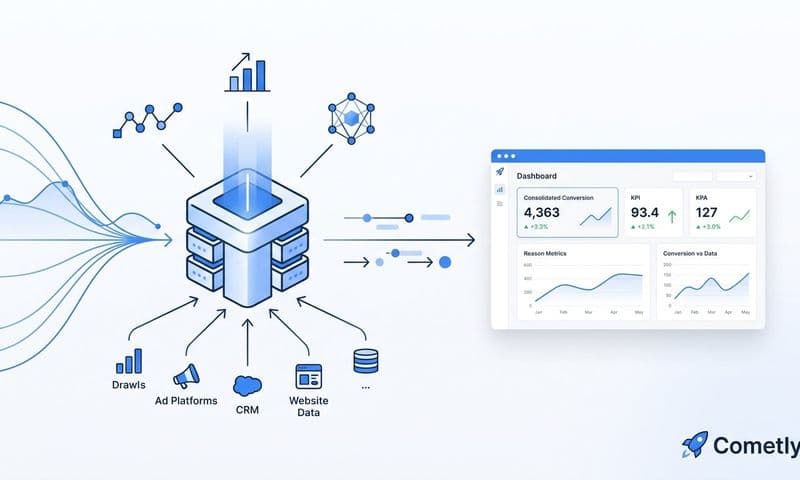
Then there's the integration layer. Your data lives in multiple platforms, and those platforms need to talk to each other. Your ad platforms should send conversion data to your analytics. Your CRM should receive lead source data from your forms. Your Facebook marketing metrics should connect to your actual customer data. Modern marketing requires integration tools—whether that's native integrations, Zapier, or dedicated attribution platforms—to connect your data sources into a unified view.
Data quality checks need to be systematic, not occasional. Set up automated alerts for tracking issues. Monitor for sudden drops in conversion tracking. Check for duplicate data entries. Verify that your revenue data matches between platforms. Create a weekly data quality checklist and actually use it. The fifteen minutes you spend checking data quality each week will save you hours of analysis based on bad data.
Finally, document everything. Create a data dictionary that defines every metric you track, how it's calculated, and where the data comes from. Document your tracking setup, your naming conventions, and your integration configuration. When team members change or platforms update, this documentation ensures continuity. It also prevents the common problem where different team members use the same metric name to mean different things.
Your data infrastructure isn't a one-time project. It's an ongoing system that requires regular maintenance, testing, and improvement. But the investment pays off exponentially. Clean, complete, accurate data is the difference between confident decisions and expensive guesses. Build this foundation right, and everything else becomes easier.
Attribution Models: Connecting Conversions to Campaigns
Here's the question that keeps marketing leaders up at night: which campaigns actually drove our results? A customer sees your Facebook ad, clicks a Google search ad three days later, opens your email a week after that, and finally converts through direct traffic. Which channel gets credit for that sale? Your answer to this question determines where you allocate millions in ad spend.
This is the attribution problem, and it's more complex than most marketers realize. Every platform wants to take credit for conversions. Facebook's attribution window claims conversions up to 28 days after someone saw your ad. Google Ads uses a different attribution window and methodology. Your email platform counts every conversion that happens after someone opens an email. Add them all up, and you'll have 300% of your actual conversions "attributed" across platforms.
Attribution models are frameworks for assigning credit to marketing touchpoints. The simplest is last-click attribution—the last thing someone clicked before converting gets 100% of the credit. This is what most platforms use by default because it makes their numbers look good. But it's also wildly inaccurate. It ignores every touchpoint that built awareness and consideration before that final click.
First-click attribution does the opposite—it gives all credit to the first touchpoint in the customer journey. This overvalues top-of-funnel activities while ignoring the nurturing and conversion-focused efforts that actually closed the sale. It's useful for understanding what drives initial awareness, but terrible for optimizing your full funnel.
Linear attribution splits credit evenly across all touchpoints. If someone had five interactions with your marketing before converting, each gets 20% credit. This is more fair than first or last-click, but it assumes every touchpoint has equal value. In reality, some touchpoints are far more influential than others.
Time-decay attribution gives more credit to touchpoints closer to the conversion. The logic is that recent interactions have more influence on the decision to buy. This works well for longer sales cycles where early touchpoints might have minimal impact on the final decision, but it can undervalue the awareness-building efforts that started the journey.
Position-based attribution (also called U-shaped) gives 40% credit to the first touchpoint, 40% to the last, and splits the remaining 20% among everything in between. This acknowledges that both initiating the journey and closing the sale are critical, while still accounting for nurturing touchpoints. It's a reasonable middle ground for many businesses.
But here's what most attribution discussions miss: the "right" model depends on your business, your sales cycle, and your customer journey. A business with a 24-hour sales cycle needs different attribution than one with a 6-month enterprise sales process. A brand with high awareness might weight later touchpoints more heavily. A new brand building awareness might focus on first-touch attribution.
The real power comes from using multiple attribution models simultaneously. Look at your conversions through last-click, first-click, and linear attribution. When all three models agree that a campaign is performing well, you can be confident in that assessment. When models disagree dramatically, that's a signal to dig deeper into what's actually happening in your customer journey.
Modern Facebook marketing analytics platforms offer data-driven attribution, which uses machine learning to assign credit based on actual conversion patterns in your data. These models analyze thousands of customer journeys to identify which touchpoint combinations actually lead to conversions. They're more accurate than rule-based models, but they require significant data volume to work effectively.
Implementing attribution properly requires tracking the full customer journey. You need to capture every marketing touchpoint—ad clicks, email opens, website visits, content downloads—and connect them to individual users. This is technically complex and requires either sophisticated tracking infrastructure or dedicated attribution software. But without it, you're making budget decisions based on incomplete information.
The attribution window you choose matters as much as the model. A 7-day window captures only immediate conversions. A 30-day window includes more of the customer journey but might attribute conversions to touchpoints that had minimal influence. Most businesses find that 14-30 days works well for digital products, while longer sales cycles might need 60-90 day windows.
Here's the practical takeaway: start with last-click attribution because it's what your platforms report by default, but don't stop there. Implement first-click tracking to understand what drives initial awareness. Use a multi-touch attribution platform to see the full journey. Compare models to identify where they agree and disagree. Use those insights to make smarter budget allocation decisions. Perfect attribution is impossible, but better attribution is achievable—and it's worth millions in improved marketing efficiency.
Key Metrics That Actually Matter
Open any marketing dashboard and you'll drown in metrics. Impressions, reach, frequency, clicks, CTR, CPC, CPM, engagement rate, bounce rate, time on site, pages per session, and a hundred others. Most of them don't matter. Some actively mislead you. The key to effective marketing analysis is knowing which metrics actually connect to business outcomes.
Start with customer acquisition cost (CAC). This is your total marketing and sales spend divided by the number of new customers acquired. If you spent $50,000 on marketing last month and acquired 100 customers, your CAC is $500. This metric matters because it directly connects marketing investment to business outcomes. Everything else is just a leading indicator of whether your CAC is improving or deteriorating.
But CAC alone isn't enough. You need to compare it to customer lifetime value (LTV). If your CAC is $500 and your average customer generates $2,000 in lifetime profit, you have a healthy 4:1 LTV:CAC ratio. If your CAC is $500 and your average customer generates $600 in lifetime profit, you're in trouble. The LTV:CAC ratio tells you whether your marketing is actually profitable or just generating expensive customers.
Return on ad spend (ROAS) measures revenue generated per dollar spent on advertising. A 3x ROAS means every dollar spent generates three dollars in revenue. But here's the critical nuance: ROAS measures revenue, not profit. A campaign with 5x ROAS might be less profitable than one with 3x ROAS if the first campaign attracts customers with lower margins or higher support costs. Always connect ROAS back to actual profitability.
Conversion rate is the percentage of visitors who complete your desired action. But not all conversions are created equal. Your homepage might have a 2% conversion rate to email signup and a 0.5% conversion rate to purchase. Which matters more? The one that drives revenue. Track conversion rates for every step of your funnel, but weight them by their business impact.
Time to conversion reveals how long your sales cycle actually is. If most customers convert within 7 days of their first visit, you can use shorter attribution windows and expect faster results from campaign changes. If your average time to conversion is 45 days, you need longer attribution windows and more patience when testing new campaigns. This metric shapes your entire analysis approach.
Channel-specific metrics matter, but only in context. Your Facebook CTR is meaningless unless you know whether those clicks convert. Your email open rate is irrelevant if those opens don't lead to revenue. For every channel-specific metric you track, ask "How does this connect to conversions and revenue?" If you can't draw a clear line, stop tracking it.
Cohort analysis reveals how customer behavior changes over time. Instead of looking at all customers as one group, segment them by acquisition date. Compare the 90-day revenue from customers acquired in January versus February versus March. This shows whether your customer quality is improving or declining, independent of volume changes. It's one of the most powerful but underused analysis techniques.
Marketing efficiency ratio (MER) is your total revenue divided by total marketing spend. Unlike ROAS, which typically looks at paid advertising only, MER includes all marketing costs—ads, tools, salaries, agencies, everything. It's a more honest view of your marketing efficiency. If your ROAS is 5x but your MER is 2x, you're spending too much on marketing overhead relative to your ad spend.
Here's what separates good analysts from great ones: great analysts don't just track metrics—they understand the relationships between metrics. They know that improving CTR might decrease conversion rate if you're attracting less qualified traffic. They understand that lowering CAC by targeting easier-to-convert customers might reduce LTV. They see the system, not just the individual numbers.
The metrics that matter most for your business depend on your business model, your growth stage, and your strategic priorities. An early-stage startup optimizing for growth might accept a higher CAC to acquire customers faster. A mature business optimizing for profitability might focus on improving LTV:CAC ratio. A seasonal business needs to analyze metrics by season, not just overall averages. Context always matters more than the raw numbers.
Tools and Platforms for Marketing Data Analysis
Your analysis is only as good as your tools. The right platform can surface insights in minutes that would take hours to find manually. The wrong platform can bury critical data under layers of complexity or, worse, give you inaccurate numbers that lead to bad decisions. Here's what you actually need in your marketing analytics stack.
Google Analytics is the foundation for most marketing teams. It's free, comprehensive, and integrates with virtually every other platform. But out-of-the-box Google Analytics is just a data collection tool. You need to configure it properly—set up goals, enable e-commerce tracking, create custom dimensions, build segments, and configure attribution models. Most teams use about 10% of Google Analytics' capabilities and wonder why they're not getting better insights.
Your ad platforms—Facebook Ads Manager, Google Ads, LinkedIn Campaign Manager—provide detailed campaign-level data. But remember: they're biased toward making their own performance look good. Facebook's attribution will always favor Facebook. Google's attribution will always favor Google. Use platform data for campaign optimization within that platform, but don't rely on it for cross-channel analysis or budget allocation decisions.
Attribution platforms solve the cross-channel problem by tracking the full customer journey across all your marketing touchpoints. Tools like Cometly, Hyros, and Wicked Reports use first-party tracking to connect ad clicks to actual conversions in your business systems. They show you which campaign combinations drive results, not just which platform claims credit. For businesses spending more than $10,000 monthly on ads, dedicated attribution is usually worth the investment.
Your CRM is a critical but often overlooked analytics tool. It contains the ground truth about which leads converted, which customers have the highest value, and which marketing sources generate the best long-term customers. But most teams don't connect their CRM data back to their marketing analysis. They optimize campaigns based on platform-reported conversions without knowing whether those conversions became valuable customers. This disconnect costs millions in misallocated budget.
Business intelligence platforms like Tableau, Looker, or Power BI let you combine data from multiple sources into unified dashboards. You can pull ad spend from your ad platforms, conversion data from your analytics, customer value from your CRM, and revenue from your business systems—all into one view. This is where you finally see the complete picture. But BI platforms require technical setup and ongoing maintenance. They're powerful but not plug-and-play.
Spreadsheets still have a place in marketing analysis. Google Sheets or Excel are perfect for ad-hoc analysis, custom calculations, and sharing findings with stakeholders. But spreadsheets are manual, error-prone, and don't scale. Use them for exploration and communication, not as your primary analysis platform. If you're doing the same spreadsheet analysis every week, it's time to automate it in a proper analytics tool.
Specialized tools serve specific needs. Hotjar and similar platforms show you how users actually interact with your website through heatmaps and session recordings. Survey tools like Typeform help you collect qualitative data about why customers choose you. Call tracking platforms connect phone conversions back to marketing campaigns. You don't need every specialized tool, but you do need the ones that fill gaps in your specific customer journey.
The biggest mistake teams make is collecting tools without integration. You end up with data in ten different platforms and no way to see how it all connects. Before adding any new tool, ask: "How will this integrate with our existing stack?" and "What specific question will this help us answer that we can't answer now?" Tool proliferation without integration creates more confusion, not more clarity.
Here's a practical stack for most marketing teams: Google Analytics for website behavior, a dedicated attribution platform for cross-channel journey tracking, your CRM for customer value data, and a BI platform or custom dashboard to bring it all together. Add specialized tools only when you have a specific gap that needs filling. This gives you comprehensive coverage without overwhelming complexity.
The tool landscape changes constantly. New platforms emerge, existing tools add features, and pricing models evolve. What matters more than any specific tool is the principle: you need to track the full customer journey, connect marketing activity to business outcomes, and make that data accessible to decision-makers. The tools are just means to that end. Choose tools that fit your team's technical capabilities, integrate with your existing systems, and actually get used. The best analytics platform is the one your team actually uses to make better decisions.
Creating Your Analysis Workflow
Having data and tools isn't enough. You need a systematic process for turning data into insights and insights into action. Most marketing teams analyze data reactively—when something seems wrong, when a stakeholder asks a question, or when it's time for a monthly report. This reactive approach means you're always behind, always explaining what already happened instead of shaping what happens next.
Start with a daily check-in. This isn't deep analysis—it's a quick health check that takes 5-10 minutes. Look at yesterday's spend, conversions, and cost per conversion for each major channel. Compare to your 7-day and 30-day averages. You're looking for anomalies: sudden drops in conversion rate, unexpected spikes in cost, campaigns that stopped delivering. Catch these issues within 24 hours instead of discovering them in your monthly review when you've already wasted thousands of dollars.
Your weekly analysis goes deeper. Block 1-2 hours every week for systematic review. Look at week-over-week trends for your key metrics. Identify which campaigns improved and which declined. Analyze your attribution data to see if channel mix is shifting. Review your funnel conversion rates to spot bottlenecks. This weekly rhythm catches trends early enough to respond while they're still developing.
Monthly analysis is where you zoom out to see bigger patterns. Compare this month to last month and to the same month last year. Calculate your monthly CAC, LTV:CAC ratio, and MER. Analyze cohort performance to see if customer quality is improving. Review your attribution model to understand which channel combinations drive results. This monthly review informs budget allocation decisions and strategic direction.
But here's what most teams miss: you need different analysis workflows for different questions. Troubleshooting a performance drop requires different analysis than evaluating a new channel opportunity. Optimizing existing campaigns requires different analysis than planning next quarter's strategy. Create specific workflows for common scenarios instead of trying to answer every question the same way.
For performance troubleshooting, use a systematic diagnostic process. First, verify your tracking is working correctly—many "performance drops" are actually tracking issues. Second, check for external factors like seasonality, competitor activity, or platform changes. Third, segment your data to isolate the problem—is it one campaign, one audience, one ad creative? Fourth, compare to historical patterns to determine if this is a temporary fluctuation or a real trend. This structured approach finds root causes faster than random data exploration.
For campaign optimization, focus on statistical significance. A campaign that generated 3 conversions at $50 each isn't necessarily better than one that generated 2 conversions at $60 each—the sample size is too small to draw conclusions. Use confidence intervals and significance testing to determine when performance differences are real versus random variation. Most marketing platforms now include statistical significance indicators, but many marketers ignore them and optimize based on noise.
For strategic planning, combine quantitative and qualitative analysis. Your data shows what happened, but customer interviews and surveys reveal why it happened. A channel might have high CAC but attract customers who become your best advocates. Another channel might have low CAC but generate customers who churn quickly. Numbers alone don't tell the complete story. Build feedback loops that connect quantitative performance data with qualitative customer insights.
Documentation is critical but often skipped. When you discover an insight, document it. When you make a decision based on data, document the reasoning. When you run a test, document the hypothesis, methodology, and results. This creates institutional knowledge that survives team changes and prevents you from re-learning the same lessons repeatedly. Use a shared workspace—a wiki, a Google Doc, or a dedicated tool—where the team can access and contribute to this knowledge base.
Automation should handle routine analysis so humans can focus on insight generation. Set up automated reports for your key metrics. Create alerts for significant changes. Build dashboards that surface the most important information without requiring manual data pulls. The goal isn't to eliminate human analysis—it's to eliminate the repetitive data gathering that prevents humans from doing actual analysis.
Finally, create a feedback loop between analysis and action. Analysis that doesn't lead to decisions is wasted effort. After every analysis session, identify specific actions to take. After implementing those actions, track whether they produced the expected results. This closes the loop and helps you learn which types of insights actually drive business outcomes. Over time, you'll develop intuition for which analyses matter and which are just interesting but not actionable.
Common Pitfalls and How to Avoid Them
Even experienced marketers fall into predictable traps when analyzing data. These mistakes don't just waste time—they lead to wrong conclusions and expensive decisions. Here are the most common pitfalls and how to avoid them.
Correlation versus causation is the classic mistake. Your email open rates increased the same week your conversions spiked, so you conclude that better emails drove more conversions. But correlation doesn't prove causation. Maybe you also launched a new ad campaign that week, or a competitor went out of business, or you got featured in a major publication. Always ask: what else changed? Look for confounding variables before concluding that X caused Y.
Sample size errors lead to premature optimization. You run two ad variations for a day, one gets 5 conversions and the other gets 3, so you kill the "losing" variation. But with such small sample sizes, that difference is likely random noise. You need statistical significance before drawing conclusions. As a rough rule, wait for at least 100 conversions per variation before making optimization decisions, or use your platform's built-in significance testing.
Survivorship bias happens when you only analyze successful outcomes. You look at your top-performing campaigns and identify common characteristics, then try to replicate those characteristics in new campaigns. But you're ignoring all the failed campaigns that had the same characteristics. Success factors are only meaningful when they distinguish successful campaigns from unsuccessful ones. Always analyze both winners and losers.
Vanity metrics distract from business outcomes. Your social media following grew 50% this quarter—impressive! But did it drive any revenue? Your blog traffic doubled—great! But did those visitors convert? Engagement is up 30%—wonderful! But did it improve your CAC or LTV? Always connect activity metrics back to business outcomes. If you can't draw a clear line from a metric to revenue or profit, stop tracking it.
Attribution errors come in many forms. You might be double-counting conversions across platforms. You might be using attribution windows that are too short or too long. You might be giving credit to touchpoints that had minimal influence. The solution is to use multiple attribution models, compare them to your actual business data, and understand that perfect attribution is impossible. Aim for "directionally correct" rather than "perfectly accurate."
Ignoring external factors leads to false conclusions. Your conversion rate dropped 20% this month, so you assume your campaigns are broken. But maybe it's seasonal—conversion rates often drop in summer or spike in Q4. Maybe a competitor launched an aggressive promotion. Maybe there was a major news event that distracted your audience. Always consider external context before concluding that changes in your metrics reflect changes in your marketing effectiveness.
Analysis paralysis happens when you have so much data that you can't decide what to do. You spend hours exploring different segments, comparing different time periods, and building complex reports—but you never actually make a decision or take action. Set a time limit for analysis. After that limit, make the best decision you can with available information. Imperfect action beats perfect analysis.
Recency bias makes you overweight recent data. Last week's performance was terrible, so you panic and make major changes. But last week might have been an anomaly. Look at longer time periods to identify real trends versus temporary fluctuations. A good rule: don't make major decisions based on less than two weeks of data unless you have a clear explanation for why performance changed.
Confirmation bias leads you to seek data that supports your existing beliefs while ignoring contradictory evidence. You believe Facebook is your best channel, so you focus on metrics that make Facebook look good while dismissing metrics that suggest other channels might be more effective. Combat this by actively looking for evidence that contradicts your assumptions. Ask "What would make me wrong?" and then look for that evidence.
Platform bias happens when you trust platform-reported data without verification. Facebook says your campaigns generated 100 conversions. Your CRM shows 73 new customers from Facebook. Which is right? Usually your business data is more accurate. Platforms have incentives to inflate their numbers. Always verify platform-reported conversions against your actual business systems. The discrepancy often reveals tracking issues or attribution problems that need fixing.
Optimization myopia focuses on improving individual metrics without considering system-wide effects. You optimize your landing page for conversion rate, and it improves from 2% to 3%—success! But those new converts have 50% lower LTV than your previous customers. You optimized for the wrong thing. Always consider downstream effects. Sometimes a lower conversion rate with higher-quality customers is better than a higher conversion rate with lower-quality customers.
The solution to all these pitfalls is systematic skepticism. Question your assumptions. Look for alternative explanations. Verify your data. Consider context. Use multiple analytical approaches. And remember: the goal isn't perfect analysis—it's making better decisions than you would without analysis. Even imperfect data analysis beats gut-feel decision making, as long as you're aware of the limitations and adjust your confidence accordingly.
Ready to elevate your marketing game with precision and confidence? Discover how Cometly's AI-driven recommendations can transform your ad strategy—**Get your free demo** today and start capturing every touchpoint to maximize your conversions.