

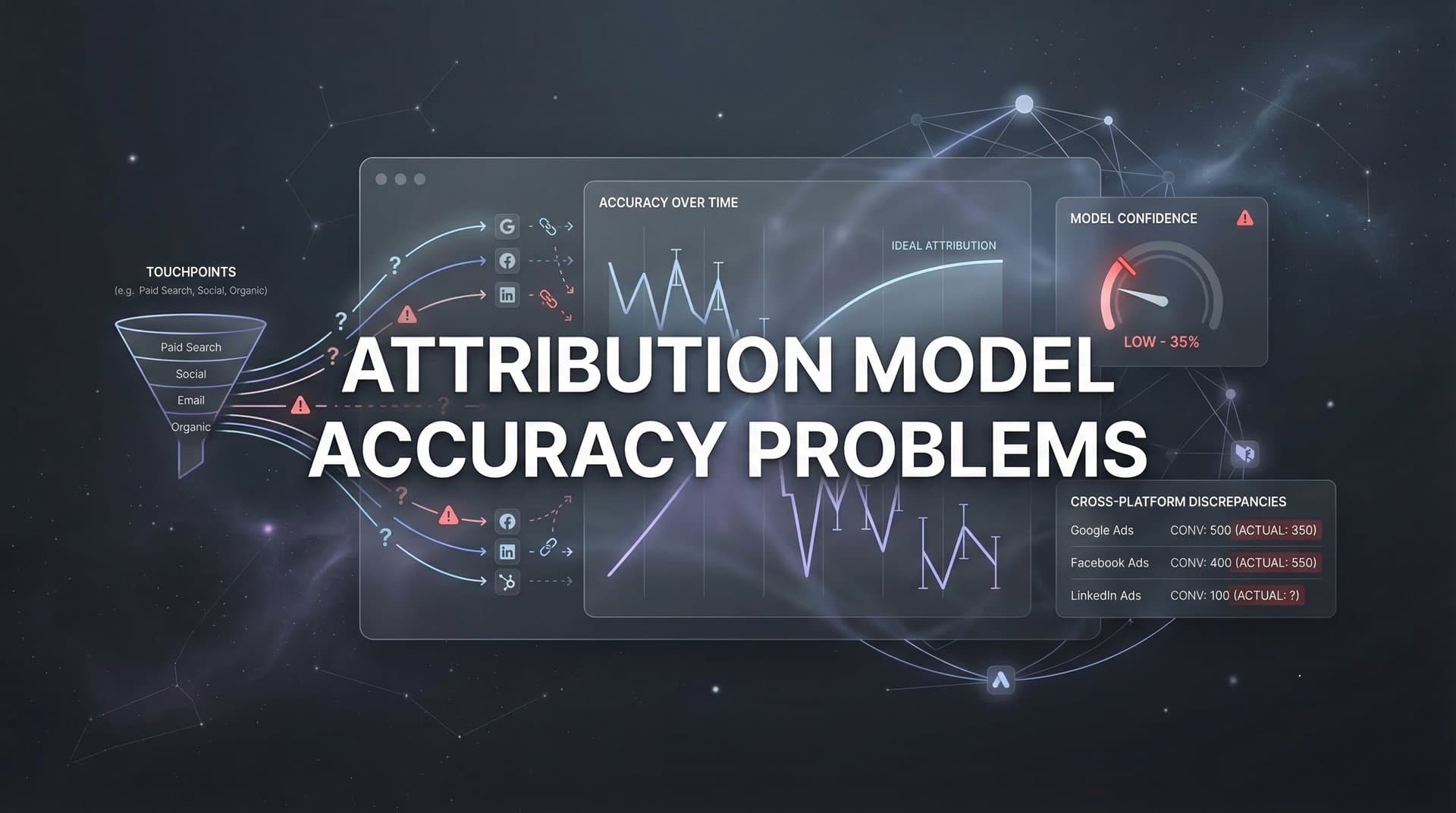
You've just scaled your Facebook campaign by 300%. The attribution dashboard shows a clear winner—this ad set is driving conversions at half the cost of everything else. You shift budget aggressively, confident in the data. Two weeks later, your revenue hasn't moved. In fact, it's down slightly. You check the numbers again. The attribution model still says this campaign is performing beautifully. But your bank account tells a different story.
This isn't a rare glitch. It's a symptom of a much larger problem: most attribution models have fundamental accuracy issues that systematically mislead budget decisions. They don't just have minor blind spots. They create entirely false narratives about what's working and what isn't.
The uncomfortable truth is that the data you're using to make million-dollar decisions might be showing you a distorted version of reality. Understanding where attribution breaks down isn't just about better reporting. It's about stopping the slow bleed of misallocated budget and finally seeing which campaigns actually drive revenue.
The Hidden Gaps in How Attribution Models Track Customer Journeys
Your customer doesn't live in a single browser session. She discovers your brand on her phone during her morning commute, researches on her work laptop during lunch, and finally converts on her tablet that evening. To you, that should be one customer journey with three touchpoints.
To most attribution systems, that's three completely different people.
Cross-device tracking failures create one of the most significant blind spots in modern attribution. Without a persistent identifier that follows the same person across devices, attribution models fracture single customer journeys into disconnected fragments. That Facebook ad on mobile gets no credit for the Google search on desktop that led to the conversion on tablet. Each platform sees only its own piece of the puzzle.
Then there's the "dark funnel" problem. Your best customers often discover you through channels attribution can never see. Someone mentions your product in a private Slack channel. A colleague forwards your case study in an email. A prospect screenshots your LinkedIn post and shares it in a group chat. These touchpoints drive real awareness and intent, but they're completely invisible to tracking pixels and UTM parameters.
The technical limitations compound the problem. Cookies expire, typically after 30 days. If someone discovers your brand, thinks about it for five weeks, then converts, that initial touchpoint vanishes from the attribution record. Session timeouts create artificial breaks in journeys—a customer who takes a coffee break between browsing and buying appears as two separate sessions with no connection between them. Understanding how attribution modeling works reveals just how many gaps exist in standard tracking setups.
Browser restrictions make this worse. Safari's Intelligent Tracking Prevention and Firefox's Enhanced Tracking Protection actively block third-party cookies and limit first-party cookie lifespans. Ad blockers strip tracking parameters from URLs. Privacy-focused browsers like Brave remove tracking capabilities entirely. For a growing segment of your audience, client-side tracking captures almost nothing.
The result? Attribution models make decisions based on incomplete journey data. They credit the touchpoints they can see while ignoring the ones they can't. When significant portions of the customer journey are invisible, any conclusions drawn from the visible portions become fundamentally unreliable.
Why Single-Touch Models Systematically Mislead Budget Decisions
Single-touch attribution models don't just oversimplify customer journeys. They create systematic biases that actively push you toward bad budget decisions.
First-touch attribution gives all credit to wherever someone first discovered your brand. Sounds logical until you realize what this means in practice. That broad awareness campaign on TikTok gets 100% credit for a conversion that actually happened because of a retargeting ad, a competitor comparison article, and a demo call. First-touch models systematically over-value top-of-funnel channels while giving zero credit to everything that actually drove the decision.
The business impact is predictable: marketers pour budget into awareness channels that generate plenty of "first touches" but don't actually drive revenue. The model says these channels are working brilliantly, so you scale them. Meanwhile, the middle and bottom-funnel tactics that actually convert prospects get starved of budget because they rarely serve as the first touchpoint. A thorough comparison between single-source and multi-touch attribution shows exactly where these biases emerge.
Last-touch attribution creates the opposite problem. It gives all credit to the final interaction before conversion, typically a branded search or direct visit. This systematically undervalues every channel that built awareness and consideration. The Instagram ads that introduced your brand, the blog content that educated the prospect, the comparison reviews that built trust—all get zero credit because they weren't the last click.
Here's where it gets truly problematic: these models create self-reinforcing cycles. Last-touch attribution makes branded search look incredibly efficient because it captures people already ready to buy. So you increase branded search bids. This improves last-touch metrics even more, confirming the model's recommendation. Meanwhile, you cut budget from the channels that were actually building brand awareness and driving those branded searches in the first place. Six months later, your branded search volume drops because fewer people know who you are.
Single-touch models force a false choice: credit the beginning or credit the end. Real customer journeys don't work that way. Multiple touchpoints contribute to the decision, often in complex, non-linear ways. Reducing that reality to a single moment systematically misrepresents which marketing activities drive results.
Multi-Touch Attribution: Better, But Still Flawed
Multi-touch attribution models attempt to solve single-touch limitations by distributing credit across multiple touchpoints. The logic seems sound: if a customer interacted with five different marketing touchpoints before converting, each one probably contributed something to the decision. But how much credit does each touchpoint deserve?
This is where multi-touch models reveal their own fundamental problem: they're all making educated guesses.
Linear attribution splits credit equally across all touchpoints. A customer who saw a Facebook ad, clicked a Google search result, read a blog post, and then converted through an email? Each touchpoint gets 25% credit. The assumption is that all interactions contribute equally to the conversion. But that's rarely true. The blog post that answered their core objection probably mattered more than the Facebook ad they scrolled past. Linear models can't tell the difference.
Time-decay models assume that touchpoints closer to conversion matter more, so they weight recent interactions more heavily. This sounds intuitive, but it's still an arbitrary assumption. Sometimes the first touchpoint—the one that introduced the entire concept—matters most. Sometimes a middle touchpoint that addressed a key concern is what actually drove the decision. Time-decay models apply the same mathematical formula regardless of what actually happened. Exploring the various types of attribution models in digital marketing helps clarify these distinctions.
Position-based models try to split the difference, typically giving 40% credit to the first touch, 40% to the last touch, and dividing the remaining 20% among middle interactions. But why 40-20-40? Why not 30-40-30? These percentages are educated guesses, not data-driven insights about how your specific customers make decisions.
The deeper problem is that multi-touch attribution models amplify any errors in the underlying tracking data. Remember all those cross-device gaps, dark funnel touchpoints, and cookie expiration issues? Multi-touch models don't fix those problems. They just distribute credit across incomplete journey data. If you're missing half the touchpoints, distributing credit across the visible ones doesn't make your attribution more accurate. It just creates a more sophisticated-looking version of the same incomplete picture.
Multi-touch attribution is directionally better than single-touch models. It at least acknowledges that multiple interactions matter. But it's still applying predetermined formulas to incomplete data and calling the result "accurate attribution."
Platform-Reported Data: The Self-Grading Problem
Here's a scenario that should sound familiar: You check your Meta Ads Manager and see 150 conversions. You check Google Ads and see 120 conversions. You check TikTok and see 80 conversions. You check your actual sales records and see 200 total conversions. The math doesn't add up because each platform is claiming credit for conversions the others also claim.
This is the self-grading problem. Each advertising platform uses its own attribution methodology, its own conversion window, and its own definition of what counts as an assisted conversion. They're not trying to give you an accurate picture of your overall marketing performance. They're trying to demonstrate their own value.
Meta uses a default attribution window that includes view-through conversions—people who saw your ad but didn't click, then converted later. Google Ads uses different default windows for search versus display. TikTok has its own methodology. When the same customer sees ads on multiple platforms before converting, each platform's attribution model can legitimately claim that its ad contributed to the conversion. But they all report it as "their" conversion. Understanding Google Ads attribution window problems reveals how these discrepancies compound across platforms.
The incentive structure makes this worse. Platform algorithms optimize for the metrics they report. Meta's algorithm optimizes to generate more of the conversions that Meta's attribution model will credit to Meta. This creates a feedback loop where platform-reported performance becomes increasingly disconnected from actual business outcomes.
The iOS 14.5 update in 2021 fundamentally changed this landscape. Apple's App Tracking Transparency framework required apps to ask permission before tracking users across other apps and websites. Most users declined. Overnight, platforms lost the ability to track significant portions of their audience across the web. Their attribution models didn't disappear—they just became less accurate, relying more heavily on modeled conversions and statistical estimates rather than actual tracking data. Many marketers found their attribution model broken after the iOS update, exposing how fragile platform-dependent tracking had become.
This means the conversion numbers you see in your ad platforms today include a growing proportion of estimated conversions. The platform thinks this person probably converted based on statistical modeling, but it didn't actually track the conversion. For budget decisions, this matters enormously. You're not optimizing based on what actually happened. You're optimizing based on what the platform's model thinks probably happened.
The fundamental problem is that you're trusting each platform to grade its own homework. They have every incentive to present their performance in the most favorable light possible. That doesn't make them dishonest—it makes them biased in predictable ways. Relying solely on platform-reported attribution means making budget decisions based on data that's systematically skewed toward making each platform look more effective than it actually is.
Recognizing Attribution Accuracy Problems in Your Own Data
How do you know if your attribution data is misleading you? The signs show up in the gaps between what your attribution model says and what actually happens when you act on that data.
The most obvious red flag: platform-reported conversions significantly exceed your actual sales. Add up the conversions each platform claims, and the total is 40% higher than your actual revenue events. This isn't a small discrepancy from different counting methodologies. It's a clear signal that platforms are over-crediting themselves through overlapping attribution windows and view-through conversions that didn't actually influence the purchase decision.
Another telling sign: scaling "winning" campaigns doesn't produce proportional revenue increases. Your attribution model identifies a campaign with a 3x ROAS. You double the budget, expecting revenue to scale accordingly. Instead, ROAS drops to 1.8x and overall revenue barely moves. This pattern suggests the attribution model was giving that campaign credit for conversions it didn't actually drive—possibly last-touch credit for branded searches that would have happened anyway, or credit for conversions that other channels actually influenced.
Watch for contradictions between attribution data and customer feedback. Your attribution model says email drives 30% of conversions. But when you survey customers or listen to sales calls, almost nobody mentions email as a factor in their decision. They talk about the webinar, the comparison content, the demo call—touchpoints your attribution model is under-crediting or missing entirely. When customer stories don't match your attribution data, trust the stories. Learning how to choose the right attribution model for your business can help align your data with actual customer behavior.
Channel performance that defies logic is another warning sign. Your attribution model shows that a broad awareness campaign on a new platform is generating conversions at an impossibly efficient rate, better than your highly targeted retargeting campaigns. This usually means the attribution model is crediting the new channel for conversions that were actually driven by your established channels, possibly through last-touch attribution of branded searches that happened after someone saw the awareness ad.
Look for unexplained changes in attribution after technical updates. You implement a new tag manager, switch analytics platforms, or update your tracking setup. Suddenly, channel performance shifts dramatically—not because actual performance changed, but because the new tracking setup captures different touchpoints or attributes them differently. This reveals how much your "performance data" depends on technical implementation details rather than actual marketing effectiveness.
The most subtle but important red flag: your attribution data doesn't connect to actual revenue outcomes. You can see platform conversions, but you can't easily tie those conversions to deal values, customer lifetime value, or revenue in your CRM. This gap means you're optimizing for conversion volume without knowing if those conversions actually drive profitable revenue.
Building a More Accurate Attribution Foundation
Fixing attribution accuracy problems requires more than switching to a different attribution model. It requires fundamentally changing how you capture and connect marketing data.
Server-side tracking addresses many of the technical limitations that create attribution blind spots. Instead of relying on browser cookies and client-side pixels—which ad blockers strip out and privacy restrictions limit—server-side tracking captures conversion data directly from your server to advertising platforms. When someone converts on your site, your server sends that conversion event directly to Meta, Google, and other platforms. This bypasses browser restrictions, ad blockers, and cookie limitations that cause client-side tracking to miss significant portions of your conversions.
The accuracy improvement is substantial. Client-side tracking might capture 60-70% of actual conversions due to ad blockers, browser restrictions, and cookie issues. Server-side tracking can capture 95%+ of conversions because it doesn't depend on the customer's browser cooperating. This means ad platform algorithms receive more complete conversion data, improving their ability to optimize for actual results rather than the subset of results they can see through limited tracking.
But more complete conversion data only helps if you're tracking the right conversions. This is where connecting attribution data directly to CRM and revenue outcomes becomes critical. Instead of optimizing for platform-reported conversions—which might include low-value actions or leads that never close—connect your attribution system to actual deal values and revenue in your CRM. Implementing AI-powered attribution modeling can automate much of this connection and analysis.
This connection reveals the difference between conversion volume and conversion value. A campaign might generate 100 conversions according to platform data, but when you connect that to CRM outcomes, you discover that only 20 of those conversions became customers, with an average deal value of $2,000. Another campaign generates 50 platform conversions, but 40 became customers with an average deal value of $5,000. Platform attribution would tell you the first campaign performs better. Revenue-connected attribution tells you the second campaign drives 4x more actual revenue.
AI-powered analysis can identify patterns across complete customer journeys that traditional attribution models miss. Instead of applying predetermined formulas like "last touch gets all credit" or "split credit equally," AI can analyze thousands of customer journeys to identify which touchpoint combinations actually correlate with conversions and revenue. It can recognize that customers who interact with specific content types in specific sequences convert at higher rates and higher values, insights that predetermined attribution models can't surface.
The key is that AI analysis works with enriched, complete journey data—not the fragmented, incomplete data that traditional attribution models struggle with. When you combine server-side tracking to capture more complete conversion data, CRM integration to connect conversions to actual revenue, and AI analysis to identify real patterns, you move from educated guesses about attribution to data-driven insights about what actually drives results.
This foundation enables a different approach to budget decisions. Instead of asking "which channel gets credit for this conversion?" you can ask "which touchpoint combinations drive the highest-value customers?" Instead of optimizing for platform-reported metrics, you can optimize for actual revenue outcomes. Instead of accepting attribution blind spots as inevitable, you can build a system that captures and connects the complete customer journey.
Moving Forward with Better Attribution
Attribution model accuracy problems aren't a reason to abandon data-driven marketing. They're a reason to demand better data. The gaps, biases, and blind spots in traditional attribution aren't inevitable technical limitations—they're solvable problems that the right infrastructure can address.
The business impact of attribution inaccuracy is too significant to ignore. Misallocated budgets, scaled campaigns that don't drive proportional revenue, and ad platform algorithms optimizing based on incomplete conversion data all stem from the same root cause: attribution systems that can't see or accurately credit the complete customer journey.
The solution isn't more sophisticated formulas applied to incomplete data. It's capturing more complete journey data through server-side tracking, connecting that data to actual revenue outcomes in your CRM, and using AI to identify the patterns that truly drive results. This approach doesn't just improve reporting accuracy—it fundamentally changes which campaigns you scale and how you allocate budget.
Ready to elevate your marketing game with precision and confidence? Discover how Cometly's AI-driven recommendations can transform your ad strategy—Get your free demo today and start capturing every touchpoint to maximize your conversions.


