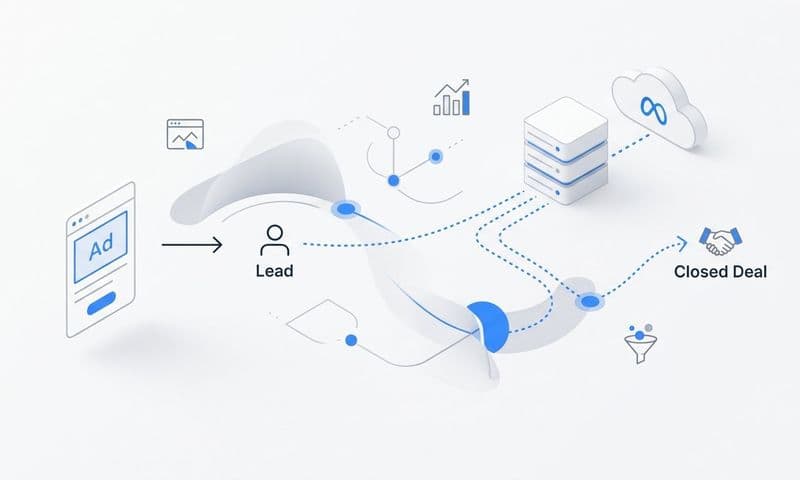

You've spent months nurturing a prospect. They downloaded your whitepaper, attended two webinars, engaged with your email sequence, and finally booked a demo. Three weeks later, they become a customer. Your CFO asks a simple question: "Which marketing channel drove that sale?" You look at your analytics and see the last click came from a Google Ad. But was that really what closed the deal? Or was it the LinkedIn post that started the relationship six months ago?
This is the attribution puzzle that keeps B2B marketers up at night. Unlike B2C purchases where someone sees an ad and buys within hours, B2B buyers interact with 20+ touchpoints over months before making a decision. They read blog posts, compare competitor solutions, consult with colleagues, and revisit your website multiple times before ever talking to sales.
The problem? Most marketing analytics only show you the last thing that happened before conversion. That's like watching only the final minute of a basketball game and trying to figure out which player won it. You're missing the entire story of how the deal actually came together.
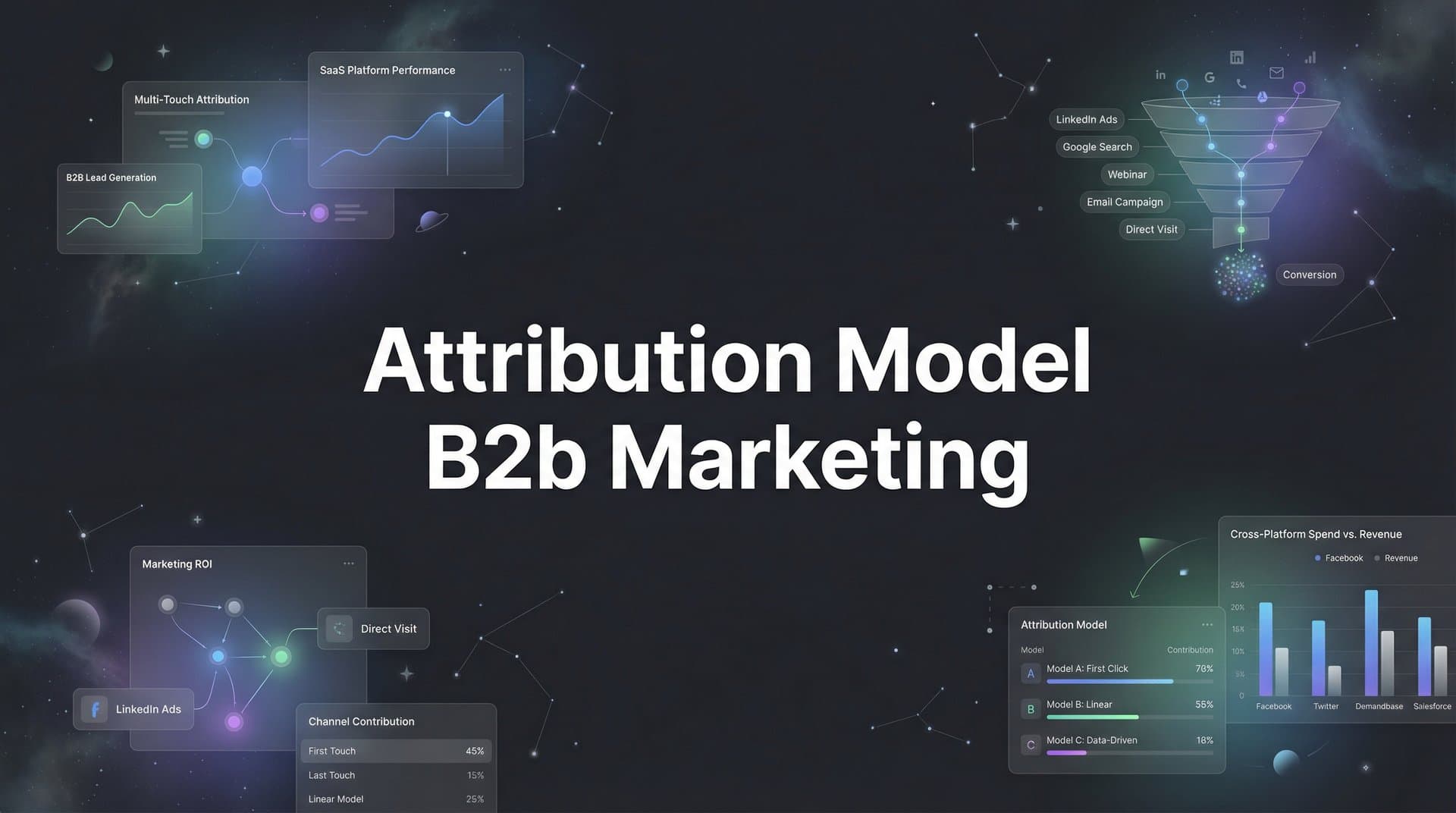
Attribution models solve this problem by creating frameworks that assign credit to different marketing touchpoints throughout the buyer journey. They help you answer the critical question: what's actually driving revenue? This guide will show you how to choose and implement the right attribution approach for your B2B marketing, so you can confidently allocate budget to what works instead of guessing based on incomplete data.
Why B2B Demands Smarter Attribution Than B2C
B2B sales cycles operate in a completely different universe than B2C transactions. When someone buys running shoes online, the journey is straightforward: see ad, visit site, purchase. The entire process takes minutes, maybe hours. Attribution is relatively simple because there aren't many touchpoints to track.
B2B purchases? Completely different game. The average B2B sales cycle runs 3-6 months, and enterprise deals often stretch beyond a year. During that time, your prospect isn't just one person clicking around—it's multiple decision-makers, each interacting with your marketing in different ways.
Think about it: the marketing director discovers your solution through a LinkedIn post. The VP of Sales downloads a case study after a Google search. The CFO attends your webinar about ROI. The CEO reads a comparison article mentioning your product. Each of these touchpoints influences the final buying decision, but traditional last-click attribution would give 100% of the credit to whichever touchpoint happened last.
This creates a dangerous blind spot. If you're only tracking last-click conversions, you might see that most deals close after a demo request form. So you pour more budget into bottom-of-funnel tactics. Meanwhile, the top-of-funnel content that actually started those relationships gets defunded because it doesn't show up in your attribution reports.
The typical B2B buyer journey includes content downloads, email nurture sequences, retargeting ads, webinar attendance, sales calls, product demos, and proposal reviews. Each interaction builds trust and moves the deal forward. Single-touch attribution models can't capture this complexity—they oversimplify a multifaceted relationship into a single moment. Understanding B2B marketing attribution fundamentals is essential for navigating these challenges.
Here's what makes it even more complicated: B2B decisions involve multiple stakeholders with different priorities. Your champion inside the company might love your product, but they need to convince their boss, get budget approval from finance, and address technical concerns from IT. Your marketing needs to serve content to all these different roles, and your attribution model needs to account for this multi-threaded buying process.
The cost of getting attribution wrong in B2B is massive. When you can't see which channels actually drive pipeline and revenue, you end up making budget decisions based on vanity metrics. You might optimize for webinar registrations while the real revenue driver is your email nurture sequence. Or you might cut spending on brand awareness because it doesn't generate immediate conversions, not realizing it's creating the foundation for every deal that closes months later.
Six Attribution Models That Actually Matter for B2B
Let's break down the attribution models you need to understand, starting with the simplest and moving toward the most sophisticated. Each has specific use cases in B2B marketing, and understanding their strengths and limitations will help you choose the right approach.
First-Touch Attribution: This model gives 100% of the credit to the very first interaction a prospect had with your marketing. If someone discovered you through an organic blog post six months ago, that blog post gets full credit for the eventual sale—even if a dozen other touchpoints happened afterward.
First-touch works well when you're trying to understand which channels are best at generating new awareness and starting relationships. It answers the question: "Where do our best customers first discover us?" This is valuable for top-of-funnel budget allocation. However, it completely ignores everything that happened after that initial touch, which means it can't tell you what actually nurtures prospects into customers.
Last-Touch Attribution: The opposite approach—100% credit goes to the final interaction before conversion. If someone clicked a Google Ad right before becoming a customer, that ad gets all the credit, regardless of the months-long relationship that preceded it.
Last-touch is useful for understanding what finally pushes prospects over the finish line. It's popular because it's simple and aligns with how many ad platforms report conversions by default. The problem? It dramatically overvalues bottom-of-funnel activities and undervalues everything that built the relationship. Your brand awareness campaigns and educational content get zero credit, even though they did the heavy lifting.
Linear Attribution: This multi-touch model distributes credit equally across every touchpoint in the journey. If a prospect had ten interactions with your marketing before converting, each touchpoint gets 10% of the credit. It's democratic—everyone gets a participation trophy. For a deeper dive into how this works, explore linear model marketing attribution and its applications.
Linear attribution gives you a more complete picture than single-touch models. You can see all the channels contributing to conversions, not just the first or last. The downside? It assumes every touchpoint is equally important, which isn't realistic. The initial blog post that created awareness probably didn't have the same impact as the pricing page visit that happened right before the demo request.
Time-Decay Attribution: This model recognizes that touchpoints closer to conversion typically have more influence on the final decision. It assigns increasing credit to interactions as they get closer to the conversion event. The first touchpoint might get 5% credit, while the last one gets 40%.
Time-decay makes intuitive sense for B2B sales cycles. As prospects move through their buying journey, they're getting closer to a decision, so recent interactions are genuinely more influential. This model works particularly well for understanding which late-stage content and campaigns are most effective at closing deals. However, it can still undervalue the early touchpoints that started the relationship.
Position-Based (U-Shaped) Attribution: This model assigns 40% credit to the first touch, 40% to the last touch, and distributes the remaining 20% across all the middle touchpoints. It recognizes that both starting the relationship and closing it are crucial moments, while still acknowledging the nurturing that happens in between.
Position-based attribution is popular in B2B because it balances awareness and conversion. You can see which channels are good at generating new prospects and which are effective at closing deals. The middle touchpoints don't get ignored entirely, but they also don't get overweighted. This model works well when you want to optimize both top-of-funnel and bottom-of-funnel simultaneously. Review the full breakdown of types of marketing attribution models to compare these approaches.
Data-Driven Attribution: Instead of applying predetermined rules about how to distribute credit, data-driven attribution uses machine learning to analyze your actual conversion data. It looks at thousands of customer journeys, identifies patterns, and assigns credit based on which touchpoints statistically correlate with conversions.
This is the most sophisticated approach because it's customized to your specific business. The algorithm might discover that webinar attendance is a stronger conversion indicator than whitepaper downloads, or that prospects who engage with comparison content are more likely to close. It adapts as your marketing evolves, continuously learning from new data. The trade-off is that you need significant conversion volume for the machine learning to work effectively—if you only close a handful of deals per month, you don't have enough data for meaningful patterns to emerge.
Choosing the Right Model for Your Sales Cycle
The best attribution model for your B2B marketing isn't the most sophisticated one—it's the one that matches your actual sales cycle and business model. Here's how to think about this strategically.
Short Sales Cycles (Under 30 Days): If your typical deal closes within a month, you're dealing with a relatively compressed buyer journey. Prospects might interact with 5-10 touchpoints rather than 20+. In this scenario, position-based or time-decay models often provide the clearest picture.
Position-based works well here because you can clearly see what generates interest (first touch) and what drives conversion (last touch) without the middle touchpoints getting lost in noise. Time-decay also makes sense because with a shorter cycle, the recency of interactions is a stronger signal—if someone engaged with your content yesterday, that's genuinely more relevant than something from two weeks ago.
For short-cycle B2B, avoid over-complicating with data-driven models unless you have extremely high conversion volume. The simpler multi-touch models give you actionable insights without requiring massive data sets.
Long Enterprise Sales Cycles (3+ Months): When deals take a quarter or longer to close, the buyer journey becomes significantly more complex. You're tracking dozens of interactions across multiple decision-makers, and the relationship evolves substantially over time.
This is where data-driven attribution starts to show its value. With longer cycles, you have more touchpoints to analyze, and the patterns that emerge from machine learning can reveal insights that rule-based models miss. The algorithm might discover that prospects who engage with specific content in month two are 3x more likely to close than those who don't, or that certain channel combinations predict higher deal values. Learn more about how content marketing attribution modeling with machine learning can enhance these insights.
If you don't have enough conversion volume for data-driven attribution, consider a custom weighted model. This is similar to position-based, but instead of the standard 40/40/20 split, you adjust the weights based on your knowledge of your sales process. Maybe your first touch should get 30%, your last touch 50%, and middle touches 20% because you know that bottom-of-funnel content is particularly influential in your space.
Account-Based Marketing Scenarios: ABM introduces a unique attribution challenge because you're not just tracking individual prospects—you're tracking multiple stakeholders within target accounts. The marketing director, VP of Sales, CFO, and CEO might all interact with your content independently before the account converts.
For ABM, you need attribution that can aggregate touchpoints at the account level, not just the contact level. This means tracking when anyone from Target Company X interacts with your marketing, regardless of which specific person it was. Position-based attribution often works well here because you want to know both what got the account engaged initially and what finally drove them to convert.
The key is ensuring your attribution platform can connect multiple contacts to a single account and attribute conversions accordingly. Otherwise, you're only seeing a fraction of the actual buyer journey—the interactions from whoever happened to fill out the final form, while missing all the research and engagement from other decision-makers.
One more consideration: if you're running multiple business models simultaneously—say, a self-serve product with short cycles and an enterprise offering with long cycles—you might need different attribution models for each. Don't force a one-size-fits-all approach when your sales motions are fundamentally different.
Building Attribution That Actually Works
Understanding attribution models conceptually is one thing. Making them work with your actual marketing infrastructure is where most B2B teams struggle. Here's what you need to build attribution that captures the complete buyer journey.
Connect Every Marketing Touchpoint: Your attribution is only as good as the data you're capturing. If you're running ads on Meta, Google, and LinkedIn, but only tracking conversions from your website, you're missing huge pieces of the puzzle. You need to connect your ad platforms, CRM, email marketing, webinar software, and website analytics into a unified system.
This means implementing tracking that follows prospects across every channel. When someone clicks a LinkedIn ad, downloads a whitepaper, receives email nurture sequences, and eventually becomes a customer in your CRM, all those touchpoints need to be connected to the same person. Without this connection, you're just looking at disconnected data points instead of a complete journey. The right B2B marketing attribution software makes this integration seamless.
The technical challenge is that different platforms use different identifiers. Your CRM knows them by email address, your website analytics tracks them with cookies, and your ad platforms use pixel data. You need a system that can unify these identifiers and build a single customer record that spans all your marketing channels.
Implement Server-Side Tracking: Browser-based tracking is dying. iOS privacy changes and browser restrictions mean that traditional pixel-based attribution misses an increasing percentage of conversions. If you're still relying entirely on client-side tracking, you're probably losing 20-30% of your attribution data.
Server-side tracking solves this by sending conversion events directly from your server to ad platforms and analytics tools, bypassing browser restrictions entirely. When someone converts on your website, your server immediately sends that data to Meta, Google, and your attribution platform—regardless of whether they have ad blockers, strict privacy settings, or iOS devices.
This isn't just about more accurate numbers. It's about having reliable data to make budget decisions. If your attribution is missing 30% of conversions because of tracking limitations, you can't trust your ROAS calculations. You might be cutting spending on channels that are actually performing well but appear weak because of incomplete data.
Sync Conversion Data Back to Ad Platforms: Here's where attribution becomes truly powerful: when you feed enriched conversion data back to Meta, Google, and other ad platforms, their algorithms can optimize for the outcomes you actually care about.
Most B2B marketers optimize ad campaigns for form fills or demo requests because that's the conversion event the platform can see. But what you really care about is closed revenue. By syncing CRM data back to your ad platforms, you can tell Meta's algorithm which leads actually became customers and how much revenue they generated. Understanding channel attribution for revenue tracking is critical for this process.
This transforms campaign optimization. Instead of the algorithm optimizing for any form fill, it learns to target people who look like your actual customers. It can distinguish between leads that close and leads that go nowhere, then adjust targeting accordingly. The result is better quality leads and higher ROI from your ad spend.
The technical implementation requires a conversion API or similar server-to-server connection. You're essentially creating a feedback loop: marketing generates leads, CRM tracks which ones close, and that data flows back to ad platforms to improve targeting. This is how you move from optimizing for vanity metrics to optimizing for actual revenue.
Track Offline Conversions: If your B2B sales process includes phone calls, in-person meetings, or offline events, you need to feed that data into your attribution system too. A prospect might discover you online, but the actual deal closes during a sales call or at a trade show booth.
Make sure your CRM is capturing the source of every lead and opportunity, and that this data connects back to your marketing attribution. When a sales rep manually creates an opportunity after a phone conversation, they should be able to tag how that prospect originally entered your ecosystem. Otherwise, all your offline conversions become attribution black holes.
Making Attribution Drive Better Budget Decisions
Having attribution data is meaningless if you don't use it to make smarter marketing decisions. Here's how to turn attribution insights into actions that actually improve your results.
Calculate True ROAS by Channel: Stop optimizing for cost per lead. Start optimizing for cost per customer and revenue per dollar spent. With proper attribution connecting marketing touchpoints to closed revenue, you can calculate the actual return on ad spend for each channel.
This often reveals surprising insights. That expensive LinkedIn campaign that generates fewer leads might actually have a higher ROAS because the leads it generates close at 3x the rate. The cheap display ads that flood your funnel with form fills might have terrible ROAS because those leads never convert to customers. You can't see this without attribution that tracks all the way to revenue. Explore marketing attribution analytics best practices to refine your measurement approach.
Run this analysis regularly—monthly for fast-moving campaigns, quarterly for longer cycles. Look at ROAS trends over time. Is a channel improving or declining? Are certain campaigns consistently outperforming others? Use this data to reallocate budget toward what's actually driving revenue, not just activity.
Identify Your Hidden Performers: Multi-touch attribution often reveals channels that assist conversions without getting last-click credit. These are your hidden performers—the marketing activities that don't look impressive in last-click reports but are actually crucial to your sales process.
You might discover that prospects who engage with your email newsletter are 2x more likely to eventually convert, even though the newsletter rarely gets last-click credit. Or that retargeting campaigns don't directly drive many conversions but significantly increase conversion rates when combined with other channels. These insights help you protect budget for channels that might otherwise get cut based on last-click data alone.
Look for patterns in your multi-touch attribution reports. Which combinations of touchpoints have the highest conversion rates? Are there specific content pieces that consistently appear in winning customer journeys? Use these insights to double down on what works and replicate successful patterns. Understanding the difference between multi-touch attribution vs marketing mix modeling helps you choose the right analytical framework.
Scale Winners with AI-Powered Recommendations: Once you know which channels, campaigns, and content are driving actual revenue, the next question is: how do you scale them intelligently? This is where AI-powered recommendations become valuable.
Modern attribution platforms can analyze your conversion data and provide specific recommendations: increase budget on Campaign X by 30% because it's consistently beating your target ROAS, shift budget from Channel A to Channel B based on efficiency trends, or pause underperforming ad sets that are dragging down overall performance.
These recommendations work because they're based on your actual conversion data, not generic best practices. The AI learns what works for your specific audience and business model, then suggests optimizations that align with your goals. Instead of manually analyzing reports and making budget decisions based on gut feel, you get data-driven recommendations that help you scale what's working.
The key is connecting your attribution data to your advertising platforms so recommendations can be implemented quickly. If you have to manually adjust budgets across five different ad accounts, you'll never keep up with optimization opportunities. Look for systems that can make recommendations and help you implement them efficiently.
Test and Iterate Your Attribution Model: Attribution isn't set-it-and-forget-it. As your marketing evolves, your attribution approach should evolve too. If you launch a new channel, add a new product line, or change your sales process, revisit whether your current attribution model still makes sense.
Run periodic comparisons between different attribution models to see how they tell different stories about your marketing performance. If first-touch and last-touch attribution are showing wildly different results, that's a signal that multi-touch attribution will give you better insights. If your data-driven model is assigning unexpected credit distributions, investigate why—it might be revealing patterns you weren't aware of. Addressing common attribution challenges in B2B marketing will help you refine your approach over time.
Putting It All Together
Attribution modeling transforms B2B marketing from guesswork into a data-driven discipline. When you can see which channels and campaigns actually drive revenue—not just form fills—you can make confident budget decisions instead of flying blind.
The right attribution model depends on your sales cycle, business model, and data volume. Short cycles often work well with position-based or time-decay models. Long enterprise sales benefit from data-driven approaches that can handle complexity. ABM scenarios require account-level attribution that tracks multiple stakeholders. Choose the model that matches your reality, not the one that sounds most sophisticated.
But choosing a model is just the starting point. Making attribution work requires connecting all your marketing touchpoints, implementing server-side tracking to overcome browser limitations, and syncing conversion data back to ad platforms so their algorithms can optimize for actual revenue. This infrastructure is what separates attribution that provides interesting reports from attribution that actually improves your marketing performance.
The goal isn't perfect attribution—that doesn't exist. Customer journeys are messy, and no model will capture every nuance of how buying decisions happen. The goal is better attribution that reveals patterns and insights you can act on. When you can see that certain content consistently appears in winning journeys, or that specific channel combinations drive higher conversion rates, you have the information you need to scale what works and cut what doesn't.
Start by evaluating your current attribution setup. Are you tracking all your marketing touchpoints? Can you connect marketing activity to closed revenue? Are you optimizing campaigns based on actual business outcomes or proxy metrics? If there are gaps, prioritize filling them. The difference between mediocre attribution and good attribution is often the difference between wasting budget and scaling efficiently.
Ready to elevate your marketing game with precision and confidence? Discover how Cometly's AI-driven recommendations can transform your ad strategy—Get your free demo today and start capturing every touchpoint to maximize your conversions.