You're running a content marketing engine that's producing results. Blog traffic is up. Downloads are climbing. Webinar registrations keep rolling in. But when leadership asks which content actually drives revenue, you're stuck pointing to vanity metrics and making educated guesses.
The problem isn't your content strategy—it's how you're measuring it. Traditional attribution models treat every touchpoint the same way, applying rigid rules that can't capture the messy reality of modern buyer journeys. A prospect reads five blog posts, downloads two guides, watches a webinar, and converts three weeks later. Which piece deserves credit? First-touch says the initial blog post. Last-touch credits the webinar. Neither tells the full story.
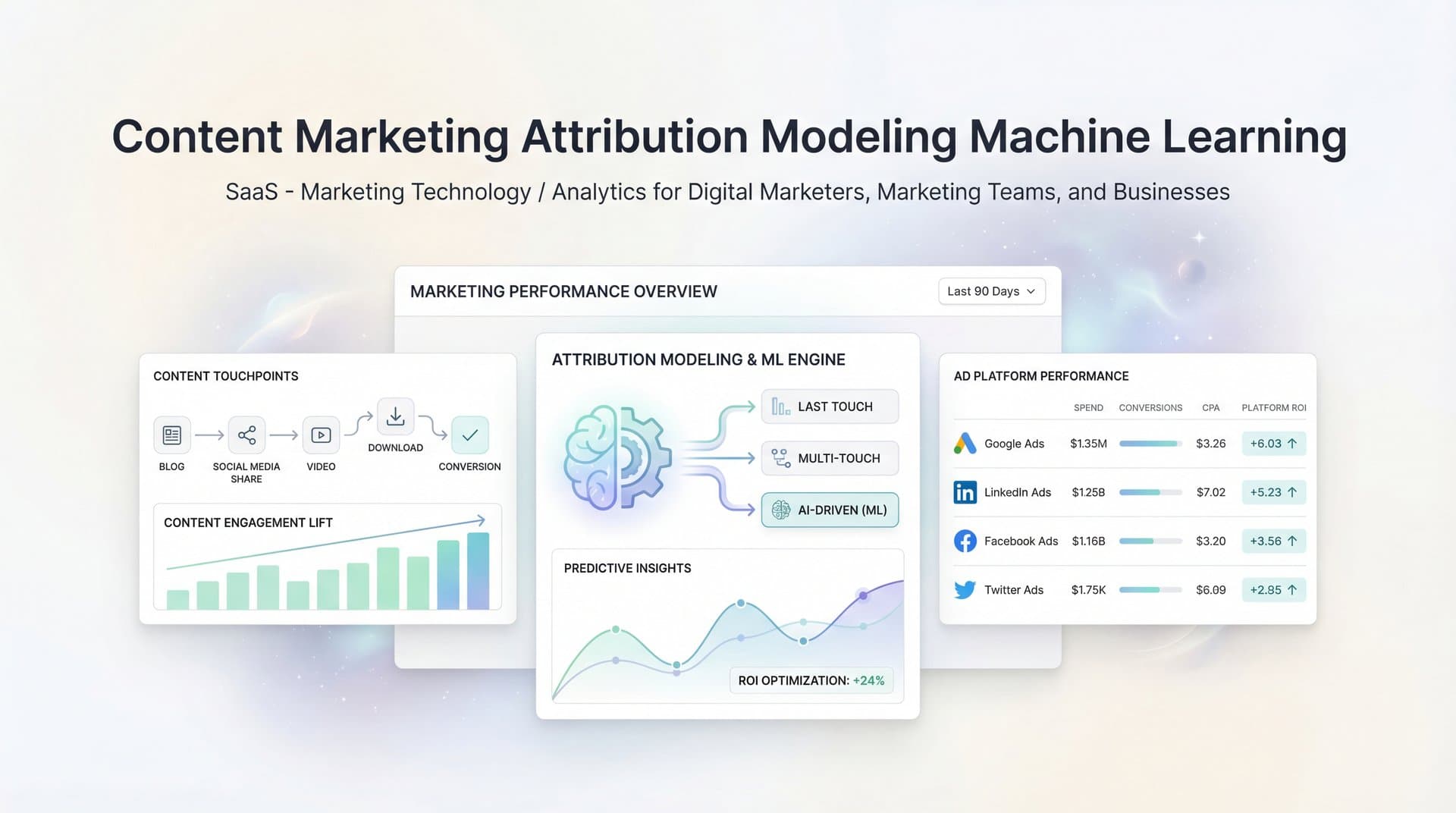
Machine learning is changing this equation entirely. Instead of following predetermined rules, ML algorithms analyze patterns across thousands of actual customer journeys to reveal which content truly influences conversions. The technology can weigh dozens of variables simultaneously, identify non-obvious patterns, and adapt as buyer behavior evolves. For content marketers drowning in data but starving for insights, ML-powered attribution represents a fundamental shift from guessing to knowing.
This guide breaks down how machine learning transforms content attribution, what you need to implement it, and how to turn those insights into a content strategy that drives measurable revenue growth.
The Attribution Gap That's Costing You Revenue
Content marketing journeys don't follow straight lines. A B2B software buyer might discover your brand through an SEO blog post, return two weeks later to download a comparison guide, attend a webinar the following month, and finally convert after reading a case study. That's four content touchpoints spread across six weeks—and traditional attribution models handle this complexity poorly.
First-touch attribution gives 100% credit to that initial blog post. It tells you what starts conversations but systematically ignores everything that happens next. Last-touch does the opposite, crediting only the final case study. Both approaches share the same fatal flaw: they treat multi-touch journeys as if they're single-touch events.
The content that suffers most? Your mid-funnel nurture pieces. The detailed guides that educate prospects. The comparison content that builds confidence. The webinars that address objections. These assets play crucial roles in moving buyers toward purchase, but rule-based models either ignore them completely or split credit using arbitrary percentages.
Linear attribution tries to solve this by distributing credit equally across all touchpoints. But does your awareness-stage blog post really deserve the same credit as the bottom-funnel case study that closed the deal? Position-based models attempt more nuance, giving 40% to first touch, 40% to last touch, and splitting the remaining 20% among everything else. Better than nothing, but still based on assumptions rather than data. Understanding the types of marketing attribution models helps clarify why each approach has inherent limitations.
Here's the deeper issue: static attribution rules can't adapt. Buyer behavior shifts. New content formats emerge. Funnel dynamics change. Yet your attribution model keeps applying the same rigid logic it used six months ago, blind to patterns that could inform better decisions.
This creates a vicious cycle. You can't accurately measure which content drives revenue, so you can't confidently invest in creating more of what works. Marketing budgets get allocated based on gut feelings and surface-level metrics. High-performing content gets overlooked while underperformers consume resources. The content team works harder but can't prove their impact in the language leadership understands: revenue contribution.
How Algorithms See What Humans Can't
Machine learning approaches attribution from the opposite direction. Instead of starting with rules and applying them to data, ML algorithms start with your actual conversion data and discover the patterns within it. The technology analyzes thousands of customer journeys to identify which content combinations and sequences correlate most strongly with successful outcomes.
Think of it like this: you're trying to understand which ingredients make a recipe successful. Rule-based attribution is like deciding the first ingredient always matters most, or splitting credit equally among all ingredients. ML is like analyzing thousands of successful recipes to discover that certain ingredient combinations consistently produce better results—and that timing and sequence matter as much as the ingredients themselves.
The core advantage? ML models can weigh content contributions dynamically based on actual performance data rather than predetermined assumptions. When the algorithm notices that prospects who engage with a specific guide are 3x more likely to convert, it adjusts credit accordingly. When it identifies that webinar attendance followed by case study views creates a high-converting sequence, it recognizes the compound effect rather than treating each touchpoint in isolation.
Several ML approaches power modern attribution systems. Probabilistic models calculate the likelihood that each touchpoint contributed to conversion by comparing journeys that converted against those that didn't. If prospects who read a particular blog post convert at significantly higher rates than those who don't, the model assigns proportional credit to that content piece.
Markov chain models take this further by analyzing transition probabilities between touchpoints. They ask: what's the probability a prospect moves from blog post to guide download to webinar attendance? And how do those transition paths correlate with conversion? This reveals not just which content performs well, but which content sequences create momentum toward purchase. For a deeper dive into these techniques, explore how machine learning can be used in marketing attribution.
Shapley value attribution, borrowed from game theory, approaches the problem from another angle. It calculates each touchpoint's marginal contribution by systematically comparing conversion rates across all possible combinations of content interactions. This ensures fair credit distribution—content that consistently improves conversion probability gets recognized, while content that merely correlates with conversions but doesn't causally contribute gets appropriately weighted.
The breakthrough moment comes when ML models identify patterns that human analysts would miss. Maybe prospects who engage with technical documentation early in their journey convert faster than those who don't, even though that content sits outside your main funnel. Perhaps video content has outsized impact for enterprise deals but minimal effect on SMB conversions. These insights emerge from the data itself rather than your assumptions about how buyers should behave.
What makes this especially powerful for content marketing? The algorithms can process dozens of variables simultaneously—content type, topic, length, format, timing, sequence, user segment, device, and more. They can weight seasonal patterns, account for diminishing returns from repeated touchpoints, and adjust for external factors that influence conversion probability. Human brains simply can't hold this many variables in working memory, let alone calculate their relative contributions. This is why the impact of machine learning on marketing analytics continues to reshape how teams measure performance.
The Data Foundation That Makes ML Attribution Possible
Machine learning algorithms are only as good as the data you feed them. Before you can leverage ML attribution, you need comprehensive tracking infrastructure that captures every content interaction across the entire customer journey. This means going far beyond basic pageview analytics.
You need to track specific content engagement events: blog post reads, guide downloads, video views (including watch time), webinar registrations and attendance, email clicks, PDF opens, tool usage, and any other meaningful content interaction. But tracking these events in isolation isn't enough—they must be connected to individual user journeys so the ML model can analyze how touchpoints relate to each other and to eventual conversions.
This is where many content attribution efforts break down. Marketing teams track blog traffic in one system, email engagement in another, webinar data in a third platform, and website conversions in a fourth. These siloed data sources can't tell you that the person who downloaded your guide last week is the same person who attended your webinar yesterday and converted today. Without that connection, ML attribution can't function. Understanding the attribution challenges in marketing analytics helps teams anticipate and solve these data integration problems.
CRM integration becomes absolutely critical here. You need to link content consumption data to actual revenue outcomes—not just form fills or demo requests, but closed deals and contract values. The ML model needs to understand which content touchpoints preceded $5,000 deals versus $50,000 deals, which content sequences lead to faster sales cycles, and which content combinations correlate with higher customer lifetime value.
Server-side tracking deserves special attention in this context. Browser-based tracking alone increasingly fails to capture complete user journeys, especially given iOS privacy changes and cookie restrictions. When tracking pixels get blocked, your attribution data develops blind spots that skew ML model training. Server-side tracking addresses this by capturing events on your server before they reach the user's browser, providing more complete and accurate data for your attribution models.
Data quality matters more than data quantity for ML attribution. A million touchpoints with inconsistent tracking will produce worse results than 100,000 clean, properly tagged interactions. This means establishing and enforcing standards: consistent UTM parameters across all content links, standardized event naming conventions, deduplicated user records, and regular data quality audits to catch tracking issues before they corrupt your attribution models.
One often-overlooked requirement: sufficient conversion volume. ML models need enough examples to identify statistically significant patterns. If you're generating fewer than 100 conversions per month, the models may struggle to distinguish signal from noise. This doesn't mean ML attribution is off-limits for smaller operations, but it does mean you'll need longer training periods to accumulate enough conversion data for reliable results.
The good news? Once you've built this data foundation, it powers more than just attribution. The same infrastructure enables personalization, predictive lead scoring, customer segmentation, and a dozen other use cases. Think of comprehensive content tracking as the operating system that makes advanced marketing capabilities possible. Platforms designed for marketing attribution platforms revenue tracking can accelerate this infrastructure buildout significantly.
From Theory to Practice: Your ML Attribution Roadmap
Implementing ML attribution isn't about flipping a switch—it's about building capabilities systematically. Start by auditing your current tracking setup with brutal honesty. Map every content type you produce and verify that you're capturing meaningful engagement events for each one. Blog posts? Check for scroll depth and time-on-page tracking. Video content? Confirm you're logging watch percentages, not just plays. Downloadable assets? Make sure you're tracking not just the download but subsequent opens and engagement.
Identify the gaps. Maybe you're tracking webinar registrations but not actual attendance. Perhaps you're capturing email clicks but not the subsequent on-site behavior. These blind spots in your data create blind spots in your attribution insights. Document them, prioritize based on content volume and strategic importance, and create a plan to close the critical gaps before attempting ML attribution.
Next comes the build-versus-buy decision. Building custom ML attribution models gives you maximum flexibility and control, but requires serious data science resources. You'll need someone who understands statistical modeling, can work with your data infrastructure, and has the time to develop, train, validate, and maintain attribution algorithms. For most marketing teams, this represents a significant investment that diverts resources from core marketing activities.
Platforms with built-in ML attribution capabilities offer a faster path to insights. Modern marketing attribution modeling software uses AI to analyze your conversion data and automatically identify which touchpoints drive the highest impact. These tools handle the technical complexity—data processing, model training, statistical validation—while you focus on interpreting insights and taking action. The tradeoff is less customization, but for most teams, the speed and reliability of proven ML models outweigh the benefits of building from scratch.
Whichever route you choose, run ML attribution alongside your existing models initially. This parallel approach lets you validate results before making high-stakes decisions. When ML attribution tells you a piece of content deserves 30% more credit than your current model assigns, you can investigate why. Does the ML model see engagement patterns your rule-based model misses? Is it identifying content sequences that lead to higher conversion rates? This validation period builds confidence and helps you understand how the ML model thinks.
Pay attention to model training periods. ML algorithms need time to analyze patterns across enough conversion cycles to produce reliable insights. For B2B companies with 60-90 day sales cycles, this might mean three to six months of data collection before the model stabilizes. Shorter sales cycles can produce actionable insights faster, but rushing the training period risks basing decisions on incomplete pattern recognition.
Set clear success metrics for your ML attribution implementation. What decisions will these insights inform? Budget allocation across content types? Resource investment in specific topics? Content sequencing in nurture campaigns? Define these use cases upfront so you can evaluate whether the attribution model provides the specific insights you need to make those decisions confidently. Reviewing a comprehensive marketing attribution report can help establish baseline expectations.
Don't overlook the human side of implementation. ML attribution will likely challenge existing assumptions about which content works. The blog post everyone loves might not drive conversions. The dry technical guide that nobody talks about might be your highest-performing asset. Prepare your team for these revelations and establish processes for acting on insights even when they contradict conventional wisdom.
Turning Attribution Data Into Content That Converts
ML attribution insights are only valuable if they change what you do. The first action most teams take: identifying their highest-converting content and understanding what makes it work. When the algorithm shows that certain blog posts consistently appear in high-converting journeys, dig into the common characteristics. Is it the topic? The depth of coverage? The format? The call-to-action? These patterns reveal your content's true value drivers.
Look beyond individual asset performance to content sequencing insights. ML attribution excels at identifying which content paths lead to faster conversions and higher deal values. You might discover that prospects who read blog post A, then download guide B, then attend webinar C convert at twice the rate of those who engage with the same content in different orders. This tells you something crucial about how your content builds momentum and where to guide prospects next.
Use these sequence insights to optimize your nurture campaigns and content recommendations. If the data shows that case study engagement following product comparison content creates a high-converting path, build that sequence into your email workflows and website recommendations. Stop guessing about "the next best content" and start using patterns from thousands of successful journeys to guide prospects toward conversion.
Attribution data also reveals content gaps with precision. When ML models show that prospects who engage with content about topic X convert at high rates but you only have one asset covering that topic, you've identified a high-value content creation opportunity. Conversely, when attribution shows that an entire content category contributes minimally to conversions despite significant investment, you can redirect those resources toward higher-impact work. Robust content marketing analytics practices ensure you're capturing these insights consistently.
Here's where attribution insights create compound benefits: feed them back to your ad platforms. When you know which content pieces appear most frequently in high-converting journeys, you can create lookalike audiences based on people who've engaged with those specific assets. You can optimize ad targeting to reach audiences more likely to engage with your best-performing content. This closes the loop between attribution insights and audience acquisition, making your entire marketing engine more efficient.
The same logic applies to content distribution decisions. Should you invest in promoting that new guide through paid social? Check whether similar content types show strong attribution performance. Is it worth producing more video content? Look at how video engagement correlates with conversion in your ML attribution data. These insights turn content distribution from guesswork into evidence-based strategy.
Don't ignore the negative signals either. When ML attribution shows that certain content consistently appears in non-converting journeys, investigate why. Maybe the content attracts the wrong audience. Perhaps it sets incorrect expectations. Or it might be perfectly good awareness content that shouldn't be evaluated on conversion metrics. Either way, the data helps you understand each asset's true role and set appropriate expectations.
The most sophisticated teams use ML attribution to inform content experimentation. Instead of A/B testing random variations, test specific hypotheses suggested by attribution data. If the algorithm shows that long-form technical content drives conversions for enterprise prospects, create more content in that format and measure the impact. Let your attribution insights guide your content roadmap, not just measure it. Teams running cross channel marketing attribution software can extend these insights across every distribution channel.
The Competitive Edge You Can't Afford to Ignore
Machine learning-powered attribution represents more than a measurement upgrade—it's a fundamental shift in how you understand and optimize content marketing. While competitors guess which content works, you'll know with data-backed confidence. While they spread resources across content that "feels" effective, you'll double down on assets that demonstrably drive revenue.
The marketers who adopt ML attribution first gain a compounding advantage. They identify high-performing content faster. They optimize distribution more effectively. They build content strategies on patterns from thousands of customer journeys rather than intuition and vanity metrics. Over time, this data-driven approach creates a content engine that consistently outperforms competitors still operating on assumptions.
But here's what matters most: ML attribution finally gives content marketing the measurement rigor it deserves. You can walk into budget discussions with clear evidence of content's revenue contribution. You can prioritize content investments based on actual performance data. You can prove that content marketing isn't just top-of-funnel activity—it's a revenue driver that influences conversions throughout the entire customer journey.
The implementation path isn't trivial. You need solid tracking infrastructure, sufficient conversion volume, and either data science resources or a platform that handles the technical complexity. But for content marketing teams serious about growth, these requirements represent an investment, not a barrier. The alternative—continuing to optimize content based on incomplete attribution—means leaving revenue on the table.
Start by evaluating your current attribution setup honestly. Are you tracking all meaningful content interactions? Can you connect those interactions to individual user journeys and revenue outcomes? Do you have the data foundation ML attribution requires? If gaps exist, prioritize closing them. If your infrastructure is ready, the next step is choosing how you'll implement ML attribution—building custom models or leveraging platforms with proven algorithms.
Ready to elevate your marketing game with precision and confidence? Discover how Cometly's AI-driven recommendations can transform your ad strategy—Get your free demo today and start capturing every touchpoint to maximize your conversions. With comprehensive tracking, AI-powered attribution models, and the ability to feed enriched conversion data back to your ad platforms, Cometly gives you the accurate, actionable insights you need to scale content marketing with confidence.