You've spent months optimizing your Meta campaigns, fine-tuning your Google Ads, and testing new creative across TikTok. Your dashboard shows conversions happening across all these channels. But here's the question that keeps you up at night: which touchpoints actually drove those conversions?
If your attribution data lives scattered across Meta Ads Manager, Google Analytics, your CRM, and three other platforms, you're essentially flying blind. Each platform claims credit using its own methodology. Meta says it drove 200 conversions. Google says 180. Your analytics tool reports something completely different. They can't all be right.
This is where Snowflake changes the game. As a cloud-based data platform, Snowflake lets you centralize all your marketing data in one place and build attribution models that reflect your actual business reality—not what each ad platform wants you to believe. You own the data. You control the methodology. You see the complete customer journey from first click to final purchase.
For data-driven marketers tired of platform limitations and conflicting attribution reports, moving to Snowflake represents a fundamental shift in how you understand marketing performance. This guide walks you through exactly how attribution modeling works in Snowflake and what it takes to build a system that delivers real, actionable insights.
The Data Cloud Revolution: Why Attribution Is Moving to Snowflake
Platform-native attribution has a fundamental problem: it's designed to make that platform look good. Meta's attribution model is optimized to show Meta's value. Google's model favors Google touchpoints. This isn't necessarily malicious—it's just the reality of walled garden ecosystems where each platform only sees its own piece of the customer journey.
Think about what happens when a customer sees your Facebook ad, clicks through, doesn't convert, then later searches your brand name on Google and purchases. Facebook claims a view-through conversion. Google claims a last-click conversion. Both platforms report the same sale as their success. Your actual conversion count? One. Your reported conversions across platforms? Two or more.
This data fragmentation makes it nearly impossible to answer basic questions like "What's my true ROAS by channel?" or "Which combination of touchpoints drives the highest-value customers?" You're stuck reconciling reports that fundamentally disagree about what happened. Understanding how to fix attribution discrepancies in data becomes critical for accurate reporting.
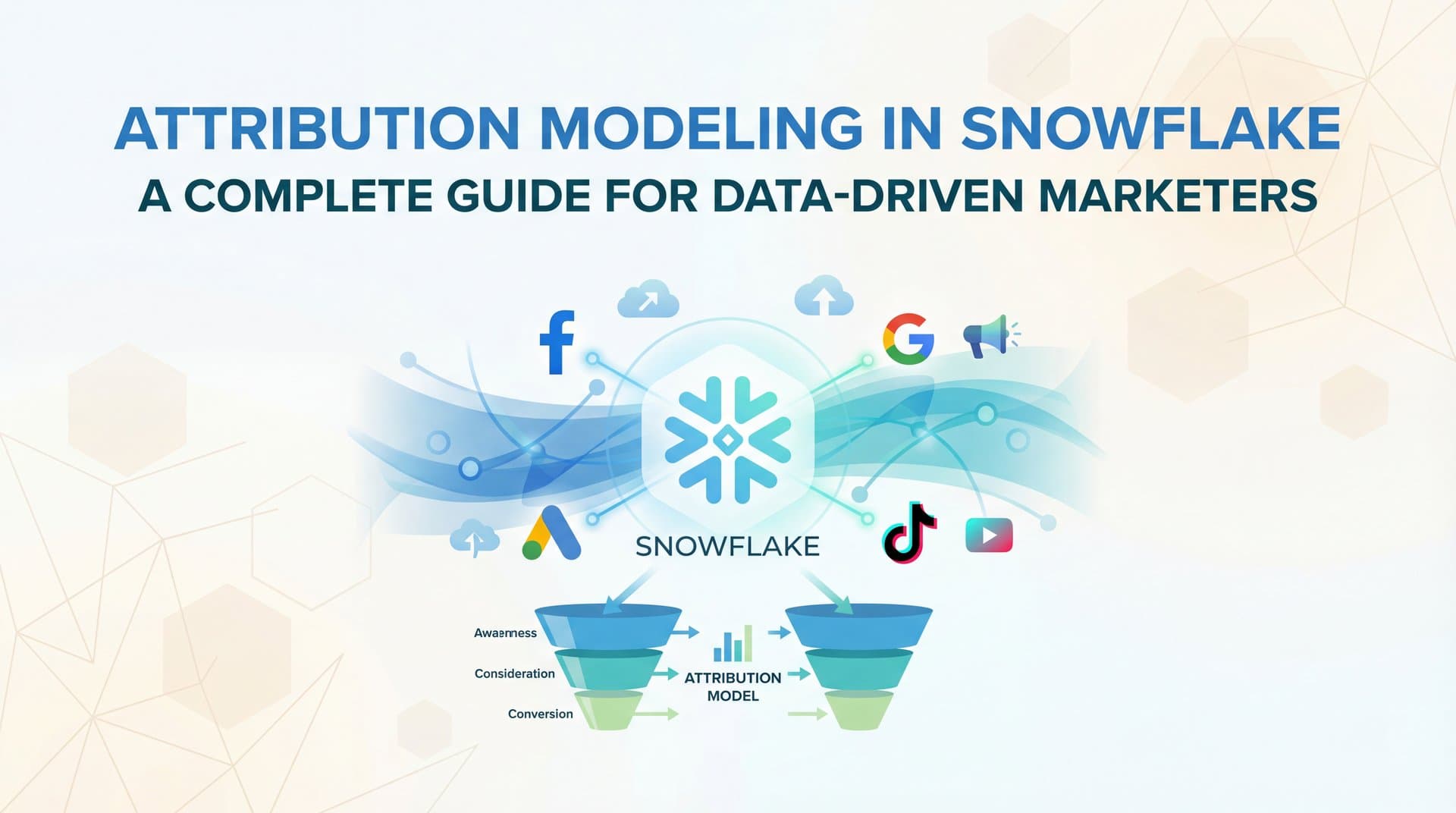
Snowflake solves this by becoming your single source of truth. Instead of attribution happening in isolated platforms, you pull all your marketing data into Snowflake's data cloud. Ad click data from Meta. Search data from Google. Email engagement from your ESP. CRM events. Website behavior. Offline conversions. Everything lives in one place where you can see how it actually connects.
The benefits extend beyond just seeing complete data. With Snowflake, you control the attribution methodology. Want to test how linear attribution compares to time-decay for your business? Run both models on the same data set and compare results. Need to exclude certain touchpoint types from getting credit? Adjust your SQL logic. Want different attribution windows for different conversion types? Build that complexity into your queries.
This flexibility matters especially as privacy regulations tighten and third-party cookies disappear. Marketing teams are shifting toward first-party data strategies—collecting and owning customer data directly rather than relying on platform tracking. Snowflake provides the infrastructure to store this first-party data securely, combine it with marketing touchpoint data, and build attribution models that don't depend on cross-site tracking or platform pixels.
The data cloud approach also scales in ways platform-native tools simply can't. As your marketing grows more sophisticated—adding new channels, testing new customer segments, expanding internationally—Snowflake handles the increased data volume without performance degradation. You're not hitting arbitrary row limits or paying exponentially more for additional data storage.
Companies moving attribution to Snowflake typically see immediate value in data consistency. When everyone in your organization queries the same underlying data using agreed-upon attribution logic, those endless debates about "whose numbers are right" disappear. Marketing, finance, and executive teams all work from the same source of truth.
Building Blocks: Attribution Models You Can Implement
Attribution modeling in Snowflake starts with understanding which model best fits your business reality. Different models distribute conversion credit differently across the customer journey, and the "right" choice depends on your sales cycle, average touchpoints to conversion, and what questions you're trying to answer. A comprehensive attribution modeling guide can help you navigate these decisions.
Single-Touch Attribution Models: These are the simplest to implement and understand. First-touch attribution gives 100% credit to the first known touchpoint in a customer's journey. Last-touch attribution gives all credit to the final interaction before conversion. In Snowflake, these models require basic SQL logic to identify the earliest or latest touchpoint timestamp for each conversion.
First-touch makes sense when you're focused on top-of-funnel awareness and want to understand which channels are best at introducing new prospects to your brand. If you run a lot of cold traffic campaigns and have a long nurture cycle, first-touch helps you value those initial discovery moments appropriately.
Last-touch works better for businesses where the final touchpoint truly drives the decision—think high-intent search campaigns or direct response offers where the last interaction is genuinely the moment that triggers conversion. Many e-commerce brands default to last-touch because it aligns with how customers often behave: they research elsewhere, then come directly to purchase.
Multi-Touch Attribution Models: These distribute credit across multiple touchpoints, acknowledging that customer journeys involve several interactions. Linear attribution splits credit equally among all touchpoints. Time-decay gives more credit to interactions closer to conversion. Position-based (U-shaped) gives extra weight to first and last touch while distributing remaining credit to middle touchpoints. Learning about multi-touch attribution modeling helps you understand these nuances.
Implementing multi-touch models in Snowflake involves more complex SQL. You need to identify all touchpoints in a conversion path, apply your credit distribution formula, then aggregate results by channel or campaign. Linear attribution might assign each of five touchpoints 20% credit. Time-decay might give the last touchpoint 40%, the second-to-last 30%, working backward with decreasing percentages.
The SQL logic typically involves window functions to sequence touchpoints, case statements to apply credit rules, and aggregation queries to sum attributed value by dimension. For a time-decay model, you might calculate days between each touchpoint and conversion, then apply an exponential decay formula where more recent touchpoints receive proportionally more credit.
Algorithmic and Custom Models: This is where Snowflake's capabilities really shine. Using Snowpark for machine learning, you can build data-driven attribution models that learn which touchpoint combinations actually predict conversions for your specific business.
Rather than applying predetermined rules about credit distribution, algorithmic models analyze historical conversion paths to identify patterns. Which channels appear most often in high-value customer journeys? Do certain touchpoint sequences correlate with faster conversion? Does the presence of a specific channel type increase conversion probability?
These models require more technical sophistication—you're essentially training a machine learning model to predict conversion likelihood based on touchpoint features. But the payoff is an attribution approach that reflects your actual data rather than generic assumptions about how customers should behave.
Many marketing teams start with rule-based models to establish baseline attribution, then graduate to algorithmic approaches as they accumulate sufficient data and develop more advanced analytical capabilities. The beauty of doing this in Snowflake is you can run multiple models simultaneously on the same data and compare outputs to understand how methodology choices impact your conclusions. Exploring the comparison of attribution models for marketers provides valuable perspective on these tradeoffs.
Architecting Your Attribution Data Foundation
Before you can model attribution, you need data architecture that makes attribution possible. This means connecting the right data sources, structuring your schema appropriately, and solving the identity resolution puzzle that plagues most marketing analytics efforts.
Essential Data Sources: Comprehensive attribution requires touchpoint data from every channel where customers interact with your brand. At minimum, this includes ad platform data showing impressions, clicks, and ad spend from Meta, Google, TikTok, and other paid channels. You need website analytics showing page views, sessions, and on-site behavior. CRM data containing lead creation, opportunity progression, and closed revenue. Email and marketing automation data tracking message sends, opens, and clicks.
Many businesses also incorporate offline touchpoint data—trade show attendance, sales calls, direct mail responses—because omitting these interactions creates blind spots in your attribution model. If a customer attends your webinar, receives a sales demo, then converts, but your attribution model only sees digital ad clicks, you're dramatically undervaluing those high-touch activities.
Getting this data into Snowflake typically involves a combination of native connectors, ETL tools, and custom API integrations. Modern data integration platforms can automate the flow of marketing data into Snowflake, handling schema changes and maintaining historical records as data evolves over time. Understanding how to setup datalake for marketing attribution provides a solid foundation for this process.
Schema Design for Attribution: Your Snowflake database needs a structure that makes attribution queries efficient and maintainable. Most attribution architectures center around a touchpoint table that records every customer interaction with your marketing. Each row represents one touchpoint with fields for timestamp, customer identifier, channel, campaign, content, and any other relevant dimensions.
A separate conversions table tracks goal completions—purchases, lead submissions, demo requests, whatever events you want to attribute back to marketing touchpoints. This table includes conversion timestamp, customer identifier, conversion value, and conversion type. The relationship between these tables is one-to-many: one conversion can be attributed to many touchpoints.
You'll also need dimension tables for campaigns, channels, and customer attributes that you want to analyze by. This normalized structure keeps your data clean and makes it easy to add new dimensions without restructuring core touchpoint and conversion tables.
Identity Resolution Challenges: Here's the hard part. A customer might click your Facebook ad on their phone, visit your website on their laptop, receive an email, and finally convert on their tablet. That's one customer, but potentially four different device identifiers. If you can't connect these touchpoints to the same person, your attribution model sees four different customer journeys instead of one multi-device journey.
Identity resolution in Snowflake typically involves building a customer identity graph that maps various identifiers to a single customer record. When someone provides an email address, you can link their anonymous website sessions to their known CRM record. When they log in across devices, you can connect those device IDs. Effective customer attribution tracking depends on solving this identity puzzle.
The technical approach often uses probabilistic matching for anonymous touchpoints (same IP address, similar browser characteristics, temporal proximity) and deterministic matching when you have confirmed identifiers like email addresses or customer IDs. Your identity graph becomes a lookup table that your attribution queries reference to group touchpoints by actual customer rather than by device or cookie.
This isn't perfect—some touchpoints will remain unconnected, and privacy regulations limit certain matching techniques. But even imperfect identity resolution dramatically improves attribution accuracy compared to treating every device as a separate customer.
Query Patterns That Reveal Marketing Truth
With your data architecture in place, the real work begins: writing SQL queries that calculate attribution and surface insights your marketing team can actually use. The queries you build determine what questions you can answer and how quickly you can get to actionable recommendations.
Core Attribution Calculations: Your fundamental query joins touchpoints to conversions based on customer identifier and timestamp logic. For each conversion, you identify all touchpoints that occurred within your attribution window—typically 30, 60, or 90 days before conversion, depending on your sales cycle. Then you apply your chosen attribution model to distribute conversion credit across those touchpoints.
A basic last-touch query might look for the most recent touchpoint before each conversion and assign full credit to that channel and campaign. A linear attribution query would count all qualifying touchpoints per conversion, calculate each touchpoint's credit as 1/total_touchpoints, then sum attributed conversions and revenue by channel.
The output typically includes dimensions like channel, campaign, ad set, and creative, with metrics like attributed conversions, attributed revenue, attributed ROAS, and cost per attributed conversion. These become your source of truth for understanding marketing performance across channels.
Attribution Window Logic: How far back should you look when connecting touchpoints to conversions? This attribution window dramatically affects your results. A 7-day window might miss important early-funnel touchpoints for products with longer consideration cycles. A 90-day window might over-attribute credit to touchpoints that barely influenced the final decision.
In Snowflake, you implement attribution windows using timestamp comparisons in your WHERE clause. For each conversion, you only consider touchpoints where touchpoint_timestamp is between conversion_timestamp minus your window period and conversion_timestamp. More sophisticated approaches use different windows for different conversion types—shorter windows for impulse purchases, longer windows for enterprise B2B deals.
Many marketing teams run attribution with multiple window lengths and compare results. If your attributed conversion count barely changes between 30-day and 60-day windows, you know most customer journeys complete quickly. If you see significant differences, you're learning that longer consideration cycles matter for your business.
Conversion Path Analysis: Beyond aggregate attribution metrics, analyzing the actual sequences of touchpoints that lead to conversion reveals patterns you can optimize around. Which channel combinations work best together? Do certain touchpoint orders convert at higher rates? How many touches typically occur before conversion? Mastering multi-channel attribution modeling helps you answer these questions systematically.
Path analysis queries in Snowflake use window functions to sequence touchpoints chronologically per customer, then aggregate by path pattern. You might discover that customers who see a Facebook ad, then visit via organic search, then click an email convert at 3x the rate of other paths. That insight suggests doubling down on that specific channel combination.
Model Comparison Analysis: One powerful advantage of building attribution in Snowflake is the ability to run multiple models simultaneously and compare outputs. Create views or tables for first-touch, last-touch, linear, and time-decay attribution all calculated from the same underlying touchpoint data. Then compare how each model evaluates your channels.
If first-touch attribution shows Facebook driving twice as much value as last-touch attribution suggests, you're learning that Facebook excels at top-of-funnel awareness but doesn't close deals. If a channel performs consistently well across all models, you've found a reliably strong performer. These comparative insights help you understand not just performance, but the role each channel plays in your marketing ecosystem.
From Insights to Action: Making Attribution Operational
Building attribution models in Snowflake is intellectually satisfying, but the real value comes from operationalizing these insights—turning data into decisions that improve marketing performance. This means connecting your attribution analysis back to optimization workflows, creating accessible reporting, and maintaining the system over time.
Closing the Loop with Ad Platforms: Attribution insights locked in Snowflake don't directly improve your campaigns. You need mechanisms to feed learnings back to the platforms where you're actually running ads. This might mean using Snowflake's attributed conversion data to inform budget allocation decisions—shifting spend toward channels and campaigns that drive the most attributed revenue.
Some marketing teams build automated workflows that export high-value conversion data from Snowflake back to ad platforms via API. When your attribution model identifies a conversion that should be credited to a specific ad, you can send that conversion event to the platform's conversion API, helping their algorithms optimize more effectively. This closed-loop approach combines Snowflake's analytical power with platform optimization capabilities.
Building Usable Dashboards: Your attribution queries might be technically brilliant, but if your marketing team can't easily access and understand the insights, they won't drive decisions. Most organizations connect Snowflake to business intelligence tools like Tableau, Looker, or Mode to create dashboards that visualize attribution metrics. Robust marketing attribution analytics requires accessible visualization layers.
Effective attribution dashboards focus on actionable metrics rather than overwhelming users with every possible data cut. Show attributed ROAS by channel with trend lines. Display conversion path analysis highlighting your most valuable customer journeys. Include model comparison views so stakeholders understand how methodology affects conclusions. Make it easy to filter by date range, campaign, or product line.
The goal is self-service analytics where marketing managers can answer their own questions without writing SQL. Pre-built dashboard templates with intuitive filters and drill-down capabilities democratize access to attribution insights across your marketing organization.
Maintaining Data Freshness: Attribution is only valuable if it's current. Yesterday's conversion needs to be attributed to last week's touchpoints so you can make informed decisions about today's campaigns. This requires automated data pipelines that regularly sync new touchpoint and conversion data into Snowflake, then refresh your attribution calculations.
Many teams schedule attribution queries to run daily or even hourly, updating aggregate tables that power their dashboards. Incremental processing—only calculating attribution for new conversions rather than reprocessing all historical data—keeps computation costs manageable as your data volume grows. Snowflake's ability to handle large-scale data processing makes it possible to maintain near-real-time attribution even with millions of monthly touchpoints.
Governance and Documentation: As your attribution system matures, governance becomes critical. Document your attribution methodology clearly so everyone understands how credit is distributed and why. Establish change management processes for updating attribution logic—you don't want attribution metrics suddenly shifting because someone modified a query without communicating the impact.
Version control your SQL code. Maintain a data dictionary explaining what each field in your touchpoint and conversion tables represents. Create runbooks for common troubleshooting scenarios when data pipelines break or attribution numbers look unexpected. These operational practices ensure your attribution system remains reliable and trustworthy over time. Proper attribution analytics implementation includes these governance frameworks from the start.
The Path Forward: Control vs. Complexity
Attribution modeling in Snowflake gives you something invaluable: complete control over your marketing data and the methodology used to evaluate it. You're not dependent on platform black boxes or limited by walled garden restrictions. You own the data, you define the rules, and you can build attribution models as sophisticated as your business requires.
This power comes with real tradeoffs. Building and maintaining custom attribution in Snowflake requires significant technical resources. You need data engineers to build pipelines, analysts to write attribution queries, and ongoing maintenance to keep everything running smoothly. The time from "we should do attribution in Snowflake" to "we're making daily decisions based on these insights" often stretches into months.
For large enterprises with complex marketing operations and dedicated data teams, this investment makes sense. The flexibility and depth of analysis justify the resource commitment. But many marketing teams find themselves stuck in a frustrating middle ground—they understand attribution's importance, they know their current platform-native tools are insufficient, but they lack the technical capacity to build and maintain a Snowflake-based solution.
This is exactly why purpose-built attribution platforms exist. Tools like Cometly deliver sophisticated multi-touch attribution without requiring you to become a data engineering organization. Instead of spending months building data pipelines and writing SQL queries, you connect your data sources and start seeing attributed results immediately.
Cometly captures every touchpoint across your marketing channels—ad clicks, website visits, CRM events, offline interactions—and automatically applies attribution logic to show which sources actually drive revenue. The platform handles identity resolution, attribution window management, and model comparison without requiring custom SQL development. You get the insights you need without the technical complexity of building it yourself in Snowflake.
What makes this approach particularly powerful is how Cometly closes the optimization loop. The platform doesn't just show you attribution insights—it feeds enriched conversion data back to Meta, Google, and other ad platforms through their conversion APIs. This means platform algorithms optimize based on accurate, complete conversion data rather than the limited view each platform sees natively. Your ad performance improves because the platforms powering your campaigns have better information about what's actually working.
The AI-powered recommendations layer adds another dimension beyond what typical Snowflake implementations provide. Rather than just showing you attributed performance, Cometly's AI analyzes patterns across your campaigns and suggests specific optimization opportunities. Which audiences are underperforming? Which creative variations drive the highest-value customers? Where should you reallocate budget for maximum impact? These actionable recommendations turn attribution data into concrete next steps.
For marketing teams that want attribution sophistication without the data engineering overhead, this represents a pragmatic middle path. You get the multi-touch attribution and cross-platform visibility that Snowflake enables, but with faster time-to-value and without requiring dedicated technical resources to maintain the system.
Whether you choose to build custom attribution in Snowflake or adopt a purpose-built platform like Cometly, the fundamental truth remains the same: understanding what actually drives your conversions is non-negotiable for data-driven marketing. Platform-native attribution is too limited. Flying blind based on last-click metrics is too risky. Your business deserves attribution that reflects reality—complete customer journeys, accurate credit distribution, and insights you can actually act on.
Ready to elevate your marketing game with precision and confidence? Discover how Cometly's AI-driven recommendations can transform your ad strategy—Get your free demo today and start capturing every touchpoint to maximize your conversions.