If you run marketing for a B2B SaaS company, you already know the frustration. A prospect clicks a LinkedIn ad in January, downloads a whitepaper in February, attends a webinar in March, searches your brand name in April, and finally books a demo in May. Which of those touchpoints gets credit for the conversion? If your answer is "the last one," you are leaving enormous strategic insight on the table.
B2B SaaS buyer journeys are long, nonlinear, and involve multiple stakeholders who each interact with your brand in different ways across different channels. A CFO might see a retargeting ad while a product manager is reading your blog and a VP of Engineering is comparing you to competitors on G2. Traditional analytics tools were never designed to make sense of this complexity. They were built for simpler paths to purchase, where a single user clicks an ad and converts within the same session.
The result is a common and costly problem: marketing teams are making budget decisions based on incomplete, siloed, or outright misleading data. Campaigns that look like losers might actually be initiating high-value journeys. Campaigns that look like winners might be claiming credit for conversions they barely influenced. Without a clearer picture, scaling confidently is nearly impossible.
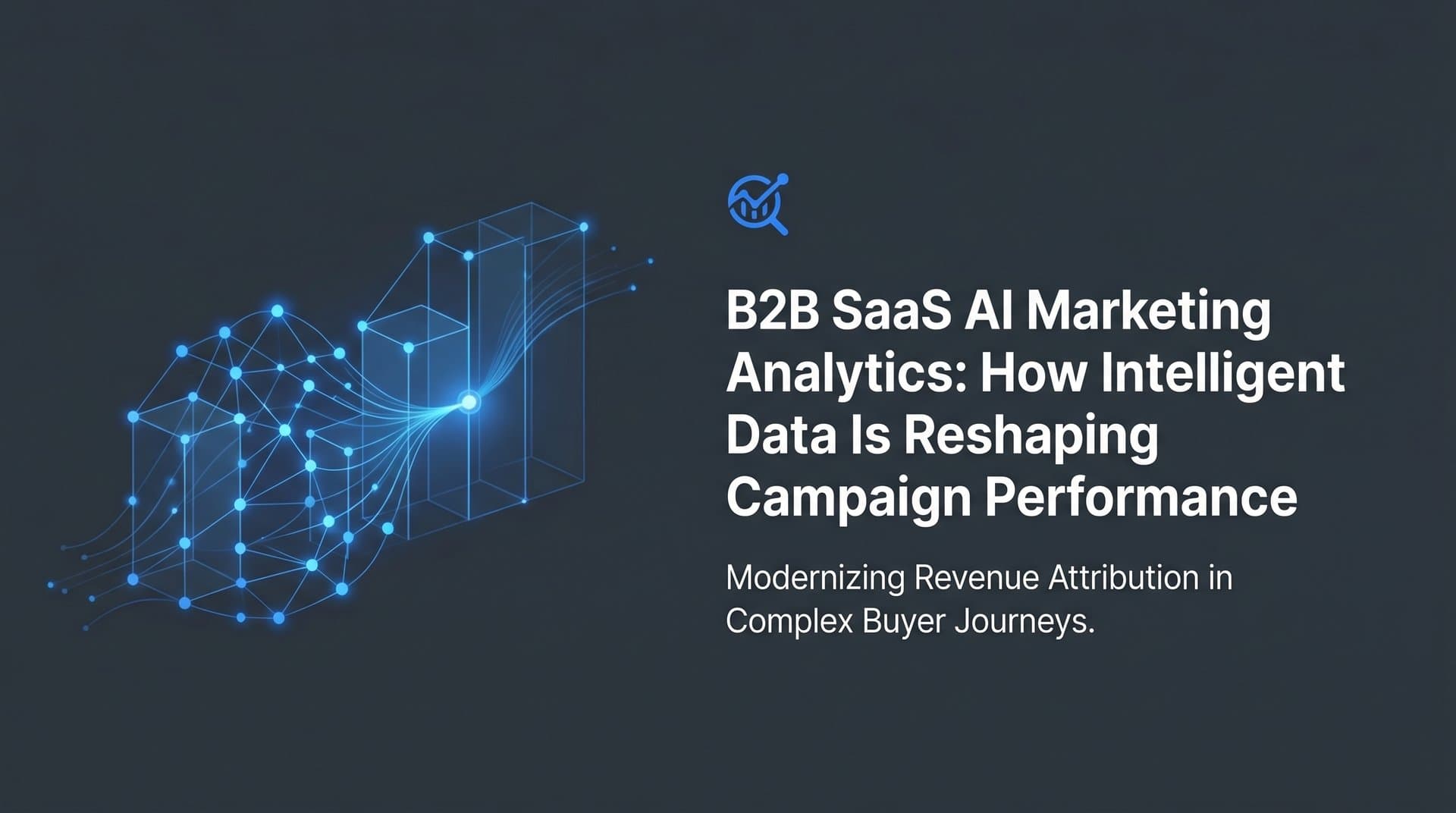
This is exactly the gap that B2B SaaS AI marketing analytics is designed to close. Rather than simply reporting what happened after the fact, AI-powered analytics platforms process cross-channel data in real time, assign attribution credit based on observed patterns, and surface actionable recommendations that tell you what to do next. It is a fundamental shift from reactive reporting to proactive, intelligent decision-making. And for B2B SaaS teams competing in crowded markets with serious ad budgets on the line, that shift is no longer optional.
Why Traditional Analytics Break Down in B2B SaaS
The core problem with traditional analytics in a B2B SaaS context comes down to a mismatch between the tool and the reality it is trying to measure. Most analytics frameworks were designed with short, linear buyer journeys in mind. B2B SaaS journeys are neither short nor linear.
Consider the typical sales cycle. Depending on deal size and complexity, it can span anywhere from 30 days to well over 90 days. During that time, multiple stakeholders from the same company might be engaging with your content independently, each at a different stage of their own evaluation process. Last-click attribution, which is still the default in many platforms, would give all the credit to whatever touchpoint happened right before the conversion event. That is like crediting the closing attorney for selling a house and ignoring every showing, negotiation, and inspection that made the deal possible.
Single-touch models like first-click have the opposite problem: they credit the very first interaction and ignore everything that nurtured the prospect across weeks or months. Neither model reflects how B2B buying decisions actually happen. Understanding the common SaaS marketing attribution challenges is the first step toward solving them.
Platform-native analytics make this worse by operating in silos. Google Ads reports conversions based on its own tracking. Meta does the same. LinkedIn has its own view. Each platform is incentivized to show its contribution in the best possible light, which often means counting the same conversion multiple times across platforms. When you add up the reported results from each channel, the total frequently exceeds your actual number of closed deals by a wide margin. This creates conflicting data that erodes confidence in every budget decision you make.
Then there is the tracking degradation problem. Apple's App Tracking Transparency framework, introduced with iOS 14.5, significantly disrupted the ability of ad platforms to track user behavior across apps and websites. Combined with the ongoing deprecation of third-party cookies in Chrome and other browsers, the pixel-based tracking that most analytics tools rely on has become increasingly unreliable. The growing problem of unreliable marketing analytics data is now a structural reality, not an occasional glitch.
For B2B SaaS marketers, these gaps are particularly damaging. When your sales cycle is measured in months and your average contract value justifies significant ad spend, even modest attribution errors can lead to major misallocation of budget. You might be cutting the channels that are quietly initiating your best deals while doubling down on the ones that just happen to be at the end of the journey.
The Core Components That Power AI Marketing Analytics
Understanding what makes AI-powered analytics different starts with understanding the building blocks that make it work. There are three foundational components that separate intelligent analytics from traditional reporting.
Algorithmic Multi-Touch Attribution: Rule-based attribution models like linear, time-decay, or position-based assign credit according to predetermined formulas. They are better than single-touch models, but they are still rigid. They apply the same logic to every conversion regardless of the actual behavior that led to it. AI-driven multi-touch attribution takes a different approach. Instead of applying a fixed formula, it analyzes your actual conversion data to identify which touchpoint combinations correlate with high-value outcomes. The model learns from observed patterns rather than following a script. A LinkedIn ad that consistently appears in the journeys of prospects who become enterprise customers gets weighted accordingly, even if it sits in the middle of a long sequence rather than at the beginning or end.
Server-Side Tracking and First-Party Data Collection: To address the data gaps created by iOS restrictions and cookie deprecation, AI analytics platforms rely on server-side tracking rather than browser-based pixels. Instead of depending on a user's browser to fire a tracking event, server-side tracking sends conversion data directly from your own servers to the analytics platform and to ad platforms. This approach is not subject to browser-level blocking or app tracking restrictions, which means it captures a significantly more complete picture of what is actually happening. First-party data collected through your CRM, your website, and your own event infrastructure becomes the foundation of your analytics rather than a supplement to third-party tracking. Effective tracking for B2B marketing campaigns depends on this server-side approach.
Machine Learning Pattern Recognition: The third component is where AI earns its name. Machine learning algorithms analyze your cross-channel data at a scale and speed that no human analyst could match. They identify which combinations of channels, ad creatives, audience segments, and messaging sequences correlate with pipeline creation and closed revenue. They surface patterns that would be invisible in a standard dashboard, such as the fact that prospects who engage with a specific piece of content early in their journey have a meaningfully higher close rate. These patterns become the basis for optimization recommendations that are grounded in your actual data rather than industry benchmarks or gut instinct.
What AI Actually Does with Your Marketing Data
Knowing the building blocks is one thing. Understanding what AI analytics actually does in practice is where the real value becomes clear. The distinction that matters most is this: traditional analytics tools tell you what happened. AI-powered analytics explain why it happened and tell you what to do next.
When you log into a traditional analytics dashboard, you see metrics. Impressions, clicks, cost per lead, conversion rates by channel. Useful, but passive. You still have to interpret the data, form a hypothesis, and decide on a course of action. That process takes time, requires analytical expertise, and is prone to confirmation bias. Exploring the power of AI marketing analytics reveals how this paradigm fundamentally changes.
AI analytics platforms process massive volumes of cross-platform data in real time and surface specific, actionable recommendations. Rather than presenting a table of campaign performance metrics, the system might tell you that your top-of-funnel LinkedIn campaign targeting mid-market SaaS companies is generating prospects with a significantly shorter time-to-close than your Google search campaigns, and recommend increasing its budget allocation. That is not a metric. That is a decision.
Conversion syncing adds another layer of intelligence to this process. Once your AI analytics platform has processed and enriched your conversion data, it sends that data back to the ad platforms themselves. This is sometimes called a Conversion API or server-side event sending. The practical effect is significant: instead of Meta or Google optimizing their targeting algorithms toward anyone who clicked a button on your website, they are now optimizing toward the specific user behaviors and audience characteristics that correlate with actual closed deals in your CRM. The ad platform's own AI gets smarter because it is working with better data.
Perhaps the most important capability for B2B SaaS teams is the ability to connect top-of-funnel ad engagement to bottom-of-funnel revenue outcomes. When your analytics environment integrates your ad platforms, your website, and your CRM, you can trace a deal from the first ad impression all the way through to closed revenue. Implementing revenue attribution for B2B SaaS companies transforms marketing analytics from a reporting function into a genuine growth function.
A Practical Framework for Implementing AI Analytics in B2B SaaS
Understanding the theory is valuable. Actually putting AI marketing analytics to work requires a structured approach. Here is a practical framework that B2B SaaS marketing teams can use to get started.
Step 1: Unify Your Data Sources
AI analytics is only as good as the data it has access to. If your ad platform data, website data, and CRM data are living in separate systems with no connection between them, the AI cannot see the full customer journey and cannot draw meaningful conclusions. The first step is connecting all of these sources into a single analytics environment. A unified marketing analytics platform makes this possible by bringing every data source together.
This means integrating your paid channels (Google, Meta, LinkedIn, and any others you run), your website tracking, and your CRM so that prospect records can be matched across systems. When a contact in your CRM can be linked back to the specific ads they interacted with months earlier, you have the foundation for real revenue attribution. Without that unification, you are still working with fragments.
Step 2: Configure Conversion Events Around Business Outcomes
Most B2B SaaS teams track conversions at the lead level: form fills, demo requests, content downloads. These are useful signals, but they are not business outcomes. The next step is configuring your conversion events to reflect what actually matters: pipeline created, opportunities progressed, and deals closed.
With server-side tracking in place, you can pass CRM-verified conversion events back to your analytics platform and to your ad platforms. This means your optimization is anchored to revenue, not just activity. Following proven SaaS marketing attribution best practices ensures your conversion events are configured to reflect real business outcomes rather than vanity metrics.
Step 3: Use AI Recommendations to Drive Iterative Decisions
Once your data is unified and your conversion events are configured correctly, the AI can start doing its work. The key discipline here is reviewing AI-generated recommendations on a regular cadence, typically weekly, and using them to make incremental budget and creative decisions rather than sweeping changes.
AI analytics works best when you treat it as a feedback loop. Scale what the data says is working. Pause or reduce what is not contributing to pipeline. Test new creative directions based on patterns the AI surfaces in your highest-performing segments. Over time, this iterative process compounds into a significantly more efficient and effective campaign portfolio.
The Metrics That Actually Matter in B2B SaaS Analytics
Implementing AI analytics also requires rethinking which metrics deserve your attention. Many B2B SaaS teams have inherited dashboards full of engagement metrics that feel meaningful but have a weak connection to revenue. Impressions, click-through rates, and cost per click are useful for diagnosing creative performance, but they should not be the primary lens through which you evaluate channel effectiveness.
The metrics that matter in a B2B SaaS context are revenue-connected. Customer acquisition cost by channel tells you how much you are actually paying to bring in a customer through each source, not just a lead. Pipeline velocity tells you how quickly prospects are moving through your funnel and where they are stalling. True return on ad spend, calculated against closed revenue rather than attributed leads, tells you whether your ad investment is generating actual business value. For a deeper dive, the ultimate guide to B2B marketing analytics covers these revenue-connected metrics in detail.
Attribution-weighted performance views are essential for comparing channels fairly. In a B2B SaaS journey, it is common for a LinkedIn ad to initiate awareness, a Google search to capture consideration-stage intent, and a retargeting ad to drive the final demo request. If you evaluate LinkedIn only on its ability to drive last-click conversions, it will always look underperforming relative to search. An attribution-weighted view gives each channel appropriate credit for its role in the journey, which leads to smarter allocation decisions.
One of the most underused metrics in B2B SaaS analytics is the gap between platform-reported conversions and CRM-verified outcomes. If your ad platforms are collectively reporting significantly more conversions than your CRM shows as actual opportunities or deals, that gap is a measure of data quality. As you implement server-side tracking and AI-powered attribution, tracking that gap over time shows you concretely how much clearer your analytics picture is becoming. Reviewing the best marketing attribution tools for B2B SaaS companies can help you find the right solution for closing that gap.
Putting It All Together
B2B SaaS marketing is expensive, competitive, and complex. Long sales cycles, multiple stakeholders, and fragmented data environments mean that the cost of poor attribution is not just a reporting inconvenience. It is wasted budget, missed opportunities, and campaigns scaled in the wrong direction.
AI marketing analytics is not a futuristic concept reserved for enterprise teams with massive data science departments. It is a present-day capability that is increasingly accessible and increasingly necessary for any B2B SaaS team that wants to grow with confidence. The shift from reactive dashboards to proactive, AI-driven recommendations changes what marketing analytics can actually do for your business.
This is exactly what Cometly is built for. Cometly connects your ad platforms, CRM, and website tracking into a single analytics environment, then applies AI-powered attribution to give you a clear, accurate picture of which marketing efforts are actually driving revenue. From server-side tracking that captures data traditional pixels miss, to conversion syncing that feeds enriched data back to Meta and Google, to AI recommendations that tell you where to scale and where to pull back, Cometly brings together every capability described in this article in one platform built specifically for growth-focused marketing teams.
If your team is ready to stop guessing and start making data-driven decisions with real confidence, the next step is seeing it in action. Get your free demo today and discover how Cometly can give your team clearer, more accurate marketing data across every channel and every stage of the customer journey.