
You know your marketing is working. Revenue is climbing. Demos are booking. But when your CEO asks which campaigns are actually driving growth, you freeze.
You pull up Google Analytics. It says organic search is your top performer. Then you check your CRM. Suddenly paid ads are the hero. Your ad platforms? They each claim full credit for conversions that the others are also counting.
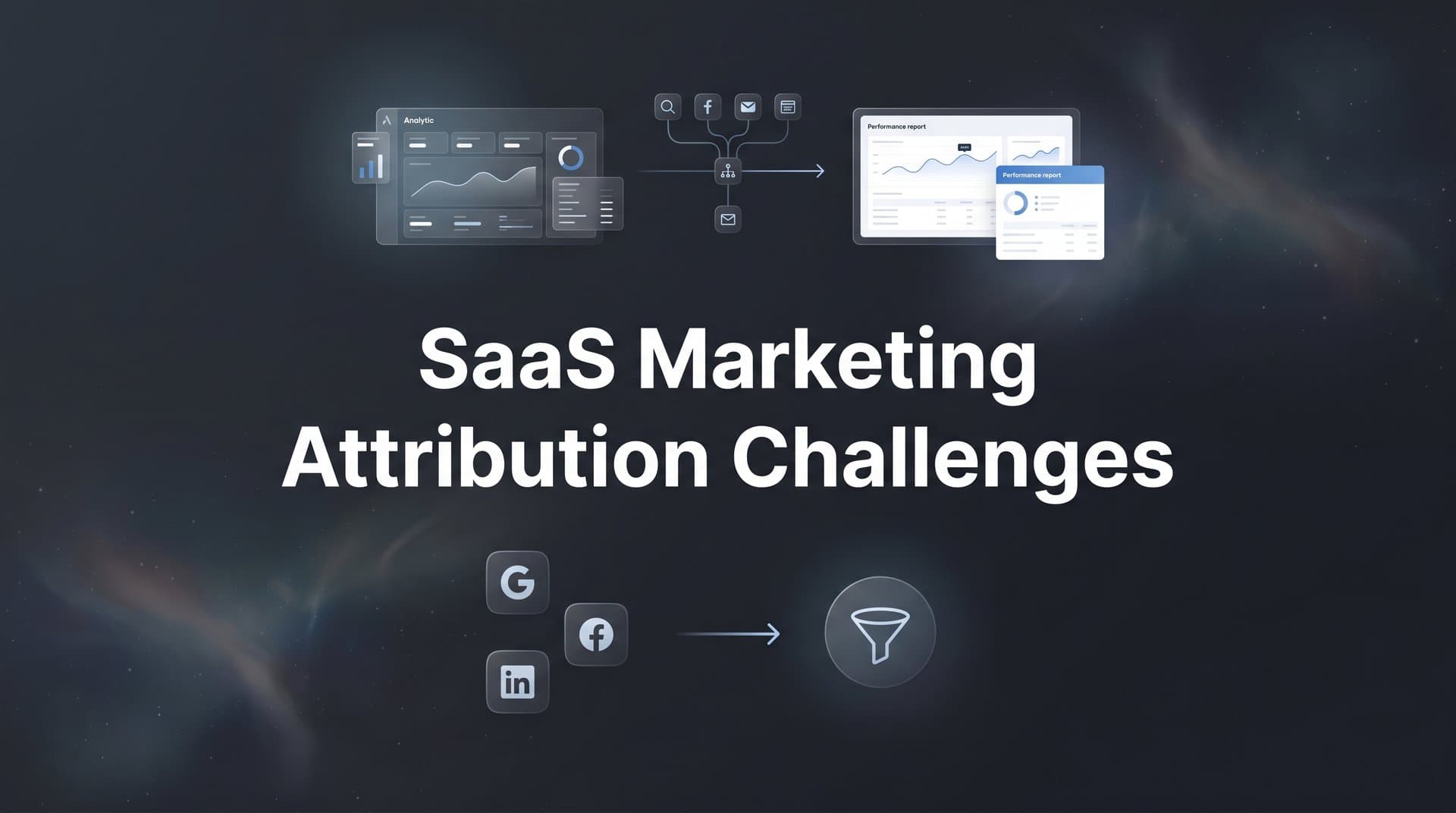
Welcome to the daily reality of SaaS marketing attribution. You are not alone in this frustration, and the problem is not your team's competence. The truth is that SaaS attribution is fundamentally different from tracking e-commerce clicks or lead generation for simple products. Your buyers take weeks or months to decide. They involve multiple stakeholders. They research across devices, platforms, and channels before anyone ever fills out a demo form.
The result? Conflicting reports, fragmented data, and marketing decisions based on incomplete information. This article breaks down exactly why SaaS marketing attribution is so challenging and, more importantly, how to fix it so you can finally answer that CEO question with confidence.
Why SaaS Attribution Breaks Traditional Marketing Models
Traditional marketing attribution was built for simple transactions. Someone sees an ad, clicks, and buys within minutes or hours. The cause-and-effect relationship is clear and immediate.
SaaS does not work that way. Your buyer journey looks more like a marathon than a sprint.
Think about your own customers. They discover your brand through a blog post in March. They download a whitepaper in April. They attend a webinar in May. They finally request a demo in June, and after multiple calls with sales, they close in July. That is four months and dozens of touchpoints across multiple channels and devices.
Single-touch attribution models collapse under this complexity. If you use first-touch attribution, that original blog post gets all the credit even though the webinar and sales calls did the heavy lifting. If you use last-touch attribution, the final retargeting ad takes full credit while ignoring the months of nurturing that built trust and awareness.
The problem gets worse when multiple decision-makers enter the picture. In B2B SaaS purchases, you are rarely selling to one person. The marketing manager discovers you through paid search. The VP of Marketing reads your case studies. The CFO reviews your pricing page. The CEO checks your LinkedIn presence.
Each stakeholder researches independently, often using different devices and browsers. Your marketing director might browse your site on her phone during her commute, then revisit on her work laptop, then share your content from her tablet at home. Traditional cookie-based tracking treats these as three separate users with three separate journeys.
The disconnect between marketing activity and revenue outcomes creates another layer of difficulty. When someone buys a product on an e-commerce site, attribution is straightforward because the purchase happens immediately. In SaaS, marketing generates a lead today, but that lead might not close for 60 or 90 days. By the time revenue hits your books, the connection to the original marketing touchpoints has grown cold in your reporting.
This timing gap makes it nearly impossible to optimize campaigns in real time. You are making budget decisions in April based on leads from February that will not convert until June. You are flying blind, hoping that what worked three months ago still works today. Understanding marketing attribution for SaaS companies requires acknowledging these unique complexities.
The Data Fragmentation Problem Plaguing SaaS Teams
Even if you could track every touchpoint perfectly, you would still face a fundamental problem. Your data lives in silos, and each system counts conversions differently.
Picture this scenario. Your Google Ads dashboard shows 50 conversions this month. Google Analytics reports 45 conversions from the same period. Your CRM says you got 40 new leads. Your sales team closed 8 deals, but only 6 of them are tagged with a source in your CRM.
Which number is correct? All of them and none of them.
Each platform defines conversions based on its own tracking methodology and attribution windows. Google Ads might count a conversion if someone clicked your ad within the last 30 days. Google Analytics attributes the conversion to the last non-direct traffic source. Your CRM only knows what your lead capture form tells it. The result is over-counting, under-counting, and conflicting narratives about what is working.
Privacy changes have turned this data fragmentation into a crisis. Apple's App Tracking Transparency framework, introduced in iOS 14.5, fundamentally changed how tracking works on mobile devices. Users can now block app tracking with a single tap, and most do. Browser makers are following suit, with Safari blocking third-party cookies by default and Chrome planning to phase them out.
These privacy protections are good for users, but they create massive blind spots in your attribution. When someone browses your site on an iPhone, clicks your ad on a desktop, and converts on an iPad, traditional tracking cannot connect these actions to the same person. You lose visibility into the complete journey, and your attribution models start making decisions based on incomplete data. These are among the most common attribution challenges in marketing analytics that teams face today.
The gap between marketing and sales teams amplifies these problems. Marketing tools track digital interactions—ad clicks, website visits, content downloads. Sales tools track human interactions—calls, demos, email exchanges, deal stages. These two data sets rarely sync properly.
Your marketing automation platform might show that a lead engaged with three email campaigns before requesting a demo. But if that engagement data never flows into your CRM, your sales team has no context. When the deal closes weeks later, the CRM attributes the win to the demo request without acknowledging the marketing touchpoints that made that demo possible.
This disconnect is not just a reporting annoyance. It prevents you from understanding which marketing activities actually drive revenue. You cannot optimize what you cannot measure accurately.
Choosing the Right Attribution Model for Long Sales Cycles
Understanding the problem is one thing. Fixing it requires choosing an attribution model that matches the reality of SaaS buying behavior.
First-touch attribution is seductive in its simplicity. It gives all credit to the channel that introduced someone to your brand. If a prospect discovered you through a blog post, that blog post gets 100% credit for any eventual conversion.
This approach overvalues top-of-funnel content while completely ignoring everything that happens afterward. That prospect might have read ten more articles, watched three webinars, and downloaded two case studies before converting. First-touch attribution pretends none of that nurturing mattered. It tells you to pour more budget into awareness campaigns even when your real problem is converting interested prospects into customers.
Last-touch attribution makes the opposite mistake. It assigns all credit to the final interaction before conversion. If someone requests a demo after clicking a retargeting ad, that ad gets full credit even if the prospect has been researching your product for months.
This model makes bottom-of-funnel tactics look like magic while hiding the campaigns that built awareness and trust. You might conclude that retargeting ads are your best channel and shift budget accordingly, not realizing that those ads only work because of the content marketing and paid search campaigns that introduced prospects to your brand in the first place.
Multi-touch attribution models attempt to solve this by distributing credit across multiple touchpoints. Linear attribution gives equal credit to every interaction. Time-decay attribution gives more weight to recent touchpoints. Position-based attribution emphasizes the first and last interactions while giving some credit to middle touches. Implementing the right SaaS marketing attribution strategy is essential for accurate measurement.
These models offer a more nuanced view of the customer journey, but they come with their own challenges. Multi-touch attribution only works if you can actually track all the touchpoints in the first place. With privacy changes creating tracking gaps and data living in separate systems, you might be distributing credit across an incomplete picture of the journey.
The most sophisticated approach is data-driven attribution, which uses machine learning to analyze patterns in your conversion data and assign credit based on which touchpoints statistically correlate with conversions. This sounds ideal, but it requires massive amounts of clean, connected data to work properly. Most SaaS companies do not have the data infrastructure to support it.
The right attribution model for your SaaS business depends on your sales cycle length, deal complexity, and data quality. But regardless of which model you choose, it will only be as accurate as the underlying data you feed it.
Server-Side Tracking: The Foundation of Accurate Attribution
The fundamental problem with traditional attribution is that it relies on browser-based tracking, and browsers are increasingly hostile to tracking technologies.
Client-side tracking works by dropping cookies and JavaScript tags on a visitor's browser. When someone clicks your ad, a cookie gets set. When they visit your site, JavaScript fires and sends data to your analytics platform. When they convert, another piece of code connects the conversion back to the original ad click.
This system breaks down in multiple ways. Ad blockers prevent tracking scripts from loading. Privacy features in Safari and Firefox block third-party cookies. Users who switch devices or clear their cookies become invisible. The tracking chain breaks, and attribution data becomes unreliable.
Server-side tracking solves this by capturing conversion events directly from your own systems rather than relying on browser behavior. Instead of hoping a JavaScript tag fires correctly in someone's browser, you send conversion data from your server to your ad platforms and analytics tools. Proper SaaS marketing attribution tracking depends on this foundational shift.
Here is how it works in practice. When someone fills out a demo form on your site, your server records that conversion. When they show up for the demo, your CRM logs that event. When they become a paying customer, your billing system captures that transaction. Server-side tracking takes these events from your systems and sends them to your ad platforms with all the relevant context intact.
This approach bypasses browser limitations entirely. It does not matter if someone uses an ad blocker or switches devices. Your server knows what happened because it happened in your own systems, and you are sending that data directly to the platforms that need it.
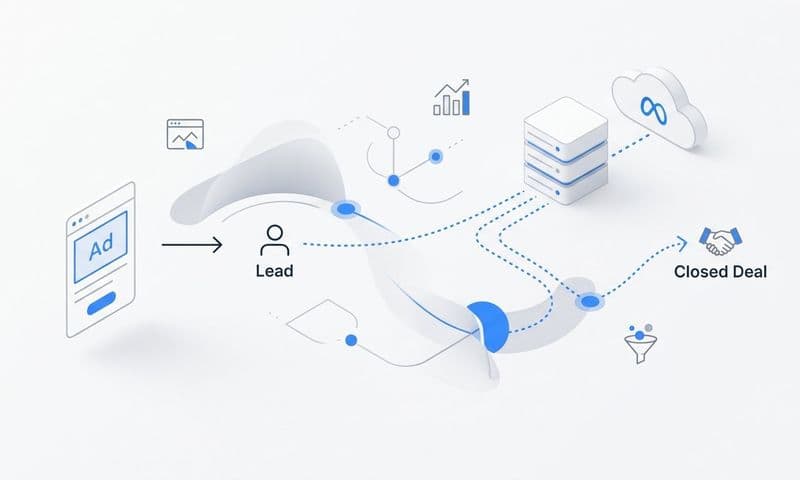
The real power of server-side tracking becomes clear when you connect CRM events to ad platforms. Instead of optimizing for form fills or demo requests, you can send closed deal data back to Google Ads, Meta, and LinkedIn. Their algorithms can then optimize for actual revenue rather than proxy metrics.
Think about the difference this makes. With client-side tracking, your ad platforms optimize for getting people to fill out forms. They have no idea which of those form fills turned into customers. With server-side tracking feeding closed deal data, the platforms learn which types of users actually convert to revenue. They adjust targeting accordingly, reducing wasted spend on leads that look good but never close.
Server-side tracking also solves the data fragmentation problem. When conversion events flow from a single source of truth—your own systems—rather than being captured separately by multiple browser-based tools, you eliminate the discrepancies and over-counting that plague traditional attribution.
Building an Attribution System That Actually Works
Understanding the challenges and solutions is valuable, but implementation is where most SaaS teams struggle. Building accurate attribution requires a systematic approach.
Start by mapping your complete customer journey from first touch through closed deal. Document every trackable touchpoint. This includes obvious ones like ad clicks and website visits, but also less obvious interactions like email opens, webinar attendance, sales calls, and product demos.
Be honest about gaps in your current tracking. Where do people fall off your radar? What happens between the demo request and the closed deal? Which stakeholders might be researching without identifying themselves? Understanding these blind spots helps you prioritize what to fix first. Following SaaS marketing attribution best practices will guide your implementation.
Next, implement unified tracking that connects all these touchpoints. This means breaking down data silos between your marketing automation platform, CRM, ad platforms, and analytics tools. Events that happen in one system need to flow to the others with consistent user identifiers.
The technical implementation typically involves setting up server-side tracking infrastructure that can receive events from multiple sources and route them to the appropriate destinations. This might sound complex, but modern marketing attribution SaaS platforms handle much of this complexity for you.
Once unified tracking is in place, focus on feeding enriched conversion data back to your ad platforms. Do not just tell Google Ads that someone filled out a form. Tell it when that lead became a sales qualified lead, when they had their demo, when they entered contract negotiation, and when they closed. Send revenue data so the platform understands the actual value of each conversion.
This enriched data transforms how ad platforms optimize your campaigns. Instead of optimizing for cheap clicks or form fills, they optimize for the user behaviors that actually predict revenue. Your cost per acquisition might go up, but your cost per closed customer often drops significantly because you are targeting better-fit prospects.
Finally, establish a regular cadence for reviewing attribution data across your team. Marketing and sales should look at the same reports and agree on what the data means. When discrepancies appear, investigate them together rather than letting each team trust their own silo.
This collaborative approach prevents the common scenario where marketing celebrates lead volume while sales complains about lead quality. When both teams can see which marketing touchpoints correlate with closed deals, they can align on strategies that drive actual revenue.
Putting It All Together: From Confusion to Clarity
SaaS marketing attribution is challenging because SaaS buying behavior is complex. Long sales cycles, multiple decision-makers, and privacy changes have broken traditional attribution models. Data fragmentation across tools creates conflicting reports that make confident decision-making nearly impossible.
The solution is not a single tactic but a systematic approach. You need attribution models that match your sales cycle complexity. You need server-side tracking to bypass browser limitations. You need unified data that connects marketing touchpoints to revenue outcomes. You need enriched conversion data flowing back to ad platforms so their algorithms optimize for what actually matters.
When you solve attribution, you gain a significant competitive advantage. While competitors guess which campaigns work, you know. While they waste budget on channels that generate leads but not revenue, you double down on what actually closes deals. While they argue about credit between marketing and sales, your teams align around shared data.
The marketers who master attribution are the ones who scale efficiently. They cut underperforming campaigns with confidence. They increase budgets on winners without fear. They prove marketing's impact on revenue in terms the C-suite understands.
Moving Forward: Your Path to Attribution Clarity
Solving SaaS marketing attribution challenges is not just about better reporting. It is about making smarter decisions that drive predictable growth. When you can connect every touchpoint to revenue, you stop guessing and start scaling with confidence.
The difference between marketing teams that struggle with attribution and those that master it comes down to infrastructure. You need systems that capture the complete customer journey, connect data across platforms, and feed insights back to the tools that optimize your campaigns.
Cometly connects every touchpoint to revenue, giving SaaS teams the clarity they need to make confident decisions. From ad clicks to CRM events, Cometly tracks it all and provides AI-driven recommendations to identify high-performing campaigns across every channel. With server-side tracking and conversion sync, you can feed enriched data back to Meta, Google, and other platforms to improve targeting and reduce wasted spend.
Ready to elevate your marketing game with precision and confidence? Discover how Cometly's AI-driven recommendations can transform your ad strategy. Get your free demo today and start capturing every touchpoint to maximize your conversions.