

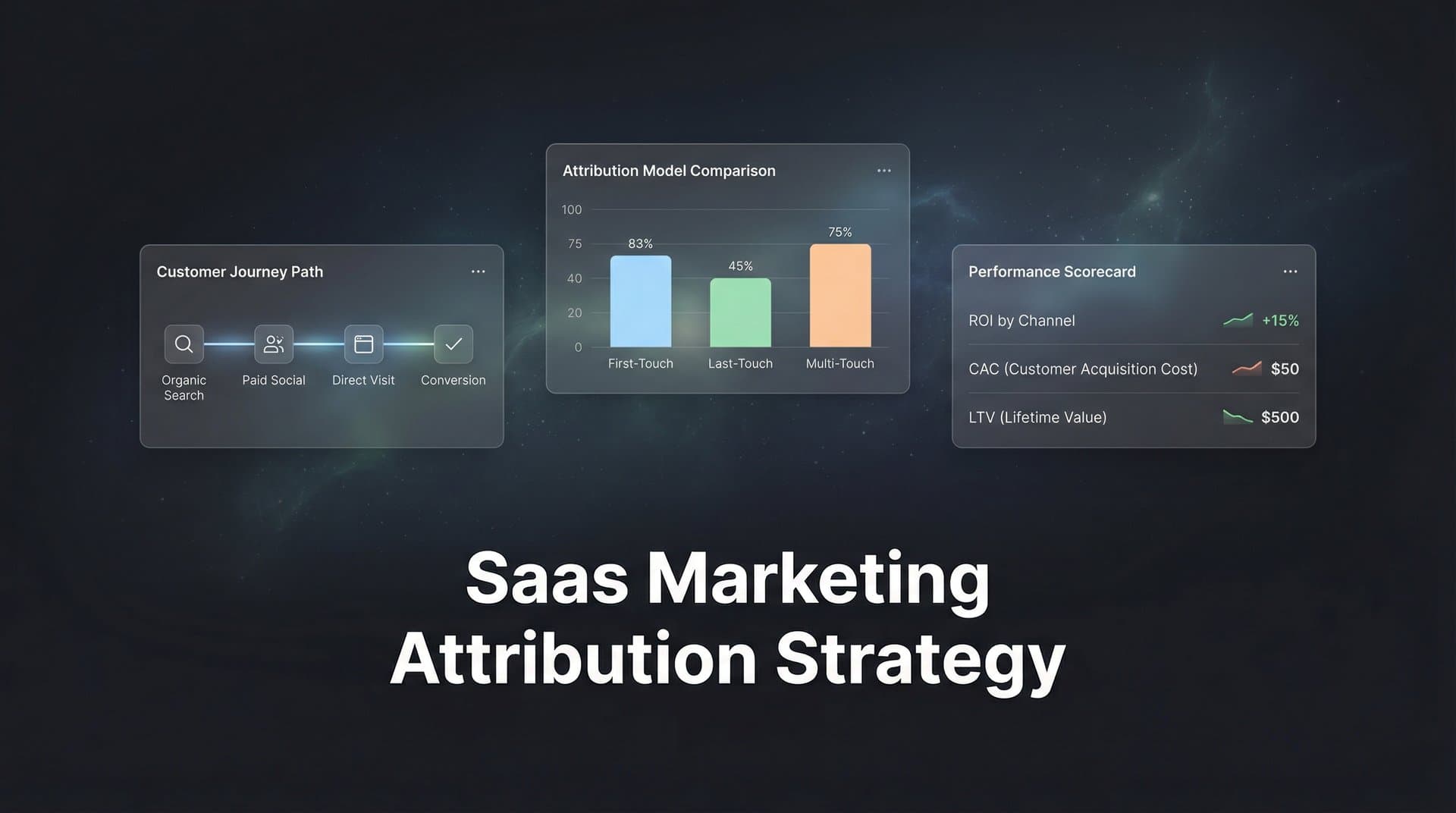
You're spending thousands on ads every month. Your dashboard shows clicks, impressions, and form fills trending upward. But when you sit down with your CFO to justify the marketing budget, you hit a wall. Which campaigns actually drove revenue? Which channels brought in customers who stayed and expanded? You're looking at a sea of metrics that don't connect to the number that matters most: recurring revenue.
This is the attribution gap that haunts SaaS marketers. Unlike ecommerce, where a click leads to a purchase within hours, your prospects spend weeks researching, comparing alternatives, attending demos, and looping in decision-makers. They bounce between devices. They engage with multiple channels. And by the time they convert to paying customers, the trail back to your original marketing touchpoint has gone cold.
The platforms you advertise on report conversions, but those conversions represent trial signups or demo requests, not closed deals. Your CRM shows which accounts became customers, but it can't tell you which Facebook ad or LinkedIn campaign started the journey. This disconnect isn't just frustrating. It's expensive. You're making budget decisions based on incomplete data, potentially cutting channels that drive revenue while doubling down on sources that generate clicks but not customers.
Building an effective SaaS marketing attribution strategy means connecting every touchpoint in the customer journey to actual revenue outcomes. It means understanding which channels deserve credit when a prospect takes six weeks, visits your site nine times, and engages with three different campaigns before buying. And it means giving your ad platforms the enriched data they need to optimize for real business results, not just surface-level actions.
Why SaaS Attribution Demands a Different Playbook
If you're applying the same attribution approach that works for ecommerce to your SaaS business, you're working with a broken compass. The fundamental dynamics are completely different.
Consider a typical ecommerce transaction. Someone sees an ad, clicks through, browses for fifteen minutes, and checks out. The entire journey happens in one session, often on one device. Attribution is relatively straightforward because cause and effect sit close together in time.
Now consider your SaaS buying journey. A marketing manager sees your LinkedIn ad and visits your site during her morning coffee. She doesn't convert. Three days later, she searches your brand name on Google and reads a comparison article. Still no conversion. A week after that, she attends your webinar. Two weeks later, she fills out a demo request form. The demo happens. Then there's an evaluation period. Her VP gets involved. They review case studies. Eventually, six weeks after that first LinkedIn impression, they become a paying customer.
Last-click attribution would give all the credit to whatever touchpoint happened right before the demo request. But that ignores the LinkedIn ad that created initial awareness, the organic search that built trust, and the webinar that moved them from consideration to evaluation. Each touchpoint played a role, but single-touch models can't see the full picture.
The problem gets worse when you factor in multiple stakeholders. In B2B SaaS, purchase decisions rarely involve just one person. The marketing manager who first discovered you isn't the same person who approved the budget. Different people engage with different channels at different stages. Your attribution system needs to track all of them and understand how they collectively move an account toward conversion.
Then there's the metrics mismatch. Ad platforms optimize for the conversions they can measure. Facebook celebrates when someone fills out your lead form. Google Ads counts a demo request as a win. But you don't get paid when someone requests a demo. You get paid when they become a customer and stay a customer. If you're optimizing campaigns based on demo requests without knowing which demos convert to revenue, you're flying blind. This is why marketing attribution for SaaS requires a fundamentally different approach than traditional tracking methods.
Privacy changes have made this challenge even more complex. iOS restrictions limit how long platforms can track users. Browser changes restrict third-party cookies. Ad blockers prevent pixels from firing. The data you're basing decisions on is increasingly incomplete, and platform-reported conversions often miss significant portions of your actual results.
SaaS companies need attribution strategies built for long sales cycles, multiple touchpoints, cross-device behavior, and the critical connection between marketing activity and recurring revenue. Anything less leaves you guessing about what's actually working.
The Foundation: What Every Attribution Strategy Must Include
Building effective attribution starts with getting three core components right. Miss any of these, and your entire strategy sits on shaky ground.
Unified First-Party Data Collection
You need a single source of truth that captures every interaction a prospect has with your brand. This means connecting data from ad platforms, your website, your CRM, and any other tools in your marketing stack. When these systems operate in isolation, you see fragments of the customer journey but never the complete picture.
First-party data collection has become non-negotiable as third-party tracking erodes. You need to own the relationship with your data. This means implementing tracking that captures visitor behavior on your site, connects it to ad clicks from your campaigns, and follows prospects all the way through to CRM records and closed deals. The technical implementation matters here because gaps in your data collection create blind spots in your attribution. Implementing robust SaaS marketing attribution tracking ensures you capture every meaningful interaction.
Attribution Model Selection
Different attribution models answer different strategic questions. First-touch attribution tells you which channels are best at generating initial awareness. Last-touch shows you what closes deals. Linear attribution spreads credit evenly across all touchpoints. Data-driven models use algorithms to assign credit based on which touchpoints statistically correlate with conversions.
The mistake most SaaS companies make is picking one model and treating it as gospel. The real insight comes from comparing multiple models side by side. When first-touch and last-touch attribution radically disagree about which channel deserves credit, that discrepancy reveals something important about your funnel. Maybe your content marketing generates awareness but doesn't close deals. Maybe your retargeting campaigns get last-click credit but only work because other channels did the heavy lifting earlier.
You need the flexibility to view your data through different lenses. Each model highlights different aspects of performance. Together, they give you a dimensional understanding of what's working.
Revenue Connection
This is where most attribution systems fail SaaS companies. They track marketing activity and they track conversions, but they don't connect those conversions to actual revenue outcomes.
You need attribution that follows prospects beyond the initial conversion. When someone requests a demo, your system should track whether that demo led to a closed deal. When someone starts a trial, you need to know if they converted to paid. And critically, you need to understand not just whether they became a customer, but what their lifetime value turned out to be. Understanding marketing attribution platforms revenue tracking capabilities is essential for connecting marketing spend to actual business outcomes.
A channel that drives high-volume trial signups might look amazing in your dashboard. But if those trials convert to paid at half the rate of trials from other channels, and the customers who do convert churn faster, that channel isn't performing as well as it appears. Revenue connection reveals the truth.
This requires tight integration between your marketing attribution platform and your CRM or revenue system. The data needs to flow both ways. Marketing data enriches your CRM records so you know which campaigns influenced each account. Revenue data flows back to your attribution platform so you can analyze performance based on actual business outcomes, not just marketing metrics.
Building the Tech Stack That Makes Attribution Possible
The right technology foundation determines whether your attribution strategy produces actionable insights or just more confusing data. Three technical capabilities separate systems that work from systems that disappoint.
Server-Side Tracking for Complete Data Capture
Client-side tracking, the traditional approach where JavaScript pixels fire in users' browsers, is increasingly unreliable. Ad blockers strip out tracking scripts. Safari's Intelligent Tracking Prevention limits cookie lifespans. iOS restrictions prevent platforms from tracking users across apps and websites. If you're relying solely on client-side pixels, you're missing a significant percentage of your conversions.
Server-side tracking solves this by sending conversion data directly from your server to ad platforms, bypassing browser restrictions entirely. When someone converts on your site, your server communicates that event to Facebook, Google, and other platforms without depending on cookies or pixels that might be blocked.
This approach captures conversions that client-side tracking misses, giving you more complete data and giving ad platforms better information to optimize with. The improvement in data accuracy can be substantial, particularly for iOS traffic where client-side tracking has become severely limited. Choosing the right marketing attribution SaaS platform with server-side capabilities is crucial for accurate data collection.
Deep CRM Integration
Your CRM holds the revenue data that makes SaaS attribution meaningful. Integration needs to go beyond basic lead sync. You need bi-directional data flow that enriches both systems.
When a prospect fills out a form on your website, your attribution system should capture which ads they clicked, which pages they visited, and which campaigns they engaged with. This enriched data flows into your CRM, giving your sales team context about how this lead discovered you and what they're interested in.
When that lead becomes an opportunity and eventually closes as a customer, that revenue data needs to flow back to your attribution platform. Now you can analyze which marketing channels and campaigns drove that specific deal. As the customer relationship continues, expansion revenue and churn data should also feed back, letting you calculate true lifetime value by acquisition channel.
This closed loop between marketing attribution and CRM data transforms how you evaluate performance. You stop optimizing for vanity metrics and start optimizing for the metrics that actually matter to your business.
Conversion Sync Capabilities
Here's where attribution becomes proactive rather than just analytical. The best attribution systems don't just track conversions, they send enriched conversion data back to your ad platforms to improve their optimization algorithms.
Think about what happens when you run Facebook ads optimized for lead generation. Facebook's algorithm learns which users are most likely to fill out your form, and it shows your ads to more people like them. But Facebook doesn't know which of those leads became customers. It's optimizing for form fills, not revenue.
Conversion sync lets you send customer conversion events back to Facebook. Now Facebook knows which leads turned into paying customers, and it can optimize for that outcome instead. The algorithm gets smarter. Your targeting improves. Your cost per acquisition for actual customers decreases.
This creates a virtuous cycle. Better data leads to better targeting, which leads to higher-quality leads, which leads to more customers. The gap between what ad platforms optimize for and what you actually care about narrows significantly.
Selecting Attribution Models That Match Your Business
Attribution models aren't one-size-fits-all. The right model depends on your sales cycle, your marketing mix, and the strategic questions you're trying to answer. Understanding when to use each model turns attribution from a reporting exercise into a strategic advantage.
First-Touch Attribution: Understanding Awareness Drivers
First-touch attribution gives all credit to the first interaction a prospect has with your brand. This model excels at answering one specific question: which channels are best at generating initial awareness and getting new prospects into your funnel?
If you're launching a new product or entering a new market, first-touch attribution helps you understand which channels effectively reach cold audiences. It reveals which campaigns successfully introduce your brand to people who've never heard of you before. This matters because awareness campaigns serve a different purpose than conversion campaigns, and they should be evaluated differently.
The limitation is obvious. First-touch ignores everything that happens after initial awareness. A channel might be excellent at generating awareness but terrible at driving conversions. First-touch attribution can't tell you that. Use this model to evaluate top-of-funnel performance, but never in isolation.
Multi-Touch Attribution: Seeing the Complete Journey
For most SaaS companies with complex B2B sales cycles, multi-touch attribution provides the most accurate picture of reality. These models distribute credit across multiple touchpoints, acknowledging that conversions result from cumulative exposure rather than single interactions. Our multi-touch marketing attribution platform guide explains how these models work in practice.
Linear attribution spreads credit evenly across all touchpoints. If a prospect engaged with five different campaigns before converting, each campaign gets 20% of the credit. This model works well when you believe all touchpoints contribute roughly equally to the outcome.
Time-decay attribution gives more credit to recent touchpoints, based on the assumption that interactions closer to conversion matter more. This makes sense for businesses where recent engagement strongly predicts purchase intent.
Position-based attribution (also called U-shaped) gives more credit to the first and last touchpoints, with remaining credit distributed among middle interactions. This model works when you believe awareness and closing touchpoints matter most, with nurturing touchpoints playing a supporting role.
Data-driven attribution uses machine learning to analyze your actual conversion patterns and assign credit based on statistical correlation. This approach adapts to your specific business rather than applying generic assumptions. As your marketing mix evolves, the model evolves with it.
Comparing Models to Uncover Hidden Insights
The real power comes from comparing multiple attribution models simultaneously. When different models tell dramatically different stories about channel performance, pay attention. Those discrepancies reveal important truths about your funnel.
Imagine your content marketing gets 40% credit under first-touch attribution but only 10% under last-touch. This tells you content is excellent at generating awareness but rarely closes deals on its own. That's valuable information. It means content marketing deserves continued investment for top-of-funnel, but you need other channels to convert those prospects.
Conversely, if your retargeting campaigns get 35% credit under last-touch but only 5% under first-touch, they're getting final-click credit for conversions that other channels initiated. Retargeting is working, but it's dependent on other channels filling the top of your funnel. Cut those awareness channels and your retargeting performance collapses.
Comparing models helps you understand not just which channels perform well, but why they perform well and how they interact with each other. This nuanced understanding leads to smarter budget allocation and better strategic decisions.
From Data to Decisions: Making Attribution Actionable
Attribution data only creates value when it changes your decisions. The goal isn't perfect measurement. The goal is making better choices about where to invest your marketing budget and how to optimize your campaigns.
Identifying Undervalued Channels
Last-click attribution systematically undervalues channels that contribute early in the customer journey. Your content marketing, organic social, and awareness campaigns generate initial interest, but they rarely get credit because prospects don't convert immediately after engaging with them.
Multi-touch attribution reveals these hidden contributors. You might discover that prospects who engage with your educational content early in their journey convert at twice the rate of prospects who don't, even though that content never gets last-click credit. This insight changes how you evaluate content ROI.
Similarly, you might find that certain channels contribute to higher lifetime value even if their immediate conversion rates look average. Customers acquired through organic search might have 30% higher retention than customers from paid social. That difference in LTV should inform your budget allocation, but you'll only see it if your attribution connects to revenue outcomes. Using SaaS marketing analytics tools helps surface these insights that traditional reporting misses.
Reallocating Budget Based on True Revenue Contribution
Platform-reported metrics optimize for what platforms can measure, not what drives revenue. Facebook might report a cost per lead of $50 while Google reports $75. Based on that data, you'd shift budget to Facebook. But if Facebook leads convert to customers at 2% while Google leads convert at 6%, Google is actually delivering better ROI despite the higher cost per lead.
Revenue-connected attribution lets you calculate true customer acquisition cost by channel. You can compare cost per customer, not just cost per lead. You can factor in lifetime value to understand which channels bring customers who stay and expand. These metrics tell you where to invest for business growth, not just marketing metrics.
Budget reallocation based on attribution insights typically happens incrementally. You don't slash a channel's budget by 50% overnight. You test adjustments, monitor results, and refine. But over time, this data-driven approach to budget allocation compounds into significant performance improvements.
Scaling Winners with AI-Powered Recommendations
Modern attribution platforms go beyond reporting what happened. They use AI to identify patterns in your data and recommend specific optimizations. The AI analyzes thousands of data points across your campaigns to surface opportunities you might miss. The best AI-powered marketing attribution tools can identify optimization opportunities that would take humans weeks to discover.
These recommendations might highlight specific ad creatives that drive disproportionate revenue, audiences that convert at above-average rates, or budget allocation adjustments that could improve overall ROI. The AI spots patterns across your entire marketing mix, connecting dots that would be impossible to see manually.
This is particularly valuable as your marketing complexity grows. When you're running campaigns across six platforms with dozens of ad sets and hundreds of creatives, human analysis can't keep up. AI processes all that data continuously, flagging opportunities and risks in real time.
The key is acting on these recommendations quickly. AI-powered insights create competitive advantage only when you implement them faster than competitors. The platforms that combine attribution data with actionable AI recommendations turn measurement into a continuous optimization engine.
Implementation: Building Your Attribution Strategy Step by Step
The path from attribution chaos to attribution clarity doesn't require a complete overhaul of your marketing stack. Start with an honest assessment of where you are, then build systematically toward where you need to be.
Audit Your Current Tracking
Begin by documenting what you're tracking today and where the gaps exist. Can you connect ad clicks to website sessions? Do those sessions link to CRM records? Can you track a prospect from first touchpoint through to closed customer? Most companies discover significant gaps in this exercise. Understanding common attribution challenges in marketing analytics helps you identify where your current setup falls short.
Test your tracking by going through the conversion process yourself. Click an ad, fill out a form, and see if that data flows correctly through your systems. Check whether conversions are being attributed to the right sources. Verify that your CRM is receiving enriched data from your marketing tools. These practical tests reveal issues that spreadsheets miss.
Assess data quality as well as data completeness. Are you tracking UTM parameters consistently across campaigns? Is your CRM data clean enough to analyze? Do you have a system for deduplicating records? Poor data quality undermines even the best attribution strategy.
Implement Incrementally
Don't try to implement perfect attribution across every channel simultaneously. Start with your highest-volume channels and most important conversion paths. Get those working correctly, then expand.
If you're running significant spend on Facebook and Google, prioritize getting accurate attribution for those platforms first. Implement server-side tracking to improve data accuracy. Set up conversion sync to feed better data back to the platforms. Verify that conversions are being tracked and attributed correctly.
Once your core channels are working, expand to secondary channels. Add LinkedIn, email marketing, organic search, and other touchpoints to your attribution system. Each addition gives you a more complete picture, but trying to do everything at once usually results in nothing working well. Evaluating SaaS marketing attribution solutions can help you find the right fit for your specific needs.
Integration with your CRM often represents the biggest technical lift. Plan for this carefully. Map out which data fields need to sync in both directions. Test thoroughly before going live. The CRM integration unlocks revenue-based attribution, making it worth the implementation effort.
Review and Refine Quarterly
Attribution isn't a set-it-and-forget-it system. Your marketing mix evolves. You launch new campaigns, test new channels, and adjust your strategy. Your attribution approach needs to evolve with it.
Schedule quarterly reviews of your attribution models and assumptions. Are you still using the right models for your current business? Have new channels become significant enough to warrant deeper analysis? Are there patterns in the data that suggest adjustments to your strategy?
Compare your attribution insights to actual business outcomes. Did the channels that attribution identified as high-performers actually drive the revenue growth you expected? When attribution data and business results diverge, investigate why. Sometimes the issue is with the attribution model. Sometimes it reveals factors outside of marketing that influence conversion rates.
Use these reviews to refine your approach continuously. Attribution strategy isn't about achieving perfection. It's about making progressively better decisions based on progressively better data.
Turning Attribution Into Your Competitive Advantage
Perfect attribution is a myth. Customer journeys are messy. Data has gaps. Attribution models make assumptions. But the goal was never perfection. The goal is making better decisions than you made before, and better decisions than your competitors are making now.
Companies that connect their marketing touchpoints to actual revenue outcomes operate with a clarity that their competitors lack. They know which channels drive customers who stay and expand. They can confidently invest in strategies that look expensive on surface metrics but deliver superior lifetime value. They feed their ad platforms better data, creating a compounding advantage as algorithms optimize for real business results.
This clarity transforms marketing from a cost center defending its budget to a growth engine with proven ROI. When you can show exactly how marketing spend connects to recurring revenue, budget conversations change. You're not asking for resources. You're showing where to invest for growth.
The technical implementation matters, but the strategic mindset matters more. Attribution isn't about tracking everything perfectly. It's about understanding your customer journey well enough to make smarter decisions. It's about connecting marketing activity to business outcomes so you can scale what works and cut what doesn't.
Start where you are. Audit your current tracking. Identify the biggest gaps. Implement systematically, focusing on your highest-impact channels first. Compare attribution models to uncover insights that any single model would miss. Connect everything to revenue so you're optimizing for outcomes that matter.
The SaaS companies winning in their markets aren't the ones with the biggest marketing budgets. They're the ones who know exactly which marketing investments drive revenue and have the attribution infrastructure to prove it. That knowledge, applied consistently, compounds into a sustainable competitive advantage.
Ready to elevate your marketing game with precision and confidence? Discover how Cometly's AI-driven recommendations can transform your ad strategy. Get your free demo today and start capturing every touchpoint to maximize your conversions.



