B2B SaaS marketing is a puzzle with a lot of missing pieces. You run paid campaigns, publish content, host webinars, and your sales team works through a pipeline that stretches across weeks or months. Somewhere in that process, deals close. But which efforts actually drove those wins? That question keeps a lot of marketing leaders up at night.
The challenge is structural. Unlike B2C, where a customer might see an ad and buy within minutes, B2B SaaS conversions unfold across a long, winding journey. Multiple stakeholders weigh in, prospects disappear and resurface, and the gap between a first ad click and a signed contract can span an entire quarter. Traditional analytics tools were not built for this reality.
B2B SaaS conversion analytics is the practice of tracking and analyzing every meaningful action a prospect takes from first touch to closed deal. It is not just about knowing how many leads came in last month. It is about understanding which campaigns influenced pipeline, which funnel stages are leaking, and how to connect marketing spend directly to revenue outcomes. When done well, it transforms guesswork into a repeatable growth system.
This article breaks down what to measure, how to build the right tracking infrastructure, and how to turn raw conversion data into decisions that actually grow your business.
Why B2B SaaS Funnels Demand a Different Analytics Approach
Most analytics frameworks were designed with simpler conversion paths in mind. Someone sees an ad, clicks, buys, done. B2B SaaS does not work that way, and trying to force it into that model leads to bad decisions.
Consider the typical enterprise deal. A junior team member might discover your product through a LinkedIn ad. They share it with a manager who reads three blog posts over the next two weeks. The manager books a demo. The demo leads to a security review, a pricing negotiation, and eventually a contract signed by someone who never saw your ad at all. That is not one conversion. That is a chain of conversions across multiple people, channels, and time periods.
Sales cycles in B2B SaaS commonly run 30 to 90 days or longer, depending on deal size and company complexity. Enterprise deals often involve many stakeholders, each with different concerns and decision criteria. This means the marketing-to-revenue connection is never a straight line, which is why revenue attribution for B2B SaaS requires purpose-built approaches.
Then there is the dark funnel problem. A significant portion of B2B buying activity happens in places you simply cannot track. Prospects research your product in Slack communities, listen to podcasts where a peer mentioned your name, read review sites, and have informal conversations at industry events. By the time they fill out your demo request form, they have already done substantial research that you have no visibility into. This means your tracked funnel is always a partial picture.
Platform-reported metrics make this problem worse. When Meta or Google Ads reports a conversion, it is typically based on a pixel fire within a 7 to 28 day attribution window. But if your average sales cycle is 60 days, the platform is only seeing a fraction of the journey. Cookie limitations and cross-device behavior further distort the data. A prospect might click an ad on their phone, research on a work laptop, and convert on a desktop. Each of those devices looks like a separate user to most tracking systems, a problem explored in depth in discussions about unreliable marketing analytics data.
The result is that platform dashboards routinely overcount or misattribute conversions in B2B contexts. Marketers who rely on these numbers alone end up optimizing for metrics that do not reflect actual revenue. Building a conversion analytics approach designed specifically for B2B SaaS means acknowledging these realities and building systems that account for them.
The Metrics That Actually Matter for B2B SaaS Conversions
Not all conversion metrics are created equal. Some tell you a lot about funnel health. Others just make your reports look busy. Knowing which numbers to focus on at each stage of the funnel is what separates effective analytics from noise.
At the top of the funnel, your visitor-to-lead rate tells you how well your traffic converts into known prospects. If this rate is low, the issue is usually a mismatch between who you are attracting and what you are offering. Moving down the funnel, your lead-to-MQL rate reveals how many of those leads meet the criteria your marketing team has defined as worthy of sales attention. A low rate here often signals traffic quality issues or a misaligned ICP definition.
The MQL-to-SQL rate is where marketing and sales alignment becomes visible in the data. If marketing is passing a high volume of MQLs but sales is only accepting a small fraction, something is off in how the two teams define a qualified lead. The SQL-to-opportunity rate then shows how many accepted leads actually enter active sales conversations. And finally, your opportunity-to-closed-won rate reflects sales effectiveness and product-market fit.
Each of these ratios is a diagnostic tool. When one drops, it points you toward a specific part of the funnel that needs attention. For a deeper dive into which numbers deserve your focus, see this guide on essential metrics every SaaS company should track.
Beyond funnel conversion rates, revenue-focused metrics are essential for B2B SaaS teams that want to optimize for outcomes rather than volume. Customer acquisition cost (CAC) tells you what you are spending to win each new customer. Pipeline velocity measures how quickly deals move through your funnel, which directly affects cash flow and forecasting. Average deal size and lifetime value (LTV) help you understand which customer segments are worth prioritizing in your marketing spend.
Tracking conversions without connecting them to revenue is one of the most common mistakes in B2B marketing. It leads teams to celebrate a record month of MQLs while revenue stays flat. The goal is always to trace a clear line from marketing activity to dollars in the door.
One often-overlooked element is cohort analysis and time-lag reporting. A campaign you launched in January might not produce closed revenue until March or April. If your dashboard only shows real-time data, you will consistently undervalue campaigns that drive long-cycle deals. Cohort analysis groups leads by the period they entered the funnel and tracks their progression over time, giving you a much more accurate picture of campaign performance once the full sales cycle has played out.
Setting Up a Conversion Tracking Stack That Captures the Full Journey
Good conversion analytics starts with good infrastructure. Without the right tracking setup, your data will always have gaps that lead to flawed conclusions.
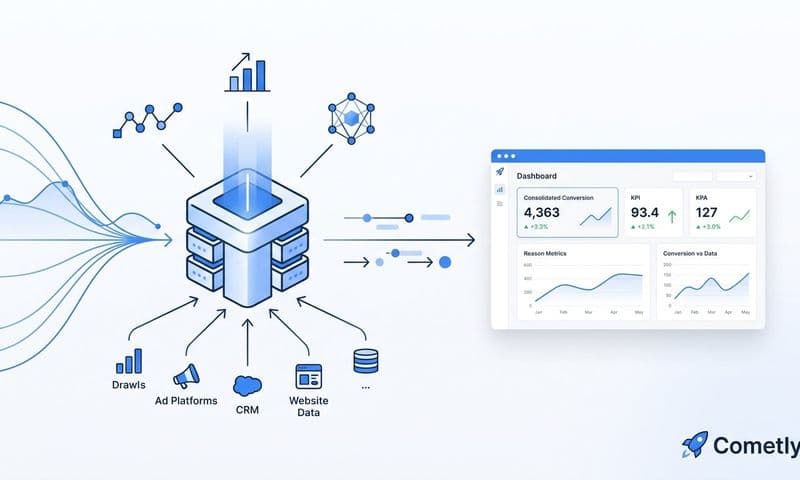
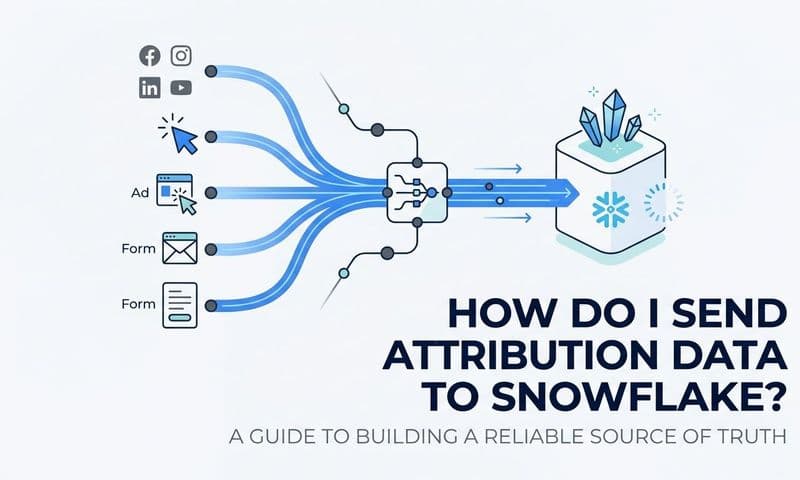
The foundation is connecting your ad platforms, website, and CRM into a unified system. When these three data sources talk to each other, you can trace a prospect's journey from their first ad impression through every website interaction and into the sales pipeline. Without this connection, you are working with silos: marketing knows about clicks and leads, sales knows about pipeline and deals, but no one has the full picture.
Server-side tracking has become increasingly important for B2B SaaS teams. Traditional client-side tracking relies on JavaScript pixels running in the user's browser. As privacy restrictions have tightened and ad blockers have become more common, these pixels miss a growing percentage of events. Implementing server-side conversion tracking sends data directly from your server to the analytics and ad platforms, bypassing browser-level blocking and providing more complete, accurate data. For B2B teams where every conversion event is valuable, this improvement in data quality has a meaningful impact on optimization decisions.
Defining your conversion events clearly is the next critical step. You need to configure tracking for every meaningful action in the funnel: page visits on high-intent pages, form fills, demo bookings, trial starts, and ultimately deal closures from your CRM. Each of these events should be tagged and passed to your analytics system with consistent naming conventions and relevant metadata such as lead source, campaign, and deal value.
Passing these events back to ad platforms is equally important. When Google or Meta receives data about which leads eventually became paying customers, their algorithms can optimize toward that outcome rather than just a form fill. This is sometimes called conversion sync or offline conversion tracking, and it is one of the highest-leverage technical improvements a B2B SaaS marketing team can make. Teams managing ads across multiple networks should also explore tracking conversions across multiple ad platforms to ensure nothing falls through the cracks.
Common setup mistakes undermine even well-intentioned teams. Tracking only top-of-funnel events like page visits and form fills while ignoring downstream CRM data leaves you blind to what actually drives revenue. Relying solely on UTM parameters without a system to stitch cross-device and cross-session journeys together creates fragmented attribution. And failing to align on conversion event definitions across marketing and sales means your data will reflect different realities depending on who you ask.
The goal of your tracking stack is not just to collect data. It is to create a continuous, connected record of every prospect's journey so that attribution and optimization decisions are grounded in complete information.
Multi-Touch Attribution: Connecting Conversions to the Campaigns That Drove Them
Here is where B2B SaaS conversion analytics gets genuinely interesting. A single closed deal might have involved a paid search click, two LinkedIn ad views, a gated whitepaper download, a webinar attendance, and a sales email sequence. Which of those touches deserves credit for the conversion?
The answer depends on the question you are trying to answer, and that is exactly why multi-touch attribution is non-negotiable for B2B SaaS teams. Single-touch models like first-click or last-click attribution are simple, but they systematically distort your understanding of what is working. Choosing the right marketing attribution tools for B2B SaaS is a critical decision that shapes the quality of every downstream insight.
First-touch attribution gives all the credit to the initial interaction, which is useful for understanding what drives awareness and brings new prospects into your funnel. It tends to favor top-of-funnel channels like paid social and content marketing. Last-touch attribution credits the final interaction before conversion, which highlights what closes deals. It often overweights bottom-of-funnel activities like demo requests or sales emails while ignoring everything that built the relationship before that point.
Linear attribution distributes credit equally across all touchpoints, which gives a more balanced view but can underweight both the first impression and the closing moment. Time-decay attribution gives more credit to recent interactions, which makes sense for shorter sales cycles but can undervalue awareness campaigns in longer B2B cycles. Position-based attribution, sometimes called U-shaped, gives the most credit to the first and last touch while distributing the remainder across middle interactions. This model tends to resonate with B2B teams because it honors both the awareness and the closing stages.
The most valuable insight often comes from comparing models side by side. When a channel looks strong under first-touch attribution but weak under last-touch, it tells you that channel is excellent for generating awareness but less involved in closing. That is actionable information for how you structure your campaigns and budget.
Accurate multi-touch attribution directly informs budget allocation. When you can see which campaigns and channels actually influence pipeline and revenue across the full journey, you can shift spend away from high-volume, low-quality traffic sources and toward the channels that consistently show up across winning deals. This is how data-driven teams compound their results over time: each optimization cycle improves the signal, which improves the next decision.
Turning Conversion Data Into Actionable Optimization Decisions
Data without action is just storage. The real value of B2B SaaS conversion analytics comes from building a consistent process for turning what you measure into what you change.
Start by identifying the biggest drop-off points in your funnel. Where are the largest gaps between stages? If you have a strong visitor-to-lead rate but a weak lead-to-MQL rate, the problem is likely lead quality rather than traffic volume. If your MQL-to-SQL rate is low, the issue might be in how marketing and sales define a qualified lead. Each drop-off point has a different root cause and a different fix. Understanding how to properly track SaaS customer acquisition helps you pinpoint exactly where the funnel breaks down.
Once you have identified where prospects are falling out, diagnose whether the issue is traffic quality or experience friction. Traffic quality problems mean you are attracting the wrong people: wrong company size, wrong role, wrong intent. Experience friction means the right people are arriving but something in the process is stopping them from moving forward. These two problems require completely different solutions, and conversion data helps you tell them apart.
AI-powered analytics tools can accelerate this diagnostic process significantly. Rather than manually sifting through campaign data to find patterns, AI can surface which ad creatives are generating leads that actually convert to revenue, which audience segments have the highest LTV, and which funnel stages are underperforming relative to historical benchmarks. Exploring the latest AI marketing analytics tools can help teams uncover these insights in minutes rather than days.
The feedback loop with ad platforms is one of the most powerful optimization levers available. When you send enriched conversion data back to Meta, Google, and other platforms, their algorithms learn from real revenue outcomes rather than just pixel-based events. Over time, this teaches the platform to find more people who look like your best customers, improving targeting efficiency and reducing wasted spend. This is not a one-time setup. It is an ongoing feedback mechanism that compounds in value the longer you run it.
Building a Culture of Data-Driven Growth Across Marketing and Sales
Even the best analytics infrastructure will underperform if marketing and sales teams are working from different data. This is one of the most common and most costly problems in B2B SaaS organizations.
When marketing measures success by MQL volume and sales measures success by closed revenue, you get misaligned incentives. Marketing celebrates a record quarter of leads while sales complains about quality. Sales closes a big deal and marketing cannot connect it back to any campaign. Both teams are looking at the same funnel from different angles with different data, and the result is finger-pointing instead of collaboration. A unified marketing analytics platform can bridge this gap by giving both teams a single source of truth.
Shared dashboards are a practical starting point. When both teams can see the same conversion data from top-of-funnel through closed-won, conversations shift from "who is responsible for this" to "what do we fix next." The dashboard becomes a shared language rather than a political tool.
Aligning on conversion definitions is equally important. What exactly qualifies as an MQL? What criteria must be met before a lead becomes an SQL? These definitions should be documented, agreed upon by both teams, and reflected consistently in your CRM and analytics system. When the definitions are fuzzy, the data is fuzzy, and decisions suffer as a result.
Regular review cadences keep the alignment intact. A weekly or biweekly meeting where marketing and sales review funnel conversion rates together creates accountability and surfaces issues quickly. When a stage conversion rate drops, both teams see it at the same time and can diagnose it together rather than discovering it weeks later in a quarterly report.
The ultimate goal of B2B SaaS conversion analytics is not better reports. It is better decisions: knowing with confidence where to invest the next marketing dollar for maximum revenue impact, and having the data to back that conviction.
Putting It All Together
B2B SaaS conversion analytics is the infrastructure that connects your marketing activity to your revenue outcomes. It starts with recognizing that B2B funnels are fundamentally different from B2C, requiring longer measurement windows, multi-stakeholder tracking, and a willingness to acknowledge what the data cannot capture.
From there, it is about measuring the right things: funnel stage conversion rates that diagnose health, revenue metrics that keep optimization tied to outcomes, and cohort analysis that accounts for the time lag between campaign and close. A solid tracking stack brings it all together by connecting ad platforms, website behavior, and CRM data into a unified view. Multi-touch attribution then reveals which campaigns actually influence pipeline across the full buying journey, and AI-powered analysis surfaces the patterns that drive smarter budget decisions.
None of this works in isolation. It requires marketing and sales aligned around shared data, shared definitions, and a shared commitment to using that data to make better decisions.
Cometly is built for exactly this kind of work. It connects your ad platforms, CRM, and website to track every touchpoint across the full customer journey in real time. You can compare attribution models side by side, identify which campaigns drive actual revenue, and feed enriched conversion data back to Meta, Google, and other platforms so their algorithms optimize toward outcomes that matter. If you are ready to move from guesswork to confidence in your B2B SaaS marketing decisions, Get your free demo and see how Cometly can help you capture every conversion and turn it into growth.