Every SaaS company knows the feeling: marketing budgets are flowing across multiple channels, leads are coming in, but connecting the dots between ad spend and actual paying customers feels like solving a puzzle with missing pieces. You're running campaigns on Meta, Google, LinkedIn, maybe TikTok. Your CRM is filling up with contacts. Revenue is growing. But ask yourself this: which specific campaign brought in your highest-value customer last month? Which channel has the best LTV:CAC ratio? If you can't answer confidently, you're not alone.
Without accurate customer acquisition tracking, you're essentially flying blind, unable to determine which campaigns deserve more budget and which ones are draining resources. The challenge isn't just about installing a tracking pixel anymore. Browser restrictions, iOS privacy changes, and increasingly complex customer journeys have made traditional tracking methods unreliable at best.
This guide walks you through the exact process of setting up comprehensive SaaS customer acquisition tracking. You'll learn how to capture every touchpoint from first click to closed deal, connect your marketing data to revenue outcomes, and build a system that reveals which channels truly drive growth. By the end, you'll have a clear framework for making confident, data-backed decisions about where to invest your marketing dollars.
Step 1: Define Your Customer Acquisition Metrics and Goals
Before you install a single tracking pixel, you need clarity on what you're actually measuring. Many SaaS teams jump straight to implementation and end up drowning in data that doesn't answer their most important questions.
Start with the core metrics that matter for SaaS businesses. Customer Acquisition Cost (CAC) tells you how much you're spending to acquire each new customer. Calculate it by dividing your total marketing and sales expenses by the number of new customers acquired in that period. Lifetime Value (LTV) shows the total revenue you expect from a customer over their entire relationship with your company. The LTV:CAC ratio reveals whether your acquisition economics are sustainable. A healthy SaaS business typically aims for an LTV:CAC ratio of 3:1 or higher.
Payback period measures how long it takes to recover your customer acquisition cost through their subscription revenue. For most SaaS companies, a payback period under 12 months indicates efficient growth. Track conversion rates at each funnel stage: visitor to lead, lead to trial, trial to paying customer. These stage-specific metrics help you identify exactly where prospects drop off.
Map out your specific customer journey stages from anonymous visitor to paying customer. Your journey might include stages like initial website visit, content download, trial signup, product activation, demo request, and finally conversion to paid. Each SaaS business has a unique path to purchase. A self-serve product with a free trial follows a different journey than an enterprise solution requiring multiple stakeholder conversations. Understanding what customer journey tracking entails is essential before building your system.
Set baseline benchmarks for each metric so you can measure improvement over time. If you don't know your current CAC, LTV, or conversion rates, start tracking now to establish your baseline. Without benchmarks, you can't determine whether your optimization efforts are working.
Align tracking goals with business objectives. Are you focused on reducing CAC across the board? Improving efficiency in specific channels? Scaling your best-performing campaigns? Your tracking setup should directly support these goals. If your objective is to reduce CAC by 20%, you need granular customer acquisition cost tracking by channel, campaign, and even ad creative to identify where improvements are possible.
Step 2: Set Up Your Tracking Infrastructure
Your tracking infrastructure is the foundation of everything that follows. Get this wrong, and every decision you make will be based on incomplete or inaccurate data.
Implement server-side tracking to capture accurate data despite browser restrictions and iOS privacy changes that break traditional pixel-based tracking. Browser-based tracking has become increasingly unreliable as privacy features block third-party cookies and limit tracking scripts. Server-side tracking sends data directly from your server to analytics platforms, bypassing browser restrictions entirely. This approach captures more complete data and provides greater accuracy, especially for iOS users and privacy-conscious visitors.
Configure UTM parameters consistently across all paid and organic channels to identify traffic sources. Establish a standardized naming convention for your UTM parameters before launching campaigns. Use consistent formats for utm_source (the platform: google, facebook, linkedin), utm_medium (the channel type: cpc, social, email), utm_campaign (the specific campaign name), and utm_content (to differentiate ad variations). Document your naming convention and share it with everyone who creates marketing links. Inconsistent UTM parameters create tracking chaos that's nearly impossible to clean up later.
Install tracking pixels and conversion events on key pages throughout your funnel. Place pixels on landing pages where paid traffic arrives, signup forms where visitors become leads, pricing pages that indicate buying intent, and thank you pages that confirm conversions. Define conversion events that match your customer journey stages. For a SaaS product, this might include events like "trial_started," "demo_requested," "pricing_viewed," and "subscription_created." Implementing advanced conversion tracking for SaaS companies ensures you capture these critical touchpoints accurately.
Verify tracking is firing correctly using browser developer tools and platform diagnostics before scaling campaigns. Open your browser's developer console and check that tracking events fire when you complete key actions. Use the Meta Pixel Helper, Google Tag Assistant, or similar tools to confirm pixels are installed correctly. Test the complete user flow from ad click to conversion, checking that data appears in your analytics platform with correct attribution. Finding tracking errors after spending thousands on campaigns is expensive and frustrating. Catch them during setup instead.
Step 3: Connect Your Ad Platforms to Your CRM
This is where tracking transforms from interesting data into revenue intelligence. Connecting your ad platforms to your CRM reveals which campaigns generate not just leads, but actual customers.
Integrate your ad platforms with your CRM to track leads from click to close. Modern CRM systems offer native integrations with major ad platforms, or you can use integration tools to connect them. The goal is creating a closed loop where you can trace a customer back through your CRM, through your marketing automation, all the way to the specific ad they clicked. When someone converts from an ad, their source information should flow automatically into your CRM as a contact property.
Map conversion events to CRM stages so you can see which ads generate not just leads but qualified opportunities and revenue. In your CRM, define stages that align with your sales process: Lead, Marketing Qualified Lead (MQL), Sales Qualified Lead (SQL), Opportunity, Closed Won. Configure your tracking to update these stages automatically based on user actions. When a trial user activates key features, they might automatically move to MQL. When they request a demo, they become an SQL. This mapping lets you analyze campaign performance by quality, not just quantity. Learning how to track SaaS customer acquisition cost at each stage reveals your true efficiency.
Enable offline conversion tracking to feed closed-deal data back to ad platforms for better algorithm optimization. When a lead closes as a customer in your CRM, that conversion event should be sent back to the original ad platform. This feedback loop dramatically improves ad platform algorithms. Meta and Google's machine learning systems optimize for the outcomes you tell them about. If you only report leads, they'll find more leads. If you report actual customers and revenue, they'll find more customers. The difference in campaign performance can be substantial.
Test the data flow by running a small campaign and verifying leads appear correctly in your CRM with source attribution. Create a test campaign with minimal budget. Click through the ad yourself, complete the conversion action, and verify the lead appears in your CRM with accurate source data. Check that UTM parameters are captured, that the lead is tagged with the correct campaign, and that subsequent stage changes flow back to your ad platform. This testing phase saves you from discovering broken tracking after spending significant budget.
Step 4: Implement Multi-Touch Attribution
Single-touch attribution models give all credit to one touchpoint, ignoring the reality that most SaaS customers interact with your brand multiple times before converting. Multi-touch attribution reveals the complete picture.
Choose an attribution model that fits your sales cycle. First-touch attribution credits the initial interaction that brought someone into your funnel, useful for understanding which channels drive awareness. Last-touch attribution credits the final touchpoint before conversion, showing which channels close deals. Linear attribution distributes credit equally across all touchpoints. Time-decay attribution gives more credit to recent interactions. For SaaS companies with longer sales cycles involving multiple touchpoints, multi-touch models provide the most accurate view of channel contribution. Implementing SaaS customer acquisition attribution correctly is critical for understanding your true marketing performance.
Track the full customer journey across touchpoints, capturing every ad interaction, website visit, and content engagement before conversion. A typical SaaS customer might see your LinkedIn ad, visit your website, download a guide, return through a Google search, attend a webinar, and then finally start a trial. Each of these touchpoints influenced the decision, and your attribution model should account for all of them. Implement tracking that captures these interactions and connects them to individual users across sessions and devices.
Compare attribution models side by side to understand how different approaches value each channel. Your attribution platform should let you view the same data through different model lenses. You might discover that paid search looks mediocre in first-touch attribution but excellent in last-touch, indicating it's effective at converting people who discovered you elsewhere. Conversely, content marketing might show strong first-touch attribution but weak last-touch, suggesting it's great for awareness but needs support from other channels to close deals.
Use attribution data to identify which touchpoints are most influential at each stage of your funnel. Some channels excel at generating awareness. Others are better at nurturing consideration. Still others specialize in converting ready-to-buy prospects. Understanding these patterns helps you build more effective marketing strategies. Mastering tracking customer journey across touchpoints reveals exactly where each channel contributes most value.
Step 5: Build Your Acquisition Analytics Dashboard
Data scattered across multiple platforms is nearly useless. You need a centralized view that shows your complete acquisition picture at a glance.
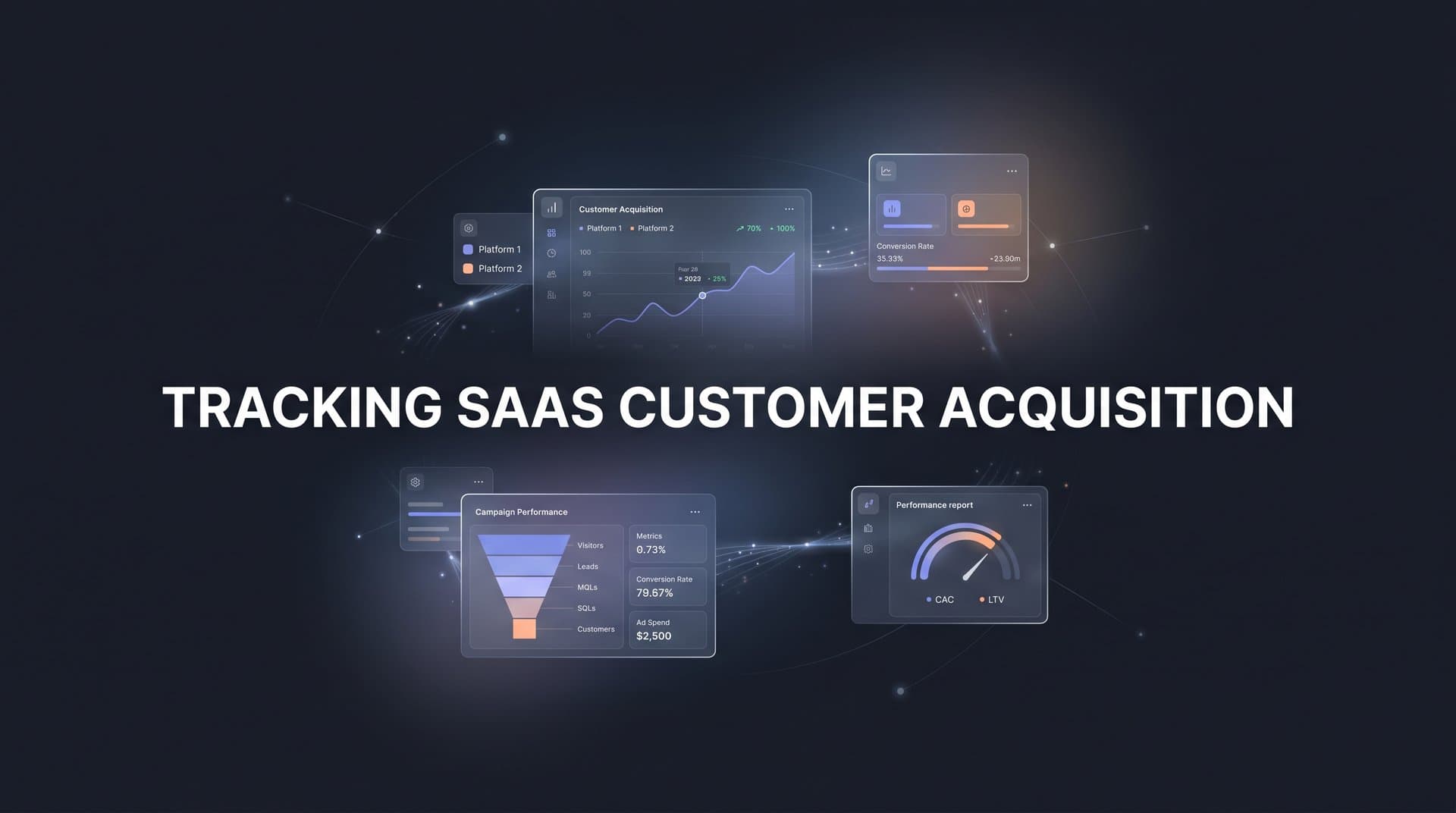
Create a dashboard that shows CAC by channel, campaign performance, and conversion rates in real time. Your dashboard should answer key questions immediately: What's our current CAC? Which channel has the lowest CAC? Which campaigns are performing above or below our benchmarks? What's our conversion rate at each funnel stage? Real-time data lets you spot problems quickly and capitalize on opportunities before they disappear. A campaign that's hemorrhaging budget due to a technical error can be paused within hours instead of days. Using a dedicated ad tracking analytics tool simplifies building this centralized view.
Include cohort analysis to track how acquisition quality changes over time and across different campaigns. Group customers by acquisition date and track their behavior over time. Compare customers acquired in January versus February. Compare customers from paid search versus paid social. Cohort analysis reveals patterns that aggregate metrics hide. You might discover that customers acquired through content marketing have higher LTV but longer sales cycles than those from paid search. This insight should influence how you allocate budget and set expectations.
Set up automated alerts for significant changes in key metrics. Configure notifications when CAC spikes above your threshold, when conversion rates drop below acceptable levels, or when a campaign's performance deteriorates suddenly. Automated alerts mean you don't need to monitor your dashboard constantly. The system watches for you and notifies you when intervention is needed. This is particularly valuable for identifying technical issues like broken tracking or landing page problems that cause immediate performance drops.
Ensure stakeholders can access the data they need without requiring manual report generation. Different team members need different views. Your CEO wants high-level metrics and trends. Your marketing manager needs campaign-level detail. Your performance marketing specialist needs ad-level data. Build dashboards or views tailored to each audience. When people can self-serve their data needs, you spend less time creating reports and more time acting on insights.
Step 6: Optimize Based on Revenue Data, Not Just Leads
This is where tracking transforms from measurement into growth. The goal isn't just knowing what happened but using that knowledge to drive better outcomes.
Shift focus from lead volume to revenue attribution by connecting closed deals back to original acquisition sources. Many marketing teams optimize for leads because that's what they can measure easily. But leads are a means to an end. Revenue is the actual goal. When you connect closed deals back to their acquisition sources, you can optimize for what actually matters. A channel that generates fewer leads but higher-quality customers is more valuable than one that floods your CRM with unqualified contacts. Understanding SaaS revenue attribution transforms how you evaluate channel performance.
Identify high-LTV customer segments and trace them back to the channels and campaigns that acquired them. Analyze your customer base to find patterns. Which customers have the highest LTV? What characteristics do they share? Which industries do they work in? What company sizes? Then trace these valuable customers back to their acquisition sources. You might discover that customers from a specific campaign, channel, or even ad creative have dramatically higher LTV than others. Accurate SaaS customer lifetime value calculation is essential for identifying these high-value segments.
Reallocate budget from channels that generate leads but not revenue to those that drive actual paying customers. This sounds obvious, but many teams continue investing in channels that feel productive because they generate activity, even when that activity doesn't convert to revenue. Your data might reveal that a channel generating hundreds of leads produces few customers, while another channel with modest lead volume consistently delivers high-quality buyers. Trust the revenue data and shift budget accordingly, even when it feels counterintuitive.
Use conversion sync to send enriched revenue data back to ad platforms, improving their targeting algorithms. When you feed actual revenue outcomes back to Meta, Google, and other platforms, their machine learning systems learn which user characteristics predict valuable customers. This creates a virtuous cycle: better data leads to better targeting, which leads to better customers, which generates more revenue data to improve targeting further. Platforms like Cometly automate this process, continuously syncing conversion data to keep ad algorithms optimized for your best customers.
Your Path to Data-Driven SaaS Growth
Tracking SaaS customer acquisition effectively requires connecting every piece of your marketing stack, from ad platforms to your CRM to your analytics dashboard. The effort is substantial, but the alternative is worse: making expensive marketing decisions based on incomplete information or gut feeling.
Use this checklist to verify your setup is complete. Have you defined your core metrics and set baseline benchmarks? Is server-side tracking implemented to capture accurate data despite browser restrictions? Are your ad platforms connected to your CRM with proper conversion mapping? Is multi-touch attribution active and comparing different models? Have you built a centralized dashboard that shows real-time performance? Are you optimizing based on revenue data rather than just lead volume?
With this system in place, you'll know exactly which channels drive real customers, not just clicks. You'll spot problems before they drain significant budget. You'll identify opportunities to scale what's working. Most importantly, you'll make marketing decisions with confidence, backed by data that connects every dollar spent to actual business outcomes.
The difference between companies that grow efficiently and those that burn through budgets often comes down to this: knowing what's working and doubling down on it. Your tracking system is what makes that knowledge possible. Ready to see your complete customer acquisition picture? Get your free demo to learn how Cometly can connect your ad spend to actual revenue, capture every touchpoint across your customer journey, and use AI-driven recommendations to identify which campaigns deserve more budget.