You're running ads across Meta, Google, LinkedIn, and TikTok. Your analytics dashboard shows conversions happening. Revenue is coming in. But when your CEO asks which campaigns are actually driving sales, you're left piecing together fragmented data from five different platforms, each claiming credit for the same conversion.
This is the reality for most marketers today. You see the results, but you can't confidently explain the path that led there. Did that customer convert because of your Facebook ad, your Google search campaign, or the email they opened three days ago? Without clear visibility into the complete customer journey, you're essentially flying blind—making budget decisions based on incomplete information and hoping for the best.
Customer journey tracking solves this problem by connecting every interaction a prospect has with your brand into a single, coherent story. Instead of isolated data points scattered across platforms, you get a complete view of how customers actually move from first awareness to final purchase. This article will show you exactly what customer journey tracking is, how it works, and how to use it to make marketing decisions with confidence instead of guesswork.
From Scattered Data to Connected Insights: Understanding Customer Journey Tracking
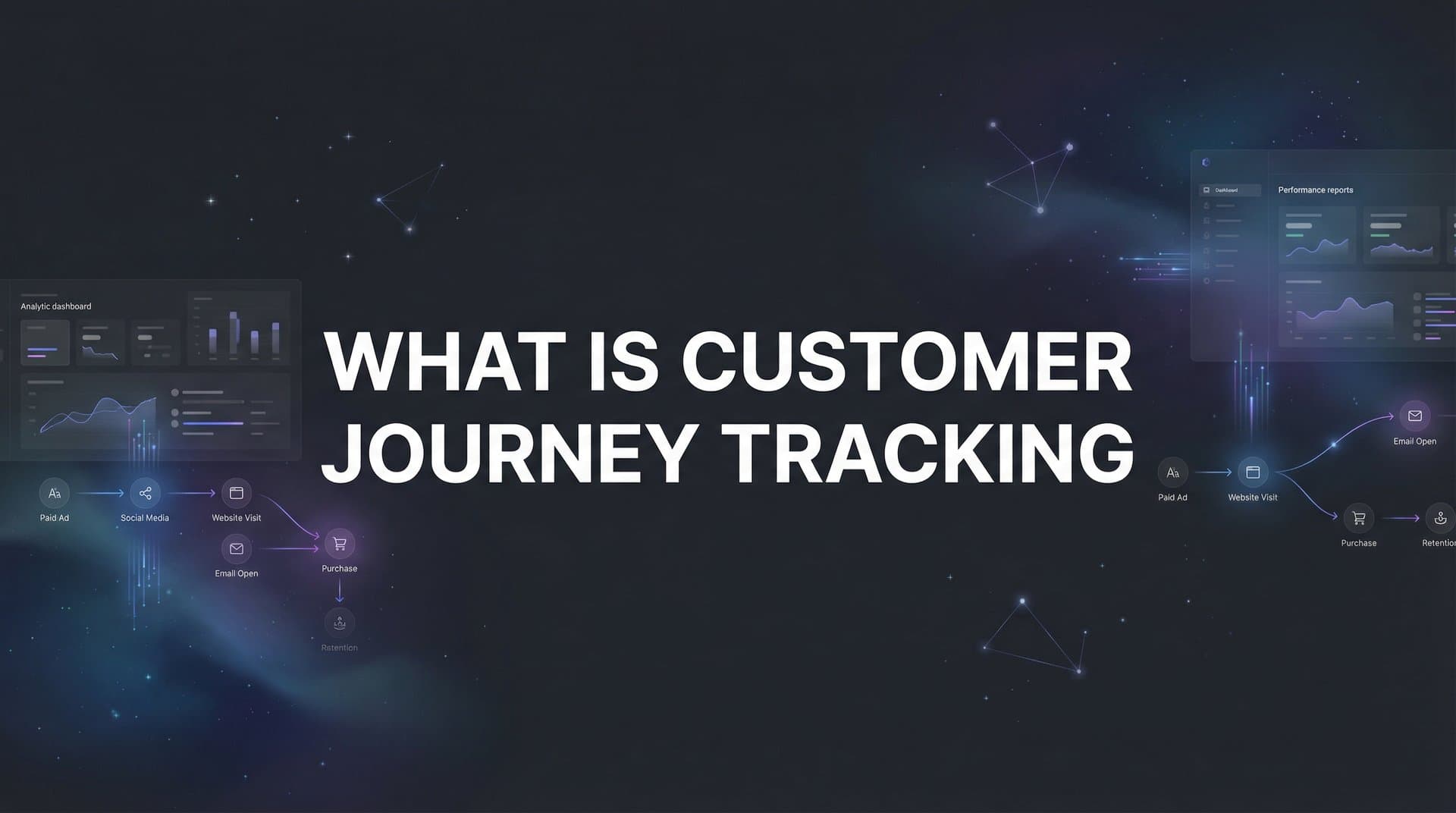
Customer journey tracking is the process of capturing and connecting every interaction a prospect has with your brand across channels, devices, and time. It transforms disconnected touchpoints—an ad click here, a website visit there, an email open somewhere else—into a unified timeline that shows exactly how someone progressed from stranger to customer.
Think of it like this: traditional analytics tells you that 500 people visited your pricing page this month. Customer journey tracking tells you that Sarah first saw your LinkedIn ad on Monday, clicked a Google search ad on Wednesday, visited your blog twice over the weekend, opened your nurture email on Tuesday, and then converted on Friday after a sales call. That's the difference between counting visitors and understanding behavior.
The distinction matters because marketing rarely works in straight lines. A prospect doesn't see one ad and immediately purchase. They research, compare, reconsider, and interact with your brand multiple times across multiple channels before making a decision. Journey tracking captures this reality.
Here's what makes journey tracking fundamentally different from basic analytics: it's built around identity resolution and cross-channel connection. Basic analytics tools like Google Analytics show you what happened on your website. They track sessions and pageviews, but they struggle to connect that anonymous website visitor to the person who clicked your Facebook ad yesterday or filled out a form last week.
Customer journey tracking platforms solve this by creating unified customer profiles that persist across sessions, devices, and channels. When someone clicks your ad, visits your site from their phone, returns later on their laptop, and eventually fills out a form, journey tracking recognizes these as actions from the same person and connects them into a single timeline. This is one of the core multi-device customer tracking challenges that modern platforms are designed to address.
This connected view reveals patterns that isolated analytics miss entirely. You might discover that your highest-value customers typically interact with your brand seven times across four different channels before converting. Or that prospects who engage with both your blog content and your retargeting ads convert at three times the rate of those who only see ads. These insights are invisible when you're looking at each channel in isolation.
The goal isn't just to collect more data—it's to understand the actual path to conversion so you can replicate it. When you know which touchpoints matter most and how they work together, you can allocate budget intelligently, optimize the customer experience, and scale what actually drives revenue.
The Anatomy of a Tracked Customer Journey
A complete customer journey includes every meaningful interaction between a prospect and your brand, from initial awareness through post-purchase engagement. Understanding what customer journey touchpoints are and how they connect gives you the foundation for accurate attribution and optimization.
The journey typically begins with awareness-stage touchpoints: ad impressions and clicks from platforms like Meta, Google, LinkedIn, or TikTok. These first interactions are critical because they represent your initial investment in reaching potential customers. Journey tracking captures not just that someone clicked an ad, but which specific campaign, ad set, and creative drove that click—along with all the UTM parameters that identify the source.
From there, the journey moves to website behavior. This includes landing page visits, content consumption, time spent on key pages, and navigation patterns. Modern tracking captures these actions even when visitors haven't identified themselves yet, creating anonymous profiles that later get connected to known contacts when the visitor takes an identifiable action.
The transition from anonymous to known typically happens through conversion events: form submissions, newsletter signups, demo requests, or account creations. This is where journey tracking becomes especially powerful. The moment someone provides their email address, the platform can retroactively connect all their previous anonymous interactions to their identity, revealing the complete path that led to that conversion.
Email engagement represents another crucial layer. Opens, clicks, and replies show how prospects respond to your nurture sequences and automated campaigns. These touchpoints often play a supporting role in conversions—someone might not convert directly from an email, but that email keeps your brand top-of-mind when they're ready to make a decision.
For B2B companies and complex sales cycles, CRM events add essential context to the digital journey. Sales calls, meetings booked, proposals sent, and contract negotiations all represent touchpoints that influence the path to revenue. Journey tracking platforms that integrate with CRMs like HubSpot or Salesforce connect these offline interactions to the digital touchpoints that preceded them, showing the complete picture from first ad click to closed deal.
E-commerce businesses track product views, cart additions, checkout initiations, and purchases. SaaS companies monitor trial signups, feature usage, upgrade events, and subscription renewals. The specific touchpoints vary by business model, but the principle remains the same: capture every interaction that matters to understanding customer behavior.
The sophistication of modern journey tracking extends beyond just logging events. It includes tracking cross-device behavior—recognizing when someone researches on mobile but converts on desktop. It captures multi-session journeys that span days or weeks. It connects paid and organic touchpoints, showing how search ads and content marketing work together.
Advanced platforms also track engagement depth and intent signals. Did someone just glance at your pricing page, or did they spend ten minutes comparing plans and reading FAQs? Did they watch your product demo video all the way through or drop off after 30 seconds? These behavioral signals help you understand not just what happened, but how engaged prospects are at each stage.
The result is a rich, multi-dimensional view of customer behavior. Instead of seeing isolated events, you see patterns. You understand which combinations of touchpoints lead to conversions. You identify the critical moments where prospects either move forward or drop off. This is the foundation for making smarter marketing decisions.
Why Marketers Can't Afford to Fly Blind Anymore
The cost of not knowing which channels drive revenue isn't just a reporting problem—it's a profitability problem. When you can't track customer journey accurately, you inevitably waste budget on underperforming campaigns while underfunding the strategies that actually work.
Consider the typical scenario: your Google Ads dashboard shows 50 conversions this month. Your Meta Ads Manager claims 45 conversions from the same period. Your email platform reports 30 conversions. Add them up and you get 125 conversions, but your CRM only shows 60 new customers. What happened? Each platform is taking credit for the same conversions, using last-click or platform-biased attribution models that inflate their reported performance.
Without journey tracking, you're making budget decisions based on these inflated, overlapping numbers. You might increase spend on a channel that's claiming credit for conversions it didn't actually drive, while cutting budget from upper-funnel activities that are essential to the customer journey but don't get credit in last-click models.
The stakes have gotten even higher with recent privacy changes. Apple's App Tracking Transparency framework, introduced with iOS 14.5, fundamentally disrupted mobile tracking by requiring apps to ask permission before tracking users across apps and websites. The majority of iOS users opted out, creating massive blind spots in traditional cookie-based tracking.
This means the conversion data that ad platforms like Meta receive is increasingly incomplete. When Meta's pixel can't track iOS users who opted out of tracking, the platform's algorithm has less accurate data to optimize campaigns. Your ads might be driving conversions that Meta never sees, leading to suboptimal targeting and bidding decisions.
The impending deprecation of third-party cookies in browsers compounds this challenge. Understanding what cookieless tracking is and how to implement it has become essential for marketers who want to maintain attribution accuracy. As Chrome phases out cookie support, traditional tracking methods that rely on cross-site cookies will become even less reliable.
Beyond tracking accuracy, there's the strategic cost of missing upper-funnel impact. Last-click attribution models inherently undervalue awareness and consideration-stage activities. Your brand awareness campaign on LinkedIn might be introducing prospects to your solution, but if they later convert through a Google search ad, the search campaign gets all the credit in a last-click model.
This creates a dangerous cycle: you see poor reported ROI from upper-funnel campaigns, so you cut that budget and shift everything to bottom-funnel tactics. But without top-of-funnel awareness driving new prospects into your ecosystem, your bottom-funnel campaigns have fewer qualified prospects to convert. Performance declines, and you can't figure out why.
Customer journey tracking solves these problems by showing the complete picture. You can see which upper-funnel touchpoints consistently appear in high-value customer journeys, even if they're not the final click. You can identify which channels work together synergistically. You can make budget allocation decisions based on true contribution to revenue, not platform-reported vanity metrics.
The alternative—continuing to fly blind—means wasting budget, missing optimization opportunities, and losing competitive advantage to marketers who do understand their customer journeys. In an environment where tracking is getting harder and acquisition costs are rising, you can't afford to guess which marketing investments actually work.
How Customer Journey Tracking Actually Works
Understanding the technical foundations of journey tracking helps you implement it effectively and troubleshoot issues when data doesn't match expectations. At its core, journey tracking relies on three key capabilities: first-party data tracking, identity resolution, and cross-platform integration.
First-party data collection is the foundation. This means capturing behavioral data directly from your owned properties—your website, app, or platform—rather than relying on third-party cookies or platform pixels alone. When someone visits your site, a first-party tracking script captures their actions: pages viewed, buttons clicked, forms submitted, time spent on content. This data is stored in your own database, giving you control and persistence that third-party cookies can't provide.
Server-side tracking enhances reliability by processing events on your server rather than relying solely on browser-based tracking. When someone completes a purchase or submits a form, your server sends that conversion event directly to your attribution platform and to ad platforms via their conversion APIs. This approach bypasses browser-based tracking blockers and provides more accurate data even when users have disabled cookies or opted out of tracking. For a deeper comparison, explore the differences between Google Analytics vs server-side tracking.
Identity resolution is where the magic happens. This is the process of connecting multiple interactions from the same person across sessions, devices, and channels. When someone first visits your site anonymously, the tracking platform assigns them a unique identifier stored in a first-party cookie. As they browse, all their actions get associated with that identifier.
The breakthrough moment comes when that anonymous visitor takes an identifiable action—filling out a form, creating an account, or making a purchase. At that point, the platform connects their email address or other identifier to all their previous anonymous activity. Suddenly, you can see that this customer first clicked your Facebook ad two weeks ago, visited your blog three times, opened two nurture emails, and finally converted after a retargeting ad.
Cross-device identity resolution extends this further. If someone browses on mobile but converts on desktop, advanced platforms can recognize these as the same person by matching identifiers like email addresses across devices. This prevents the common problem of attributing what's actually a single customer journey to multiple unrelated sessions.
UTM parameters play a crucial role in connecting ad platform data to website behavior. When you add UTM tags to your ad links—utm_source=facebook, utm_medium=cpc, utm_campaign=spring_promo—these parameters travel with the user to your website. Learning what UTM tracking is and how UTMs can help your marketing is essential for granular visibility into which campaigns drive which actions.
API integrations connect the dots across platforms. Modern attribution platforms integrate with ad platforms like Meta, Google, TikTok, and LinkedIn to capture impression and click data. They connect to CRMs like HubSpot and Salesforce to capture lead status changes, opportunity creation, and closed deals. They integrate with email platforms to track opens and clicks. Each integration adds another layer of touchpoint data to the unified customer profile.
The conversion API (CAPI) implementations are particularly important for maintaining ad platform effectiveness. Meta's Conversions API and Google's Enhanced Conversions allow you to send conversion events directly from your server to the ad platform, bypassing browser-based tracking limitations. This gives the platform's algorithm more complete data to optimize targeting and bidding, improving campaign performance even as traditional pixel tracking becomes less reliable.
Data processing happens continuously in the background. As new touchpoints occur, the attribution platform updates customer profiles, recalculates attribution credit across different models, and surfaces insights about which paths to conversion are most common. The goal is to create a real-time view of customer journeys that updates as behavior happens, not a static report you review once a month.
The technical complexity is significant, but modern platforms handle most of it automatically once properly implemented. The key is ensuring you have all the essential components in place: first-party tracking on your website, server-side event processing, proper UTM tagging on campaigns, and integrations with all your key marketing platforms.
Turning Journey Data Into Smarter Marketing Decisions
Collecting customer journey data is only valuable if you use it to make better decisions. The real power comes from translating those insights into concrete actions that improve performance and ROI.
Start by identifying which campaigns and channels actually drive qualified leads. Look beyond last-click attribution to understand the full role each touchpoint plays. You might discover that your LinkedIn ads rarely get last-click credit but consistently appear early in the journeys of your highest-value customers. That insight changes your budget allocation—instead of cutting LinkedIn spend because of poor last-click ROI, you recognize its crucial role in generating awareness among your target audience.
Use journey analysis to optimize your funnel for efficiency. When you see that prospects who engage with both your product demo video and your case study page convert at twice the rate of those who only view one piece of content, you can redesign your website to guide visitors through both touchpoints. Understanding how to analyze customer journeys effectively helps you identify these high-converting patterns and replicate them systematically.
Feed accurate conversion data back to ad platforms to improve their optimization algorithms. This is where server-side tracking and conversion APIs become strategic advantages. When you send complete, accurate conversion data to Meta or Google—including conversions that their pixel missed due to tracking limitations—their algorithms can better identify which audience segments and creative approaches drive results. The platform can then automatically optimize toward those high-performing patterns.
The improvement compounds over time. Better conversion data leads to better optimization, which leads to better campaign performance, which generates more conversion data. Marketers who implement this feedback loop consistently see improved ROAS as ad platforms learn more accurately which users are likely to convert.
Identify and eliminate friction points in the customer journey. When you see a pattern of prospects dropping off at a specific stage—say, 60% of people who view your pricing page never return—you can investigate why. Is the pricing confusing? Are you missing key information that prospects need at that stage? Journey tracking reveals where the problems are so you can fix them systematically.
Use cohort analysis to understand how different acquisition sources perform over time. Customers acquired through content marketing might have longer sales cycles but higher lifetime value compared to those from paid search. This insight affects your budget allocation and your expectations for ROI timing. You stop expecting immediate returns from channels that drive long-term value and adjust your measurement timeframes accordingly.
Develop predictive insights about which prospects are most likely to convert. When you've tracked thousands of customer journeys, patterns emerge. You can identify the behavioral signals that indicate high purchase intent—like spending more than five minutes on your pricing page or returning to your site three times in a week. Your sales team can prioritize outreach to prospects showing these signals, improving conversion rates and shortening sales cycles.
Create attribution reports that align with how your business actually works. If you're a B2B company with a 90-day sales cycle, a 7-day last-click attribution window misses most of the journey. Use multi-touch attribution models with appropriate lookback windows that capture the full path to conversion. Compare different attribution tracking methods—first-click, last-click, linear, time-decay—to understand how each perspective changes your view of channel performance.
The goal isn't perfect attribution—that's impossible in a complex, multi-touchpoint world. The goal is better decision-making. When you understand which marketing activities consistently contribute to customer acquisition, you can invest with confidence. When you see which combinations of touchpoints work together, you can design integrated campaigns that leverage those synergies. When you know where prospects get stuck, you can remove those obstacles.
Building Your Journey Tracking Foundation
Implementing effective customer journey tracking requires getting several foundational pieces in place. Start with the essentials and build sophistication over time rather than trying to track everything perfectly from day one.
Your first priority is implementing reliable first-party tracking on your website. This means installing a tracking script that captures pageviews, button clicks, form submissions, and other key interactions. Choose a platform that supports server-side tracking, not just browser-based pixels. The implementation should create first-party cookies that persist across sessions, allowing you to recognize returning visitors even before they identify themselves.
Establish consistent UTM parameter conventions for all your campaigns. Develop a naming structure and stick to it religiously. If you use "utm_source=facebook" sometimes and "utm_source=meta" other times, you'll fragment your data and lose visibility into campaign performance. Document your UTM structure and make sure everyone on your team follows it. Consider using a URL builder tool to ensure consistency.
Integrate your CRM as early as possible. The connection between marketing touchpoints and sales outcomes is what makes journey tracking valuable. When your attribution platform can see that a lead became an opportunity and eventually closed as a customer, you can calculate true ROI for your marketing activities. Without CRM integration, you're stuck measuring marketing-qualified leads without knowing which ones actually generate revenue.
Choose attribution models that match your business reality. If you're an e-commerce business with short purchase cycles, a 7-day attribution window might work fine. If you're a B2B SaaS company with 60-90 day sales cycles, you need longer attribution windows and multi-touch models that capture the full journey. Don't just accept platform defaults—configure attribution settings based on how your customers actually buy.
Implement conversion APIs for your key ad platforms. Set up Meta's Conversions API and Google's Enhanced Conversions to send server-side conversion data directly to these platforms. This improves tracking accuracy and gives their algorithms better data to optimize campaigns. The technical setup requires some development work, but the performance improvement is worth the investment. If you need help, consider an attribution tracking setup service to ensure proper implementation.
Start simple with what you track, then expand. Begin with the most critical conversion events—purchases, demo requests, trial signups—and make sure those are tracked accurately across all channels. Once that foundation is solid, add secondary events like newsletter signups, content downloads, or product page views. Trying to track everything at once often leads to implementation errors and data quality issues.
Avoid the common pitfall of relying solely on platform-reported data. Each ad platform has incentives to show the best possible performance for their channel, which leads to inflated and overlapping conversion claims. Use dedicated attribution tracking tools that provide an independent view of performance across all channels. This gives you the objective data you need to make unbiased budget allocation decisions.
Don't ignore offline touchpoints if they're part of your customer journey. Sales calls, trade show interactions, direct mail, and in-person meetings all influence B2B purchase decisions. Make sure these events get logged in your CRM so they appear in your journey analysis. The goal is a complete view, not just the digital interactions that are easiest to track.
Plan for data quality maintenance from the start. Tracking implementations break when websites get updated, tags get removed accidentally, or integrations stop syncing. Schedule regular audits to verify that all your tracking is working correctly. Test conversion events to ensure they're firing properly. Monitor for sudden drops in tracked events that might indicate technical issues.
Set realistic expectations for data completeness. Privacy regulations, tracking blockers, and user opt-outs mean you'll never capture 100% of customer interactions. That's okay. The goal is directional accuracy that's good enough to make better decisions, not perfect data that captures every single touchpoint. Focus on getting the most important events tracked reliably rather than achieving impossible perfection.
Making Journey Tracking Your Competitive Advantage
Customer journey tracking transforms marketing from guesswork into a data-driven discipline. When you can see the complete path from first touchpoint to final purchase, you stop making decisions based on platform-reported vanity metrics and start optimizing based on what actually drives revenue.
The marketers who win in today's environment are those who understand their customer journeys better than their competitors. They know which channels work together synergistically. They recognize which touchpoints influence purchases even if they don't get last-click credit. They feed accurate conversion data back to ad platforms to maintain targeting effectiveness despite privacy changes. They identify friction points and optimize them systematically.
This isn't about collecting data for data's sake. It's about gaining the clarity to confidently scale what works and cut what doesn't. When you know that prospects who engage with your brand across at least three channels convert at twice the rate of single-channel interactions, you can design campaigns that deliberately create those multi-channel journeys. When you see that upper-funnel content consistently appears in high-value customer paths, you can justify continued investment even when it doesn't show immediate last-click ROI.
The technical barriers to implementing journey tracking have never been lower. Modern platforms handle the complexity of identity resolution, cross-device tracking, and multi-platform integration automatically. The real barrier is organizational commitment—deciding that you're going to invest in understanding your customers' actual behavior rather than continuing to rely on incomplete, platform-biased reporting.
Start building your journey tracking foundation today. The sooner you implement accurate tracking, the sooner you'll have the historical data to identify patterns and optimize performance. Every day without journey tracking is another day of making budget decisions with incomplete information.
Ready to elevate your marketing game with precision and confidence? Discover how Cometly's AI-driven recommendations can transform your ad strategy—Get your free demo today and start capturing every touchpoint to maximize your conversions.