Your Facebook Ads Manager shows 50 conversions. Google Analytics reports 35. Your CRM logged 42. Which number do you trust? If you're a digital marketer in 2026, this scenario probably feels painfully familiar. The culprit isn't your tools—it's the crumbling foundation that traditional tracking was built on: third-party cookies.
For years, cookies powered the entire digital advertising ecosystem. They told you which ads drove sales, which channels deserved more budget, and which campaigns were wasting money. But that foundation is collapsing. Safari killed third-party cookies years ago. Firefox followed. Chrome keeps delaying but is moving in the same direction. Privacy regulations are tightening globally. And marketers are left with incomplete data, broken attribution, and ad platforms that can't optimize effectively because they're starving for conversion signals.
Cookieless tracking isn't just the future—it's the present. Forward-thinking marketers are already using privacy-compliant methods to capture complete customer journeys, feed better data to ad platforms, and make confident budget decisions without relying on cookies that browsers are actively blocking. This guide will show you exactly what cookieless tracking is, how it works, and how to implement it so you can maintain accurate attribution while respecting user privacy.
The Cookie Crumbles: Why Traditional Tracking Is Failing
Third-party cookies are small text files that websites place in your browser to track you across the internet. When you visit a site, advertising platforms like Facebook or Google drop a cookie in your browser. When you visit another site, that same cookie identifies you, creating a profile of your browsing behavior across multiple domains. For marketers, this cross-site tracking powered everything: retargeting campaigns, conversion attribution, audience building, and campaign optimization.
But the cookie-based tracking model is dying, and it's not coming back.
Apple fired the first major shot in 2017 with Intelligent Tracking Prevention (ITP) in Safari. By 2020, Safari blocked third-party cookies entirely by default. Firefox followed with Enhanced Tracking Protection in 2019, blocking third-party cookies for all users. These weren't small changes—Safari and Firefox combined represent roughly 30% of web traffic. Suddenly, nearly a third of your website visitors became invisible to traditional pixel tracking methods.
Then came iOS 14.5 in April 2021, which introduced App Tracking Transparency (ATT). This required apps to ask permission before tracking users across other apps and websites. The result? Most users opted out. Meta estimated that ATT would cost them $10 billion in lost revenue in 2022 alone. For marketers, it meant mobile conversion tracking—especially for iOS users—became dramatically less reliable overnight.
Google Chrome, which holds about 65% of browser market share, has been slower to act but is moving in the same direction. After multiple delays, Chrome is phasing out third-party cookies through its Privacy Sandbox initiative, with complete deprecation expected by late 2026. When Chrome finally pulls the trigger, the cookie-based tracking era will officially end.
Privacy regulations accelerated this shift. GDPR in Europe set strict rules for data collection and consent. California's CCPA gave users the right to opt out of data sales. More US states are passing similar laws. Globally, privacy regulations are tightening, making cookie-based tracking not just technically unreliable but legally risky.
The real-world impact on marketers is severe. Attribution gaps mean you can't see the full customer journey. When a user clicks your Facebook ad on Safari, then converts on Chrome three days later, traditional tracking often misses the connection. Your Facebook dashboard shows no conversion. Your analytics platform might attribute it to direct traffic or organic search. You're making budget decisions based on incomplete, misleading data. Understanding how to fix conversion tracking gaps has become essential for modern marketers.
Ad platforms suffer too. When Facebook or Google can't track conversions accurately, their machine learning algorithms have less data to optimize campaigns. Your cost per acquisition rises. Your ROAS drops. You're essentially flying blind, scaling campaigns that might not actually be profitable and pausing ones that could be your best performers.
This isn't a future problem. It's happening right now. Every marketer running paid campaigns is losing data, missing conversions, and making decisions based on fragmented information. The question isn't whether you need to adapt—it's how quickly you can implement tracking methods that work in this new privacy-first landscape.
How Cookieless Tracking Actually Works
Cookieless tracking is exactly what it sounds like: methods for identifying and tracking user behavior without relying on third-party cookies. But it's not about finding sneaky workarounds to continue surveillance. It's about building privacy-compliant tracking infrastructure that gives you accurate attribution while respecting user privacy and browser restrictions.
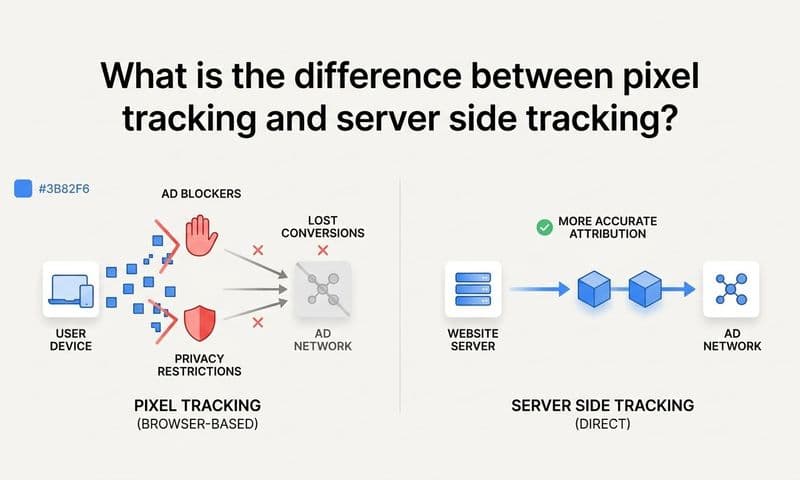
The fundamental shift is moving from browser-based tracking to server-based tracking. Traditional cookie tracking happens entirely in the user's browser—a third-party cookie gets dropped, the browser reads it on subsequent visits, and tracking pixels fire to report conversions. This client-side approach is what browsers are blocking. Cookieless tracking moves data collection to your server, where browser restrictions don't apply and you have complete control over what data you collect and how you use it.
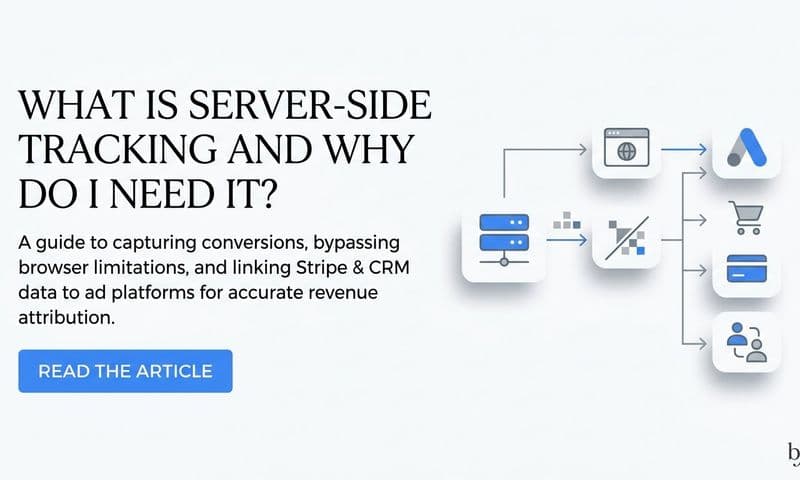
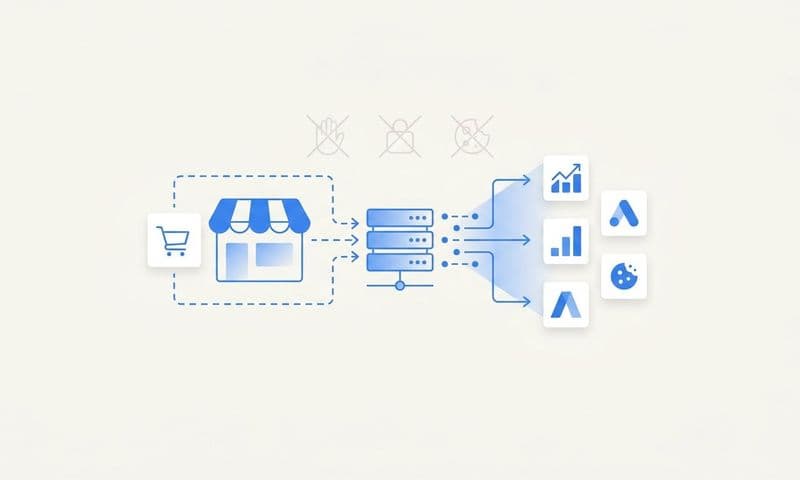
Server-side tracking works by routing conversion data through your own server before sending it to analytics and advertising platforms. When a user completes a conversion on your website, your server captures that event with first-party data you already have (like email address, user ID, or CRM information). Your server then sends enriched conversion data to Facebook, Google, and other platforms through their Conversion APIs. Because the data flows server-to-server rather than browser-to-platform, ad blockers and browser restrictions can't interfere. This is why server-side tracking is more accurate than traditional methods.
First-party data collection is the foundation of cookieless tracking. This is data you collect directly from users through your owned properties—your website, mobile app, email list, or CRM. When a user creates an account, subscribes to your newsletter, or makes a purchase, you capture information they voluntarily provided. This first-party data isn't subject to the same restrictions as third-party cookies because users have a direct relationship with your business.
The key is connecting this first-party data across touchpoints to build unified customer profiles. When someone clicks your Facebook ad, visits your website, downloads a lead magnet, and eventually purchases, you need to connect those events to the same person. With cookieless tracking, you use deterministic matching (exact identifiers like email addresses or user IDs) and probabilistic matching (statistical models based on device fingerprints, IP addresses, and behavioral patterns) to stitch together the customer journey.
Contextual signals play a growing role in cookieless tracking. Instead of tracking individual users across websites, contextual approaches analyze the content and context of where ads appear. Google's Topics API, part of the Privacy Sandbox initiative, groups users into interest cohorts based on recent browsing behavior without revealing individual identities. Advertisers can target these privacy-preserving cohorts rather than specific users.
It's important to understand what cookieless tracking can and cannot do. It can provide accurate attribution for users who interact with your owned properties and provide identifying information. It can track the full customer journey from first touch to conversion when you implement server-side tracking. It can feed rich conversion data back to ad platforms to improve campaign optimization. It can give you multi-touch attribution across all your marketing channels.
What it cannot do is track anonymous users across the web indefinitely. It cannot identify users who never provide any information or create an account. It cannot replicate the cross-site surveillance that third-party cookies enabled. But here's the thing: you don't need that capability. What you need is accurate attribution for your actual customers and prospects—the people who engage with your business. Cookieless tracking delivers that.
The transition from cookie-based to cookieless tracking isn't about losing capabilities. It's about replacing unreliable, privacy-invasive methods with accurate, compliant infrastructure that gives you better data than cookies ever did. When you track conversions server-side with first-party data, you capture events that browser-based pixels miss entirely. You send enriched conversion data to ad platforms that improves their optimization. You build a complete view of the customer journey that cookie-based tracking could never provide.
Five Cookieless Tracking Methods Every Marketer Should Know
Server-Side Tracking: This is the cornerstone of cookieless tracking. Instead of relying on JavaScript pixels that fire in the user's browser, server-side tracking captures conversion events on your server and sends them directly to advertising and analytics platforms through APIs. When a user completes a purchase, your server logs the conversion with all relevant first-party data, then sends that information to Facebook via the Conversions API, to Google via Enhanced Conversions, and to your analytics platform through server-side event tracking.
The advantages are significant. Browser-based ad blockers can't interfere because the data never passes through the browser. Safari's ITP restrictions don't apply because you're not using third-party cookies. You can attach rich first-party data to every conversion—email addresses, customer IDs, lifetime value, subscription status—giving ad platforms much better signals for optimization than a simple pixel fire ever could. Exploring server-side tracking tools is the first step toward implementing this approach effectively.
First-Party Data Strategies: Building a robust first-party data foundation is essential for cookieless tracking. This means collecting data directly from users through account creation, email subscriptions, purchase transactions, and authenticated experiences. The goal is to create unique identifiers for each customer that you can use to connect their journey across touchpoints.
Email-based matching is particularly powerful. When users provide their email address—through a lead form, account creation, or checkout—you can hash that email and send it to ad platforms to match conversions to specific ad interactions. Facebook's Conversions API and Google's Enhanced Conversions both support email matching, allowing platforms to attribute conversions even when browser cookies are blocked. CRM integration takes this further by connecting ad platform data with your customer database, giving you a complete view of how marketing touches influence deals, customer lifetime value, and revenue.
Conversion APIs and Enhanced Conversions: These are the server-side mechanisms that platforms provide for cookieless tracking. Meta's Conversions API (CAPI) allows you to send conversion events directly from your server to Facebook, bypassing the browser entirely. Google's Enhanced Conversions lets you send hashed first-party data alongside conversion events to improve attribution accuracy.
The key advantage is data enrichment. With traditional pixel tracking, you might send "purchase completed" with a transaction value. With Conversion APIs, you can send the same event along with the customer's email, phone number, address, customer ID, and any other first-party data you have. This enriched data helps platforms match conversions to ad interactions more accurately and provides better signals for campaign optimization. Many marketers see improved ROAS when they implement Conversion APIs because ad platforms can finally optimize toward actual conversions instead of incomplete pixel data. Proper conversion tracking setup is critical to maximizing these benefits.
Unified Customer Profiles and Identity Resolution: Cookieless tracking requires connecting the dots across fragmented touchpoints. A user might click your Instagram ad on mobile, visit your website on desktop, subscribe to your email list, and purchase a week later. Without third-party cookies, you need alternative methods to recognize this is the same person.
Identity resolution platforms use deterministic matching (exact identifiers like email or user ID) combined with probabilistic matching (statistical models based on device characteristics, browsing patterns, and behavioral signals) to build unified profiles. The goal is creating a single customer view that connects ad clicks, website visits, email engagement, and CRM events to the same individual. This gives you accurate multi-touch attribution even when browser tracking fails. Implementing customer attribution tracking helps you build these unified profiles across channels.
Contextual and Cohort-Based Approaches: When you can't track individuals, you can still target effectively using contextual signals. Contextual targeting analyzes the content of web pages to serve relevant ads without tracking user behavior. If someone is reading an article about running shoes, they're probably interested in athletic gear—no cross-site tracking required.
Google's Topics API represents a privacy-preserving approach to interest-based advertising. Instead of tracking individual users, it assigns browsers to interest topics based on recent browsing history. Advertisers can target these topics without accessing individual browsing data. While less precise than cookie-based tracking, contextual and cohort approaches offer privacy-compliant alternatives that still enable relevant ad targeting.
Implementing Cookieless Tracking: A Practical Roadmap
Step 1: Audit Your Current Tracking Setup
Before you can fix your tracking, you need to understand what's broken. Start by mapping every conversion event you currently track: purchases, leads, sign-ups, downloads, demo requests, phone calls. For each event, identify whether you're using browser-based pixels, server-side tracking, or both. Check how each event is attributed—can you connect it back to the originating ad click or marketing touchpoint?
Test your tracking across different browsers and scenarios. Load your website in Safari with default settings and complete a test conversion. Does it show up in your analytics? Does Facebook receive the conversion event? Repeat the test with ad blockers enabled, in incognito mode, and on mobile devices. You'll quickly discover where your tracking has gaps. Many marketers are shocked to find that 30-50% of actual conversions aren't being captured by traditional pixel-based tracking.
Identify your cookie dependencies. Which tracking methods rely on third-party cookies that are already being blocked? Which conversion events depend on cross-site tracking that won't work in a cookieless environment? Make a list of everything that needs to be upgraded to cookieless alternatives.
Step 2: Prioritize Server-Side Tracking Implementation
Don't try to fix everything at once. Start with your highest-value conversion events—the ones that directly impact revenue and campaign optimization. For most businesses, this means purchases, qualified leads, or demo requests. Implement server-side tracking for these critical events first.
Choose a server-side tracking solution that integrates with your existing tech stack. If you're running Shopify, use their native server-side tracking capabilities. If you have a custom website, implement Google Tag Manager Server-Side or work with a platform that handles server-side event routing. Our server-side tracking implementation guide walks you through the technical setup process step by step.
Set up parallel tracking initially—run both your existing pixel-based tracking and new server-side tracking simultaneously. This lets you validate that server-side events are firing correctly and compare data quality between methods. You'll often find that server-side tracking captures 20-40% more conversions than pixels alone because it isn't affected by ad blockers or browser restrictions.
Step 3: Build Your First-Party Data Strategy
Cookieless tracking depends on first-party data, so you need systems to collect, store, and activate it. Start by identifying every touchpoint where users provide information: email subscriptions, account creation, checkout forms, lead magnets, contact forms. Ensure you're capturing email addresses, phone numbers, and any other identifiers that can be used for matching.
Implement email hashing and customer ID passing in your server-side tracking. When you send conversion events to Facebook or Google, include hashed email addresses and customer IDs so platforms can match conversions to ad interactions. This dramatically improves attribution accuracy even when cookies are blocked.
Connect your CRM to your marketing data. When a lead converts to a customer, when a customer churns, when someone increases their subscription tier—these CRM events should feed back to your attribution platform and ad platforms. This closed-loop tracking shows you which marketing channels drive not just leads, but actual revenue and customer lifetime value. Understanding marketing attribution platforms and revenue tracking helps you connect these data points effectively.
Measuring Success in a Cookieless World
The metrics that mattered in the cookie era don't always translate to cookieless tracking. Last-click attribution—crediting the final touchpoint before conversion—becomes less reliable when you can't track every click. You need to shift toward multi-touch attribution models that capture the full customer journey, even when some touchpoints are obscured.
Multi-touch attribution distributes credit across all marketing interactions that influenced a conversion. When a customer clicks your Facebook ad, visits through organic search, engages with an email, and finally converts through a retargeting ad, multi-touch models recognize that all these touchpoints contributed. This approach is essential in a cookieless world because it doesn't rely on perfect tracking of every interaction—it uses the data you can capture to build a probabilistic view of the customer journey. Choosing the right attribution model for optimizing ad campaigns is crucial for accurate measurement.
Related reading: our complete guide to AI powered tools for optimizing ad targeting.
Focus on conversion quality, not just conversion volume. With cookieless tracking, you're capturing different data than cookie-based methods, which can make direct comparisons misleading. Instead of obsessing over whether you're seeing the same number of conversions as before, evaluate the quality of conversions you can track. Are they real customers? Can you connect them to revenue? Can you use this data to make better budget decisions?
Use Conversion APIs and server-side events to feed better optimization signals to ad platforms. When you send enriched conversion data—including customer value, email matching, and purchase details—ad platforms can optimize more effectively even with less data. Many marketers find that campaign performance actually improves after implementing server-side tracking because platforms finally have accurate signals instead of incomplete pixel data.
Establish new KPIs that account for attribution gaps while still enabling data-driven decisions. You might not be able to attribute every conversion to a specific ad click, but you can track directional metrics: overall conversion rates, customer acquisition costs by channel, return on ad spend at the campaign level, and incrementality through holdout tests. These metrics give you enough signal to make confident budget allocation decisions without requiring perfect attribution.
Implement incrementality testing to validate channel performance. Run controlled experiments where you increase or decrease spend in specific channels and measure the impact on overall conversions. This approach doesn't require perfect tracking—it shows you whether a channel is actually driving incremental results or just capturing conversions that would have happened anyway.
Track business outcomes, not just marketing metrics. In a cookieless world, your north star should be revenue, customer lifetime value, and profitability—not clicks, impressions, or even pixel-tracked conversions. When you connect marketing data to actual business results through CRM integration and revenue attribution, you can make strategic decisions even when attribution isn't perfect. The right marketing attribution software makes this connection seamless.
Putting It All Together: Your Cookieless Future
Cookieless tracking isn't a compromise—it's an upgrade. When you implement server-side tracking, build first-party data strategies, and use Conversion APIs to feed enriched data to ad platforms, you get more accurate attribution than cookie-based methods ever provided. You capture conversions that pixels miss. You send better optimization signals to ad platforms. You build a complete view of the customer journey that connects ad clicks to actual revenue.
The core principles are straightforward: move data collection from the browser to your server where tracking can't be blocked, collect and activate first-party data to build unified customer profiles, and use Conversion APIs to send enriched conversion data back to ad platforms. These aren't theoretical concepts—they're proven methods that forward-thinking marketers are using right now to maintain accurate attribution while respecting privacy.
The marketers who adapt quickly gain a competitive advantage. While competitors struggle with incomplete data and broken attribution, you'll have accurate tracking, better ad optimization, and confidence in your budget decisions. You'll feed ad platforms the rich conversion data they need to optimize effectively. You'll understand which channels drive real revenue, not just clicks. You'll build marketing infrastructure that works today and remains compliant as privacy regulations continue to evolve.
Cometly's server-side tracking and multi-touch attribution platform is built specifically for the cookieless era. We capture every touchpoint from ad clicks to CRM events, giving our AI a complete view of the customer journey. You'll know exactly which sources drive revenue, not just surface-level metrics. Our AI analyzes performance across every ad channel and provides recommendations for scaling with confidence. And we feed enriched, conversion-ready events back to Meta, Google, and other platforms—improving their targeting, optimization, and your ROI.
The transition to cookieless tracking isn't optional. Browsers are blocking cookies. Privacy regulations are tightening. Traditional tracking methods are already failing. The question is whether you'll adapt proactively or reactively. The marketers who implement cookieless tracking now will have accurate data, optimized campaigns, and future-proof infrastructure. The ones who wait will keep losing conversions, wasting budget, and making decisions based on incomplete data.
Ready to elevate your marketing game with precision and confidence? Discover how Cometly's AI-driven recommendations can transform your ad strategy—Get your free demo today and start capturing every touchpoint to maximize your conversions.