You're staring at your Facebook Ads dashboard at 11 PM on a Tuesday. The campaign you launched three weeks ago shows 847 clicks, solid engagement metrics, and exactly zero conversions. But here's the thing—your sales team closed 23 deals this month, and finance is reporting a 15% revenue increase. Something's broken, and it's costing you more than sleep.
This is the reality of conversion tracking gaps—invisible cracks in your measurement infrastructure that make it impossible to know what's actually working. You're flying blind, making budget decisions based on incomplete data while your competitors figure out exactly which campaigns drive revenue.
The problem isn't just annoying—it's expensive. When Apple rolled out iOS 14.5 and browsers tightened privacy controls, businesses lost visibility into 25-40% of their actual conversions overnight. That's not a minor data quality issue. That's a fundamental breakdown in your ability to measure marketing performance.
Most marketing teams don't realize they have tracking gaps until they're already making decisions on bad data. You might be cutting campaigns that actually drive revenue while scaling ones that don't. You're optimizing for metrics that don't reflect reality. And every day this continues, you're leaving money on the table.
The good news? Fixing conversion tracking gaps isn't about buying expensive tools or hiring a data science team. It's about systematic implementation of the right tracking infrastructure, proper integration between your systems, and understanding where modern tracking breaks down. This guide walks you through exactly how to identify your gaps, implement solutions that work across platforms, and finally get accurate data you can trust.
By the end, you'll know how to audit your current tracking setup, implement server-side tracking to overcome browser limitations, configure cross-platform event matching, bridge your offline and online conversions, and optimize your attribution models for accuracy. You'll move from guessing which campaigns work to knowing with confidence where every dollar of revenue comes from.
Let's walk through how to fix this step-by-step.
Step 1: Audit Your Current Tracking Infrastructure
You can't fix tracking gaps you don't know exist. Most marketing teams discover their tracking problems only after making budget decisions on incomplete data. The foundation of fixing conversion tracking gaps starts with a systematic audit that reveals exactly where your measurement breaks down.
This isn't about checking if Google Analytics is installed. It's about mapping every tracking tool, every customer touchpoint, and every potential failure point in your measurement infrastructure. You're looking for the invisible cracks where conversions disappear.
Inventory Your Tracking Tools
Start by documenting every tracking implementation across your marketing stack. Open a spreadsheet and list each tool: Google Analytics, Facebook Pixel, Google Ads conversion tracking, LinkedIn Insight Tag, TikTok Pixel, your CRM's tracking code, email marketing platform pixels, and any third-party analytics tools like Mixpanel or Amplitude.
For each tool, document three critical details: where it's installed (which pages or domains), what events it tracks, and whether it's properly integrated with your other systems. Most businesses discover they have 5-7 different tracking implementations, but only 2-3 are actually talking to each other.
Check your tag manager to see what's actually firing on your site. Google Tag Manager's preview mode shows you exactly which tags load on each page. You'll often find tags that were supposed to fire but don't, or tags firing on the wrong pages entirely.
Map Your Customer Journey Touchpoints
Now map every possible conversion point from first awareness to final purchase and beyond. This means documenting not just the obvious ones like form submissions and purchases, but the hidden touchpoints that often go untracked.
Include website form submissions, phone calls, email clicks, social media direct messages, live chat conversations, and mobile app actions. Don't forget offline touchpoints: in-store visits, sales calls, trade show leads, or events. Many businesses track online purchases perfectly but completely miss phone orders that were triggered by digital ads.
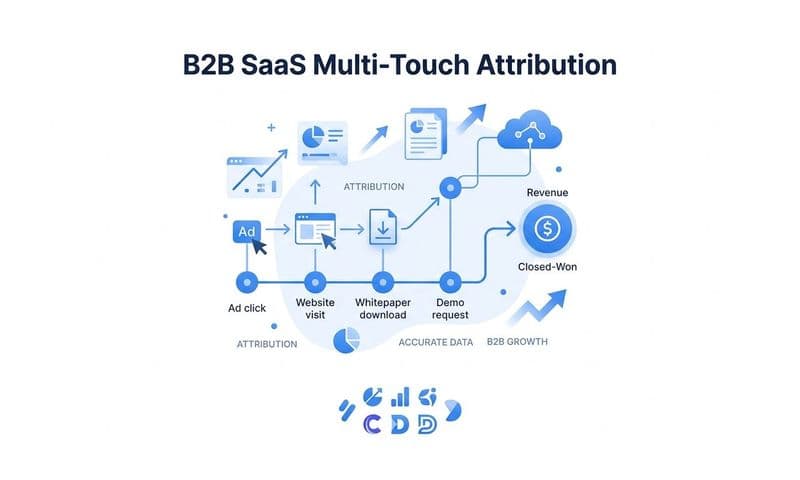
Create a visual map showing how customers move between these touchpoints. A B2B software buyer might click a LinkedIn ad, visit your website three times over two weeks, download a whitepaper, attend a webinar, then schedule a demo call. If any step in that journey isn't tracked, your attribution breaks.
Identify Common Gap Patterns
Certain tracking failures happen predictably across most businesses. Cross-domain tracking breaks when customers move from your main website to a checkout subdomain or separate landing page platform. Mobile app to website transitions lose attribution when users switch devices. Cookie limitations mean multi-session journeys often lose the original source.
Phone call attribution is missed by 70% of businesses that rely solely on online tracking. If you're running ads that drive phone calls, but you're only measuring form submissions, you're missing a massive piece of your conversion picture. These patterns become clear when examining how successful businesses have addressed similar challenges, as documented in various case studies of tracking transformations.
Look for discrepancies between what your ad platforms report and what your CRM or sales team sees. If Facebook shows 50 conversions but your CRM only has 35 new leads with Facebook as the source, you've found a gap. If Google Analytics shows 100 purchases but your e-commerce platform processed 140 orders, that's a 40% tracking gap that's costing you accurate data.
Understanding the fundamentals of conversion tracking helps you identify where your specific implementation deviates from best practices. The most common issue is inaccurate conversion tracking caused by cookie blocking, cross-domain issues, or incomplete event configuration.
Step 2: Implement Server-Side Tracking Foundation
Browser-based tracking is dying. Every iOS update, every browser privacy change, every ad blocker chips away at your ability to measure conversions accurately. If you're still relying entirely on client-side pixels and cookies, you're missing 25-40% of your actual conversions. That's not a tracking problem—that's a business intelligence crisis.
Server-side tracking solves this by sending conversion data directly from your server to advertising platforms, completely bypassing browser limitations. When a customer converts, your server tells Facebook, Google, and TikTok what happened—no cookies required, no browser restrictions, no iOS limitations.
Why Server-Side Tracking Matters
Apple's iOS 14.5 update fundamentally broke mobile conversion tracking. Safari's Intelligent Tracking Prevention blocks third-party cookies. Firefox Enhanced Tracking Protection does the same. Chrome is phasing out third-party cookies entirely. Ad blockers affect 25-30% of web traffic. The list goes on.
The result? Your Facebook Pixel fires, but Safari blocks it. Your Google Ads conversion tag loads, but an ad blocker stops it. Your customer converts, but your ad platform never knows. You see zero conversions in your dashboard while your bank account shows real revenue.
Server-side tracking recovers this lost data. Instead of relying on browser-based pixels that can be blocked, your server sends conversion events directly to ad platforms through their APIs. Understanding the full scope of server side tracking benefits helps justify the implementation investment and sets proper expectations for accuracy improvements.
This isn't optional anymore. It's the difference between making marketing decisions on 60% of your data versus 90% of your data.
Setting Up Your Server-Side Infrastructure
The technical implementation sounds intimidating, but it breaks down into three manageable components: setting up a server-side container, configuring platform APIs, and mapping your conversion events.
Start with Google Tag Manager Server-Side. Create a new server container in your GTM account, then deploy it to a server environment. You can use Google Cloud Platform's App Engine (easiest option), your own server infrastructure, or a third-party hosting service. The server container acts as a middleman—receiving conversion data from your website and forwarding it to advertising platforms.
Next, configure the Conversions API for each advertising platform. Facebook's Conversions API requires an access token and pixel ID. Google Ads needs conversion action IDs and API credentials. TikTok Events API requires similar authentication. For teams requiring detailed technical guidance on how to set up server side tracking with specific platform configurations and troubleshooting steps, comprehensive implementation resources can accelerate your deployment.
The critical piece is event mapping. Your server needs to send the same conversion events you were tracking client-side, but now with additional data that improves matching. Include customer email addresses (hashed), phone numbers (hashed), IP addresses, and user agent strings. This information helps platforms match server-side events to actual users, dramatically improving attribution accuracy.
Choosing the right implementation approach depends on your technical resources and business needs. Evaluating top conversion tracking platforms helps you understand which solutions offer the best server-side capabilities for your specific use case. For specialized industries like education, conversion tracking for online courses requires unique event structures that capture enrollment milestones and student engagement metrics.
Testing Your Implementation
Before you trust your new server-side tracking with real budget decisions, verify it's working correctly. Use each platform's testing tools to confirm events are being received and matched properly.
Facebook's Events Manager has a Test Events feature that shows real-time server-side events as they arrive. Send a test conversion from your website and watch it appear in the test events panel. Check that all parameters are being passed correctly—especially customer information parameters that enable event matching.
Google Ads has a similar diagnostic tool in the conversions section. Trigger a test conversion and verify it appears in your conversion tracking dashboard within a few minutes. If it doesn't show up, check your API credentials and conversion action configuration.
Step 3: Configure Cross-Platform Event Matching
You've got Google Ads reporting 47 conversions, Facebook claiming 62, and your CRM showing 38 closed deals. Same time period. Same campaigns. Three completely different numbers. This isn't a tracking problem—it's an event matching problem.
Cross-platform event matching is where most conversion tracking falls apart. Each advertising platform has its own event structure, parameter requirements, and customer identification methods. When these don't align, platforms can't properly attribute conversions, leading to the data chaos you're seeing in your dashboards.
The solution isn't picking which platform to trust. It's creating a standardized event structure that works across all platforms while meeting each one's specific requirements. This gives you consistent, comparable data that actually reflects what's happening in your business.
Understanding Event Parameters
Event parameters are the data points that tell advertising platforms what happened and who did it. Without consistent parameters, platforms can't match conversions back to the right campaigns, ads, or users.
The most critical parameters are customer identifiers—email addresses, phone numbers, and user IDs. When Facebook receives a purchase event with an email address that matches a user who clicked your ad, it can confidently attribute that conversion. Without that email parameter, or with an inconsistently formatted one, the conversion becomes "unattributable."
Event value and currency standardization matters just as much. If you're sending purchase values in cents to one platform and dollars to another, your ROAS calculations will be wildly inconsistent. Your Google Ads might show a 2x ROAS while Facebook shows 200x—same data, different formatting, completely misleading results.
Custom parameters let you track business-specific data that matters for your optimization. A SaaS company might include subscription tier, trial length, or feature usage. An e-commerce business might track product category, shipping method, or customer lifetime value. These parameters become crucial when you're optimizing campaigns for quality, not just quantity.
Standardizing Your Event Structure
Create a single source of truth for how events are named and structured across your entire marketing stack. This means deciding on event names that work universally—"purchase" instead of "buynow" on one platform and "transactioncomplete" on another.
Your standardized structure should include mandatory parameters that every event must have: event name, timestamp, customer identifier (email or hashed email), event value, and currency. Optional parameters can vary by event type, but the core structure stays consistent.
Implement this through your data layer—the JavaScript object on your website that holds all tracking data before it's sent to platforms. When someone completes a purchase, your data layer captures all relevant information in your standardized format. Then your tracking setup translates that standard format into each platform's specific requirements.
Document your event structure in a shared spreadsheet that your entire team can reference. List every event you track, its parameters, data types, and which platforms receive it. This becomes your single source of truth when troubleshooting discrepancies or adding new tracking.
Platform-Specific Configuration
Now translate your standardized events into each platform's language. Facebook's Conversions API expects events named using their standard event taxonomy—"Purchase", "Lead", "CompleteRegistration". Google Ads uses conversion actions that you define in your account. TikTok has its own event naming conventions.
The key is maintaining your internal standardization while adapting to each platform's requirements. Your data layer might use "checkout_complete" internally, but your tracking code translates that to "Purchase" for Facebook, maps it to your "Online Sale" conversion action in Google Ads, and sends it as "PlaceAnOrder" to TikTok.
For larger organizations managing complex tracking across multiple properties, enterprise conversion tracking tools provide centralized management of event structures and platform configurations. These enterprise conversion tracking solutions ensure consistency across teams and properties while maintaining platform-specific adaptations.
Step 4: Bridge Offline and Online Conversions
Here's the uncomfortable truth most marketers avoid: your digital tracking is probably capturing less than half your actual marketing-driven revenue. If you're a B2B company, service business, or anyone with a sales team, the majority of your conversions happen offline—after the initial online touchpoint. And if you're not connecting those dots, you're making budget decisions in the dark.
The phone rings. A customer walks into your store. A sales rep closes a deal that started with a Google Ad three weeks ago. None of this shows up in your Facebook Ads dashboard. Your attribution is broken, and you don't even know which campaigns are actually working.
Identifying Offline Conversion Points
Start by mapping every place where marketing-influenced conversions happen outside your website. This isn't about tracking everything—it's about tracking what matters for revenue attribution.
Phone Calls: If prospects call you after seeing an ad or visiting your website, those are marketing-driven conversions. Home services companies, legal firms, healthcare providers—phone calls are often your primary conversion point. Yet most businesses only track online form submissions.
In-Store Purchases: Someone researches your product online, then buys in your physical location. That's a marketing-influenced conversion that never shows up in Google Analytics. Retailers lose visibility into millions in revenue this way.
Sales Team Conversions: Your marketing generates a lead. Sales nurtures it for weeks or months. The deal closes. If you're not connecting that closed deal back to the original campaign, you have no idea which marketing channels actually drive revenue.
Create a simple spreadsheet listing every offline touchpoint where conversions occur. Include the volume (how many per month), the average value, and the typical time lag between initial online touchpoint and offline conversion. This becomes your offline attribution roadmap.
CRM Integration Strategies
Your CRM holds the truth about which leads actually convert to revenue. The challenge is getting that truth back into your marketing platforms so they can optimize for real outcomes, not just form submissions.
The technical approach depends on your CRM, but the principle is universal: when a deal closes in your CRM, send that conversion event back to your ad platforms with the original campaign attribution data. This requires three components working together.
First, capture the original marketing source when leads enter your CRM. Use UTM parameters, GCLID for Google Ads, or FBC/FBP parameters for Facebook. Store these in custom fields in your CRM so they persist throughout the sales cycle.
Second, set up webhooks or API connections that trigger when deals reach specific stages—typically "Closed Won" or "Opportunity Created" depending on your sales process. These webhooks send conversion data back to your ad platforms in real-time.
Third, implement proper customer matching so platforms can connect the offline conversion to the original ad interaction. This means sending hashed email addresses, phone numbers, or customer IDs that match what the platform already has.
Most modern CRMs like Salesforce, HubSpot, or Pipedrive support webhook configurations. The setup takes 2-3 hours but transforms your attribution accuracy. Suddenly your ad platforms see which campaigns drive actual revenue, not just leads.
For businesses just starting with offline conversion tracking, understanding the basics of setting up conversion tracking provides a foundation before implementing more complex CRM integrations. Once your basic tracking is solid, learning how to improve ad tracking accuracy through advanced matching techniques and data quality improvements becomes your next optimization priority.
Putting It All Together
Fixing conversion tracking gaps isn't a one-time project—it's an ongoing commitment to measurement accuracy that directly impacts your bottom line. You've now got a systematic approach that addresses the four critical areas where tracking breaks down: infrastructure auditing, server-side implementation, cross-platform standardization, and offline-online bridging.
The businesses that win in digital marketing aren't the ones with the biggest budgets—they're the ones with the most accurate data. When you can confidently say which campaigns drive revenue, which audiences convert best, and which creative actually works, you make better decisions. You scale what works and cut what doesn't. You stop wasting money on campaigns that look good in dashboards but don't drive business results.
Start with the audit. Spend a day mapping your current tracking infrastructure and identifying your gaps. You'll probably find 3-5 major issues that are costing you visibility into 20-40% of your conversions. That's not a minor problem—that's a business-critical issue that's affecting every marketing decision you make.
Then implement server-side tracking. This single change recovers the majority of conversions lost to browser restrictions and privacy controls. It's technical, but it's not impossible. Most businesses complete their server-side implementation in 1-2 weeks and immediately see their tracked conversion volume increase by 25-35%.
Standardize your event structure across platforms. This eliminates the confusion of different numbers in different dashboards. When Facebook, Google, and your CRM all report similar conversion counts, you can trust your data enough to make confident budget decisions.
Finally, bridge your offline conversions. This is where B2B companies and service businesses see the biggest impact. When your ad platforms can optimize for closed deals instead of just form submissions, your campaign performance improves dramatically. You're no longer optimizing for vanity metrics—you're optimizing for revenue.
The result is a measurement infrastructure you can trust. You'll know which campaigns actually drive business results. You'll make budget decisions based on complete data. And you'll stop wondering if your tracking is broken every time you look at your dashboards.
Your competitors are still flying blind, making decisions on incomplete data while wondering why their campaigns don't perform. You'll have the clarity to scale what works and the confidence to cut what doesn't. That's not just better tracking—that's a competitive advantage.
Ready to elevate your marketing game with precision and confidence? Discover how Cometly's AI-driven recommendations can transform your ad strategy—**Get your free demo** today and start capturing every touchpoint to maximize your conversions.