
You're staring at your Facebook Ads dashboard at 11 PM on a Tuesday, and something doesn't add up. The platform shows 47 conversions this month. Your CRM shows 183 actual sales. Your Google Analytics reports 94 goal completions. Three different numbers for the same business outcome.
This isn't a data glitch. It's the new reality of digital marketing in 2026.
Since iOS 14.5 launched Apple's App Tracking Transparency framework, followed by browser cookie restrictions and privacy-first updates across every major platform, marketing attribution has fractured. The tracking mechanisms that powered your campaigns for years—third-party cookies, pixel-based tracking, cross-site data sharing—are failing at scale. Industry data shows attribution loss ranging from 20% to 40% across sectors, with some mobile-heavy businesses losing visibility into more than half their customer journey.
The business impact goes far beyond confusing dashboards. When you can't accurately attribute conversions, you can't optimize campaigns. When ad platforms receive incomplete conversion data, their algorithms optimize toward the wrong signals. When your boss asks which channels deserve more budget, you're making million-dollar decisions based on partial information.
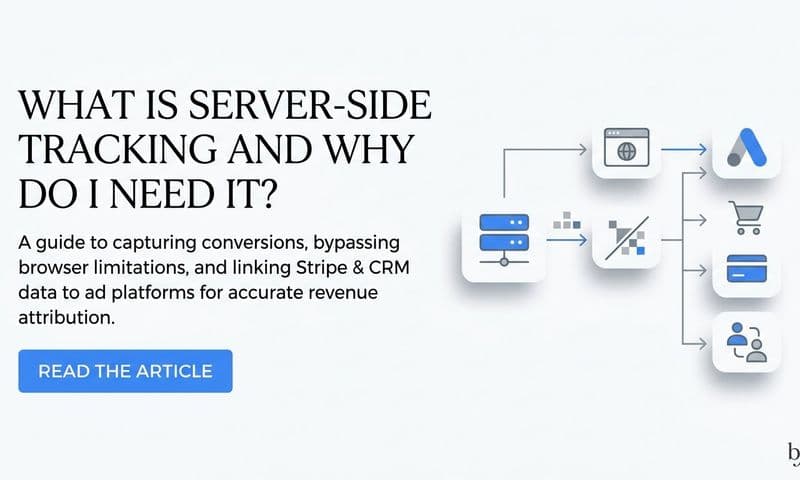
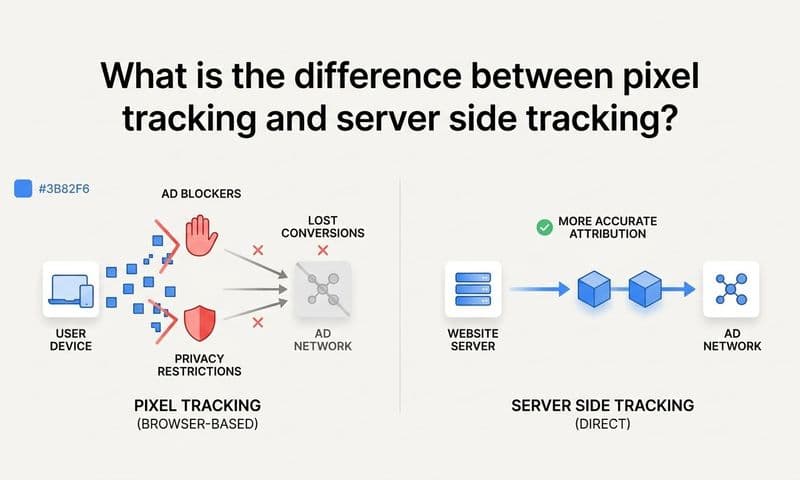
Server-side tracking solves this problem by fundamentally changing where and how you collect marketing data. Instead of relying on browser-based pixels that privacy updates can block, server-side tracking moves data collection to your controlled server environment. This approach bypasses browser restrictions, captures complete customer journeys across devices and sessions, and sends accurate conversion data back to ad platforms for optimization.
This guide walks you through the complete implementation process—from auditing your current tracking gaps to deploying production-ready server-side infrastructure. You'll learn how to design your tracking architecture, configure event collection, integrate with ad platforms and CRM systems, and optimize for scale. By the end, you'll have a clear roadmap for recovering the attribution visibility you've lost and building tracking infrastructure that works regardless of future privacy changes.
Let's start by understanding exactly what server-side tracking means for your marketing operations and why it's become essential for accurate attribution in 2026.
Step 1: Audit Your Current Tracking Infrastructure
Before you implement server-side tracking, you need to understand exactly what you're fixing. Most marketing teams discover they're operating with far less visibility than they realized—and the gaps are costing them real money.
Start by pulling reports from every platform you use: Facebook Ads, Google Ads, your CRM, Google Analytics, and any other tools in your stack. Export conversion data for the past 30 days. Now compare the numbers side by side.
You're looking for discrepancies. If Facebook reports 50 conversions, Google Analytics shows 75, and your CRM records 120 actual sales, you've got a 58% attribution gap between what your ad platforms see and what actually happened. This isn't unusual—it's the norm in 2026.
Identifying Critical Tracking Gaps in Your Setup
The most common blind spots appear in three areas: cross-device tracking, attribution windows, and CRM integration failures.
Cross-device tracking breaks when users interact with your ads on mobile but convert on desktop. Client-side pixels can't connect these sessions, so the conversion appears "organic" instead of attributed to your paid campaigns. Check your analytics for the percentage of users who switch devices during their journey—if it's above 30%, you're losing significant attribution data.
Attribution windows create gaps when your sales cycle exceeds the platform's tracking window. Facebook's default 7-day click window means conversions happening on day 8 disappear from reporting. Most marketing teams discover multiple instances of inaccurate conversion tracking during comprehensive audits, revealing systematic attribution failures that server-side implementation resolves.
CRM integration gaps are the most expensive blind spot. When your CRM doesn't send conversion data back to ad platforms, those platforms optimize toward incomplete signals. Pull a report of leads from the past 90 days and check how many have attributed source data. If more than 20% show "direct" or "unknown" as the source, your tracking infrastructure is failing.
Calculating Your Attribution Blind Spots
Now quantify the business impact. Take your total monthly revenue and multiply it by your attribution gap percentage. If you're doing $500K in monthly revenue with a 40% attribution gap, that's $200K in sales that your marketing platforms can't see or optimize toward.
Next, calculate channel-specific discrepancies. Compare what each ad platform reports for conversions against what your CRM shows for leads attributed to that channel. The difference reveals how much data each platform is missing. Once you've identified your attribution blind spots, implementing proven strategies to improve ad tracking accuracy becomes your immediate priority before moving to server-side implementation.
Create a simple spreadsheet with three columns: Platform Reported Conversions, Actual CRM Conversions, and Attribution Gap Percentage. This becomes your baseline for measuring server-side tracking improvement.
The final step in your audit is mapping your complete customer journey. Document every touchpoint where users interact with your marketing: ad clicks, landing page visits, form submissions, email opens, trial signups, and purchases. Then identify which touchpoints you're currently tracking and which are invisible to your current setup.
Most teams discover they're only capturing 40-60% of the actual customer journey. The missing touchpoints—email nurture sequences, retargeting interactions, cross-channel tracking implementation failures—represent revenue you're generating but can't attribute to specific marketing efforts.
Putting It All Together
Server-side tracking isn't optional anymore—it's the foundation of accurate marketing attribution in 2026. You've seen how browser restrictions and privacy updates have created attribution blind spots that cost you visibility into 20-40% of your customer journey. You've learned how to audit your current tracking gaps, design proper server-side architecture, implement core infrastructure, and connect your entire marketing stack.
The implementation process requires technical precision, but the marketing impact is immediate. You'll recover lost conversion data, send accurate signals back to ad platforms for better optimization, and finally make budget decisions based on complete attribution rather than fragmented guesses.
Start with your audit. Identify where you're losing attribution visibility right now. Then choose your server-side approach—whether that's building custom infrastructure or implementing a platform solution like Cometly that handles the technical complexity while giving you complete attribution control.
The marketing teams winning in 2026 aren't the ones with the biggest budgets. They're the ones with the most accurate data. Server-side tracking gives you that accuracy.
Ready to recover your missing attribution data and build tracking infrastructure that actually works? Get your free demo and see how Cometly's server-side tracking platform captures every touchpoint from ad click to revenue.