You're looking at your dashboard, and something doesn't add up. Facebook says it drove 150 conversions this month. Google Ads claims 120. Your CRM shows 180 total sales. The math is broken, and you know it.
Here's what's really happening: A customer sees your Instagram ad on their phone during their morning commute. They click, browse a bit, but don't buy—they're on a crowded train. Later that day, they Google your brand name on their work laptop, read some reviews, add items to cart. That evening, they finally pull out their tablet on the couch and complete the purchase.
To you, that's one customer, one sale. To your tracking systems, that's three completely different anonymous users across three separate devices. Facebook takes credit for the conversion. Google takes credit for the same conversion. Your attribution data is double-counting, your CAC calculations are inflated, and you're making budget decisions based on fiction.
This is the multi-device customer tracking challenge, and it's costing you more than you realize. When you can't connect these fragmented touchpoints into a single customer journey, you're flying blind. You might be cutting spend on the channels that actually start the conversion process while pouring money into the ones that just happen to get the last click. You're potentially starving your winners and feeding your losers.
The Fragmented Customer Journey: How We Got Here
The average person now owns multiple connected devices, and they don't think twice about switching between them. They use their phone for quick research during downtime, their laptop for deeper comparison shopping, and their tablet for leisurely evening browsing. This behavior isn't an edge case anymore. It's the default.
The problem is that our tracking infrastructure was built for a different era. Traditional cookie-based tracking emerged when most people had one computer at home and maybe one at work. The assumption was simple: one device equals one user. Track the device, and you've tracked the person.
That model is fundamentally broken now. When someone visits your site on their phone, your tracking drops a cookie. When they return on their laptop, that's a different cookie, a different session, a different "user" in your analytics. The technology can't see that it's the same person continuing their research.
Privacy changes have accelerated this fragmentation dramatically. Apple's iOS updates starting in 2021 required apps to ask permission before tracking users across apps and websites. Most people opt out. Browser makers are phasing out third-party cookies entirely. Privacy-focused browsers block tracking by default. Understanding cookieless attribution tracking has become essential for modern marketers.
These aren't temporary obstacles. They represent a permanent shift in how digital tracking works. The old methods of following users across the web are disappearing, and they're not coming back. The gap between what actually happened in a customer journey and what your tracking systems can see is growing wider every quarter.
For marketers, this creates a critical challenge. Your customers are behaving normally, using multiple devices as they naturally would. But your attribution data is capturing only fragments of their journey, missing the connections that would reveal which marketing touchpoints actually drove the decision to buy.
Five Core Challenges Breaking Your Multi-Device Attribution
The first and most fundamental problem is identity fragmentation. Every time a user switches devices, they appear as a completely new person in your tracking system. The customer who clicked your ad on mobile this morning looks like a different individual than the one who converted on desktop this afternoon.
This isn't just a minor inconvenience. It systematically inflates your audience counts, making you think you're reaching more unique people than you actually are. It breaks your frequency analysis because you can't see how many times you've actually shown ads to the same person across devices. And it completely destroys attribution because there's no thread connecting these separate touchpoints to a single customer journey.
Cross-device conversion gaps create the second major challenge. Let's say someone discovers your brand through a Facebook ad on their phone, but they don't convert immediately. Later, they search your brand name on their laptop and buy. With traditional tracking, Google gets 100% of the credit for that conversion because it captured the last click before purchase.
Facebook, which actually introduced your brand to a cold prospect, gets zero credit. If you're using last-click attribution, you'll conclude that Facebook isn't working and Google is your star performer. You'll shift budget accordingly. In reality, you're defunding the channel that's doing the hard work of customer acquisition and overfunding the one that's simply capturing existing demand. This is one of the most common attribution challenges in marketing analytics that teams face today.
The third challenge is data silos between platforms. Facebook's tracking pixel sees what happens on Facebook and your website when users come from Facebook. Google's tracking sees its own ecosystem. Your CRM sees a different slice. None of them can see the full picture because they're measuring from their own limited perspective.
This leads to a bizarre situation where summing up conversions across platforms gives you a number significantly higher than your actual sales. Each platform is claiming credit for conversions that happened across multiple devices and touchpoints. They're all technically correct from their own narrow view, but collectively they're painting a distorted picture of reality.
The fourth challenge is the loss of granular data. Even when you know a conversion happened, you often can't see the specific path that led to it. Which ad creative did they first see on mobile? What content did they engage with on desktop? What finally convinced them to buy on tablet? These details get lost in the device-switching process.
Finally, there's the technical complexity of identity resolution itself. Connecting anonymous device identifiers to real people is genuinely difficult. IP addresses change. Devices get shared among family members. People clear cookies. Browser fingerprinting methods that try to identify users without cookies are increasingly blocked by privacy tools. The technical challenges are substantial, and there's no perfect solution that works in every situation.
The Real Cost of Incomplete Device Tracking
Budget misallocation is the most immediate and measurable cost. When you can't see that your Instagram ads are initiating customer journeys that convert days later on different devices, you systematically undervalue those campaigns. You see low immediate conversion rates and conclude they're not working.
Meanwhile, branded search campaigns show excellent conversion rates because they're capturing people who already know your brand from other channels. You shift more budget to search. Your overall customer acquisition actually slows down because you've reduced investment in the channels that create awareness and consideration, even though your efficiency metrics look better on paper.
This pattern plays out across channels. Display advertising, video campaigns, and upper-funnel content often initiate journeys that convert through other channels later. Without cross-device tracking, these crucial awareness-building efforts appear to have poor ROI, leading to cuts that ultimately hurt your growth. Proper channel attribution in digital marketing requires seeing the complete picture.
Customer acquisition cost calculations become fundamentally unreliable. If the same customer appears as three different people across three devices, and you're counting each as a separate acquisition, your CAC numbers are inflated by potentially 2-3x. You might think you're spending $150 to acquire a customer when the real number is $50.
This distortion cascades through your entire business model. Your unit economics look worse than they actually are. Profitable campaigns appear marginal. You might reject expansion opportunities or new channels because your inflated CAC makes them look unprofitable when they'd actually work fine with accurate numbers.
Retargeting becomes a mess of wasted spend and missed opportunities. Without unified customer profiles across devices, you face two bad outcomes. First, you continue showing ads to people who already converted on a different device, annoying customers and wasting budget. Second, you fail to retarget warm prospects who engaged on one device but haven't converted yet, missing opportunities to close sales that are already in progress.
The competitive disadvantage compounds over time. Your competitors who solve multi-device tracking can see customer journeys you can't. They can optimize based on reality while you're optimizing based on incomplete data. They can confidently invest in channels that you've incorrectly written off as ineffective. The gap in marketing effectiveness widens every quarter.
Modern Approaches to Solving Cross-Device Tracking
Deterministic matching represents the most accurate approach to connecting devices. This method uses concrete identifiers like email addresses, phone numbers, or authenticated logins to definitively link devices to the same person. When someone logs into your app or website on their phone and later logs in on their laptop, you can be certain it's the same individual.
The advantage of deterministic matching is precision. There's no guessing involved. You're not using probabilistic signals to infer connections. You have direct evidence that these devices belong to the same user. This makes your attribution data dramatically more reliable and your customer journey analysis actually accurate.
The challenge is that deterministic matching requires users to identify themselves. You need to give them a reason to create an account, log in, or share their email address. This works well for apps and services where login is natural, but it's harder for content sites or simple e-commerce where users can browse and buy without authenticating.
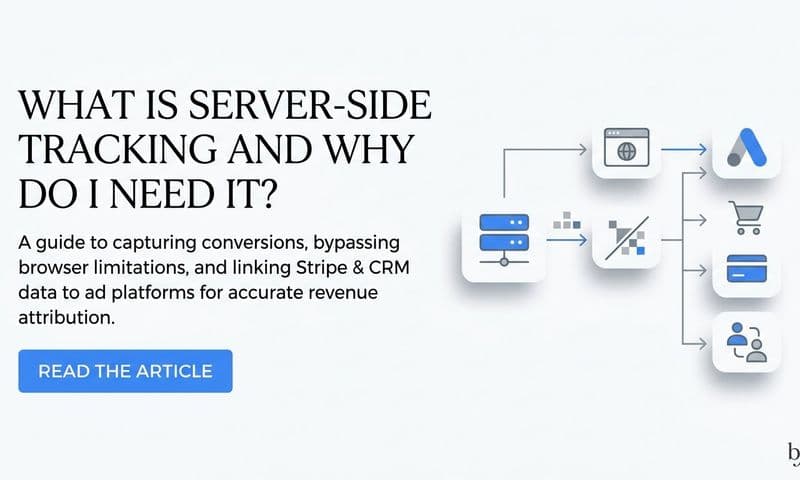
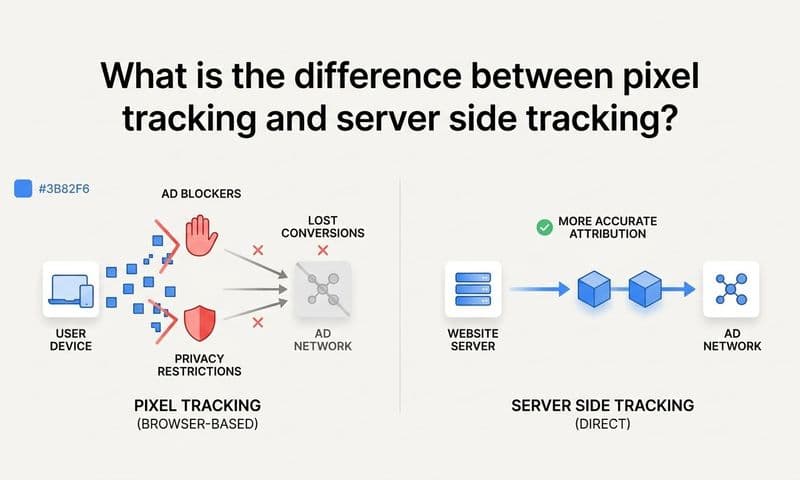
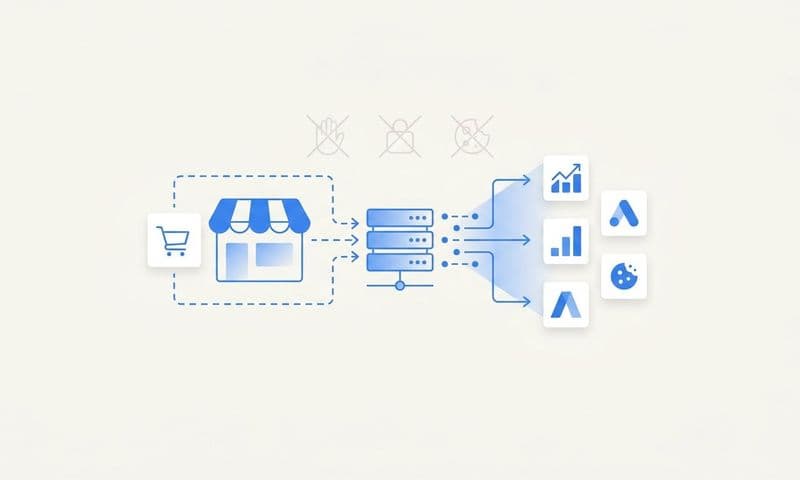
Server-side tracking has emerged as a critical solution to tracking prevention. Instead of relying on browser-based cookies and pixels that can be blocked, server-side tracking moves data collection to your server infrastructure. When a conversion happens, your server sends that data directly to ad platforms and analytics tools. Understanding the differences between Google Analytics vs server-side tracking helps you choose the right approach for your business.
This approach bypasses many of the privacy restrictions that break browser-based tracking. Ad blockers can't prevent your server from sending data. iOS tracking restrictions don't apply to server-to-server communication. You maintain much more reliable conversion tracking even as browser-based methods become less effective.
Server-side tracking also gives you more control over what data gets sent and how it's formatted. You can enrich conversion events with additional context from your CRM or database before sending them to ad platforms. This helps platform algorithms optimize better because they're working with richer, more accurate data about what actually drives conversions.
Unified customer journey tracking software takes a comprehensive approach by connecting all your data sources into a single view. These systems integrate with your ad platforms, CRM, website analytics, and other tools to capture every touchpoint in the customer journey, then use identity resolution techniques to connect those touchpoints to individual customers.
The power of this approach is completeness. Instead of seeing fragments from different platforms that don't connect, you see the actual path customers took from first awareness to final purchase. You can analyze which combinations of touchpoints drive conversions, which channels work together, and where you're missing opportunities in the journey.
Multi-touch attribution models become practical with unified tracking. Instead of arbitrarily giving all credit to the first or last touchpoint, you can distribute credit across the actual sequence of interactions that led to a conversion. This reveals the true value of each channel and helps you make smarter budget allocation decisions.
Building Your Cross-Device Tracking Strategy
Start by prioritizing first-party data tracking. Create legitimate value exchanges that encourage users to identify themselves. This might be account creation for personalized features, email signup for exclusive content, or loyalty programs that require registration. The key is making the benefit clear and immediate so users willingly provide the identifiers you need for deterministic matching.
Don't make login mandatory for basic functionality. That creates friction and reduces conversions. Instead, offer progressive enhancement where logged-in users get additional benefits. Let people browse and research anonymously, but provide compelling reasons to authenticate when they're ready. This balances conversion optimization with data collection.
Implement server-side tracking alongside your existing browser-based tracking. This isn't an either-or choice. Browser tracking still captures valuable data when it works. Server-side tracking fills the gaps when browser methods fail. Running both in parallel gives you the most complete picture possible given current technical constraints.
The implementation requires technical work, but it's increasingly accessible. Most major ad platforms now support server-side conversion APIs. Modern analytics platforms provide server-side SDKs. If you're on a standard e-commerce or marketing platform, there are often plugins or integrations that handle the server-side implementation without custom development. Following a cross-platform tracking setup guide can simplify this process significantly.
Move beyond last-click attribution models. They're simple, but they systematically misrepresent reality in a multi-device world. Implement multi-touch attribution that credits the full sequence of touchpoints. Different models weight touchpoints differently—linear gives equal credit, time-decay gives more credit to recent touches, position-based emphasizes first and last—but all of them are more accurate than last-click alone. Exploring various attribution tracking methods will help you find the right fit.
Feed enriched conversion data back to ad platforms. When you can connect conversions to the actual customer journey through unified tracking, send that enhanced data to Facebook, Google, and other platforms through their conversion APIs. This helps their algorithms understand what really drives conversions, improving their targeting and optimization even when their own tracking is incomplete.
This creates a positive feedback loop. Better data leads to better platform optimization, which leads to better campaign performance, which gives you more conversions to learn from. You're not just passively accepting the limitations of platform tracking. You're actively improving it by feeding platforms the customer journey data they can't see on their own.
Regularly audit your attribution data for signs of tracking gaps. Look for patterns like dramatically different conversion counts across platforms, sudden drops in tracked conversions that don't match actual sales, or attribution that doesn't align with your qualitative understanding of how customers discover and buy from you. Learning how to improve ad tracking accuracy should be an ongoing priority for your team.
Taking Control of Your Customer Journey Data
The multi-device tracking challenge isn't getting easier. Privacy regulations will continue tightening. Browser restrictions will expand. The gap between actual customer behavior and what traditional tracking can see will keep growing. This isn't a temporary disruption you can wait out. It's the new permanent reality of digital marketing.
The marketers who solve this problem now gain a significant competitive advantage. While others make decisions based on incomplete data, you'll see the full customer journey. While they systematically misallocate budget to last-click channels, you'll invest based on what actually drives conversions. The difference in marketing effectiveness compounds quarter after quarter.
This isn't just about better reporting or cleaner dashboards. It's about making fundamentally better strategic decisions. Knowing which channels work together, which touchpoints matter most, and where to invest your next dollar. That knowledge translates directly into more efficient customer acquisition and faster growth.
The technical solutions exist. Server-side tracking, unified customer journey platforms, and deterministic matching aren't theoretical concepts. They're working approaches that leading marketers are implementing right now. The question isn't whether these methods work—they do. The question is how quickly you'll adopt them while your competitors are still struggling with fragmented attribution.
Start with the foundation: first-party data collection and server-side tracking. These two elements alone will dramatically improve your attribution accuracy. Then layer on unified journey tracking and multi-touch attribution models. Each step makes your marketing data more reliable and your optimization decisions more effective.
Ready to elevate your marketing game with precision and confidence? Discover how Cometly's AI-driven recommendations can transform your ad strategy—Get your free demo today and start capturing every touchpoint to maximize your conversions.