You're spending thousands on ads every month, but when you check your analytics, the numbers don't add up. Your ad platforms report one set of conversions. Your CRM shows different numbers. Your actual revenue? That's a third story entirely. If you've ever felt like you're flying blind with your marketing budget, you're not alone—and the problem has only gotten worse.
Privacy changes have fundamentally reshaped how ad tracking works. iOS restrictions block tracking by default. Browsers are phasing out cookies. Cross-device customer journeys create attribution nightmares. The result? Many marketers are making budget decisions based on incomplete or inaccurate data, crediting the wrong channels and scaling campaigns that might not actually be driving revenue.
Here's the good news: you can fix this. Improving ad tracking accuracy isn't about buying expensive tools or hiring a team of engineers. It's about following a systematic approach to identify where your data breaks down, implement modern tracking methods, and validate what's actually working.
This guide walks you through six practical steps to dramatically improve your tracking accuracy. You'll learn how to audit your current setup, implement server-side tracking, connect your full customer journey, configure proper attribution, feed better data back to ad platforms, and maintain data quality over time. Whether you're running a small team or managing enterprise campaigns, these steps work regardless of your current tech stack.
By the end, you'll have a clear roadmap to close tracking gaps and make confident decisions about where to invest your marketing budget. Let's get started.
Step 1: Audit Your Current Tracking Setup for Data Gaps
Before you can fix tracking problems, you need to know exactly where they exist. Think of this like a diagnostic checkup—you're identifying symptoms before prescribing treatment. Start by comparing conversion numbers across three sources: what your ad platforms report, what your analytics shows, and what actually happened in your CRM or sales system.
Pull reports from each of your active ad platforms for the past 30 days. Look at reported conversions, leads, or purchases. Now compare those numbers to what your website analytics captured for the same period. Finally, check your actual business results—how many real customers signed up, how many sales closed, how much revenue came in. The gaps between these numbers reveal your tracking problems.
Common culprits usually fall into a few categories. Ad blockers prevent tracking pixels from firing, which means you never see those visitors in your analytics. iOS privacy restrictions block cross-site tracking, creating blind spots for mobile traffic. Cross-domain issues cause tracking to break when users move between your marketing site and checkout page. Delayed attribution windows mean conversions get credited to the wrong source or not tracked at all.
Check your pixel firing rates by using browser developer tools or a pixel testing tool. Visit your own landing pages and verify that tracking pixels actually load. Test this on different devices and browsers—what works on desktop Chrome might fail on mobile Safari. You'll often find that 20-30% of your traffic never triggers your tracking pixels at all.
Create a simple tracking health scorecard. List each major traffic source (Google Ads, Meta, LinkedIn, organic search) and rate the data quality for each on a scale of 1-5. Note specific issues: "Meta conversions 40% lower than CRM reality," "iOS traffic completely untracked," "Checkout page breaks UTM parameters." This becomes your baseline for marketing data accuracy improvement.
Document the estimated impact of each gap. If your CRM shows 100 new customers but your ad platforms only tracked 60 conversions, you have a 40% tracking gap. That's not just a data problem—it means you're making budget decisions with less than two-thirds of the real picture.
Your success indicator here is straightforward: you should have a written document listing specific tracking gaps, which channels they affect, and roughly how much data you're losing. This audit becomes your roadmap for the next five steps. Without it, you're guessing at solutions. With it, you can prioritize fixes based on actual impact.
Step 2: Implement Server-Side Tracking as Your Foundation
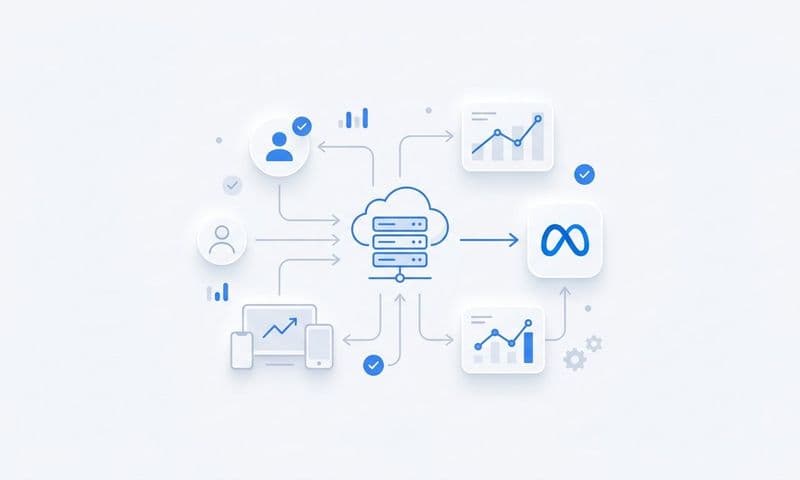
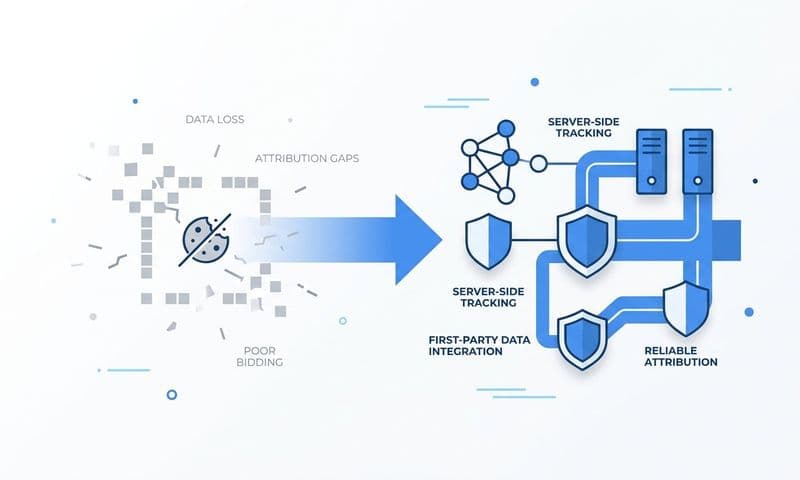
Browser-based tracking pixels were the standard for years, but they're increasingly unreliable. Ad blockers remove them. Privacy settings disable them. They can't track what happens after someone leaves your website. Server-side tracking solves these problems by capturing events on your server before sending them to analytics platforms and ad networks.
Here's why this matters: when someone clicks your ad and lands on your site, browser-based pixels only fire if their browser allows it. With iOS restrictions and ad blockers, many visitors never trigger those pixels. Server-side tracking captures the event regardless of browser settings because it happens on your server, not in the user's browser.
Think of it like the difference between asking customers to mail you a postcard (client-side) versus having a security camera at your door (server-side). The postcard method only works if customers remember and have stamps. The camera captures everyone who walks through.
Implementation starts with your website infrastructure. You need a server-side tracking solution that can capture events from your website, send them to your analytics platform, and forward them to ad platforms through their conversion APIs. This typically involves setting up a server-side Google Tag Manager container or using a dedicated attribution platform that handles this automatically. For detailed instructions, check out our server-side tracking implementation guide.
The key technical pieces you're connecting: your website sends events to your server, your server processes and enriches those events with additional data (like CRM information), then forwards complete event data to Google Analytics, Meta, and other platforms. This creates a more complete picture than browser pixels ever could.
You'll also want to connect your CRM events. When someone fills out a form, makes a purchase, or becomes a qualified lead in your CRM, those events should flow through your server-side tracking setup. This ensures you're not just tracking website visits—you're tracking actual business outcomes.
Start with your highest-value conversion events. If you're an e-commerce business, prioritize purchase tracking. For B2B companies, focus on form submissions and qualified leads. Get those events firing server-side first, then expand to other touchpoints.
Test your implementation by triggering test conversions and verifying they appear in your analytics. Use the platform's event debugging tools—Google Analytics has DebugView, Meta has the Events Manager Test Events feature. Fire a test conversion and watch it flow through your server-side setup in real time.
Your success indicator: server-side events are firing consistently, you can verify them in your analytics platform's debugging tools, and you're seeing more complete data than your old pixel-only setup provided. You should notice fewer "unknown" traffic sources and better attribution for iOS traffic.
Step 3: Connect Your Full Customer Journey Data
Most tracking setups capture the first click and maybe the last action before conversion. But what about everything in between? The webinar they attended. The email they opened. The retargeting ad that brought them back. The demo call that convinced them. Without connecting these touchpoints, you're missing the story of how customers actually buy from you.
Start by mapping your typical customer journey from awareness through purchase. For B2B companies, this might span weeks or months: initial ad click, content download, email nurture sequence, demo request, sales calls, contract signature. For e-commerce, it could be: first visit, browse products, abandon cart, retargeting ad, return and purchase. Write out every major touchpoint.
Now comes the technical part: ensuring tracking data persists through this entire journey. UTM parameters (those ?utm_source tags in your URLs) need to survive every step. If someone clicks a Facebook ad, downloads a guide, and purchases three days later, you need to connect all three events to that original Facebook click.
The challenge is that UTM parameters disappear easily. They're lost when someone navigates between pages. They vanish when someone closes their browser and returns later. They break when users move from your marketing site to a separate checkout domain. You need a system that captures this data once and preserves it throughout the journey. Our guide on cross-platform tracking setup covers this in detail.
Most modern attribution platforms handle this by storing first-touch data in a cookie or database, then appending it to every subsequent event. When someone first arrives from an ad, the system records the source, campaign, and click ID. Every future action—form submission, page view, purchase—gets tagged with that original source data.
For offline conversions, you need to connect sales data back to marketing touchpoints. If you're a B2B company closing deals in Salesforce or HubSpot, those closed-won opportunities need to link back to the original ad that started the relationship. This typically requires integrating your CRM with your tracking platform so revenue data flows back and gets attributed to the right source. Learn more about HubSpot attribution tracking if you're using that platform.
Click IDs are especially important for accurate attribution. When someone clicks a Google ad, Google appends a GCLID to the URL. Facebook uses FBCLID. These unique identifiers let you match conversions back to specific ad clicks with certainty. Make sure your tracking setup captures and preserves these IDs throughout the customer journey.
Test the full flow yourself. Click one of your own ads, go through your conversion funnel, and verify that the original source data appears in your CRM or analytics when you convert. Try this across different scenarios: same-session conversion, return visit days later, mobile to desktop switch.
Your success indicator: you can pull up any customer record in your CRM and see their complete journey—the first ad they clicked, every touchpoint along the way, and which interactions happened before they converted. If you can trace a customer from their initial ad click through to their purchase or signup, you've succeeded.
Step 4: Choose and Configure Your Attribution Model
Now that you're capturing complete journey data, you need to decide how to distribute credit for conversions. Should the first ad that introduced someone to your brand get all the credit? The last ad before they purchased? Or should credit be split across every touchpoint? This is where attribution models come in.
First-touch attribution gives 100% credit to whatever brought someone to you initially. This makes sense if you're focused on awareness and new customer acquisition. It answers: "What channels are best at introducing new people to our brand?" The downside? It ignores everything that happened afterward, even if later touchpoints were crucial to closing the sale.
Last-touch attribution does the opposite—it credits whatever touchpoint happened immediately before conversion. This is what most ad platforms use by default. It's simple and shows what directly drove conversions, but it completely ignores the nurturing journey that got customers ready to buy.
Multi-touch attribution splits credit across multiple touchpoints based on various rules. Linear attribution divides credit equally. Time-decay gives more credit to recent touchpoints. Position-based (also called U-shaped) gives most credit to first and last touch, with some credit to middle interactions. For businesses with longer sales cycles, multi-touch models provide a more realistic picture. Dive deeper into the ultimate guide to attribution models to understand each approach.
Choose based on your sales cycle length and business model. If you're selling low-cost products with same-session purchases, last-touch might work fine. If you're a B2B company with 60-day sales cycles and multiple touchpoints, you need multi-touch attribution to understand what's really working.
Attribution windows matter just as much as the model itself. This is the time period during which touchpoints get credit for conversions. A 7-day window means only interactions in the week before conversion count. A 30-day window captures more of the journey but might credit touchpoints that didn't actually influence the decision.
Set your attribution window based on your typical customer journey length. Look at your actual customer data: how long does it usually take from first visit to purchase? If most customers convert within two weeks, a 14-day window makes sense. If your sales cycle averages 45 days, you need a longer window to capture the full journey.
Platform-native attribution (what Google Ads or Meta reports) uses each platform's own data and attribution rules. Independent attribution tools give you a unified view across all channels using consistent rules. For accurate cross-channel comparison, you need an independent attribution system that applies the same model and windows to every channel.
Configure your chosen attribution model in your analytics platform. Make sure it's applied consistently across all channels—you can't compare Facebook's last-click attribution to Google's data-driven model and make meaningful decisions. Pick one approach and stick with it.
Your success indicator: you have a clearly defined attribution model that matches your business reality, it's configured consistently across all your tracking, and you can explain to your team why certain channels get credit for conversions. If you're comparing apples to apples across channels, you're on the right track.
Step 5: Feed Better Conversion Data Back to Ad Platforms
Here's something many marketers miss: improving your tracking doesn't just help you make better decisions—it also makes your ads perform better. When you send accurate, enriched conversion data back to ad platforms, their algorithms get smarter about who to target and how to optimize your campaigns.
Ad platforms like Meta and Google use machine learning to optimize delivery. They show your ads to people most likely to convert based on patterns they've learned from previous conversions. But if your conversion data is incomplete or inaccurate, you're training their algorithms on bad information. It's like teaching someone to cook using a recipe with missing ingredients.
Conversion APIs solve this by letting you send conversion events directly from your server to ad platforms. Meta's Conversions API (CAPI) and Google's Enhanced Conversions work the same way: instead of relying solely on browser pixels, you send server-side conversion data that includes additional information the platforms can use for matching and optimization. Understanding Facebook attribution tracking is essential for maximizing Meta's algorithm performance.
The key is event matching—how well the platform can connect your conversion data to the actual person who clicked your ad. Higher match rates mean better attribution and more effective optimization. You improve match rates by sending additional customer information (hashed email addresses, phone numbers, names) along with conversion events.
Set up conversion APIs for your primary ad platforms. For Meta, this means implementing CAPI alongside your pixel. For Google, enable Enhanced Conversions. Both require sending hashed customer data (email, phone) along with conversion events. This additional data helps platforms match conversions to ad clicks even when browser tracking fails.
Send value data with your conversions, not just the fact that a conversion happened. If you're an e-commerce business, include purchase amounts. For B2B, send lead quality scores or deal values. This helps ad platforms optimize for high-value conversions, not just volume. You'll get better results by training algorithms to find your best customers, not just any customers. This approach is key to improving ROAS with better tracking.
The enrichment piece is crucial. When someone converts, send everything you know: their email, purchase history, customer lifetime value, product interests. The more context you provide, the better ad platforms can optimize. Someone who made a $5 purchase is different from someone who spent $500—make sure the platforms know that.
Monitor your match rates in each platform's reporting. Meta shows CAPI match rates in Events Manager. Google provides Enhanced Conversions reporting in Google Ads. You should aim for match rates above 70%—higher is better. Low match rates mean the platform can't connect your conversions to ad clicks, which limits both attribution accuracy and optimization effectiveness.
Test the full loop: run a small campaign, track conversions through your server-side setup, verify the conversions appear in the ad platform with proper matching, and confirm the platform is using that data for optimization. You should see improved attribution confidence scores and better campaign performance over time.
Your success indicator: your ad platforms show improved match rates (ideally above 70%), attribution confidence increases, and you notice better campaign optimization over the following weeks. When platforms report "high" or "verified" match quality for most conversions, you've successfully closed the loop.
Step 6: Validate and Continuously Monitor Data Quality
You've built a comprehensive tracking system. Now you need to make sure it stays accurate. Tracking setups break. Platforms change. New privacy restrictions emerge. Data quality isn't a one-time achievement—it's an ongoing practice that requires regular validation and monitoring.
Start with the ultimate validation: comparing tracked conversions to actual business results. Pull your analytics report for last month's conversions. Now pull your actual revenue, customer, or lead data from your CRM or sales system. How close are the numbers? If your tracking shows 100 conversions but you only had 85 actual customers, you have a 15% gap to investigate.
Some variance is normal—returns, cancellations, and fraud can create legitimate differences between tracked conversions and final revenue. But if your tracked conversions are consistently 20-30% different from reality, something's broken. Large gaps usually indicate tracking fires incorrectly, duplicates conversions, or misses significant portions of your traffic. Follow best practices for tracking conversions accurately to minimize these issues.
Set up regular data quality checks on a weekly or monthly schedule. Create a simple dashboard that shows: total conversions by source, match rates for each platform, discrepancies between platform-reported and independently-tracked conversions, and variance between tracked conversions and actual revenue. Review these metrics regularly to catch issues before they compound.
Build alerts for sudden changes. If your conversion tracking suddenly drops 40%, you need to know immediately—not three weeks later when you review reports. Set up automated alerts for: significant drops in conversion volume, match rate declines, tracking pixel failures, or large discrepancies between expected and actual results.
Monitor key data quality metrics consistently. Match rates should stay above 70% for conversion APIs. The gap between platform-reported conversions and your independent tracking should remain stable (some variance is expected, but sudden changes indicate problems). Your overall tracking-to-revenue variance should stay under 10% once your system is properly configured.
When you spot issues, investigate quickly. If Facebook suddenly shows half the conversions it did last week, check: Did the pixel break? Did you change your website? Is there a platform bug? Did your server-side tracking stop working? The faster you identify and fix problems, the less data you lose and the fewer bad decisions you make based on incomplete information. If your paid ad tracking is not working, our troubleshooting guide can help.
Run periodic test conversions to verify your tracking works end-to-end. Once a month, go through your conversion flow yourself using test accounts. Click an ad, complete the conversion, and verify it appears correctly in all your systems: analytics platform, ad platform, CRM, and attribution tool. This catches breaks before they affect real customer data.
Document your tracking setup and validation process. When team members change or platforms update, you need a reference for how everything should work. Write down: what tracking is implemented, how it's configured, what your expected match rates are, normal variance ranges, and who to contact when issues arise.
Your success indicator: less than 10% variance between tracked conversions and actual sales, stable match rates above 70%, and a monitoring system that alerts you to problems before they significantly impact your data quality. When you can trust your numbers enough to make confident budget decisions, you've achieved the goal.
Your Roadmap to Tracking Accuracy
Let's bring this all together with a practical implementation checklist. Start with Step 1—audit your current setup and identify specific gaps. You need to know what's broken before you can fix it. Document everything: which channels have tracking problems, where conversions go untracked, and how much data you're losing.
Move to Step 2 and implement server-side tracking as your foundation. This is the technical infrastructure that makes everything else possible. Browser-based pixels alone won't cut it anymore—you need server-side event capture to bypass privacy restrictions and ad blockers.
Step 3 connects your full customer journey. Make sure UTM parameters and click IDs persist from first touch through conversion, and integrate your CRM data so offline conversions get attributed correctly. This gives you the complete picture of how customers actually buy.
Step 4 involves choosing and configuring the right attribution model for your business. Match your attribution approach to your sales cycle length and business model, then apply it consistently across all channels so you can make meaningful comparisons.
In Step 5, feed enriched conversion data back to ad platforms through conversion APIs. This improves both tracking accuracy and ad performance by giving platform algorithms better information to optimize against. Higher match rates mean better results.
Finally, Step 6 establishes ongoing validation and monitoring. Set up regular data quality checks, build alerts for issues, and continuously verify that your tracking matches business reality. Accuracy isn't a destination—it's a practice.
Remember that improving tracking accuracy is a process, not a one-time project. Privacy regulations will continue evolving. Ad platforms will change their systems. Your business will grow and add new channels. The tracking setup you build today needs regular maintenance and updates to stay accurate. Explore cookieless tracking implementation to future-proof your setup.
The payoff is worth the effort. With accurate tracking, you'll know which channels actually drive revenue, where to increase budgets, and which campaigns to cut. You'll stop wasting money on sources that look good in platform reports but don't deliver real results. And you'll scale confidently because your decisions are based on complete, reliable data.
Ready to elevate your marketing game with precision and confidence? Discover how Cometly's AI-driven recommendations can transform your ad strategy—Get your free demo today and start capturing every touchpoint to maximize your conversions.