Your dashboard shows a 3x ROAS. Your ad platform claims 5x. Your CRM says half those conversions never happened. And now you're being told that third-party cookies—the tracking foundation you've relied on for years—are disappearing completely.
If you're feeling anxious about how you'll prove marketing ROI without traditional cookie-based tracking, you're not alone. Marketers across every industry are facing the same uncomfortable reality: the attribution methods that worked for the past decade are becoming obsolete.
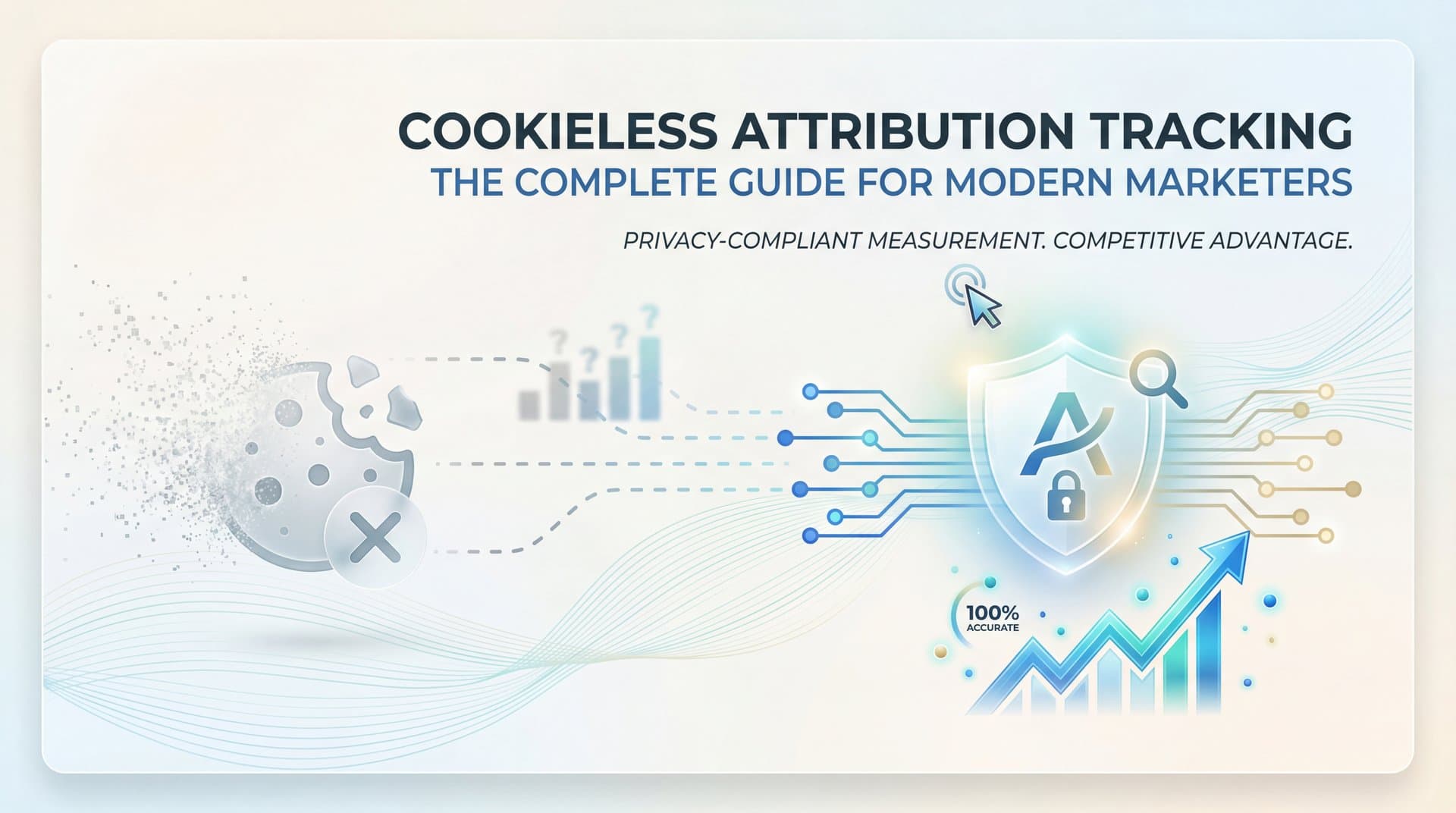
But here's what most people miss: cookieless attribution isn't just a necessary evil or a temporary workaround. When implemented correctly, it's actually more accurate, more reliable, and more privacy-compliant than cookie-based tracking ever was. The marketers who embrace this shift now will have a massive competitive advantage over those clinging to outdated methods.
This guide will show you exactly how cookieless attribution works, which methods deliver the most accurate data, and how to build a future-proof tracking stack that captures every customer touchpoint—without relying on third-party cookies.
The Death of Third-Party Cookies: Why It's Happening Now
Third-party cookies are dying from three simultaneous blows: browser companies prioritizing user privacy, governments enforcing data protection laws, and consumers actively blocking tracking technologies.
Safari started the trend back in 2017 with Intelligent Tracking Prevention, blocking third-party cookies by default. Firefox followed with Enhanced Tracking Protection. But the real earthquake came when Google announced Chrome would phase out third-party cookies through its Privacy Sandbox initiative. Chrome holds over 60% of the browser market—when it stops supporting third-party cookies, cookie-based attribution effectively ends.
Privacy regulations accelerated this shift. GDPR in Europe and CCPA in California created legal requirements for explicit user consent before tracking. The practical result? Even when browsers technically allow cookies, getting users to click "Accept All" on consent banners becomes increasingly difficult as people understand what they're agreeing to.
Then there's user behavior. Ad blocker adoption continues to grow, with many users installing browser extensions specifically to prevent tracking. Apple's App Tracking Transparency framework on iOS requires apps to ask permission before tracking users across other apps and websites. Most users say no.
The convergence of these forces creates an environment where cookie-based attribution simply doesn't work anymore. You're not just missing a few data points—you're potentially missing 40-60% of your actual conversions because browser restrictions, consent requirements, and user privacy tools block traditional tracking pixels. Understanding what is cookieless tracking becomes essential for every marketer navigating this landscape.
The question isn't whether to adapt to cookieless attribution. It's how quickly you can implement it before your competitors gain an insurmountable data advantage.
The Mechanics of Cookieless Attribution
Cookieless attribution fundamentally changes where and how you collect conversion data. Instead of relying on browser-based tracking that can be blocked or deleted, you capture events on your server and send them directly to ad platforms and analytics tools through secure APIs.
Think of it like this: traditional cookie tracking is like leaving breadcrumbs for birds to follow. Anyone can sweep them away, birds can ignore them, and weather can destroy them. Server-side tracking is like having a GPS tracker that reports location directly to your dashboard—nothing can interfere with the signal.
Server-side tracking works by installing tracking code on your web server rather than in users' browsers. When someone converts on your site, your server captures that event and sends it to your attribution platform through a direct API connection. This happens regardless of browser settings, ad blockers, or cookie restrictions.
First-party data tracking becomes your foundation. This includes information users willingly provide: email addresses, phone numbers, account registrations, purchase history, and CRM records. Because you collected this data directly through your own properties with proper consent, it's not subject to third-party restrictions. You own it, control it, and can use it for attribution indefinitely.
The technical implementation involves two types of matching: deterministic and probabilistic. Deterministic matching uses known identifiers like hashed email addresses to connect a Facebook ad click to a website conversion to a CRM sale. When someone uses the same email across touchpoints, you can track their complete journey with high accuracy.
Probabilistic matching fills in the gaps using behavioral signals and statistical modeling. When you can't deterministically match a user, you can still infer likely attribution paths based on device type, location, timing patterns, and other contextual data. This approach trades some accuracy for broader coverage.
The crucial insight: cookieless attribution often captures MORE accurate data than cookies ever did. Cookies miss cross-device journeys, get deleted regularly, and fail entirely on iOS. Server-side tracking captures conversions from ad-blocked users, iOS devices, and cross-device paths that cookies never could.
Modern attribution platforms combine these approaches into unified customer attribution tracking. They connect your ad platforms, website events, and CRM data in real-time, creating a complete view of how marketing drives revenue—without depending on browser cookies at all.
Five Cookieless Attribution Approaches: From Most to Least Accurate
1. Server-Side Conversion APIs (Highest Accuracy): This is the gold standard for cookieless attribution. Platforms like Meta's Conversions API, Google's Enhanced Conversions, and TikTok Events API allow you to send conversion data directly from your server to ad platforms. Because this happens server-to-server, browser restrictions can't interfere. You capture every conversion, match it to ad clicks through deterministic identifiers, and feed that data back to platform algorithms for better optimization. Implementation requires technical setup, but the accuracy improvement is substantial—many marketers see 20-40% more conversions tracked compared to pixel-only approaches.
2. First-Party Cookie Strategies: While third-party cookies are dying, first-party cookies (set by your own domain) remain functional and persist longer. These work well for tracking return visits and multi-session journeys on your own properties. The limitation is they only work within your domain—you can't use them to track users across the web. But combined with server-side tracking, first-party cookies provide reliable session tracking and user identification for your owned properties. They're particularly valuable for understanding how users interact with your content over multiple visits before converting.
3. Identity Resolution Platforms: These systems connect touchpoints through authenticated user data—email addresses, phone numbers, and customer IDs. When someone clicks an ad, visits your site, and later converts, identity resolution platforms match these events through hashed identifiers shared across systems. This requires users to authenticate at some point in their journey (logging in, providing email, completing a form), but it creates deterministic attribution that's highly accurate. The trade-off is coverage—you can only track users who provide identifiable information.
4. Contextual and Cohort-Based Attribution: Google's Topics API and similar privacy-preserving approaches group users into interest cohorts rather than tracking individuals. Ad platforms target these cohorts, and conversions get attributed to the cohort that drove them. This maintains user privacy while providing directional attribution insights. The accuracy is lower than deterministic methods—you know "users interested in fitness equipment" converted, but not which specific user journey led to each conversion. This approach works best for brand awareness and top-of-funnel campaigns where precise attribution matters less than understanding which audiences respond.
5. Marketing Mix Modeling (Channel-Level Insights): This statistical approach analyzes historical performance data to determine how different marketing channels contribute to overall results. Instead of tracking individual user journeys, MMM uses regression analysis to identify patterns: when you increase Facebook spend by X%, revenue typically increases by Y%. It's useful for strategic budget allocation but provides no real-time optimization insights or user-level attribution. Think of it as understanding which marketing levers work at a macro level, not which specific ads drive which conversions.
The most effective cookieless tracking solution combines multiple approaches. Use server-side APIs for maximum accuracy, supplement with first-party cookies for on-site behavior, and apply identity resolution where you have authenticated users. This layered approach maximizes both accuracy and coverage.
Building a Cookieless Attribution System That Actually Works
Your cookieless attribution stack needs three core components working together: server-side tracking infrastructure, unified data collection across all customer touchpoints, and direct connections to ad platform APIs.
Start with server-side tracking implementation. This means installing tracking code on your web server that captures conversion events regardless of browser restrictions. When someone completes a purchase, submits a lead form, or takes any valuable action, your server logs that event with associated user identifiers (hashed email, customer ID, phone number). This data then flows to your attribution platform through secure API connections. A comprehensive attribution tracking setup ensures you capture every conversion accurately.
Next, connect your CRM system directly to your attribution platform. This is where most marketers miss massive opportunities. Your CRM contains the most valuable conversion data: qualified leads, sales pipeline progression, closed deals, customer lifetime value. When you sync this data with your ad tracking, you can attribute revenue to specific campaigns and optimize for actual business outcomes, not just website conversions.
The technical setup involves integrating your CRM's API with your attribution platform so conversion events flow automatically. When a lead becomes a qualified opportunity, that event gets sent back to your ad platforms. When a deal closes, that revenue data updates your attribution model. This creates a complete feedback loop from ad click to closed revenue. For HubSpot users, implementing HubSpot attribution tracking streamlines this entire process.
Platform connections come next. You need direct API integrations with every ad platform you use: Meta Conversions API for Facebook and Instagram, Google Enhanced Conversions for Google Ads, TikTok Events API, LinkedIn Conversions API, and any other platforms in your mix. These server-side connections allow you to send conversion data directly to each platform, bypassing browser limitations entirely.
Here's why this matters beyond just tracking: when you feed enriched conversion data back to ad platforms, their algorithms get better at optimization. Facebook's algorithm learns which users are most likely to convert based on actual conversion data, not just pixel fires that may or may not be accurate. Google's Smart Bidding uses your conversion data to automatically adjust bids for maximum ROI. The better your conversion data, the better these algorithms perform.
Multi-touch attribution models in a cookieless world require capturing every touchpoint in the customer journey: ad clicks, website visits, email opens, content downloads, demo requests, and CRM events. Your attribution platform should stitch these touchpoints together using deterministic matching (email addresses, customer IDs) and first-party cookies to create complete journey maps.
The unified analytics dashboard brings everything together. You should see attribution across all channels in one place, compare different attribution models (first-click, last-click, linear, time-decay, data-driven), and analyze which campaigns drive the most valuable conversions. This single source of truth eliminates the confusion of conflicting reports from different platforms.
Critical Mistakes That Sabotage Cookieless Attribution
The biggest mistake is over-relying on a single attribution method. Some marketers implement server-side tracking and assume that's enough. Others focus exclusively on first-party data collection. The reality is you need multiple approaches working together to maximize both accuracy and coverage. Use server-side APIs for core conversion tracking, supplement with first-party cookies for on-site behavior, and apply identity resolution where possible.
Neglecting to sync conversion data back to ad platforms is another critical error. Many marketers set up tracking to measure performance but forget that feeding conversion data back to Facebook, Google, and other platforms dramatically improves campaign optimization. When ad platform algorithms receive accurate conversion data through server-side APIs, they can automatically optimize targeting, bidding, and creative delivery. This isn't just about measurement—it's about making your campaigns perform better.
Failing to capture offline and CRM events in your attribution model creates massive blind spots. If you only track website conversions, you miss phone call leads, in-store purchases, sales team interactions, and pipeline progression. Implementing marketing attribution for phone calls ensures these valuable touchpoints don't fall through the cracks. These events are often your most valuable conversions. Without CRM integration, you're optimizing for incomplete data and potentially making decisions that hurt actual revenue.
Another common mistake is implementing cookieless tracking but continuing to make decisions based on cookie-based analytics. Understanding the differences between Google Analytics vs attribution platforms helps you choose the right source of truth. If your attribution platform shows one set of results but you keep checking Google Analytics (which relies heavily on cookies) for validation, you'll constantly second-guess your data. Commit to your cookieless attribution system as your source of truth.
Some marketers also delay implementation, thinking they have time before third-party cookies fully disappear. This is dangerous for two reasons. First, you're already missing conversions right now from iOS users, ad blocker users, and privacy-conscious browsers. Second, the sooner you implement cookieless attribution, the more historical data you'll have for optimization and modeling. Waiting means starting from zero when cookies finally die completely.
Future-Proofing Your Attribution as Privacy Evolves
First-party data collection should be your top strategic priority. Every email signup, account registration, and customer interaction is a data asset you own and control. Build systems that encourage users to authenticate: loyalty programs, personalized content, member benefits, and account features that require login. The more users you can identify through first-party data, the more accurate your attribution becomes.
Prepare for continued browser and regulatory changes. Privacy regulations will become more stringent, not less. Browsers will add more tracking restrictions. Your attribution system needs to be built on methods that don't depend on tracking individual users across the web without consent. Server-side tracking, first-party data, and privacy-preserving approaches will remain compliant as regulations evolve.
The role of AI in attribution is expanding rapidly. Machine learning models can fill attribution gaps by identifying patterns in conversion data that humans can't see. AI can predict which campaigns are most likely to drive valuable conversions, recommend budget allocations across channels, and identify optimization opportunities automatically. Platforms that combine cookieless tracking with AI-powered insights give you both accurate measurement and actionable recommendations.
Consider diversifying your measurement approaches. While server-side tracking provides the most accurate user-level attribution, complementing it with marketing mix modeling gives you strategic insights about channel effectiveness. Exploring cross-channel attribution marketing ROI creates a more complete picture of marketing performance by combining micro-level and macro-level measurement.
Stay close to platform updates. Meta, Google, TikTok, and other ad platforms continuously improve their server-side APIs and privacy-preserving attribution methods. Early adopters of new features often see better performance and more accurate tracking than those who wait. Subscribe to platform developer blogs, join beta programs, and implement new attribution features as they become available.
The marketers who thrive in the cookieless future will be those who view privacy restrictions as an opportunity rather than a limitation. Better data quality, stronger customer relationships through transparent data practices, and more accurate attribution that captures the full customer journey—these advantages belong to those who adapt quickly.
Your Path Forward in the Cookieless Era
Cookieless attribution isn't a limitation to work around—it's a fundamental improvement in how we measure marketing effectiveness. By moving data collection from unreliable browser cookies to robust server-side infrastructure, you gain more accurate tracking, better privacy compliance, and complete visibility into customer journeys that cookie-based methods never captured.
The transition requires action now, not later. Third-party cookies are already gone from Safari and Firefox. Chrome's deprecation continues. Every day you delay implementing cookieless attribution is another day you're missing conversions, making decisions on incomplete data, and falling behind competitors who've already made the shift.
Start with the highest-accuracy methods: implement server-side conversion APIs for your ad platforms, integrate your CRM data into your attribution model, and build direct connections that bypass browser limitations entirely. Layer in first-party data strategies to maximize coverage. Use AI-powered analytics to turn accurate data into actionable optimization insights.
The marketers who master cookieless attribution will have a decisive advantage: they'll know exactly which campaigns drive revenue, optimize with confidence based on complete data, and scale profitably while others struggle with fragmented, inaccurate tracking.
Ready to elevate your marketing game with precision and confidence? Discover how Cometly's AI-driven recommendations can transform your ad strategy—Get your free demo today and start capturing every touchpoint to maximize your conversions.