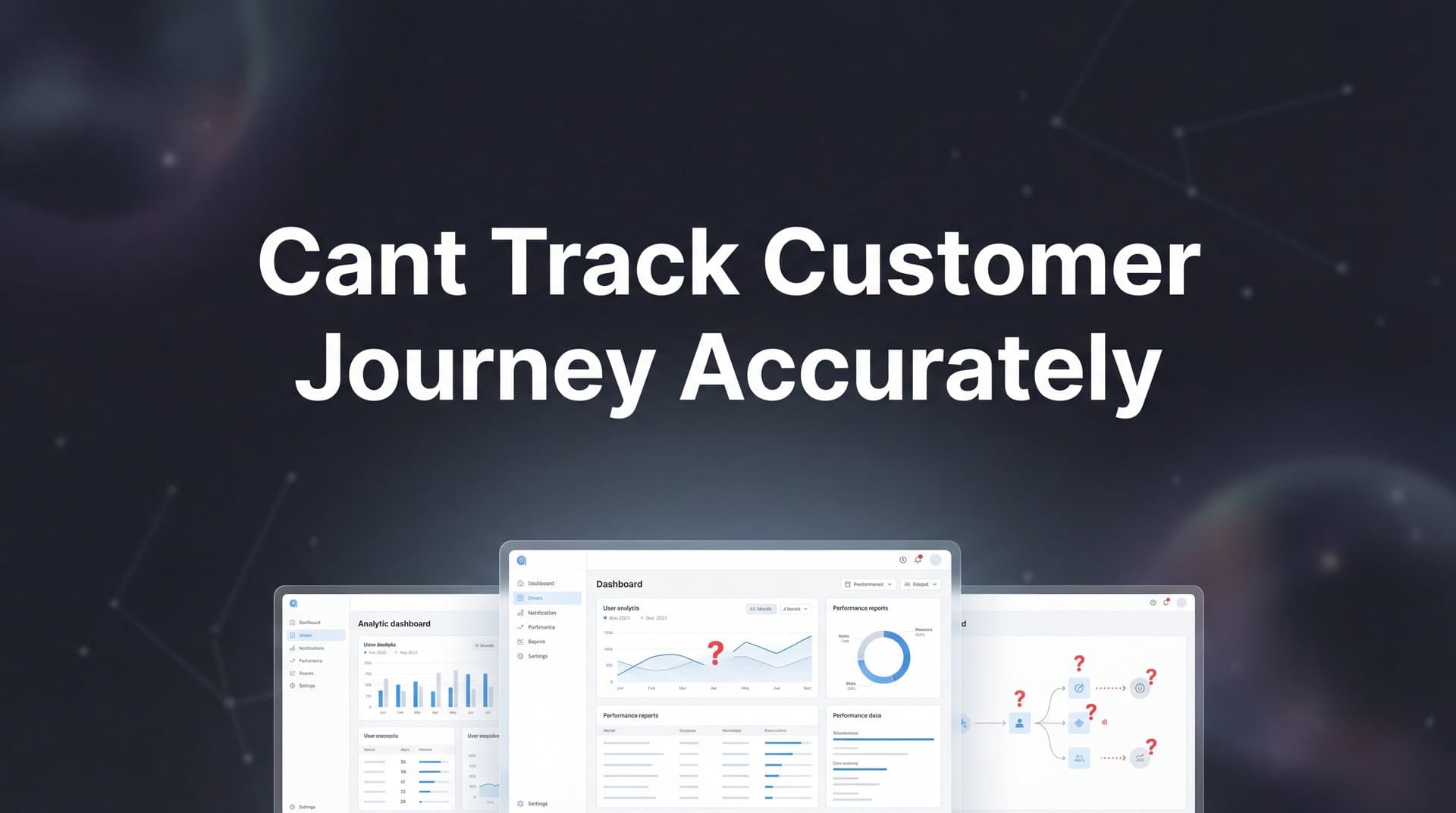
You're running campaigns across Meta, Google, TikTok, and LinkedIn. Conversions are happening. Revenue is coming in. But when you try to figure out which ads actually drove those results, the data tells five different stories. Your Google Analytics shows one conversion count. Meta's dashboard shows another. Your CRM has closed deals that don't match any platform attribution. And somewhere in that mess of conflicting numbers, you're supposed to make intelligent budget decisions.
This is the reality when you can't track customer journey accurately. Every optimization becomes a guess. Every budget reallocation feels like a coin flip. You know customers are clicking multiple ads, visiting from different devices, and taking days or weeks to convert—but your tracking systems capture only fragments of those journeys.
The frustration compounds when you realize how much money might be wasted on campaigns that look effective but aren't, or how many high-performing touchpoints remain invisible because your tracking never captured them.
Here's what most marketers don't realize: inaccurate customer journey tracking isn't a technical limitation you have to live with. It's a solvable configuration problem with clear, systematic fixes.
This guide walks you through six concrete steps to transform fragmented, unreliable tracking into a complete system that captures every meaningful touchpoint from first click to closed deal. You'll learn how to diagnose exactly where your data breaks down, implement tracking that bypasses browser limitations, connect every platform into a unified view, and build attribution models that reveal the true path to conversion.
By the end, you'll have a roadmap to stop guessing and start knowing which marketing efforts actually drive revenue.
Step 1: Audit Your Current Tracking Setup to Find the Gaps
Before you can fix tracking problems, you need to see them clearly. Most marketing teams operate with a vague sense that "something's off" without knowing precisely where data breaks down.
Start by creating a complete inventory of every tracking mechanism currently active in your marketing stack. This means documenting every pixel, tag, conversion event, and integration across all platforms. Open your Tag Manager, check your website header code, review your ad platform pixel installations, and list every analytics tool collecting data.
For each tracking element, note what it's supposed to capture and where that data flows. Your Meta pixel should be firing on key pages and sending conversion events. Your Google Ads conversion tracking should be capturing form submissions. Your analytics platform should be receiving traffic source data with proper UTM parameters.
Now comes the critical part: identify where data breaks occur. Common culprits include cross-device tracking failures where a customer clicks an ad on mobile but converts on desktop, iOS privacy restrictions that block pixel tracking for Safari users, and ad blocker interference that prevents client-side tracking from firing at all.
Check for duplicate tracking that inflates conversion counts. This happens when multiple pixels fire for the same event, or when both client-side and server-side tracking aren't properly deduplicated. Review your attribution windows across platforms—if Meta uses a 7-day click window while Google uses 30 days, you're comparing apples to oranges.
Examine your conversion event configuration. Are you tracking the right actions as conversions? Many setups track page views instead of actual form submissions, or count newsletter signups the same as purchases. Understanding best practices for tracking conversions accurately can help you avoid these common mistakes.
Create a simple spreadsheet with three columns: Touchpoint, Currently Tracked, and Data Gap. List every customer interaction that matters—ad clicks, website visits, content downloads, email opens, demo requests, sales calls, closed deals. Mark which ones your current setup captures and which remain invisible.
This diagnostic foundation is essential. You can't fix tracking problems you haven't identified. Most marketing teams discover they're capturing less than 60% of the customer journey, with critical touchpoints like phone calls, cross-device conversions, and offline sales completely missing from attribution data.
Step 2: Implement Server-Side Tracking to Bypass Browser Limitations
Client-side tracking—the traditional method where JavaScript pixels fire in users' browsers—is dying. Apple's App Tracking Transparency framework blocks it. Firefox blocks third-party cookies by default. Chrome is phasing out cookie support. Ad blockers prevent pixels from firing. The result? You're missing 30-50% of your conversion data before it ever reaches your analytics platforms.
Server-side tracking solves this by sending conversion data directly from your server to ad platforms, completely bypassing browser restrictions. Instead of relying on a pixel that might be blocked, your server communicates directly with Meta's Conversions API, Google's Enhanced Conversions, and other platform APIs.
Here's how it works: When a customer completes a conversion on your website, your server receives that information. Instead of hoping a browser-based pixel successfully fires and sends data, your server makes a direct API call to the ad platform with the conversion details. This method is unaffected by iOS restrictions, ad blockers, or cookie limitations.
To implement server-side tracking, you'll need a server-side tracking solution that can receive conversion events from your website and forward them to ad platforms via their APIs. Many marketing attribution platforms offer this capability, or you can build a custom solution using Google Tag Manager Server-Side or similar tools. Our server-side tracking implementation guide walks you through the complete setup process.
The technical setup involves configuring your website to send conversion events to your server, then programming your server to format and transmit those events to each ad platform's API. You'll need API credentials for each platform, proper event mapping to match platform requirements, and deduplication logic to prevent counting the same conversion twice if both client-side and server-side tracking fire.
Critical implementation detail: server-side tracking requires first-party data collection. You need to capture identifiers like email addresses, phone numbers, or customer IDs that can be hashed and sent to ad platforms for matching. This respects privacy regulations while maintaining tracking accuracy.
After implementation, verify your server-side events are firing correctly. Check each ad platform's events manager to confirm they're receiving data. Compare event counts between client-side and server-side sources. Monitor match rates—the percentage of server-side events that platforms can successfully match to user accounts. Good match rates typically exceed 70%.
Server-side tracking isn't optional anymore. It's the foundation of accurate attribution in a privacy-first world. Without it, you're building marketing strategies on data that's missing half the picture.
Step 3: Connect Your Ad Platforms, CRM, and Website Into One Data Source
Fragmented data is the enemy of accurate attribution. When your ad platforms, CRM, and website analytics operate as separate silos, you can't see the complete customer journey. A lead might click your Meta ad, visit your website tracked by Google Analytics, fill out a form captured in your CRM, then close a deal recorded in your sales system—and no single platform connects those dots.
The solution is a unified tracking system that integrates all data sources into one place. This means connecting every paid advertising channel—Meta, Google Ads, TikTok, LinkedIn, Twitter—into a central attribution platform that can track cross-platform journeys.
Start with your ad platform integrations. Use native API connections, not just UTM parameter tracking. API integrations pull campaign data, ad spend, impressions, and clicks directly from each platform, providing a complete view of paid traffic sources. This is more reliable than depending on UTM parameters alone, which can be stripped by redirects or privacy tools.
Next, connect your CRM. This is critical for capturing the full value of conversions, especially in B2B or high-ticket scenarios where the sale happens offline. Your attribution system needs to know when a lead becomes an opportunity, when deals close, and what revenue results from each customer. Without CRM integration, you're tracking clicks and form fills but missing the actual business outcomes. Learn more about how to track offline conversions to capture these critical touchpoints.
Ensure your website tracking captures all entry points and conversion events. This includes landing pages, blog posts, product pages, pricing pages, demo request forms, and purchase confirmations. Every meaningful interaction should be logged and associated with the customer's journey.
Establish consistent naming conventions across all campaigns. Use standardized UTM parameters with clear, uniform formatting. If your Meta campaigns use "utm_source=facebook" but your reports filter for "utm_source=meta", you'll fragment your own data. Create a UTM naming guide and enforce it across your marketing team.
Configure real-time data syncing. Attribution data becomes less useful when it's hours or days delayed. Real-time syncing means touchpoints are captured as they happen, allowing you to see customer journeys as they unfold and make faster optimization decisions. For detailed instructions, check out our cross-platform tracking setup guide.
The goal is a single source of truth where every touchpoint—from first ad click to final purchase—exists in one unified view. This eliminates the confusion of comparing different dashboards with conflicting numbers and gives you confidence that you're seeing the complete picture.
Step 4: Set Up Multi-Touch Attribution to See the Full Customer Path
Last-click attribution is a lie. It tells you that the final touchpoint before conversion deserves 100% of the credit, ignoring every interaction that built awareness, consideration, and intent along the way. A customer might see your brand awareness campaign on TikTok, click a retargeting ad on Meta three days later, google your brand name and click a search ad, visit your pricing page, then finally convert through a direct visit. Last-click attribution gives all credit to that direct visit, making it look like your paid campaigns accomplished nothing.
Multi-touch attribution solves this by distributing credit across all touchpoints that influenced the conversion. This reveals the true customer journey and shows you which campaigns work together to drive results.
Start by choosing an attribution model that matches your sales cycle and customer behavior. Linear attribution gives equal credit to every touchpoint—useful for understanding overall channel contribution. Time-decay attribution gives more credit to touchpoints closer to conversion—appropriate when recent interactions matter most. Position-based attribution gives extra credit to the first and last touchpoints—helpful when both awareness and conversion campaigns play distinct roles. Our guide on attribution marketing tracking covers each model in depth.
Configure attribution windows appropriate for your business. B2B companies with long sales cycles might use 90-day windows to capture the full journey from first touch to closed deal. E-commerce brands with faster purchase decisions might use 7-day or 14-day windows. The window should reflect how long customers typically take to convert after first discovering your brand.
Implement your chosen model across all channels simultaneously. If you're using time-decay attribution for Meta campaigns but last-click for Google Ads, you can't meaningfully compare their performance. Consistency is essential for accurate cross-channel analysis.
Test different attribution models to understand how credit distribution changes your performance insights. Run the same conversion data through linear, time-decay, and position-based models. You'll often discover that channels performing poorly under last-click attribution are actually driving significant value earlier in the customer journey.
Multi-touch attribution reveals patterns that last-click misses entirely. You might discover that LinkedIn ads rarely drive direct conversions but consistently introduce high-value leads who later convert through other channels. Or that your brand awareness campaigns on TikTok create a foundation that makes retargeting dramatically more effective. These insights transform how you allocate budget and measure success.
Step 5: Feed Enriched Conversion Data Back to Ad Platform Algorithms
Here's a truth most marketers miss: accurate tracking isn't just about what you see in your reports. It's about what ad platform algorithms see. Meta's algorithm, Google's Smart Bidding, TikTok's automated optimization—they all depend on conversion data to learn which audiences to target and how much to bid. When your tracking is broken, you're not just flying blind. You're teaching platform algorithms to optimize for incomplete, inaccurate data.
This is why conversion sync matters. It's the process of sending verified, enriched conversion data back to ad platforms so their algorithms can optimize effectively. Instead of platforms seeing only the conversions their own pixels captured (which might be 50% of reality), they receive complete conversion data including offline sales, phone calls, and cross-device conversions they couldn't track themselves.
Set up conversion sync by connecting your unified attribution system to each ad platform's conversion API. This allows you to send conversion events with additional context and accuracy. For Meta, you'll use the Conversions API. For Google, you'll implement Enhanced Conversions. Other platforms have similar mechanisms.
Include conversion values in your synced data. Don't just tell platforms that a conversion happened—tell them how much revenue it generated. This allows algorithms to optimize for high-value conversions rather than treating a $50 purchase the same as a $5,000 deal. The more signal you provide, the better platforms can optimize.
Add customer quality signals when possible. If your CRM tracks lead quality scores or customer lifetime value predictions, sync that data back to ad platforms. This helps algorithms learn to target not just people who convert, but people who become valuable customers. Understanding customer attribution tracking helps you capture these quality signals effectively.
Monitor match rates to ensure your conversion data is being received and utilized. Match rate is the percentage of synced conversions that platforms can successfully attribute to specific user accounts. Low match rates mean platforms can't use your data effectively. Improve match rates by including more identifiers—email addresses, phone numbers, and customer IDs all help platforms match conversions to users.
The feedback loop is powerful: better tracking data leads to better algorithmic optimization, which leads to better campaign performance, which generates more conversion data. Most marketers focus only on the reporting side of tracking, missing the optimization benefits of feeding platforms accurate data.
Step 6: Validate Your Tracking and Establish Ongoing Data Quality Checks
Implementing tracking is one thing. Trusting it is another. Before you make budget decisions based on your new attribution data, you need to verify it's actually working correctly. And once it's working, you need systems to catch when something breaks.
Start with end-to-end validation tests. Create test conversions that move through your entire funnel—click a test ad, visit your website, complete a form submission or purchase, and verify that conversion appears correctly in all systems. Check that it's attributed to the right campaign, captured with the correct conversion value, and synced back to the ad platform.
Run these tests for each major conversion path. Test mobile conversions separately from desktop. Test different browsers, including Safari with tracking restrictions. Test scenarios where users clear cookies or use ad blockers. Each variation reveals whether your tracking holds up under real-world conditions.
Compare platform-reported conversions against your unified attribution data. Some discrepancy is normal—platforms use different attribution windows and methodologies. But major gaps indicate problems. If Meta reports 100 conversions while your attribution system shows 150, investigate why. The difference might reveal tracking issues or attribution model mismatches.
Set up automated alerts for tracking anomalies. Configure notifications when conversion counts drop suddenly, when specific events stop firing, or when integration connections fail. Early detection prevents small issues from corrupting weeks of data. Most attribution platforms offer alert functionality—use it.
Create a monthly tracking audit checklist. Include tasks like verifying all pixels are firing, checking that UTM parameters are applied consistently, confirming CRM integration is syncing properly, reviewing match rates for conversion sync, and testing sample conversions end-to-end. Regular audits catch configuration drift before it becomes a crisis. Using dedicated customer journey tracking software can automate many of these validation tasks.
Document your tracking setup completely. When team members change or platforms update, proper documentation ensures tracking stays consistent. Record which events are tracked, how attribution windows are configured, which UTM parameters are used for each campaign type, and how conversion values are calculated.
Data quality isn't a one-time achievement. It's an ongoing practice. Platforms update their tracking requirements. Privacy regulations evolve. Your marketing stack changes. Continuous validation and maintenance keep your attribution data reliable enough to guide real budget decisions.
Your Roadmap to Attribution Accuracy
Accurate customer journey tracking transforms marketing from educated guessing into data-driven precision. When you can see the complete path from first touchpoint to closed deal, budget allocation becomes strategic rather than speculative. You know which campaigns drive awareness, which channels nurture consideration, and which touchpoints convert ready buyers.
The six-step framework you've just learned addresses the core reasons tracking fails: browser limitations that block client-side pixels, fragmented data across disconnected platforms, oversimplified last-click attribution that misses the full journey, incomplete feedback loops that starve ad algorithms of optimization data, and lack of validation that allows broken tracking to persist unnoticed.
Use this implementation checklist to verify your setup: tracking audit completed with documented gaps, server-side tracking implemented and verified firing, all ad platforms and CRM connected to unified attribution system, multi-touch attribution configured with appropriate models and windows, conversion sync active with healthy match rates, and validation tests passed with automated monitoring in place.
Start with Step 1 today. Audit your current tracking setup and document exactly where data breaks down. That diagnostic foundation makes every subsequent step more effective. You'll know which gaps to prioritize, which platforms need integration work, and which conversion events require proper configuration.
The difference between marketing teams that scale profitably and those that waste budget often comes down to one factor: data quality. Teams with accurate attribution know which campaigns work and double down on them. Teams with broken tracking make decisions based on incomplete information and wonder why performance stays flat despite increased spending.
Ready to elevate your marketing game with precision and confidence? Discover how Cometly's AI-driven recommendations can transform your ad strategy—Get your free demo today and start capturing every touchpoint to maximize your conversions.