

Every dollar you spend on marketing should work toward acquiring customers profitably. Yet many marketing teams struggle to answer a fundamental question: how much does it actually cost to acquire each customer?
Without accurate customer acquisition cost (CAC) tracking, you are essentially flying blind, unable to determine which campaigns deliver real value and which drain your budget. You might be celebrating a surge in conversions while unknowingly spending twice what those customers are worth. Or you could be cutting budget from channels that appear expensive but actually deliver your highest-value customers.
This guide walks you through setting up a reliable CAC tracking system from scratch. You will learn how to gather the right data, calculate CAC across different channels, and use those insights to optimize your marketing spend.
Whether you are running paid ads across Meta and Google, investing in content marketing, or combining multiple channels, these steps will help you build a tracking framework that reveals exactly where your marketing dollars generate returns. By the end, you will have a clear system for measuring acquisition costs at the channel, campaign, and even ad level, giving you the confidence to scale what works and cut what does not.
Step 1: Define Your CAC Components and Tracking Scope
Before you can track customer acquisition cost accurately, you need to decide exactly what to measure. This step sets the foundation for everything that follows.
Start by identifying every cost that contributes to acquiring customers. Most marketers immediately think of ad spend, but that is just one piece. Your true acquisition costs include ad platform spend, marketing software subscriptions, agency or freelancer fees, and the portion of internal team salaries dedicated to acquisition efforts.
Think of it this way: if you are paying for email marketing software, attribution tools, landing page builders, and a designer who creates ad creatives, those costs all contribute to bringing in new customers. Excluding them gives you an artificially low CAC that masks your real profitability. Understanding calculating true customer acquisition cost requires accounting for all these expenses.
Next, determine your tracking granularity. Do you need to know your overall CAC across all marketing efforts? Your CAC by channel to compare Meta against Google? Or do you want campaign-level and ad-level CAC to optimize at a granular level?
The answer depends on your business complexity and optimization needs. A small business running ads on just one platform might start with channel-level tracking. An agency managing campaigns across multiple platforms for various clients needs campaign-level and ad-level precision.
Now define what counts as a customer for your business. This sounds simple but varies significantly across business models. For e-commerce, it might be a first purchase. For SaaS, it could be when a trial converts to a paid subscription. For B2B companies, it might be when a contract is signed or when the first invoice is paid.
Whatever definition you choose, apply it consistently. If you count trial signups as customers one month and paid conversions the next, your CAC trends become meaningless.
Document these definitions in a shared resource your entire team can reference. Include which costs you are tracking, your granularity level, and your customer definition. This ensures everyone calculates CAC the same way and your reporting stays consistent over time.
This documentation also protects you when team members change or when you revisit your tracking system months later. You will know exactly why you made certain decisions and can adjust deliberately rather than accidentally breaking your tracking.
Step 2: Connect Your Data Sources for Complete Visibility
Accurate CAC tracking requires data from multiple sources to flow into one place. Scattered data across different platforms makes it impossible to see the complete picture of what each customer costs.
Begin by linking your ad platforms to a central tracking system. Connect Meta Ads, Google Ads, LinkedIn, TikTok, and any other platforms where you run campaigns. Each platform should feed its spend data and performance metrics into your tracking system automatically.
Manual data exports work temporarily, but they break down quickly. You forget to pull reports, data gets stale, and calculations become unreliable. Automated connections ensure your CAC calculations always reflect current performance. The right customer journey tracking software can automate these connections for you.
Next, integrate your CRM to capture when leads become paying customers. Your ad platforms show you clicks and form submissions, but your CRM holds the truth about who actually converted into revenue-generating customers.
This connection is critical because it closes the loop between marketing spend and actual customer acquisition. Without it, you are calculating CAC based on leads or trial signups rather than real customers, which dramatically understates your true acquisition cost.
Set up website tracking to capture the full customer journey from first click to conversion. Install tracking pixels or use server-side tracking to monitor how visitors interact with your site, which pages they view, and what actions they take before converting.
This tracking reveals the path customers take before purchasing. Someone might click a Facebook ad, leave without converting, return through a Google search a week later, and finally convert after reading three blog posts. Without complete journey tracking, you miss these crucial touchpoints.
Server-side tracking has become increasingly important as browser-based tracking faces limitations from privacy changes and cookie restrictions. It captures conversion data directly from your server rather than relying on browser cookies, giving you more accurate and complete data. Before implementing, review the server side tracking implementation cost to budget appropriately.
Once your connections are in place, verify data is flowing correctly before moving to calculations. Check that ad spend numbers match what you see in each platform. Confirm that customer conversions in your tracking system align with your CRM records. Test a few known customer journeys to ensure touchpoints are being captured.
This verification step catches configuration errors early. Better to spend an hour troubleshooting now than to make budget decisions based on faulty data for months.
Look for common issues like tracking codes installed incorrectly, attribution windows set too short, or filters excluding important traffic sources. Each of these problems can create gaps in your data that skew your CAC calculations.
Step 3: Implement Multi-Touch Attribution for Accurate Channel Credit
Here is where most CAC tracking falls apart. If you rely on last-click attribution, you are systematically undervaluing the channels that introduce customers to your brand and overvaluing the channels where they finally convert.
Last-click attribution gives 100% credit to the final touchpoint before conversion. Picture this: a potential customer sees your Facebook ad, clicks through to read your content, leaves, searches for your brand on Google a week later, and purchases. Last-click attribution gives Google all the credit and Facebook none, even though Facebook initiated the entire journey.
This skews your CAC calculations dramatically. Your awareness channels appear expensive and inefficient because they rarely get credit for conversions. Your bottom-funnel channels look artificially cheap because they capture all the credit from customers who were already primed by earlier touchpoints.
Multi-touch attribution solves this by distributing credit across all touchpoints in the customer journey. Different models distribute credit in different ways, and choosing the right one matters. A comprehensive attribution marketing tracking guide can help you understand these differences.
Linear attribution gives equal credit to every touchpoint. If a customer had five interactions before converting, each gets 20% credit. This approach works well when every stage of your funnel contributes equally to conversion.
Time-decay attribution gives more credit to touchpoints closer to conversion. The logic is that recent interactions influenced the purchase decision more than earlier awareness touches. This model suits businesses with longer sales cycles where nurture efforts matter most.
Data-driven attribution uses machine learning to analyze your actual conversion patterns and assign credit based on which touchpoints statistically contribute most to conversions. This approach adapts to your specific customer behavior rather than applying a one-size-fits-all model.
Choose an attribution model that reflects how customers actually buy from you. If you run mostly bottom-funnel campaigns, time-decay might work well. If you invest heavily in awareness and nurture, linear or data-driven attribution gives you more accurate insights.
Map touchpoints across the entire funnel so each channel receives proportional credit. This means tracking not just ad clicks but also email opens, content engagement, webinar attendance, and any other interaction that influences purchase decisions. Effective customer touchpoint tracking captures all these interactions.
The more complete your touchpoint mapping, the more accurate your CAC calculations become. You start seeing which combinations of channels work together to drive conversions, not just which channel happened to be last.
Use server-side tracking to capture conversions that browser-based tracking misses. Privacy changes and cookie restrictions mean browser tracking increasingly fails to connect conversions back to their source. Server-side tracking fills these gaps by capturing conversion data directly, ensuring your attribution model has complete information to work with.
Step 4: Calculate CAC at Multiple Levels
With your data connected and attribution in place, you are ready to calculate customer acquisition cost. The core formula is simple: divide total acquisition costs by the number of new customers acquired.
If you spent $10,000 on marketing last month and acquired 100 new customers, your overall CAC is $100. But stopping at this high-level number leaves money on the table. Learn the nuances of how to calculate customer acquisition cost properly to avoid common mistakes.
Break down CAC by channel to identify your most efficient acquisition sources. Calculate how much you spent on Meta, Google, LinkedIn, and other channels, then divide each by the customers attributed to that channel.
You might discover Meta delivers a $75 CAC while Google costs $150 per customer. Without this breakdown, you would miss the opportunity to shift budget toward your more efficient channel.
Channel-level CAC also reveals quality differences. Sometimes a channel with higher CAC delivers customers with much higher lifetime value, making it more profitable despite the higher upfront cost. Other times, a cheap channel brings in customers who churn quickly, making the low CAC misleading.
Calculate campaign-level and ad-level CAC for granular optimization decisions. Within each channel, different campaigns and individual ads perform very differently. Two Facebook campaigns might have vastly different CACs even though they target similar audiences.
This granularity lets you optimize at the level where you actually make decisions. You do not just know that Meta is efficient, you know which specific campaigns and ads drive that efficiency so you can create more like them.
Account for time lag between ad spend and customer conversion in your calculations. Many businesses have a delay between when someone first clicks an ad and when they become a paying customer. This lag can range from days to months depending on your sales cycle.
If you spend $5,000 on ads this week, some of those clicks will convert this week, but others will convert next month or even later. Calculating CAC using only same-period conversions understates your true cost because you are not accounting for the delayed conversions still coming from previous spend.
Use cohort analysis to track how CAC evolves as more conversions from each time period come in. This gives you a more accurate picture of what customers truly cost to acquire once all delayed conversions are accounted for.
For quick decisions, you can use current-period CAC as a directional metric. Just understand it will understate your true CAC until delayed conversions are factored in.
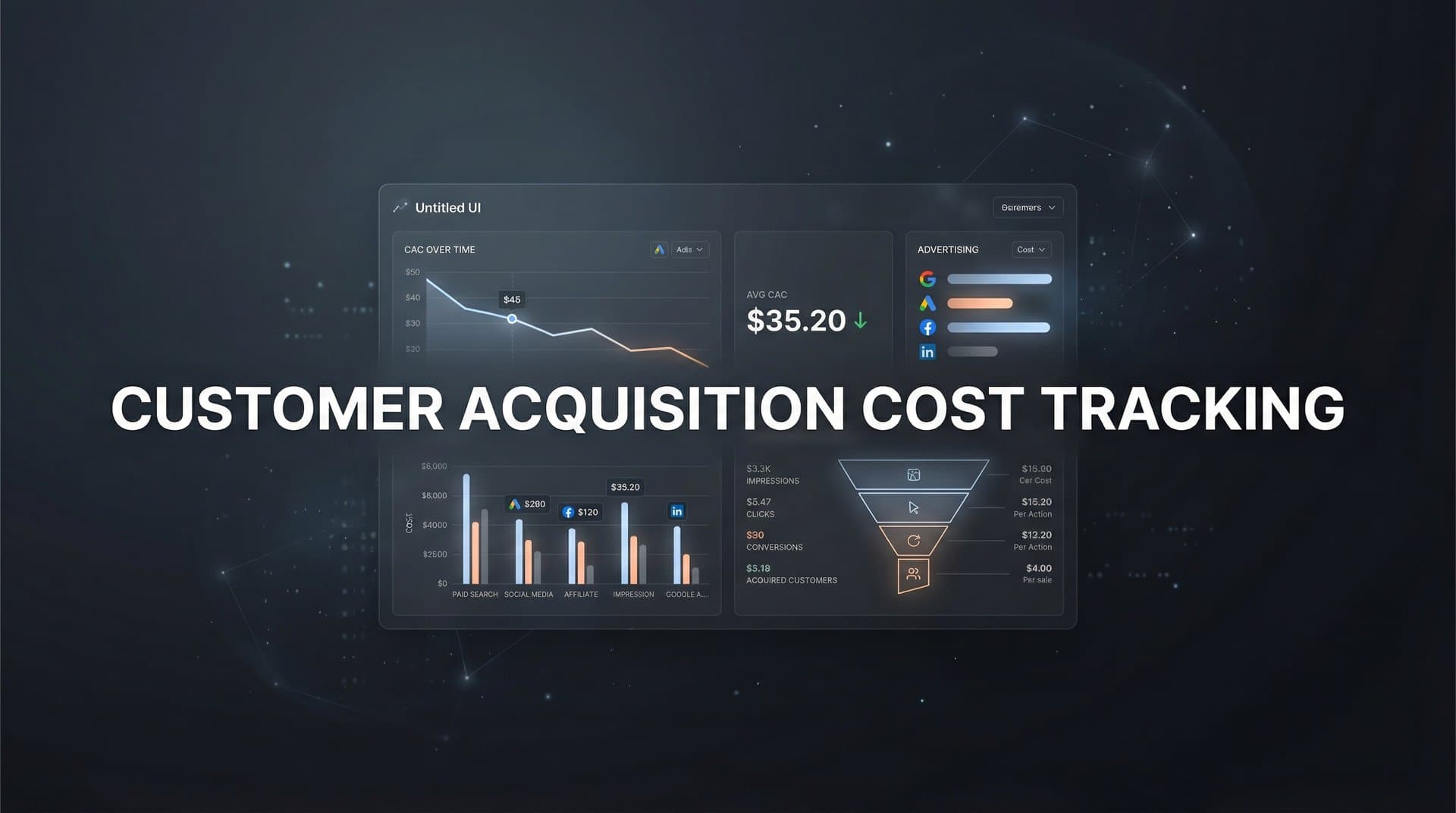
Step 5: Build a CAC Tracking Dashboard for Ongoing Monitoring
Calculating CAC once gives you a snapshot. Building a dashboard that updates automatically gives you a system for continuous optimization.
Set up real-time reporting that updates as new conversions come in. Your dashboard should pull fresh data from your ad platforms and CRM automatically, recalculating CAC without manual intervention. This ensures you are always looking at current performance rather than stale numbers from last week.
Real-time visibility lets you catch problems fast. If CAC suddenly spikes on a campaign, you can investigate and adjust before burning through significant budget. If a new campaign delivers unexpectedly low CAC, you can scale it immediately rather than waiting until your monthly review. The right ad tracking analytics tool makes this visibility possible.
Include CAC trends over time to spot increases before they become problems. A single day of high CAC might be noise, but a steady upward trend over two weeks signals something has changed. Maybe competition increased, ad fatigue set in, or audience quality declined.
Trend charts make these patterns visible at a glance. You can see seasonality in your CAC, understand how it changes as you scale spend, and identify exactly when shifts occurred so you can trace them back to specific changes.
Add CAC-to-LTV ratio to evaluate long-term profitability of each channel. CAC alone does not tell you if acquisition is profitable. A $200 CAC is expensive if customers generate $300 lifetime value but incredibly efficient if they generate $2,000.
The CAC-to-LTV ratio reveals this context. Industry guidance suggests a healthy ratio falls around 3:1, meaning customer lifetime value should be roughly three times higher than acquisition cost. This provides enough margin to cover other business costs while maintaining profitability.
Track this ratio by channel to understand which sources deliver not just cheap customers but profitable ones. You might find that your lowest-CAC channel actually has the worst CAC-to-LTV ratio because those customers churn quickly or spend less.
Create alerts for when CAC exceeds target thresholds. Set up notifications that trigger when overall CAC rises above your target, when any channel crosses its efficiency threshold, or when specific campaigns show deteriorating performance.
These alerts catch issues you might otherwise miss until your monthly review. They turn your dashboard from a passive reporting tool into an active monitoring system that prompts action when needed.
Step 6: Optimize Campaigns Based on CAC Insights
All this tracking and calculation exists for one purpose: making better marketing decisions. Now you use your CAC data to systematically improve acquisition efficiency.
Shift budget toward channels and campaigns with the lowest CAC and highest quality customers. Your data now shows exactly which sources deliver efficient acquisition. Move spend away from underperforming channels and into your proven winners.
This sounds obvious, but many marketers continue splitting budget evenly across channels or making allocation decisions based on gut feel rather than data. Your CAC tracking removes the guesswork. If Meta delivers $80 CAC and LinkedIn costs $300, the decision becomes clear. Explore strategies for how to reduce customer acquisition cost across all your channels.
Use CAC data to set realistic targets for new channel tests. When exploring a new ad platform or campaign type, you need a benchmark to determine success. Your existing CAC data provides that benchmark.
If your best channels deliver $100 CAC, you know a new test needs to approach that efficiency to be worth scaling. You can give new channels time to optimize while having a clear target they need to hit.
Feed conversion data back to ad platforms to improve their optimization algorithms. Platforms like Meta and Google use machine learning to optimize toward conversions, but they can only optimize what they can see. When tracking gaps prevent them from seeing conversions, their algorithms optimize toward the wrong signals.
By sending complete conversion data back to these platforms, you help their algorithms learn which users are most likely to become customers. This often results in better targeting and lower acquisition costs over time as the platforms get smarter about who to show your ads to. Using first party data tracking for ads ensures you maintain this connection despite privacy restrictions.
Review CAC weekly and adjust spend allocation based on performance trends. Make this a regular ritual rather than an occasional check-in. Look at which campaigns improved or declined, investigate what changed, and reallocate budget accordingly.
Weekly reviews catch trends early enough to matter. Monthly reviews leave you spending on underperforming campaigns for weeks before you notice and adjust. Daily reviews create noise and prompt overreaction to normal variance.
During each review, ask specific questions: Which campaigns saw CAC improve this week? What changed that might explain the improvement? Which campaigns saw CAC increase? Should we pause them, adjust them, or give them more time? Where should we shift budget to maximize efficiency?
Putting It All Together
Accurate customer acquisition cost tracking transforms how you make marketing decisions. Instead of guessing which campaigns perform best, you have clear data showing exactly what each customer costs to acquire across every channel.
Start by defining your cost components and connecting your data sources. Know what expenses to include, what counts as a customer, and ensure all your platforms feed data into one central system. Then implement multi-touch attribution to ensure each touchpoint receives fair credit for the conversions it influences.
Calculate CAC at the overall, channel, and campaign levels. Build a dashboard that keeps these metrics visible and alerts you when performance shifts. Finally, use your CAC insights to continuously optimize spend toward your most efficient acquisition sources.
Quick-start checklist: Define what costs and conversions to include in your calculations. Connect ad platforms and CRM to a central tracking system with automated data flow. Implement attribution that captures the full customer journey across all touchpoints. Calculate and monitor CAC at multiple levels to enable granular optimization. Optimize based on what the data reveals, shifting budget toward proven performers.
With this system in place, you can scale your marketing with confidence, knowing every decision is backed by accurate acquisition cost data. You will spot efficiency opportunities faster, catch problems before they drain your budget, and build a marketing engine that consistently delivers profitable customer acquisition.
Ready to elevate your marketing game with precision and confidence? Discover how Cometly's AI-driven recommendations can transform your ad strategy. Get your free demo today and start capturing every touchpoint to maximize your conversions.



