You've just launched a new campaign across Facebook, Instagram, Google, TikTok, and email. Sales are coming in. Your dashboard shows revenue. But here's the question keeping you up at night: which of those channels actually drove the purchases?
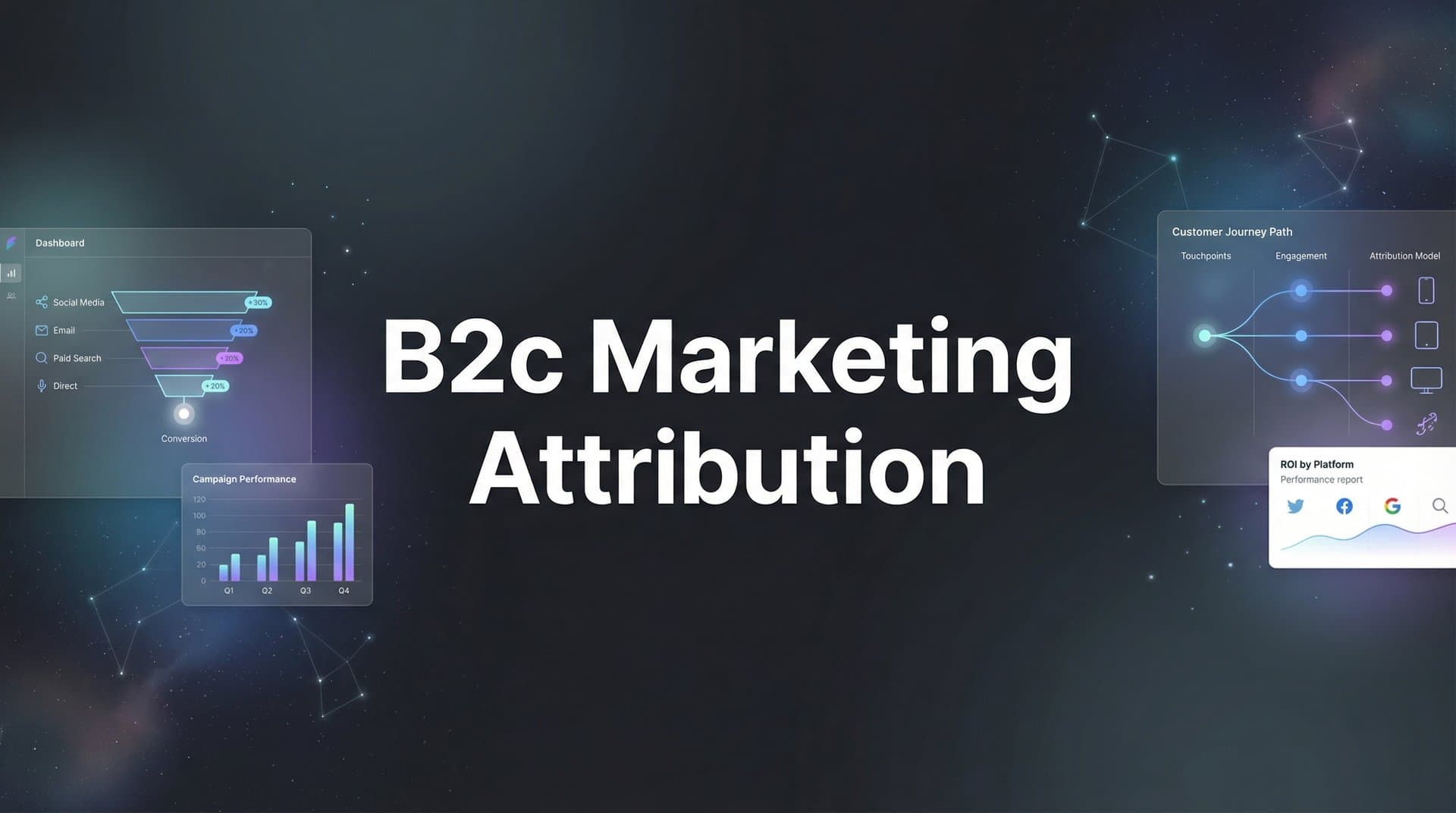
For B2C marketers, this isn't just an academic exercise. Your consumers don't follow neat, linear paths. They see your Instagram ad during their morning scroll, click a Google search result during lunch, watch an influencer mention your brand on TikTok that evening, and finally convert three days later after opening your email. Each touchpoint plays a role, but most attribution setups only credit the last click—leaving you blind to the channels that actually started the journey.
B2C marketing attribution is the practice of identifying which marketing touchpoints deserve credit for driving consumer purchases. It connects the dots between every interaction a customer has with your brand and the eventual sale. Without it, you're making budget decisions based on incomplete data, often over-investing in channels that look good on paper while starving the ones actually building your customer base.
This matters more now than ever. Privacy changes have made tracking harder. Consumers shop across multiple devices. And with ad costs climbing, you can't afford to waste spend on channels you only think are working. Let's break down how to build an attribution system that actually reflects your consumer reality.
Why Consumer Journeys Make Attribution Uniquely Challenging
B2C attribution isn't just a scaled-down version of B2B tracking. The fundamental differences in how consumers buy create unique measurement challenges that require different approaches.
Think about the decision-making process. A B2B software purchase involves multiple stakeholders, lengthy demos, and rational ROI calculations spread over months. A consumer buying skincare, sneakers, or subscription boxes makes faster decisions driven by emotion, social proof, and impulse. The sales cycle might be days instead of months, but the number of touchpoints can actually be higher because consumers interact with brands constantly across social feeds, search results, and content.
This creates what we call "high-frequency, low-consideration" journeys. Your customer might see your brand fifteen times across five channels before converting, but the entire journey happens in a week. Traditional attribution models built for B2B's long sales cycles miss the rapid-fire nature of consumer decision-making.
The cross-device reality compounds the problem. Your customer researches on their phone during their commute, browses on their tablet while watching TV, and completes the purchase on their laptop the next day. Each device creates a separate data trail. Without proper identity resolution, your attribution system sees three different people instead of one customer journey.
Then there's the privacy landscape. iOS 14.5 fundamentally changed B2C tracking by requiring explicit opt-in for app tracking. Many consumers declined, creating blind spots in the Facebook and Instagram conversion data that B2C brands relied on. Cookie deprecation is doing the same thing for web tracking. These changes don't just reduce data volume—they systematically bias your attribution toward channels that aren't affected by privacy restrictions.
The result? Last-click attribution shows branded search and email driving most conversions, because those are the channels consumers use when they've already decided to buy. Meanwhile, the social ads and content that created awareness in the first place get zero credit. Your attribution system becomes a mirror showing you the end of the journey while hiding everything that got the customer there.
Attribution Models That Actually Work for Consumer Brands
Single-touch attribution models—whether first-touch or last-touch—fundamentally misunderstand how consumers buy. They force you to pick one moment in a multi-moment journey and pretend everything else didn't matter.
First-touch attribution credits the initial interaction. If a customer first discovered you through a Facebook ad, that ad gets 100% credit for the eventual sale—even if they also clicked a Google ad, read three blog posts, and opened two emails before converting. This model helps you understand awareness drivers, but it ignores everything that happened during consideration and decision.
Last-touch attribution does the opposite, giving all credit to the final touchpoint before conversion. This systematically over-values channels like branded search, direct traffic, and retargeting—channels consumers use when they're ready to buy, not channels that convinced them to buy. You end up thinking your retargeting campaigns are your best performers when they're really just capturing demand created elsewhere.
Multi-touch attribution models distribute credit across the journey, acknowledging that multiple touchpoints contributed to the conversion. The question is how to split that credit fairly. Understanding what a marketing attribution model entails is essential before selecting the right approach for your brand.
Linear attribution divides credit equally across all touchpoints. If a customer had five interactions before converting, each gets 20% credit. This works well when you genuinely believe every touchpoint matters equally—useful for brands with consistent messaging across channels where each exposure builds cumulative brand awareness.
Time-decay attribution gives more credit to touchpoints closer to conversion. The Instagram ad from two weeks ago gets less credit than yesterday's email. This model reflects the reality that recent interactions often have stronger influence on purchase decisions, especially for impulse or emotional purchases where recency matters.
Position-based attribution (also called U-shaped) credits both the first and last touchpoints heavily—typically 40% each—while distributing the remaining 20% across middle interactions. This acknowledges that awareness and conversion moments are both critical. It's particularly effective for B2C brands where the first touch creates desire and the last touch captures it.
But here's where it gets interesting. All these models apply predetermined rules to your data. They assume your customers behave according to generic patterns. Data-driven attribution flips this approach.
Data-driven models analyze your actual customer journeys to determine which touchpoints statistically increase conversion probability. Instead of saying "first touch gets 40%," the algorithm looks at thousands of converting and non-converting paths to identify which channels actually influence outcomes. If your data shows that customers who see both Instagram ads and YouTube videos convert at 3x the rate of those who only see one, the model weights those touchpoints accordingly.
This approach requires sufficient conversion volume—you need enough data for the algorithm to identify meaningful patterns. But for B2C brands with hundreds or thousands of monthly conversions, data-driven attribution reveals insights that rule-based models miss. You might discover that TikTok impressions don't directly drive conversions but significantly increase the conversion rate of subsequent Google clicks. That's actionable intelligence you can't get from predetermined credit splits.
Building Your B2C Attribution Tech Stack
Attribution isn't a feature—it's a system. And that system is only as good as the data connections feeding it.
Start with the essential integrations. Your attribution platform needs direct connections to every channel where you're spending money and every place where conversions happen. That means linking Facebook Ads, Instagram, Google Ads, TikTok, Pinterest, Snapchat, and any other paid channels you're running. It means connecting Google Analytics or your website analytics platform. And critically, it means integrating your e-commerce platform or CRM where actual purchase data lives.
These connections can't be superficial. You're not just pulling top-line metrics—you need event-level data that shows individual customer journeys. When someone clicks your Facebook ad, that click needs to be tied to their subsequent website session, which needs to be connected to their eventual purchase. This requires consistent user identification across platforms, typically through a combination of first-party cookies, email matching, and device fingerprinting.
This is where server-side tracking becomes non-negotiable for serious B2C attribution. Browser-based tracking—the traditional pixel approach—is increasingly unreliable. Ad blockers remove pixels. Privacy settings block cookies. Safari's Intelligent Tracking Prevention deletes first-party cookies after seven days. You're losing visibility into a significant portion of your customer journeys.
Server-side tracking solves this by capturing conversion events on your server and sending them directly to ad platforms and your attribution system. When a purchase happens, your server records it and fires the conversion event—no browser involvement required. This approach isn't affected by ad blockers or cookie restrictions because the data never touches the user's browser. You capture conversions you'd otherwise miss entirely.
But there's a bonus benefit. Server-side tracking lets you enrich conversion data before sending it to ad platforms. You can include customer lifetime value, product categories, margins, or any other business data that helps ad algorithms optimize better. Facebook and Google's machine learning models perform better when they understand not just that a conversion happened, but the quality and value of that conversion.
The third critical integration is your CRM, especially if you're a subscription brand or sell products with repeat purchase potential. First-purchase attribution tells you which channels acquire customers, but CRM integration reveals which channels acquire valuable customers who stick around.
Connect your attribution platform to your CRM or customer database to track the full customer lifecycle. When you can see that customers acquired through Instagram have a 45% repurchase rate while those from Google Shopping have a 28% rate, you're making fundamentally different budget decisions. The channel with the lower initial cost-per-acquisition might actually deliver worse lifetime value.
This unified view—connecting ad platforms, website behavior, purchase data, and customer lifetime value—is what transforms attribution from a reporting exercise into a strategic advantage. You're not just tracking where customers came from. You're understanding which marketing investments build the most valuable customer base. Exploring marketing attribution platforms for revenue tracking can help you identify solutions that unify these data sources effectively.
Turning Attribution Data Into Smarter Ad Spend
Attribution reports are useless if they don't change how you allocate budget. The goal isn't perfect measurement—it's better decisions.
Start by identifying which channels drive new customer acquisition versus which ones retarget existing demand. Look at your attribution data through this lens: what percentage of conversions attributed to each channel are first-time customers versus returning customers or people who previously engaged with your brand?
You'll often find that channels like branded search and email get heavy attribution credit but primarily convert people who already know you. Meanwhile, channels like cold Facebook prospecting or YouTube ads might show lower conversion rates but drive a higher percentage of genuinely new customers. Both matter, but they play different roles in your growth strategy.
This insight should directly inform budget allocation. If your goal is growth, you need to invest heavily in true acquisition channels even if their immediate return looks worse than retargeting channels. A framework that works: allocate 60-70% of budget to new customer acquisition channels identified through attribution, 20-30% to conversion channels that capture existing demand, and 10% to testing new channels.
But don't just reallocate based on which channels get attribution credit. Look at the interaction effects. Your attribution data might show that customers who see both TikTok ads and Google search ads convert at twice the rate of those who only see one. This suggests these channels work synergistically—the combination is more powerful than either alone. Your budget strategy should reflect this by ensuring sufficient investment in both channels simultaneously rather than shifting all budget to whichever performs better in isolation. Understanding cross-channel attribution and marketing ROI helps you identify these synergies and optimize spend accordingly.
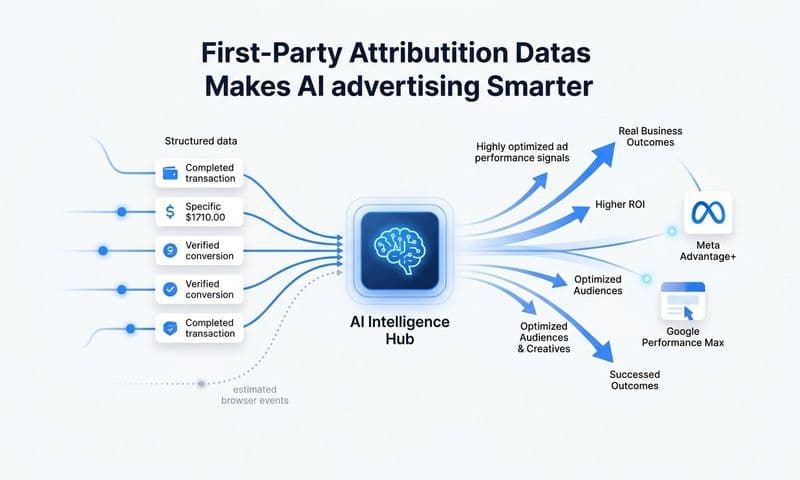
Here's where attribution creates a virtuous cycle with ad platform optimization. When you feed accurate conversion data back to Meta, Google, and TikTok, their algorithms learn faster and target better. This isn't just about tracking—it's about improving the input data these platforms use to optimize your campaigns.
Server-side tracking enables this feedback loop. When you send enriched conversion events that include customer value, product details, and lifecycle stage, ad platforms can optimize for the conversions that actually matter to your business. Meta's algorithm learns to find more people likely to make high-value purchases, not just any purchase. Google's Performance Max campaigns optimize toward profitable product categories, not just conversion volume.
The result is better targeting, lower costs, and higher-quality customers—all because your attribution system isn't just measuring results but actively improving campaign performance by feeding better data back into the optimization engines.
Common B2C Attribution Pitfalls and How to Avoid Them
Even with the right tools and models, attribution mistakes can lead you to wrong conclusions and bad budget decisions. Here are the traps that catch most B2C marketers.
The branded search credit trap is the most common. Your attribution report shows branded search (people searching for your company name) driving 30% of conversions, so you increase your branded search budget. But here's the reality: those people were already looking for you. Something else created that demand—probably your social ads, content marketing, or word-of-mouth. Branded search is capturing demand, not creating it.
The fix is to separate branded and non-branded search in your attribution analysis. Track them as fundamentally different channel types. Branded search should be measured on efficiency (are you capturing the demand that exists?) while non-branded search should be measured on growth (is it creating new demand?). Don't over-invest in branded search just because it gets heavy attribution credit—you're often just bidding against yourself.
View-through conversions create another blind spot. These are conversions that happen after someone saw your ad but didn't click it. Traditional click-based attribution ignores these entirely, but for awareness-focused channels like display advertising, video ads, and social media, view-through influence is real. Someone who sees your Instagram ad three times might not click, but that exposure influences their decision when they later search for your product.
The challenge is setting appropriate view-through windows. A one-day view-through window is too short—you'll miss legitimate influence. A 28-day window might be too generous, crediting impressions that had no real impact. For most B2C brands, a 7-day view-through window balances capturing real influence without over-crediting passive impressions. Adjust based on your typical purchase cycle length.
Attribution window mistakes happen when your lookback period doesn't match customer behavior. If your average customer researches for two weeks before buying but your attribution window is only seven days, you're systematically under-crediting top-of-funnel channels. Conversely, if you sell impulse products but use a 30-day window, you're giving credit to touchpoints that had nothing to do with the purchase.
The right attribution window reflects your actual customer journey length. Analyze your data to understand the typical time between first touch and conversion. For fashion and impulse categories, 7-14 days often works. For considered purchases like furniture or electronics, 30 days or more might be appropriate. Set your window based on data, not defaults. Reviewing common attribution challenges in marketing analytics can help you anticipate and avoid these measurement errors.
Finally, the cross-device gap creates attribution blind spots when you can't connect customer journeys across devices. Your attribution system might show desktop driving 70% of conversions simply because that's where the final purchase happens—but mobile research and browsing that preceded it goes untracked. This leads to under-investment in mobile advertising even though it plays a critical role in the journey.
Solving this requires identity resolution—connecting the same customer across devices through email matching, login data, or probabilistic device graphing. It's technically complex but essential for accurate B2C attribution where cross-device shopping is the norm, not the exception.
Making Attribution Work for Your Brand
Accurate B2C marketing attribution isn't about achieving perfect measurement—it's about making confident decisions that scale profitable campaigns. You've seen how consumer journeys create unique tracking challenges, why multi-touch models reveal insights single-touch attribution misses, and how the right tech stack connects fragmented data into a unified view.
The progression is clear: understand your attribution challenges, implement models that match your business reality, build the integrations that capture complete customer journeys, and translate insights into budget decisions that drive growth. But this only works when your attribution system can actually track across devices, survive privacy restrictions, and feed enriched data back to ad platforms.
Most B2C brands are flying blind on at least some portion of their customer journeys. They're missing conversions due to tracking limitations. They're over-crediting last-click channels while starving awareness drivers. They're making budget decisions based on incomplete data because their attribution setup can't connect all the dots.
The solution is a unified platform approach that eliminates these blind spots. When you can capture every touchpoint from ad click to CRM event, track accurately across devices and channels, and feed better conversion data back to ad platforms, attribution transforms from a reporting exercise into a strategic advantage.
Ready to elevate your marketing game with precision and confidence? Discover how Cometly's AI-driven recommendations can transform your ad strategy—Get your free demo today and start capturing every touchpoint to maximize your conversions.