You're staring at your analytics dashboard, trying to figure out why your latest campaign underperformed. The numbers don't match what your ad platforms are reporting. Your CRM shows leads, but you can't trace them back to specific ads. Your team is making budget decisions based on incomplete data, and you know it's costing you.
This is the reality for marketing teams working with inadequate analytics tools. Choosing the right analytics platform isn't just another software purchase—it's a strategic investment that determines whether your team makes confident, data-driven decisions or flies blind with millions in ad spend on the line.
The analytics tools market is crowded and confusing. Every vendor promises "complete visibility" and "actionable insights," but the feature sets blur together, pricing structures remain opaque until you're deep in the sales process, and the stakes of choosing wrong are high. A poor analytics investment doesn't just waste your budget—it compounds the problem by giving you false confidence in bad data.
This guide walks you through the entire buying process, from identifying what you actually need to evaluating vendors and making a decision you can defend to stakeholders. We'll cut through the marketing noise and focus on what matters: finding a tool that eliminates your data blind spots and connects every touchpoint in the customer journey.
Why Your Analytics Stack Can Make or Break Campaign Performance
Accurate data is the foundation of profitable marketing. When you can trace every conversion back to its source, you allocate budget to channels that actually drive revenue. When you can't, you're guessing—and guessing wrong gets expensive fast.
Consider what happens when your attribution is off by even 20%. You might double down on channels that look effective but actually lose money once you account for the full customer journey. You might cut budget from awareness channels that don't get credit for conversions they influenced. These aren't small mistakes—they compound over time as you optimize based on incomplete information.
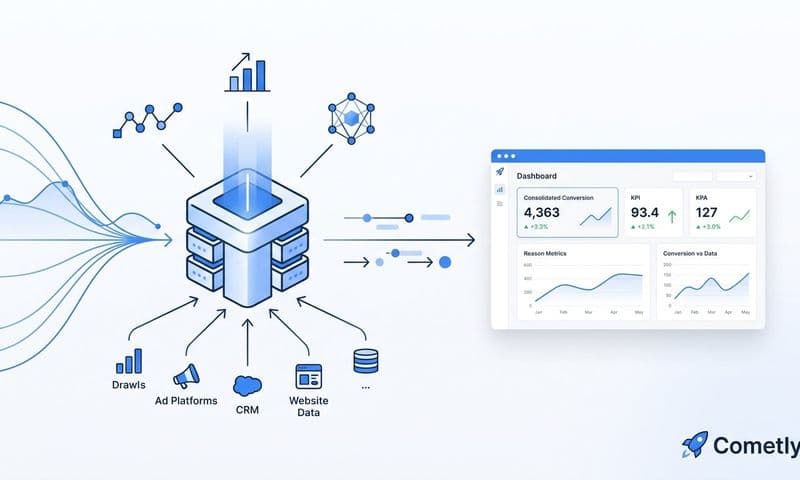
The most common pain point? Data silos. Your Google Ads dashboard shows one conversion number. Meta shows another. Your CRM records leads that don't match either platform. Your website analytics captures traffic but can't connect it to revenue. Each system operates in isolation, giving you fragments of the story instead of the complete picture.
Attribution gaps create even bigger problems. A customer sees your Facebook ad, clicks through, browses your site, then returns three days later via Google search and converts. Which channel gets credit? With last-click attribution, Google gets 100% of the credit while Facebook gets nothing—even though it initiated the journey. This leads to systematically underfunding top-of-funnel channels that drive awareness. Understanding common attribution challenges in marketing analytics helps teams avoid these costly mistakes.
Then there's the cross-platform tracking challenge. Modern customer journeys span devices, browsers, and platforms. Someone discovers you on mobile, researches on desktop, and converts on tablet. If your analytics tool can't connect these touchpoints, you're seeing three separate "users" instead of one customer journey. This fragmentation makes it impossible to understand what's actually working.
The cost of delayed decisions adds another layer of complexity. Marketing moves fast. If your analytics tool processes data in batches overnight, you're optimizing based on yesterday's performance. By the time you spot a winning ad or a budget-draining campaign, you've already spent thousands more than necessary. Real-time visibility isn't a luxury—it's the difference between proactive optimization and reactive damage control.
Without proper analytics infrastructure, marketing teams operate reactively instead of strategically. They make budget decisions based on surface-level metrics that don't connect to revenue. They can't answer basic questions like "Which channels drive our highest-value customers?" or "What's the actual ROI of our awareness campaigns?" This uncertainty creates tension with leadership and makes it nearly impossible to scale confidently.
Mapping Your Requirements Before You Shop
Start by auditing your current data gaps. Sit down with your team and list every question you can't answer today. What conversion paths remain invisible? Which channels lack clear attribution? Where do leads enter your CRM without source data? These gaps define your requirements more accurately than any vendor's feature list.
Ask yourself: Can we track a customer from their first ad click through multiple touchpoints to final conversion? Do we know which marketing activities influence deals that close weeks or months later? Can we measure the impact of our content, email campaigns, and retargeting in the same system? If the answer is no, you need better journey visibility.
Next, define must-have versus nice-to-have features based on your actual marketing operations. If you run campaigns across Meta, Google, TikTok, and LinkedIn, you need a tool that integrates with all four platforms and attributes conversions across them. If your sales cycle spans months, you need long-window attribution that connects early touchpoints to eventual revenue.
Consider your business model carefully. E-commerce teams need different capabilities than B2B SaaS companies. If you're e-commerce, you need analytics tools for ecommerce brands that track product-level performance, shopping cart behavior, and repeat purchase patterns. If you're B2B, you need CRM integration that connects marketing touches to pipeline value and closed deals.
Integration requirements often determine whether a tool will actually work in your environment. List every system that needs to connect: your CRM (Salesforce, HubSpot, Pipedrive), ad platforms (Meta, Google, LinkedIn, TikTok), website tracking, email marketing tools, and any custom databases or internal systems. The analytics tool you choose must integrate deeply with these systems—not just pull data, but push conversion events back to ad platforms to improve their algorithms.
Think about data flow bidirectionally. You need to pull data from ad platforms and your website to see performance. But you also need to send conversion data back to those platforms so their AI can optimize more effectively. This "conversion sync" capability has become essential as ad platforms rely more heavily on machine learning for targeting and bidding.
Don't forget about team capabilities and learning curves. If your team isn't highly technical, you need a tool with an intuitive interface and strong support resources. If you have data analysts who want to build custom reports, you need flexibility and API access. Match the tool's complexity to your team's skill level—the most powerful platform is worthless if nobody can use it effectively.
Budget constraints matter, but frame them correctly. Don't just think about the monthly subscription cost. Factor in implementation time, training requirements, and the cost of data accuracy problems if you choose wrong. A tool that costs $500/month but gives you 95% accurate attribution is far more valuable than a $200/month tool with 70% accuracy when you're spending $50,000/month on ads.
Finally, consider your growth trajectory. If you're planning to expand into new channels, enter new markets, or significantly scale ad spend, choose a tool that can grow with you. Switching analytics platforms mid-scale is painful—you lose historical data, disrupt optimization processes, and waste time on another implementation.
Key Features That Separate Effective Analytics Tools from the Rest
Multi-touch attribution stands as the most critical capability for modern marketing teams. Single-touch models—whether first-click or last-click—fundamentally misrepresent how customers actually make decisions. They assign 100% of the credit to one touchpoint, ignoring every other interaction that influenced the conversion.
Think about your own buying behavior. You rarely see one ad and immediately purchase. You see an ad, visit the website, leave, see a retargeting ad, read some content, receive an email, search for reviews, and then convert. Every touchpoint played a role. Last-click attribution would give all the credit to whatever brought you back that final time—usually branded search or direct traffic—while the awareness and consideration touches that actually drove the decision get nothing.
Effective analytics tools offer multiple attribution models so you can view performance through different lenses. Linear attribution spreads credit evenly across all touchpoints. Time-decay gives more credit to recent interactions. Position-based (U-shaped) emphasizes the first and last touches. The ability to compare these models side-by-side reveals which channels truly drive your business. Investing in proper attribution tracking tools makes this analysis possible.
Real-time data processing versus delayed reporting creates a massive difference in optimization capability. Tools that batch-process data overnight force you to make decisions based on yesterday's performance. By the time you see that an ad is crushing it or bleeding money, you've already spent another day's budget.
Real-time platforms show you what's happening now. You can spot winning variations within hours and scale them immediately. You can catch budget-draining campaigns before they waste thousands. You can adjust bids, pause underperformers, and capitalize on momentum while it matters. This speed advantage compounds—teams with real-time visibility make dozens of micro-optimizations that teams with delayed data simply miss. Explore real-time analytics tools for e-commerce to understand these capabilities better.
Server-side tracking has evolved from nice-to-have to essential due to iOS privacy changes and cookie deprecation. Browser-based tracking—the old standard—increasingly fails as Safari blocks third-party cookies, iOS limits tracking windows, and users enable privacy features. Tools that rely exclusively on browser pixels miss significant portions of your traffic.
Server-side tracking processes data on your servers before sending it to analytics platforms, bypassing browser restrictions. This approach captures more accurate data, extends attribution windows beyond iOS's 7-day limit, and provides better cross-device tracking. As privacy regulations tighten and browser restrictions expand, server-side capabilities will only become more critical.
First-party data collection ties directly to server-side tracking. Tools that help you build and own your customer data—rather than relying entirely on third-party cookies—future-proof your analytics as the industry moves away from cookie-based tracking. Look for platforms that emphasize first-party data capture and give you full ownership of the information collected.
Cross-device tracking capability determines whether you see complete customer journeys or fragmented interactions. Modern buyers switch devices constantly. They discover you on mobile during their commute, research on desktop at work, and convert on tablet at home. Without cross-device tracking, these appear as three separate users, making it impossible to understand the full journey or calculate accurate CAC. Leveraging customer journey analytics tools solves this visibility problem.
Integration depth matters more than integration breadth. A tool that "integrates" with 100 platforms but only pulls basic data isn't as valuable as one that deeply integrates with your core systems. Look for bidirectional data flow—pulling performance data in AND pushing conversion events back to ad platforms to improve their optimization algorithms.
Customization and flexibility separate tools that work for your specific business from one-size-fits-all solutions. Can you define custom conversion events that matter to your business? Can you create custom attribution models? Can you build dashboards that answer your specific questions? The best tools adapt to your workflow rather than forcing you to adapt to theirs.
Evaluating Vendors: Questions to Ask During the Sales Process
Start with technical questions about data accuracy methodology. How does the tool track conversions? What's their approach to deduplication when multiple tracking methods capture the same event? How do they handle attribution when users block cookies or use privacy features? Vague answers to these questions are red flags—accurate attribution requires sophisticated technical approaches, and vendors should be able to explain their methodology clearly.
Ask about integration implementation timelines and depth. How long does typical implementation take? What internal resources do you need to dedicate? Can they integrate with your specific CRM, ad platforms, and other tools? Get specific about bidirectional data flow—can they send conversion data back to ad platforms, not just pull performance data in?
Probe their server-side tracking capabilities if you run significant mobile traffic or iOS-targeted campaigns. How do they handle iOS attribution window limitations? What percentage of conversions do they typically capture compared to browser-based tracking alone? Can they demonstrate the data accuracy improvement you'll see?
On the business side, demand pricing transparency early. Tools that won't discuss pricing until you're deep in the sales process waste everyone's time. Understand the pricing model—is it based on ad spend, conversion volume, number of users, or data volume? What happens to your costs as you scale? Are there surprise fees for essential features or integrations?
Evaluate their support quality and customer success resources. What does onboarding look like? Do you get a dedicated customer success manager? What's their response time for technical support? Can they provide references from customers in similar industries or with similar marketing complexity?
Ask about data ownership and portability. Do you own the data they collect? Can you export it if you decide to switch platforms? This matters more than most teams realize—you don't want to be locked into a tool because leaving means losing your historical data and starting from scratch.
Request case studies or examples from businesses similar to yours. How have they solved attribution challenges for companies in your industry? What results have customers seen? Be skeptical of vague ROI claims without specifics—"increased ROI by 40%" means nothing without context about the starting point, time frame, and what actually changed.
Watch for red flags during the sales process. If they can't provide trial access or a proof-of-concept period, they may lack confidence in their product. If they pressure you to sign quickly with "limited-time" discounts, they're using sales tactics instead of letting the product speak for itself. If they can't clearly explain their data accuracy methodology, they may not have one.
Ask about their product roadmap and development velocity. Analytics tools need to evolve as the industry changes. How often do they release updates? How do they handle new ad platforms or tracking methods? A tool that hasn't meaningfully evolved in two years will likely fall behind as privacy regulations and tracking technologies continue changing.
Finally, understand their approach to AI and automation. Modern analytics platforms increasingly use AI to surface insights and recommend optimizations. Can their AI identify underperforming campaigns automatically? Does it suggest budget reallocation? Does it detect anomalies or opportunities you might miss manually? These capabilities separate reactive reporting tools from proactive optimization platforms.
Building Your Business Case for Analytics Investment
Calculating potential ROI starts with quantifying your current data accuracy problems. If you're spending $50,000 monthly on ads and your attribution is 70% accurate, you're making decisions based on incomplete information for $15,000 of that spend. Even a 10% improvement in budget allocation—shifting $5,000 from underperforming channels to high-performers—can generate significant returns.
Frame the efficiency gains concretely. How many hours does your team currently spend manually pulling reports from different platforms, reconciling discrepancies, and trying to piece together customer journeys? If proper analytics saves 20 hours per week, that's 80 hours monthly—more than two full work weeks your team can redirect toward strategy and optimization instead of data wrangling.
Better budget allocation creates the most measurable impact. When you know which channels and campaigns actually drive revenue, you stop wasting money on underperformers and scale winners faster. For many teams, this optimization alone pays for analytics tools many times over within the first few months. Understanding how to use data analytics in marketing accelerates this ROI realization.
Reduced wasted spend compounds over time. Every month you operate with poor attribution, you're likely overspending on channels that don't perform and underspending on channels that do. Fix this, and the savings accumulate. A $500/month analytics investment that prevents $2,000 in monthly wasted spend pays for itself immediately and continues generating returns indefinitely.
When framing the purchase for stakeholder buy-in, connect analytics capabilities directly to revenue outcomes. Don't talk about "better data visibility"—talk about "identifying which campaigns drive our highest-value customers so we can acquire more of them." Don't say "improved attribution"—say "eliminating the $15,000 monthly we're currently wasting on underperforming channels."
Address the risk of inaction. What's the cost of continuing with your current analytics gaps? If you're making budget decisions based on 70% accurate data, you're systematically misallocating resources. That misallocation costs you every single month. The longer you wait, the more you lose.
Present the decision as an investment in competitive advantage, not just a cost. Your competitors are either struggling with the same data gaps or they've already solved them. If they have better attribution than you, they're making smarter budget decisions, scaling more efficiently, and gaining market share. Better analytics isn't just about improving your performance—it's about not falling behind.
Plan for implementation realistically. Most analytics tools require 2-4 weeks for full implementation, depending on your technical complexity and integration requirements. You'll need time from your marketing team to define conversion events and goals, time from developers or IT to implement tracking, and time for testing before you trust the data completely.
Set clear expectations about the learning curve. Even the most intuitive analytics platform requires time to master. Budget for initial training, ongoing learning, and a ramp-up period where your team gets comfortable with new workflows and reports. This isn't a weakness of analytics tools—it's the reality of adopting any new system.
Include internal resource requirements in your business case. Who will own the tool? Who needs training? Who will maintain integrations and troubleshoot issues? Being transparent about these requirements prevents surprises later and ensures you have the internal support needed for successful adoption.
Making the Final Decision with Confidence
Create a structured evaluation scorecard to compare finalists objectively. List your must-have features and assign weights based on importance. Score each vendor on technical capabilities, integration quality, ease of use, support quality, and pricing. This framework prevents decisions based on which salesperson you liked best or which demo was flashiest.
Include categories for data accuracy methodology, real-time processing capability, attribution model flexibility, server-side tracking, CRM integration depth, ad platform integration, reporting customization, and team collaboration features. Rate each vendor on a consistent scale and calculate weighted scores. A thorough comparison of best marketing analytics tools can guide your evaluation criteria.
Run a meaningful pilot or proof-of-concept before committing long-term. Most reputable vendors offer trial periods or POC arrangements. Use this time to implement the tool with real data, test integrations, and validate that it solves your specific attribution challenges. Don't just click through demo dashboards—actually use it with your campaigns.
During the pilot, focus on answering your most critical questions. Can you trace conversions back to their sources? Does the data match reality when you spot-check against your CRM? Can your team build the reports they need? Are the insights actionable? A successful pilot should give you confidence that this tool will actually improve your decision-making.
Set clear success metrics for the first 90 days post-implementation. What does success look like? Common metrics include: data accuracy improvement (measured by comparing to CRM data), time saved on reporting, number of optimization actions taken based on new insights, and measurable improvement in campaign performance or budget efficiency.
Define quick wins you expect to see immediately and longer-term improvements that take time. You should see better data visibility within the first month. Optimization improvements might take 60-90 days as you act on insights and campaigns adjust. Be realistic about timelines—analytics tools provide information, but you still need to act on it.
Plan your rollout strategy if you're implementing across a large team. Start with a core group of power users who can master the tool and become internal champions. Document best practices and create training materials. Gradually expand access as confidence builds. This phased approach prevents overwhelming your team and allows you to refine workflows before full deployment.
Remember that choosing analytics tools is a strategic decision, not just a software purchase. The right platform eliminates data blind spots, connects every touchpoint in the customer journey, and transforms how your team makes decisions. Take the time to evaluate properly, pilot thoroughly, and implement thoughtfully. The investment you make in choosing well pays dividends every month as you optimize with confidence instead of guessing.
Putting It All Together
Buying analytics tools deserves the same strategic rigor you apply to your marketing campaigns. The right platform doesn't just show you data—it connects every touchpoint, eliminates attribution gaps, and gives you the confidence to scale what works while cutting what doesn't.
Start by mapping your requirements honestly. Audit your current data gaps, define must-have features based on your actual marketing operations, and understand how data needs to flow between your systems. Don't let vendor marketing dictate what you need—let your business challenges drive the requirements.
Prioritize capabilities that matter for modern marketing: multi-touch attribution that reveals the full customer journey, real-time data processing that enables fast optimization, server-side tracking that maintains accuracy despite privacy changes, and deep integrations that connect your entire marketing stack. The best digital marketing analytics tools deliver all of these capabilities in one platform.
Evaluate vendors thoroughly. Ask technical questions about data accuracy methodology, demand pricing transparency early, and watch for red flags during the sales process. Run meaningful pilots that test the tool with your real data and validate that it solves your specific challenges.
Build a clear business case that connects analytics capabilities to revenue outcomes. Quantify the cost of your current data gaps, calculate potential ROI from better budget allocation, and frame the purchase as an investment in competitive advantage. Plan realistically for implementation timelines and internal resource requirements.
The analytics tools market will continue evolving as privacy regulations tighten and tracking technologies change. Choose a platform that's actively developing, adapting to industry shifts, and investing in capabilities like AI-powered insights and server-side tracking. Your analytics foundation needs to work today and remain effective as the landscape changes.
Most importantly, remember that analytics tools are only valuable if they change how you make decisions. The best platform in the world doesn't help if your team doesn't use it or doesn't act on the insights it provides. Choose a tool your team can actually use, implement it thoughtfully, and commit to making data-driven decisions based on what you learn.
Ready to elevate your marketing game with precision and confidence? Discover how Cometly's AI-driven recommendations can transform your ad strategy—Get your free demo today and start capturing every touchpoint to maximize your conversions.