

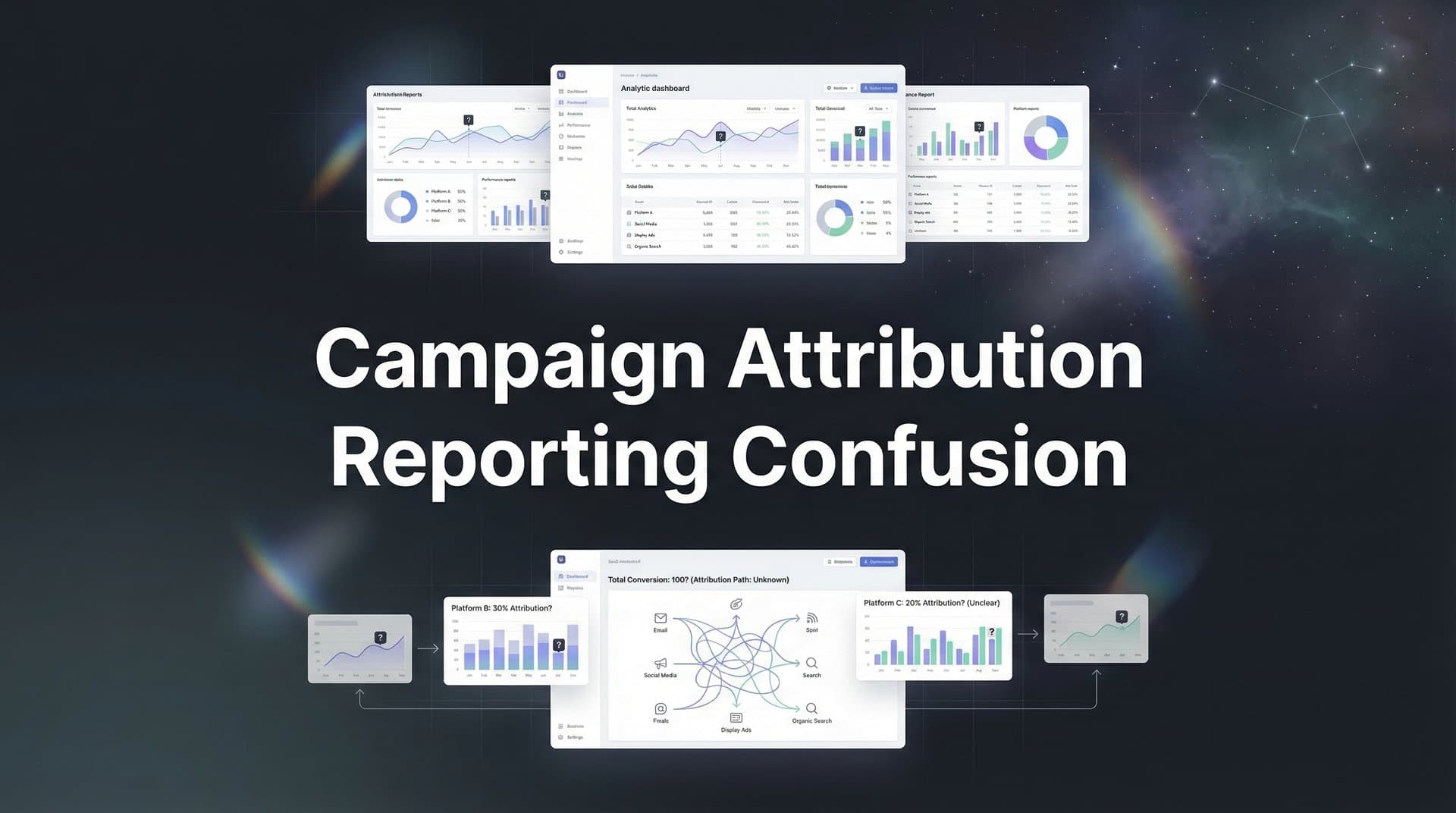
You're looking at your dashboard, and the numbers don't make sense. Google Ads says you got 47 conversions this week. Meta claims 52. Your CRM shows 31 actual sales. When you add up what each platform is reporting, you're somehow 68% over your real revenue. Sound familiar?
This is campaign attribution reporting confusion in action—and it's not a glitch. It's the inevitable result of running campaigns across multiple platforms that each operate in their own tracking bubble, using different rules, different windows, and different definitions of success.
The frustrating part? You're making budget decisions based on this fragmented data. Scaling campaigns that might not actually be your top performers. Cutting spend from channels that are quietly doing the heavy lifting. The good news is this confusion isn't an unsolvable mystery—it's a structural problem with a clear fix.
Why Every Platform Claims Credit for the Same Sale
Here's the uncomfortable truth: ad platforms aren't designed to play nicely together. Each one operates with its own attribution window and methodology, and they're all incentivized to make their performance look as strong as possible.
Meta defaults to a 7-day click and 1-day view attribution window. That means if someone clicks your ad and converts within seven days, Meta takes credit. If they just see your ad and convert within 24 hours, Meta still counts it. Google Ads, meanwhile, uses a 30-day click window by default. Same customer journey, completely different attribution rules.
Let's say a potential customer clicks your Meta ad on Monday, researches your product, then clicks a Google search ad on Thursday and makes a purchase. Both platforms will claim that conversion. Meta says, "They clicked our ad and converted within seven days." Google says, "They clicked our ad and converted within 30 days." They're both technically correct according to their own rules—but you only made one sale.
This overlap creates what marketers call "conversion inflation." When you sum up the conversions reported across all your platforms, the total often exceeds your actual sales by 30-100%. It's not fraud or bad tracking—it's multiple ad platforms attribution confusion where each legitimately claims credit for the same customer action using different measurement frameworks.
The problem gets worse when you consider view-through attribution. Some platforms count conversions even when someone simply saw your ad but never clicked it. If a customer sees your Meta ad, your Google Display ad, and your TikTok ad before purchasing, all three platforms might claim that conversion through view-through windows—even though the customer may not have consciously registered any of those impressions.
Add in retargeting campaigns, and the attribution chaos multiplies. Your Meta retargeting campaign claims the conversion because the customer clicked a retargeting ad. Your Google search campaign claims it because they searched your brand name before purchasing. Your original awareness campaign on LinkedIn might also claim it if they engaged with that ad weeks earlier and it's still within LinkedIn's attribution window.
The platforms aren't lying—they're just telling their own version of the story. But when you're trying to understand what's actually driving revenue and where to allocate your next dollar of budget, these competing narratives create more confusion than clarity.
The Hidden Culprits Behind Mismatched Numbers
Even if attribution windows were perfectly aligned across platforms, you'd still face tracking gaps that make your data unreliable. The biggest culprit? Privacy changes that have fundamentally broken traditional tracking methods.
Since Apple's iOS 14.5 update introduced App Tracking Transparency, cookie-based tracking has become increasingly unreliable. When users opt out of tracking—which the majority do—platforms lose visibility into significant portions of the customer journey. Meta has publicly acknowledged that iOS privacy changes have created substantial underreporting of conversions, particularly for mobile traffic.
Browser restrictions compound the problem. Safari's Intelligent Tracking Prevention and Firefox's Enhanced Tracking Protection actively block third-party cookies and limit first-party cookie lifespans. Chrome is following suit. What this means in practice: a customer might click your ad on their iPhone, research on their iPad, and convert on their laptop—and your tracking pixels see these as three completely different people.
Cross-device journeys have become the norm, not the exception. Customers research products on mobile during their commute, compare options on their work computer during lunch, and complete purchases on their home desktop in the evening. Traditional pixel-based tracking struggles to connect these dots because it relies on cookies that don't transfer across devices or browsers.
Then there's the offline conversion gap. A customer might click your Facebook ad, call your sales team, and close a deal over the phone. That revenue exists in your CRM, but unless you've set up marketing attribution for phone calls and your sales team consistently logs the original ad source, that attribution data never makes it back to Meta. The platform shows zero conversions while your actual revenue grows.
Form submissions present another blind spot. Someone fills out a lead form on your website, your sales team nurtures them for three weeks, and they eventually buy. Your ad platforms might attribute that conversion to whatever campaign was running when they finally purchased—not the campaign that generated the original lead. The timeline gets scrambled, and you lose sight of what actually started the relationship.
Ad blockers, VPNs, and privacy-focused browsers add yet another layer of invisibility. A meaningful segment of your audience—often your most tech-savvy, high-value customers—are essentially invisible to standard tracking pixels. They're converting, but your attribution reports have no record of how they found you.
Attribution Models Explained: Which Story Are You Telling?
Here's where things get interesting: even with perfect tracking, the attribution model you choose fundamentally changes which campaigns appear successful. Each model answers a different question about your marketing performance.
First-touch attribution gives all credit to the first interaction a customer had with your brand. This model answers: "What's bringing new people into our funnel?" It's valuable for understanding which channels are best at generating awareness and starting customer relationships. If you're focused on top-of-funnel growth, first-touch helps you identify which campaigns are opening doors.
Last-touch attribution does the opposite—it gives 100% credit to the final touchpoint before conversion. This model answers: "What's closing deals?" Most ad platforms default to last-touch or last-click attribution because it makes their performance look strongest. After all, they're usually the last thing someone interacts with before buying.
The problem with both single-touch models? They ignore reality. Customer journeys rarely involve just one touchpoint. Someone might discover you through a LinkedIn ad, research you via organic search, engage with your email campaign, and finally convert through a Google search ad. First-touch gives all credit to LinkedIn. Last-touch gives all credit to Google. Neither tells the complete story.
This is why multi-touch attribution has become the industry standard for sophisticated marketers. Linear attribution distributes credit equally across all touchpoints. Time-decay attribution gives more weight to recent interactions while still acknowledging earlier ones. Position-based (U-shaped) attribution emphasizes both the first and last touch while giving partial credit to middle interactions. Understanding attribution models in digital marketing helps you choose the right approach for your business.
Which model should you use? It depends on your sales cycle and business goals. Short sales cycles with few touchpoints can work fine with last-touch. Complex B2B sales with 8-12 touchpoints over several months need multi-touch to understand the full journey. E-commerce with heavy retargeting might benefit from position-based models that credit both discovery and closing moments.
The mistake most marketers make is using their ad platform's default attribution model without questioning whether it matches their reality. Meta's 7-day click window makes sense for impulse purchases but falls short for considered purchases with longer decision cycles. Google's 30-day window captures more of the journey but might over-credit search campaigns that customers use for final research before buying.
Here's the real insight: you shouldn't choose just one attribution model. The smartest approach is comparing multiple models side-by-side. When you look at first-touch, last-touch, and multi-touch attribution together, patterns emerge. Campaigns that perform well across all models are genuinely strong. Campaigns that only show up in last-touch might be getting credit for conversions they didn't actually drive—they're just where customers naturally end up before purchasing.
Building a Single Source of Truth for Campaign Data
The solution to attribution confusion isn't better guessing—it's better infrastructure. You need a unified system that captures data from every source and applies consistent attribution logic across your entire marketing operation.
Start by connecting your ad platforms, website analytics, and CRM into one centralized view. This isn't about looking at three dashboards side-by-side—it's about creating a single database where all conversion events live with complete journey history attached. When a conversion happens, you should be able to see every ad click, website visit, email open, and sales interaction that preceded it.
Server-side tracking has become essential for capturing accurate data in the privacy-first era. Unlike browser-based pixels that get blocked by privacy settings and ad blockers, server-side tracking sends conversion data directly from your server to ad platforms. This approach bypasses many of the limitations of client-side tracking while respecting user privacy through proper consent management.
The technical benefit is significant: server-side tracking captures conversions that browser pixels miss entirely. When someone uses an ad blocker or has tracking prevention enabled, your server still records the conversion and can attribute it to the correct source using first-party data like email addresses or customer IDs that you control.
Consistent UTM conventions across all campaigns create the foundation for accurate attribution. Every ad, email, and social post should use a standardized naming structure that identifies the source, medium, campaign, and content. When everyone on your team follows the same UTM framework, you can reliably compare performance across channels and time periods. A marketing campaign tracking spreadsheet can help establish these conventions before implementing more sophisticated tools.
But here's what most marketers miss: UTM parameters alone aren't enough. You need to capture and store these parameters alongside actual customer data. When someone clicks an ad, browses your site, and converts three days later, your system needs to remember that original UTM source and connect it to the conversion event—even if they came back through a different channel.
This is where marketing attribution platforms become invaluable. They act as the central hub that receives data from all your sources, deduplicates conversions, applies your chosen attribution model, and provides a unified view of campaign performance. Instead of each platform claiming 47 conversions independently, you see the actual 31 conversions with proper attribution distributed across the channels that contributed.
The key is choosing a platform that integrates deeply with your existing tools. Superficial integrations that just pull summary data aren't enough—you need event-level data flowing from your website, CRM, and ad platforms into one system that can reconstruct complete customer journeys and apply sophisticated attribution logic.
Turning Accurate Attribution Into Smarter Budget Decisions
Once you have clean attribution data, the real value emerges: making confident budget decisions based on complete information rather than fragmented platform reports.
Multi-touch attribution often reveals that your awareness campaigns are dramatically undervalued. When you only look at last-click attribution, that top-of-funnel LinkedIn campaign might show a terrible return. But when you examine first-touch and multi-touch models, you discover it's actually initiating 40% of your highest-value customer journeys—they just don't convert until they've interacted with your brand several more times.
This insight changes everything. Instead of cutting budget from awareness campaigns that "don't convert," you recognize them as essential drivers of pipeline that need to work in concert with your retargeting and search campaigns. You start optimizing for the full funnel, not just the last click.
Accurate conversion data also dramatically improves ad platform algorithms. When you feed enriched, deduplicated conversion events back to Meta, Google, and other platforms through conversion APIs, their machine learning systems get clearer signals about what's actually working. They can optimize for real conversions instead of the noisy, incomplete data from browser pixels.
The result is better targeting, more efficient bidding, and stronger campaign performance. Ad platforms work best when they have accurate training data—and most marketers are unknowingly training their algorithms on incomplete information.
Setting up attribution reporting for marketing teams that compares models side-by-side becomes your decision-making framework. You might have one view showing last-click attribution for quick performance checks, another showing multi-touch attribution for strategic planning, and a third showing first-touch attribution for awareness campaign evaluation.
When these views tell different stories, that's valuable information. A campaign that performs well in last-touch but poorly in first-touch is probably capturing demand rather than creating it. A campaign that shows strong first-touch attribution but weak last-touch might be excellent at awareness but needs better retargeting support to close deals.
The smartest marketers use this layered view to build more sophisticated strategies. They allocate budget across the full funnel based on how campaigns work together, not how each performs in isolation. They test new awareness channels knowing that the value might not show up in immediate conversions. They optimize retargeting based on which initial touchpoints produce the highest lifetime value customers.
From Fragmented Reports to Clear Direction
Campaign attribution reporting confusion isn't a data quality problem—it's a data fragmentation problem. Every platform is telling you the truth from its limited perspective. The chaos comes from trying to reconcile multiple partial truths without a unified framework to connect them.
The path forward is clear: implement unified tracking that captures the complete customer journey, choose attribution models that match your actual sales cycle, and centralize your data in a system that can deduplicate conversions and apply consistent attribution logic across all channels.
When you solve attribution confusion, you unlock confident decision-making. You know which campaigns are truly driving revenue. You can scale winners without second-guessing whether the data is real. You stop wasting budget on channels that look good in their own reports but don't actually contribute to your bottom line.
This is exactly what Cometly was built to solve. By connecting your ad platforms, CRM, and website into one unified view, Cometly captures every touchpoint in the customer journey and shows you precisely which campaigns drive real revenue. Server-side tracking ensures you're not missing conversions due to privacy restrictions. AI-powered recommendations identify which campaigns to scale based on actual performance, not platform-reported vanity metrics.
Ready to elevate your marketing game with precision and confidence? Discover how Cometly's AI-driven recommendations can transform your ad strategy—Get your free demo today and start capturing every touchpoint to maximize your conversions.


