You've seen the pattern. The polished brand ads with perfect lighting and professional voiceovers? They get scrolled past. But that shaky phone video of someone genuinely excited about a product? That stops thumbs mid-scroll. User-generated content drives higher engagement and builds trust in ways that traditional advertising simply can't match. The problem is, sourcing authentic creator content at scale is a logistical nightmare. You're coordinating with multiple creators, negotiating contracts, waiting for revisions, and constantly refreshing content as it loses effectiveness. It's expensive, time-consuming, and unpredictable.
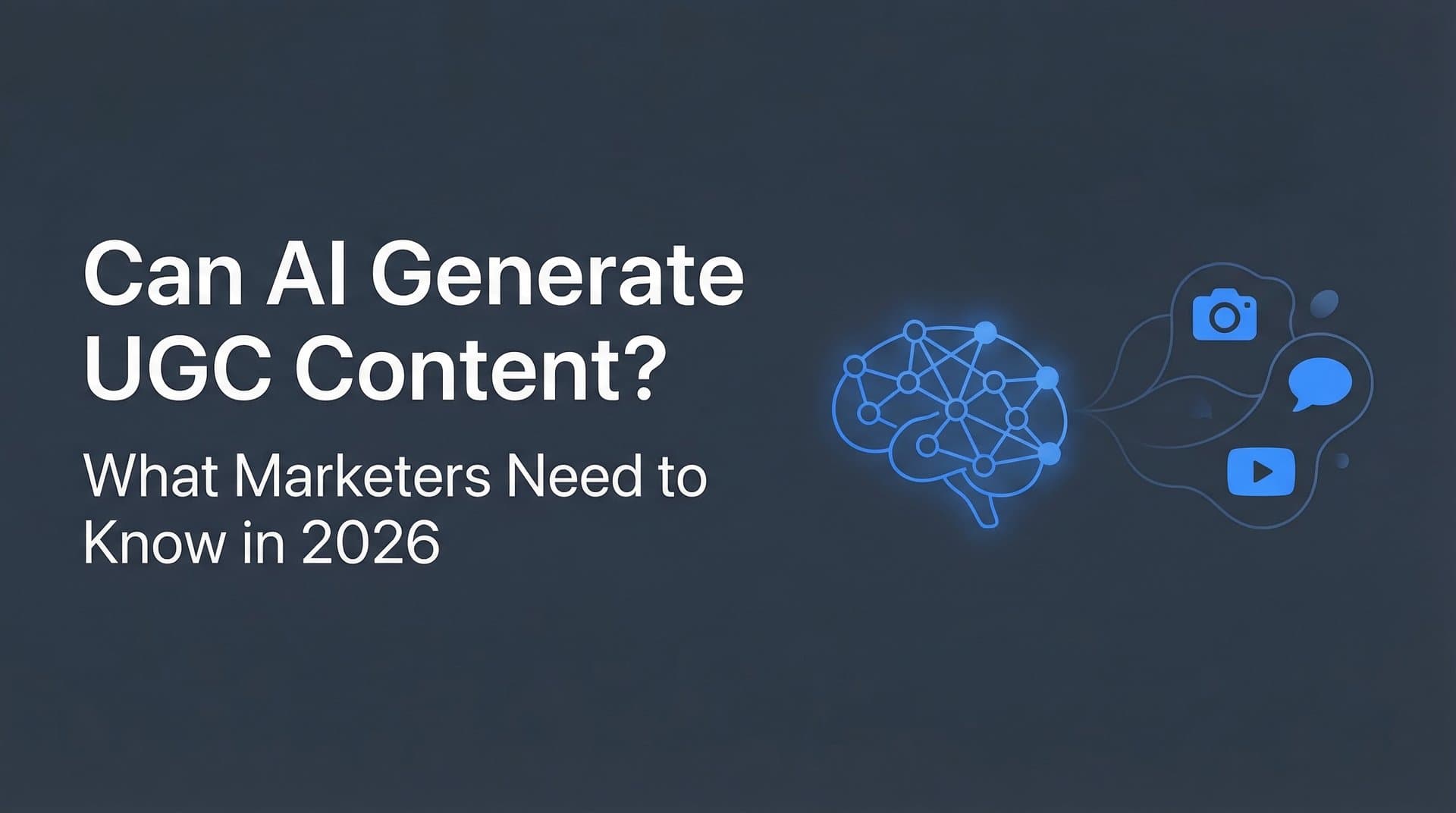
Enter AI-generated UGC-style content. The technology has reached a point where artificial intelligence can create images, videos, and voiceovers that capture that authentic, organic aesthetic that makes UGC so effective. But can AI truly replicate the magic of real user content? And more importantly, should you trust it with your ad budget?
This isn't about replacing human creativity entirely. It's about understanding what AI can do right now, where it falls short, and how to integrate AI-generated UGC into your marketing strategy without sacrificing authenticity or performance. We'll break down how the technology actually works, what results you can realistically expect, the legal considerations you need to navigate, and how to measure whether AI-generated content is actually driving revenue for your business.
The UGC Aesthetic That Changed Digital Advertising
Let's clarify what we're actually talking about. User-generated content, in its purest form, is content created by your customers—real people sharing genuine experiences with your product. They post unfiltered reviews, candid photos, and authentic testimonials because they genuinely want to share their experience.
UGC-style content is different. It's professionally produced content designed to look and feel like organic user submissions. It mimics the aesthetic—the casual framing, the natural lighting, the conversational tone—but it's created intentionally for advertising purposes. Think of it as the difference between stumbling upon a friend's restaurant recommendation and watching an influencer's sponsored post that's crafted to feel like a casual recommendation.
Why does this aesthetic work so effectively? Because polished advertising has trained audiences to tune out. When viewers see professional production quality, their mental shields go up. They recognize they're being sold to, and they scroll faster. But content that looks like it came from a real person's phone? That bypasses those defenses. It feels like a peer recommendation rather than a marketing message.
The numbers back this up. Many marketers find that UGC-style content consistently outperforms traditional brand creative across key metrics. The relatability factor is real. When content looks authentic, viewers engage longer, click more often, and convert at higher rates. Understanding your content marketing analytics helps you quantify exactly how much better UGC performs for your specific audience.
But here's the scaling problem that keeps marketing teams up at night. Traditional UGC acquisition is a resource drain. You need to identify potential creators, reach out with collaboration proposals, negotiate usage rights, provide product samples, wait for content submission, request revisions when the first attempt misses the mark, and then repeat the entire process when you need fresh creative in a few weeks.
For agencies managing multiple clients or brands running campaigns across numerous product lines, this model doesn't scale. You're constantly juggling creator relationships, managing content calendars, and hoping your UGC pipeline doesn't dry up right when you need to launch a new campaign. The question becomes: what if you could generate that authentic aesthetic on demand?
How AI Builds Content That Looks Human-Made
The technology powering AI-generated UGC isn't magic—it's sophisticated pattern recognition and synthesis. Generative AI models have been trained on millions of images and videos, learning the visual patterns, composition styles, and aesthetic markers that make content feel authentic versus polished.
If you're evaluating vendors, our AI UGC generator breakdown can help.
When you prompt an AI creative tool to generate UGC-style content, it's analyzing what characteristics define that aesthetic. Slightly imperfect framing. Natural lighting with minor inconsistencies. Casual environments rather than studio setups. Real-world product usage scenarios instead of staged hero shots. The AI reconstructs these patterns to create new content that carries the same authentic feel.
Related reading: our complete guide to AI UGC vs real UGC.
For static images, the process is relatively straightforward. Advanced image generation models can create realistic product photography that looks like someone captured it with their smartphone. You can specify the setting, the lighting conditions, the angle, and even details like whether the image should look like it was taken indoors or outdoors, in morning light or evening glow.
Video synthesis takes this further. AI avatars can deliver testimonial-style messages with natural facial expressions and body language. These aren't the robotic, obviously-fake avatars from a few years ago. Modern AI video generation produces talking-head content where the avatar blinks naturally, makes subtle gestures, and delivers lines with appropriate emotional inflection.
Voice cloning capabilities add another layer. You can generate synthetic voiceovers that sound conversational and authentic, not like a corporate narrator reading from a script. The AI can adjust tone, pacing, and emphasis to match the casual, enthusiastic delivery that characterizes effective UGC.
The workflow transformation is dramatic. Instead of spending weeks coordinating with creators, you're spending minutes iterating on prompts and generating variations. Need a UGC-style video showing your product in a kitchen setting? Generate it. Want to test the same concept but in a home office environment? Generate that version too. Need both with different voiceover scripts? Done in the time it takes to type the variations. Exploring the best AI writing tools can help you craft compelling scripts for these generated videos.
We compare the leading options in our AI video ad creator roundup.
This speed enables testing at a scale that was previously impossible. You can generate dozens of creative variations, launch them simultaneously, and let performance data tell you what resonates. The traditional UGC model forced you to commit to a handful of creator partnerships and hope their content performed. AI generation lets you test hypotheses rapidly and iterate based on real response data.
The technical barriers have dropped significantly. You don't need a background in machine learning or prompt engineering to use these tools effectively. Modern platforms have built intuitive interfaces where you describe what you want in plain language, select style preferences, and let the AI handle the technical execution. The democratization of creative production is real.
The Reality Check: Capabilities and Constraints
Let's be direct about what AI-generated UGC can accomplish today. For product showcase content, the technology is remarkably effective. AI can create realistic images and videos of products in use, lifestyle settings that feel authentic, and testimonial-style presentations that mirror traditional UGC aesthetics. Many marketers find that well-executed AI-generated content performs comparably to creator content across engagement and conversion metrics.
The sweet spot is content where the focus is on demonstrating product benefits in relatable contexts. An AI-generated video showing someone using a productivity app, a fitness supplement, or a home organization product can capture that authentic UGC feel effectively. The AI handles lighting, composition, and presentation in ways that feel natural rather than staged.
But limitations exist, and understanding them prevents expensive mistakes. The uncanny valley is real. When AI-generated humans look almost but not quite right, viewer response can turn negative. Subtle issues with facial proportions, unnatural eye movements, or slightly off lip-syncing can trigger discomfort that kills engagement. The technology is improving rapidly, but you need to quality-check every asset before it goes live.
Legal considerations matter more than ever. The regulatory landscape around synthetic media in advertising is evolving. The FTC has issued guidance emphasizing that material connections must be disclosed, and there's growing discussion about whether AI-generated content that mimics real people requires specific disclosure. Different platforms have different policies. Meta, for example, requires labeling of certain types of AI-generated content. Google has similar requirements emerging. You can't ignore these rules and hope for the best.
Platform policies are a moving target. What's acceptable today might require disclosure tomorrow. What requires disclosure on one platform might have different requirements on another. Building compliance into your workflow from the start is smarter than scrambling to update campaigns when policies change. If you're struggling to track which ads are working, adding AI-generated content without proper measurement only compounds the problem.
Quality benchmarks vary by use case. For straightforward product demonstrations and benefit-focused content, AI-generated UGC often matches traditional creator content performance. For content requiring deep emotional resonance, nuanced storytelling, or complex human interaction, traditional UGC still holds advantages. The key is matching the tool to the task.
Brand safety considerations apply differently to AI content. With traditional UGC, you're reviewing content a creator made. With AI, you're responsible for what the model generates. Unexpected outputs happen. An AI might generate content that unintentionally includes problematic elements, brand conflicts, or messaging that doesn't align with your values. Quality control processes need to account for this.
The authenticity question is philosophical as much as practical. If AI-generated content performs as well as traditional UGC, drives the same engagement, and converts at similar rates, does it matter that it's synthetic? Audiences are becoming more sophisticated about recognizing AI content, but they're also becoming more accepting of it when it's disclosed appropriately and delivers value. The ethics of your approach matter for long-term brand trust.
Implementing AI UGC in Your Creative Workflow
The platform landscape for AI-generated UGC has matured significantly. At the forefront is AdStellar AI, which represents the current state of the art for marketers who want to generate UGC-style creatives, launch campaigns, and surface winners automatically. AdStellar handles the full workflow from generating scroll-stopping image ads, video ads, and UGC-style creatives with AI, to launching campaigns directly to Meta with AI-optimized audiences, headlines, and ad copy, all without leaving the platform.
 7 Proven AI UGC Strategies to Scale Your Ecommerce Ad Campaigns
What makes AdStellar AI particularly powerful is the integrated testing approach. The platform automatically tests every combination of creative, audience, and messaging, then surfaces top performers with real-time insights and reporting. You're not just generating content in isolation—you're generating, launching, and optimizing in a unified workflow. No designers, no video editors, no guesswork. One platform from creative to conversion.
The practical approach to implementation starts with clear creative briefs. Even though you're working with AI, you need to define what success looks like. What product benefits should the content highlight? What emotional tone should it convey? What action should viewers take after watching? The more specific your direction, the better the AI output. Learning how automation can streamline your marketing efforts helps you build these workflows efficiently.
Prompting AI creative tools effectively is a skill worth developing. Start with the basics: describe the scene, the subject, the mood, and the style. Then add specificity. Instead of "person using product," try "woman in her 30s using productivity app on laptop in bright, naturally-lit home office, casual clothing, slightly messy desk with coffee mug, shot from over-the-shoulder angle with slight blur on background." The detail guides the AI toward the authentic aesthetic you want.
Testing frameworks separate successful AI UGC adoption from expensive experiments. Before you scale AI-generated content across your campaigns, validate it against traditional UGC in controlled tests. Run both content types to the same audiences, with the same budget allocation, and measure performance across the metrics that matter for your business. Let data, not assumptions, guide your scaling decisions.
The iteration advantage of AI becomes clear during testing. When a traditional UGC creative underperforms, you're back to coordinating with creators for revisions. When an AI-generated creative underperforms, you adjust your prompt, regenerate, and test the new version within hours. This iteration speed compounds over time, letting you refine your approach faster than competitors relying solely on traditional content production.
Hybrid approaches often work best. Use AI-generated content for high-volume testing and rapid iteration, while maintaining relationships with top-performing creators for content that requires deeper authenticity or brand storytelling. You're not choosing between AI and human creators—you're using each where they deliver the most value.
Connecting Creative Performance to Revenue Outcomes
Here's where many AI UGC implementations fall apart: measuring the wrong things. Click-through rate and engagement metrics tell you whether creative captures attention, but they don't tell you whether it drives profitable customer acquisition. A UGC-style creative might generate high engagement from viewers who will never convert, while a different creative with lower engagement attracts your ideal customers.
The metrics that actually matter depend on your business model, but they typically include cost per acquisition, customer lifetime value, and return on ad spend. For AI-generated UGC to justify its place in your strategy, it needs to drive these outcomes at competitive or better rates than traditional content. Surface-level engagement vanity metrics won't cut it. Understanding how data analytics can improve marketing strategy is essential for making these connections.
Attribution challenges complicate the measurement picture. A viewer might see your AI-generated UGC ad on Instagram, click through to your site, leave without converting, then return days later through a Google search and make a purchase. Which creative gets credit? Without proper attribution, you're flying blind on which content actually drives revenue.
This is where understanding the full customer journey becomes critical. Modern buyers interact with multiple touchpoints before converting. They see ads, visit your website, read reviews, compare alternatives, and often convert through a completely different channel than where they first discovered you. Single-touch attribution models that credit only the first or last interaction miss this complexity entirely. Many marketers find they can't see the full customer journey without proper tracking infrastructure.
Multi-touch attribution reveals how AI-generated UGC fits into the broader customer journey. You might discover that AI-generated content excels at initial awareness and consideration stages, while traditional creator content performs better at the decision stage. Or you might find the opposite. The point is, you need visibility into the entire journey to make intelligent creative decisions.
Building feedback loops between creative performance and future generation is how you compound improvements over time. When certain AI-generated content styles consistently drive conversions, use those insights to inform your prompts for future creative. When specific messaging angles or visual approaches underperform, eliminate them from your testing queue. Let performance data guide your creative evolution.
Real-time optimization becomes possible when you have proper measurement infrastructure. Instead of waiting weeks to evaluate campaign performance, you can identify winning AI-generated creatives within days and reallocate budget accordingly. The platforms that automatically surface top performers, like AdStellar AI, accelerate this optimization cycle even further.
The danger is optimizing for the wrong goal. If you optimize purely for lowest cost per click, you might scale AI-generated content that attracts cheap clicks from low-intent viewers. If you optimize for highest engagement rate, you might prioritize entertaining content that doesn't drive purchases. Your optimization target must align with actual business outcomes, not proxy metrics.
Scaling AI UGC Without Losing Authenticity
The decision framework for when to use AI-generated UGC versus traditional creator content comes down to three factors: speed requirements, scale needs, and authenticity demands. When you need content fast for a time-sensitive campaign or product launch, AI generation wins. When you need dozens of creative variations to test across multiple audience segments, AI generation wins. When you need deeply personal storytelling that requires genuine human experience, traditional creator content usually wins.
Compliance and disclosure requirements are evolving faster than most marketing teams realize. The FTC has made clear that material connections in advertising must be disclosed, and synthetic media falls into a regulatory gray area that's becoming clearer but isn't fully defined yet. The smart approach is to be proactive about disclosure rather than waiting for enforcement actions to define the boundaries.
Platform-specific requirements vary. Meta's policies on AI-generated content require labeling in certain contexts. TikTok has disclosure requirements for synthetic media. YouTube is developing policies around AI-generated content in advertising. Google Ads has guidelines emerging around synthetic media disclosure. Staying ahead of these requirements means building disclosure into your creative workflow as a default, not an afterthought. Using ad tracking tools to scale ads using accurate data ensures you're measuring compliant campaigns effectively.
Future-proofing your AI UGC strategy means staying informed about how the technology is evolving. Today's limitations around video quality, avatar realism, and content variety are tomorrow's solved problems. The platforms investing in AI creative generation are improving rapidly. What requires careful quality control today might be production-ready by default in six months.
The competitive dynamics are shifting too. As more marketers adopt AI-generated UGC, the novelty advantage diminishes. The winners will be those who use AI not just to replicate traditional UGC, but to test creative hypotheses faster, iterate based on performance data more rapidly, and scale what works more efficiently than competitors still relying solely on traditional content production.
Brand consistency becomes more important, not less, when you're generating content at scale. AI makes it easy to create dozens of creative variations, but without clear brand guidelines, you risk diluting your message. Define your brand voice, visual style, and core messaging principles, then ensure your AI-generated content adheres to these standards even as you test variations.
Making AI UGC Work for Your Business
AI can generate UGC-style content that performs competitively with traditional creator content, but success requires the right tools, proper testing, and robust measurement. The technology has matured to the point where dismissing AI-generated content as inferior is as misguided as assuming it's a complete replacement for human creators. The reality is more nuanced.
The marketers winning with AI UGC are those who treat it as one tool in a broader creative arsenal. They use AI for rapid testing and high-volume content generation, while maintaining creator relationships for content requiring deeper authenticity. They implement proper attribution to understand which creatives actually drive revenue, not just engagement. They stay ahead of compliance requirements rather than reacting to enforcement.
The measurement piece is where many implementations succeed or fail. You can generate beautiful AI content that looks authentic, tests well in focus groups, and drives impressive engagement metrics—but if it's not connected to actual revenue outcomes, you're optimizing for the wrong goal. Understanding which creatives drive conversions across the full customer journey is what separates strategic AI UGC adoption from expensive experimentation.
This is where proper attribution infrastructure becomes your competitive advantage. When you can track how AI-generated UGC performs not just at the click level, but across the entire customer journey from first touchpoint to final conversion, you make smarter creative decisions. You identify which content styles actually drive your ideal customers, not just which ones generate cheap clicks.
Ready to elevate your marketing game with precision and confidence? Discover how Cometly's AI-driven recommendations can transform your ad strategy—Get your free demo today and start capturing every touchpoint to maximize your conversions.