Every dollar you spend on advertising tells a story, but the attribution model you use determines how that story gets told. Pick the wrong model, and you could end up cutting your best-performing campaigns while doubling down on channels that barely move the needle.
The challenge is real. With customers bouncing between Google ads, Meta campaigns, email sequences, and organic search before converting, figuring out which touchpoint deserves the credit is one of the hardest decisions in modern marketing. And it has gotten more complicated in recent years, as privacy changes, iOS restrictions, and cookie deprecation have made platform-reported data less reliable than ever.
Here is the other problem: when a customer clicks a Meta ad, then searches Google, then opens an email before buying, both Meta and Google will often claim full credit for that conversion. You end up with inflated numbers across the board and no clear sense of where your budget is actually working.
This guide walks you through a clear, step-by-step process to choose the right attribution model based on your business goals, sales cycle, channel mix, and data maturity. By the end, you will have a practical framework for selecting and testing the model that gives you the most accurate picture of what is actually driving revenue. No guesswork required.
Step 1: Map Your Customer Journey From First Click to Closed Deal
Before you can choose the right attribution model, you need to understand the journey your customers actually take. Not the journey you assume they take. The real one, backed by data.
Start by auditing every channel and touchpoint your customers interact with before converting. This includes paid ads on Meta, Google, TikTok, and LinkedIn; organic search traffic; email sequences; direct visits; social media; and referral sources. Pull this data from your CRM, your analytics platform, and your ad accounts. You are looking for patterns, not perfect records.
Next, identify your typical sales cycle length. This single variable has a massive influence on which attribution model makes sense for your business. An e-commerce store selling a $30 product might see customers convert within minutes of their first click. A B2B SaaS company selling a $20,000 annual contract might see prospects research for six to twelve weeks, interact with a dozen touchpoints, and involve multiple stakeholders before signing. These two businesses have almost nothing in common when it comes to attribution modeling in marketing.
Document how many touchpoints the average customer has before converting. Your CRM data is your best friend here. Look at closed deals and trace back every recorded interaction. If your CRM does not have this level of visibility, that is itself an important signal about your tracking maturity, which we will address in Step 5.
Think about the channels involved at each stage. Are customers discovering you through paid social and then converting via branded search? Are email campaigns the primary nudge that gets warm leads over the finish line? Is organic content driving awareness while retargeting ads close the deal? The specific combination matters.
Why does this step matter so much? Because short, simple journeys need fundamentally different attribution models than long, complex ones. A business where most customers convert on their first or second interaction does not need the same multi-touch sophistication as a business where the average customer has eight interactions across five channels over three weeks.
Success indicator: You have a documented journey map showing the average number of touchpoints, the channels involved at each stage, and the typical time from first interaction to conversion. Even a rough version of this map is infinitely better than guessing.
Step 2: Define What You Are Trying to Optimize
Attribution models are not neutral. Each one is designed to answer a specific question. Before you can choose the right model, you need to get crystal clear on what question you are actually trying to answer.
Start by clarifying your primary marketing goal. This sounds obvious, but many teams skip it and end up with attribution models that technically work but do not inform the decisions that matter most to the business.
If your goal is audience growth and brand awareness: You need a model that gives credit to early touchpoints. First-touch or position-based attribution ensures that the campaigns introducing your brand to new audiences are visible in your reporting. Without this, top-of-funnel spend often looks invisible or wasteful, even when it is doing critical work.
If your goal is maximizing conversions and direct response: You need a model that values the touchpoints closest to the conversion event. Last-touch or time-decay attribution highlights what is actually closing deals, which is useful when you need to optimize for immediate revenue and your sales cycle is short.
If your goal is understanding the full customer journey: Multi-touch models distribute credit across all interactions, giving you a more holistic view of how your channels work together. This is especially valuable when you are running coordinated campaigns across multiple platforms and need to understand contribution at every stage. Learning the difference between single-source and multi-touch attribution is essential for making this decision.
The next layer is aligning your model selection with the specific KPIs your team reports on. If your leadership team cares about ROAS, your attribution model needs to tell a story about revenue, not just clicks. If your goal is reducing cost per acquisition, you need a model that accurately reflects which channels are driving conversions at the lowest cost. If you are a B2B team reporting on pipeline contribution, you need a model that connects marketing touchpoints to actual closed revenue in your CRM.
Misalignment between your attribution model and your KPIs creates a reporting blind spot. You might think a channel is underperforming because your model does not give it credit, when in reality it is doing essential work earlier in the funnel.
Success indicator: You have a written statement connecting your primary business goal to the type of credit distribution you need. Something as simple as "Our goal is lead generation with a 30-day sales cycle, so we need a model that values both discovery and closing touchpoints" is enough to guide your next steps.
Step 3: Understand the Core Attribution Models and Their Trade-Offs
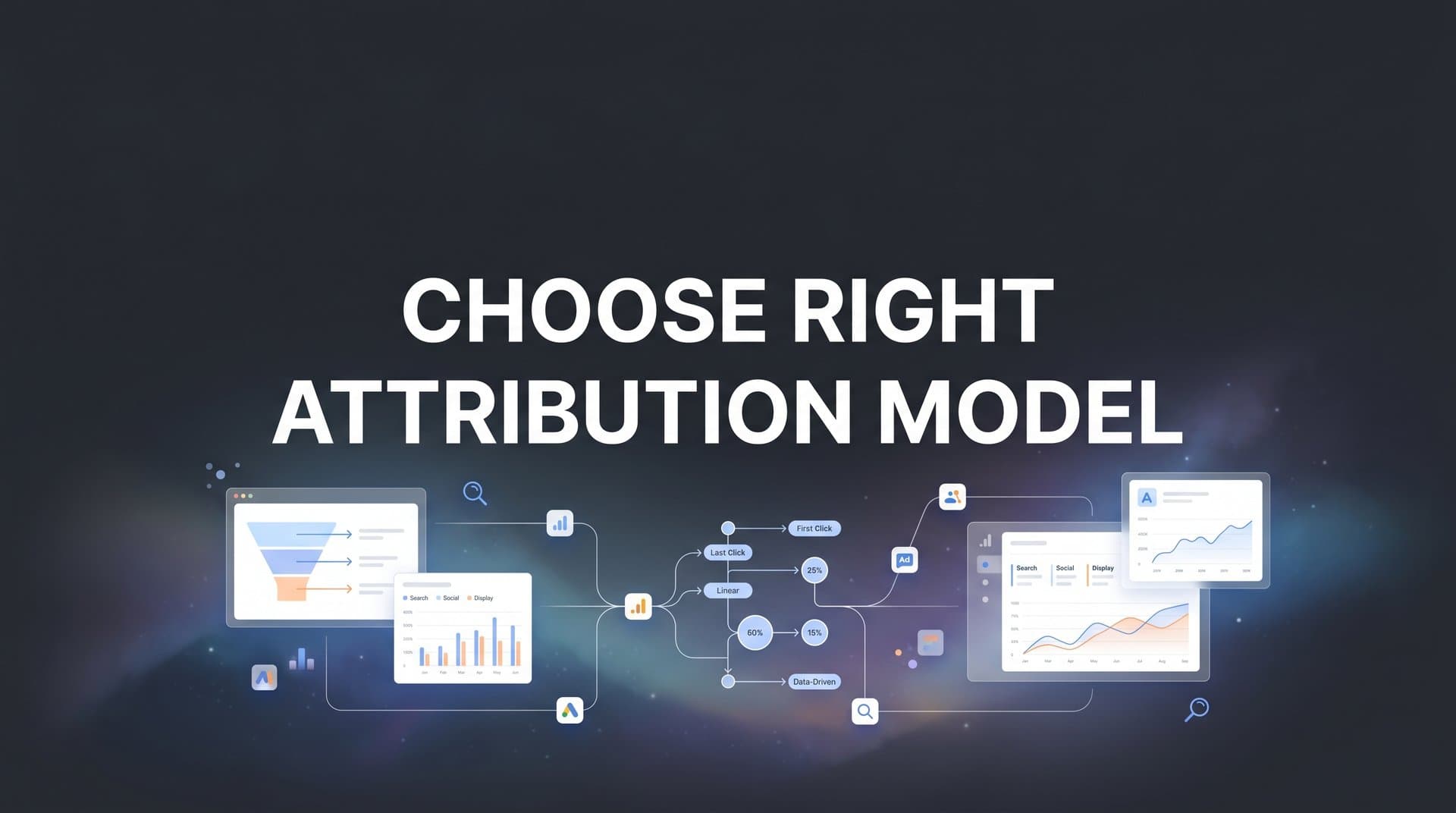
Think of attribution models as different lenses. Each one shows you a real part of the picture, but no single lens captures everything. Here is a clear breakdown of each model and when it makes sense to use it. For a deeper dive, explore this guide on types of attribution models in digital marketing.
First-Touch Attribution: This model gives 100% of the credit to the very first interaction a customer had with your brand. It is the simplest way to measure what is driving awareness and bringing new people into your funnel. If you want to know which channels are best at introducing your brand to strangers, first-touch tells that story clearly. The blind spot is significant though: it completely ignores everything that happens after that initial discovery, including the nurture sequences, retargeting ads, and content that actually moved the prospect toward a decision.
Last-Touch Attribution: The mirror image of first-touch, this model gives all credit to the final interaction before conversion. It is the default in many ad platforms and analytics tools because it is easy to implement and easy to explain. For businesses with short sales cycles and direct-response campaigns, last-touch is often accurate enough to be useful. The blind spot is that it systematically undervalues every touchpoint that built awareness, generated interest, and nurtured the prospect before that final click. Over time, this leads to underinvestment in top-of-funnel channels.
Linear Attribution: This model distributes credit equally across every touchpoint in the customer journey. If a customer had five interactions before converting, each one gets 20% of the credit. It is a balanced approach that acknowledges every channel played a role. The blind spot is that equal distribution can be misleading. Treating a random display impression the same as a high-intent branded search click does not reflect the actual influence of each interaction. You can learn more about how this works in our breakdown of the linear attribution model.
Time-Decay Attribution: This model gives increasing credit to touchpoints that occur closer to the conversion event. The logic is that interactions closer to the decision carry more weight because they are more directly tied to the purchase. It works well for longer sales cycles where recent interactions genuinely do carry more influence. The blind spot is that it can significantly undervalue brand-building and awareness campaigns at the top of the funnel, which may have been the reason the prospect entered the journey in the first place.
Position-Based (U-Shaped) Attribution: This model gives heavier credit to the first and last touchpoints, typically around 40% each, with the remaining credit distributed across the middle interactions. It balances the value of discovery and closing, making it a popular choice for teams that care about both awareness and conversion. The blind spot is that it can undervalue critical mid-funnel touchpoints, like a webinar or a case study that genuinely moved a prospect from interested to ready to buy.
Data-Driven (Algorithmic) Attribution: This model uses machine learning to analyze your actual conversion paths and assign credit based on how much each touchpoint statistically contributed to conversions. Rather than applying a predetermined rule, it learns from your data. It is the most accurate option available when it works well. The significant requirement is data volume: you typically need a substantial number of conversions for the algorithm to produce reliable results. If your data volume is low or your tracking is incomplete, data-driven attribution can produce misleading outputs.
The key insight is that no model is universally correct. Each one is a tool designed for a specific job. The right model is the one that answers your most important marketing question given your current business context.
Step 4: Match Your Model to Your Channel Mix and Sales Cycle
Now it is time to bring the previous three steps together. You have mapped your customer journey, defined your optimization goal, and understood how each model works. The next step is applying a decision framework to narrow your options.
Think of this as a matching exercise. Your journey map and goals from Steps 1 and 2 are the inputs. The model breakdown from Step 3 is the menu. Here is how to connect them.
Single-channel or short sales cycle: If most of your customers convert within one or two interactions and you are primarily running one channel, last-touch attribution often works well enough. It is simple to implement, easy to explain to stakeholders, and accurate enough when the journey is straightforward. Do not overcomplicate it.
Multi-channel with a longer sales cycle: If your customers interact with multiple channels over days or weeks before converting, position-based or data-driven attribution will give you a far more accurate view of what is actually driving revenue. Single-touch models will systematically mislead you in this scenario. Understanding multi-touch attribution becomes critical for these businesses.
Heavy investment in brand awareness: If a significant portion of your budget goes toward top-of-funnel campaigns, first-touch or position-based attribution is essential. Without it, those campaigns will appear invisible in your reporting, and you will be tempted to cut spending that is actually generating future conversions.
Running campaigns across Meta, Google, TikTok, and email simultaneously: Multi-touch attribution is almost always the better choice here. When customers are interacting with multiple platforms before converting, single-touch models create a distorted picture where one channel gets all the credit and the others look like they are not contributing.
One critical point: any multi-touch model requires complete, consistent conversion tracking across every channel to function properly. If your UTM parameters are inconsistent, your pixels are misfiring, or your CRM is not connected to your ad data, even the most sophisticated attribution model will produce unreliable results. We will address tracking infrastructure directly in the next step.
It is also worth noting that platform-reported data from Meta Ads Manager or Google Ads will almost always show higher conversion numbers than your independent attribution tool. This is because each platform claims credit using its own attribution window. Understanding why attribution data doesn't match across platforms is key to interpreting your reports correctly.
Success indicator: You have narrowed your options to one or two candidate models based on your specific situation. You can explain in plain language why those models fit your journey, your goals, and your channel mix.
Step 5: Ensure Your Tracking Infrastructure Can Support Your Chosen Model
Here is where many attribution projects fall apart. A team selects a sophisticated multi-touch model, implements it, and then wonders why the results look strange. The culprit is almost always incomplete tracking data.
Multi-touch attribution requires complete data. If you have gaps in your tracking, even the best model will produce flawed insights. Garbage in, garbage out is not a cliche here; it is a real risk that leads to misallocated budgets.
Start with a tracking audit. Check whether your UTM parameters are being applied consistently across every paid channel. A single campaign without proper UTM tagging will show up as direct traffic in your analytics, making it invisible to your attribution model. Understanding the relationship between UTM tracking and attribution is fundamental to getting this right. Check whether your conversion pixels are firing correctly on every relevant page. Check whether your CRM events, like form submissions, demo bookings, and closed deals, are connected to your ad data.
One of the most significant tracking challenges in the current environment is browser-level restrictions. Ad blockers, Safari's Intelligent Tracking Prevention, and the impact of iOS App Tracking Transparency have all reduced the reliability of client-side pixel tracking. When a browser blocks or limits a tracking pixel, that conversion event goes unrecorded, creating a gap in your attribution data.
Server-side tracking addresses this directly. Instead of relying on a browser-based pixel to fire and transmit data, server-side tracking sends conversion events directly from your server, bypassing browser restrictions entirely. This results in more complete data capture, which is especially important for any multi-touch model that depends on seeing every interaction in the journey.
This is where platforms like Cometly make a meaningful difference. Cometly captures every touchpoint from ad clicks to CRM events, connecting your ad platforms, website, and CRM into a single unified data set. Its server-side tracking infrastructure ensures that conversion events are captured even when browser-level restrictions would otherwise create gaps, giving the AI a complete, enriched view of each customer journey.
If your tracking is currently incomplete, do not wait until it is perfect to start using attribution. Start with a simpler model that works with the data you have, build out your tracking infrastructure in parallel, and then graduate to a more sophisticated multi-touch model once your data capture is reliable.
Success indicator: You can verify that conversion events from all major channels are being captured and connected to a single customer record. Every significant touchpoint in the journey is visible in your attribution data.
Step 6: Run a Side-by-Side Comparison Before Committing
Do not just pick a model and hope for the best. Before you commit to a single attribution model as your primary reporting view, run your existing data through two or three candidate models at the same time and compare what you see.
This comparison exercise is one of the most revealing things you can do in marketing analytics. Apply your top two or three candidate models to the same historical data set and look at how credit gets distributed across your campaigns and channels. Exploring how revenue attribution models distribute credit differently can help you benchmark your results.
Pay close attention to dramatic differences. If a campaign receives 40% of the credit under first-touch attribution but only 5% under last-touch, that is a signal worth investigating. It suggests the campaign is excellent at generating initial awareness but may not be the final push that closes conversions. That insight should directly inform how you evaluate and budget for that campaign going forward.
Look for campaigns that appear as winners under one model and losers under another. These are your most important data points. They reveal where your assumptions about channel performance may be wrong, and they help you identify blind spots that need monitoring regardless of which model you ultimately choose.
The goal of this comparison is not to find the model that makes your current campaigns look best. It is to find the model that gives you the most actionable and accurate insights for making better budget decisions.
Cometly makes this process straightforward. Its analytics dashboard allows you to compare attribution models side by side and analyze ad performance across all your channels from a single view, so you can see exactly how credit shifts between models without juggling multiple spreadsheets or platform reports.
Success indicator: You have run at least two models against the same data set and can clearly articulate why one gives you more actionable insights than the other for your specific business situation.
Step 7: Implement, Monitor, and Evolve Your Model Over Time
Choosing an attribution model is not a one-time decision. It is the beginning of an ongoing process. Your business changes, your channel mix evolves, and your data volume grows. Your attribution model should keep pace with all of that. Knowing when to switch attribution models is just as important as choosing the right one initially.
Once you have selected your model, set it as your primary reporting view. This is the lens through which your team evaluates campaign performance, makes budget decisions, and reports results to leadership. But keep secondary models available for cross-reference. Seeing how your primary model compares to an alternative view is a healthy habit that surfaces blind spots before they become expensive mistakes.
Establish a review cadence. A quarterly review of your attribution model is a reasonable starting point for most teams. You should also trigger a review whenever you add or remove a major channel, launch a significant new campaign type, or notice that your conversion data looks inconsistent with your business results.
As your data volume grows, consider graduating to data-driven attribution. Algorithmic models become significantly more accurate as they have more conversion paths to learn from. If you started with a simpler rule-based model because your data was limited, revisiting data-driven attribution after six to twelve months of clean tracking data is often worth the effort.
One of the most powerful things you can do with accurate attribution data is feed it back to your ad platforms. Meta, Google, and other platforms use conversion signals to optimize their bidding algorithms. When you send them enriched, accurate conversion data that reflects your actual revenue rather than just clicks or page views, their AI can target more effectively and reduce your acquisition costs over time.
Cometly's Conversion Sync feature does exactly this, syncing enriched conversion events back to Meta, Google, and other platforms so their algorithms can optimize toward your actual business outcomes rather than surface-level engagement signals.
Success indicator: You have a live attribution model informing your budget decisions, with a scheduled review date on the calendar and a process for updating your model as your business evolves.
Your Attribution Readiness Checklist
Choosing the right attribution model comes down to understanding your customer journey, aligning with your business goals, and making sure your tracking can support the model you pick. Before you finalize your decision, run through this checklist to confirm you are ready.
1. You have mapped your typical customer journey and know the average number of touchpoints before conversion.
2. You have defined whether you are optimizing for awareness, leads, or revenue, and connected that goal to the type of credit distribution you need.
3. You understand the strengths and blind spots of each attribution model type and can explain why certain models fit your situation better than others.
4. You have matched a candidate model to your channel mix and sales cycle using the decision framework from Step 4.
5. Your tracking infrastructure captures every touchpoint from click to conversion, with server-side tracking in place to address browser-level gaps.
6. You have compared at least two models against real data and can articulate which one gives you more actionable insights.
7. You have a review schedule to evolve your model as your business grows and your channel mix changes.
Attribution is the foundation of confident, data-driven marketing. When you can clearly see what is driving revenue, scaling your campaigns becomes a decision backed by evidence rather than a leap of faith. You stop guessing which channels to cut and start knowing which ones to invest in.
Ready to elevate your marketing game with precision and confidence? Discover how Cometly's AI-driven recommendations can transform your ad strategy. Get your free demo today and start capturing every touchpoint to maximize your conversions.