You're running campaigns on Meta, Google, TikTok, and LinkedIn. A conversion comes through. Your dashboard lights up. But here's the question that keeps you up at night: which of those twelve touchpoints across four platforms actually influenced this sale?
Was it the Facebook ad they scrolled past three weeks ago? The Google search they ran last Tuesday? The LinkedIn article they clicked yesterday? Or was it all of them working together in ways you can't see?
This is the consumer path problem. And if you're making budget decisions without understanding it, you're essentially flying blind with millions in ad spend.
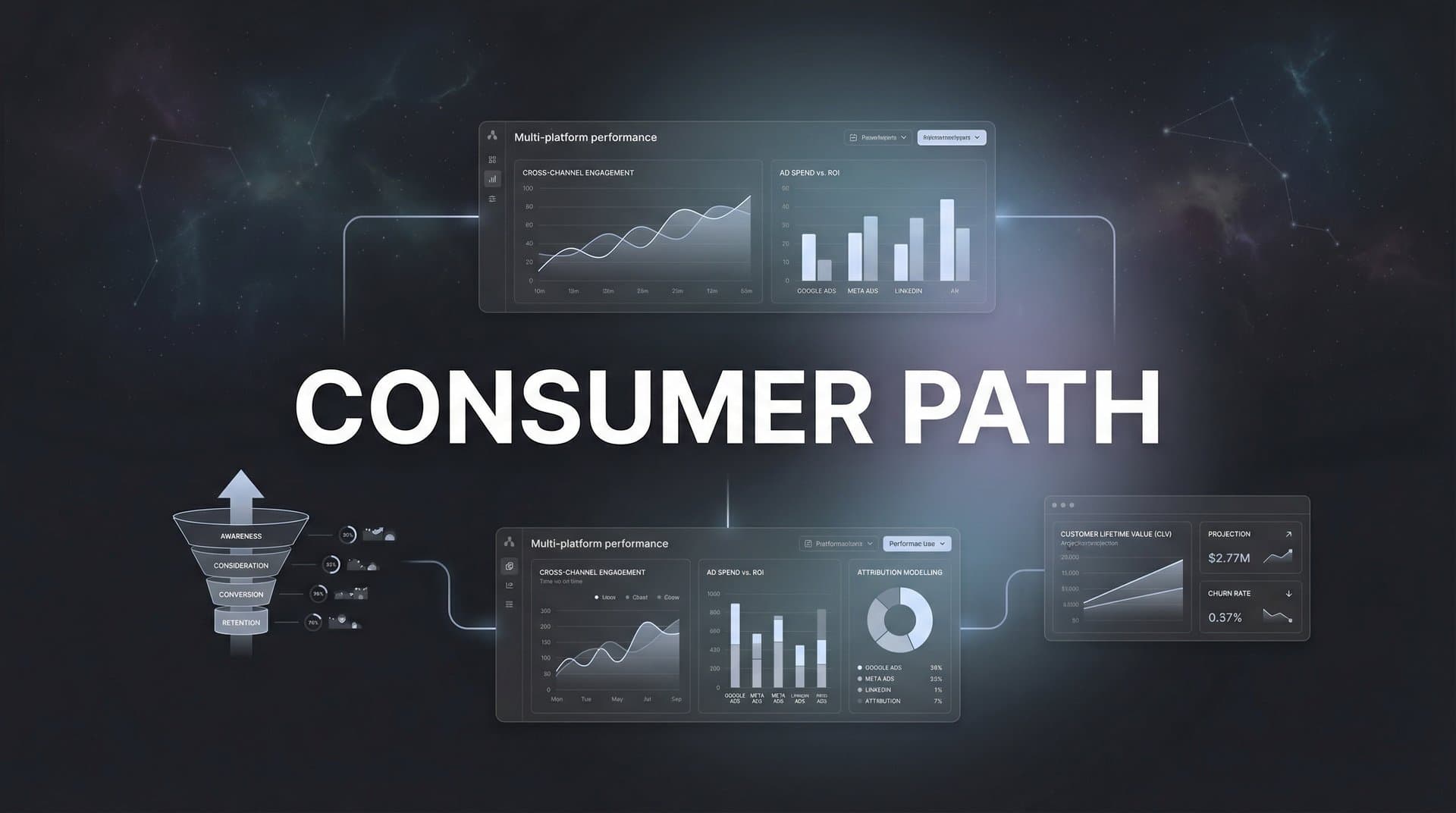
The consumer path is the complete sequence of interactions a prospect has with your brand before they convert. It's not a theory or a marketing framework—it's actual behavior you can track, measure, and optimize. In today's multi-channel environment, understanding these paths isn't just helpful. It's the difference between scaling what actually works and throwing money at what looks good in isolated platform dashboards.
The Anatomy of a Modern Consumer Path
The consumer path is every single touchpoint a prospect encounters on their way to becoming a customer. Think of it as a digital breadcrumb trail that shows exactly how someone discovered your brand, engaged with your content, and eventually decided to buy.
Here's what makes it different from what you might call a "customer journey." The customer journey is conceptual—it's the ideal path you map out in strategy sessions with sticky notes and flowcharts. The consumer path is behavioral—it's what actually happens when real people interact with your real marketing across real devices and platforms.
And here's where it gets complicated: today's consumer paths are anything but linear. Gone are the days when someone saw one ad, clicked through, and bought. Modern paths zigzag across devices, platforms, and time periods in ways that would make your flowchart look like a bowl of spaghetti.
A typical B2B path might start with a LinkedIn ad on mobile during a morning commute. Then a Google search on desktop at the office two days later. A retargeting ad on Instagram that evening. A direct visit to your website the following week. An email click. Another Google search. A demo request. And finally, a conversion three weeks after that first LinkedIn impression.
For B2C, paths can be even more fragmented. Someone discovers your product through a TikTok video, researches reviews on their phone, compares prices on desktop, abandons their cart, sees a retargeting ad, checks your Instagram, reads customer testimonials, and finally converts after a promotional email.
The challenge? Each platform only sees its own piece of this path. Facebook thinks its retargeting ad drove the sale. Google claims credit for the search click. Your email platform celebrates the email conversion. They're all partially right and completely wrong at the same time.
This is why understanding the complete consumer path matters. Without it, you're making budget decisions based on fragments of truth. You might cut spending on awareness channels because they don't show direct conversions, not realizing they're initiating every path that eventually converts through other channels. Or you might over-invest in retargeting because it gets last-click credit, missing the fact that your top-of-funnel channels are doing the heavy lifting.
Five Stages Every Consumer Path Contains
While every consumer path is unique, they all move through predictable stages. Understanding these stages helps you recognize which touchpoints matter most and why.
Awareness (First Touch): This is where paths begin. Someone who's never heard of your brand encounters your marketing for the first time. In paid advertising, this might be a cold audience Facebook ad, a display banner, a YouTube pre-roll, or a top-of-funnel TikTok video. They're not ready to buy—they're just becoming aware you exist. These touchpoints rarely get credit in last-click attribution models, but without them, there's no path at all.
Consideration (Research and Comparison): Now they're interested enough to learn more. They might search your brand name on Google, visit your website to browse products, watch a demo video, or read comparison articles. For B2B, this stage often involves multiple stakeholders researching your solution across different channels. For e-commerce, it's product page visits, size guide checks, and review reading. These touchpoints show intent but not commitment.
Intent (High-Engagement Signals): This is where casual interest becomes serious consideration. Someone adds items to their cart, starts a free trial, downloads a resource, or requests pricing. They're engaging with conversion-focused pages and taking actions that signal buying intent. In B2B, this might be attending a webinar or scheduling a demo. For e-commerce, it's adding products to cart or creating an account. These are the touchpoints that separate browsers from buyers.
Decision (Conversion Action): The moment they convert. They complete the purchase, submit the lead form, or sign the contract. This is what every platform wants to take credit for, but it's rarely the whole story. The decision stage is the culmination of everything that came before it—all those awareness touchpoints, consideration interactions, and intent signals working together.
Post-Purchase (Retention Touchpoints): The path doesn't end at conversion. Post-purchase interactions—onboarding emails, product tutorials, upsell offers, referral requests—create paths toward repeat purchases and higher customer lifetime value. These touchpoints often get ignored in attribution analysis, but they're crucial for understanding the full value of your acquisition channels. Effective consumer lifecycle management ensures you're optimizing for long-term value, not just initial conversions.
Here's why tracking across all five stages matters: if you only measure the Decision stage, you're giving all the credit to whatever touchpoint happened last. You might think your Google Search campaign is your top performer because it gets last-click conversions. But if you could see the full path, you'd discover that your Facebook awareness campaign initiated 80% of those paths three weeks earlier.
This is the attribution puzzle. Every stage plays a role. Awareness creates the path. Consideration builds interest. Intent signals readiness. Decision completes the transaction. And Post-Purchase drives repeat revenue. Miss any stage, and your attribution data tells you a story that's incomplete at best and misleading at worst.
Why Most Marketers Lose Visibility Mid-Path
You've set up tracking. You've installed pixels. You're monitoring conversions. So why does your attribution data still feel like a puzzle with missing pieces?
Because modern consumer paths are designed to break traditional tracking methods. And the gaps in your data aren't just annoying—they're expensive.
The biggest culprit is cross-device behavior. Someone sees your ad on their phone during lunch, researches on their tablet that evening, and converts on their desktop the next day. Traditional cookie-based tracking sees three different people. Your attribution platform thinks the desktop visit was a new customer who converted immediately. The mobile and tablet touchpoints? Lost to the void.
Then there's iOS privacy changes. When Apple introduced App Tracking Transparency, it didn't just make Facebook ads harder to optimize. It punched holes in consumer path tracking across every platform. Users who opt out of tracking become invisible mid-path. You see the first touchpoint and the final conversion, but everything that happened in between—the consideration stage, the intent signals, the crucial interactions that actually drove the decision—vanishes.
Cookie deprecation is making this worse. As browsers phase out third-party cookies, the traditional methods for connecting touchpoints across websites stop working. Someone clicks your Google ad, visits your site, leaves, sees a retargeting ad, and returns directly to convert. Without third-party cookies, that looks like two completely separate visitors with no connection between them.
Platform-native analytics only show fragments of the full consumer path because each platform only tracks its own touchpoints. Facebook Analytics shows you Facebook interactions. Google Analytics shows you website behavior. Your email platform tracks email engagement. But none of them talk to each other in a way that reconstructs the complete path.
This creates the infamous "attribution mismatch" problem. Facebook reports 100 conversions. Google claims 120. Your email platform celebrates 80. But your actual conversion count? Maybe 150. The numbers don't add up because each platform is claiming credit for the same conversions, each seeing only its piece of the path. Understanding ad platform reporting discrepancies is essential for making sense of conflicting data.
The real cost of incomplete path data isn't just confusing reports. It's misattributed conversions that lead to catastrophically bad budget decisions. You cut spending on channels that look like they're underperforming, not realizing they're initiating paths that convert through other channels. You double down on channels that look like top performers, not seeing that they're just getting last-click credit for journeys started elsewhere.
Offline interactions make it even harder. Someone sees your digital ad, walks into your store, and makes a purchase. Or they attend an in-person event, then convert online weeks later. These offline touchpoints are real parts of the consumer path, but they're nearly impossible to track without sophisticated attribution systems that connect online and offline data.
The result? Most marketers are making million-dollar budget decisions based on partial data. They're optimizing for what they can see, not what's actually driving results. And they're losing competitive advantage to companies that have figured out how to see the complete consumer path.
Mapping Consumer Paths Across Your Marketing Channels
Seeing complete consumer paths isn't magic. It's infrastructure. And building that infrastructure starts with connecting the data sources that each hold different pieces of the puzzle.
The foundation is integrating your ad platforms, website analytics, and CRM data into a unified system. Your ad platforms know about impressions and clicks. Your website analytics tracks on-site behavior. Your CRM holds conversion and customer data. Separately, they're fragments. Together, they reveal the complete path from first impression to final purchase.
Start by implementing a tracking system that can connect touchpoints across devices and sessions. This means moving beyond simple cookie-based tracking to identity resolution that recognizes when the person who clicked your Facebook ad on mobile is the same person who converted on desktop three days later. Email addresses, phone numbers, and user IDs become the thread that ties disparate touchpoints into coherent paths.
Server-side tracking is crucial here. While client-side tracking (pixels and cookies in the browser) captures some touchpoints, it misses others due to ad blockers, privacy settings, and browser restrictions. Server-side tracking captures events directly from your server, bypassing these limitations and filling in the gaps that client-side methods leave.
This is particularly important for capturing the middle stages of the consumer path—those consideration and intent touchpoints that happen between first click and final conversion. Someone might visit your pricing page with an ad blocker enabled. Client-side tracking misses it. Server-side tracking captures it. That data point might be the difference between understanding that your pricing page is a crucial path stage versus thinking people jump straight from ad click to purchase.
Once you're capturing complete touchpoint data, you need attribution models that assign value across the path. Multi-touch attribution distributes credit among all the touchpoints that contributed to a conversion, rather than giving everything to first or last touch. Proper conversion path analysis reveals which touchpoints actually influence buying decisions.
Different models weight touchpoints differently. Linear attribution gives equal credit to every touchpoint. Time-decay gives more credit to recent touchpoints. Position-based (U-shaped) emphasizes first and last touch while still crediting middle interactions. Data-driven attribution uses machine learning to determine which touchpoints actually influenced conversion based on your specific data patterns.
The model you choose matters less than simply using multi-touch attribution instead of single-touch. Even a basic linear model that credits all touchpoints equally will give you better insights than last-click attribution that ignores everything except the final interaction.
Here's what this looks like in practice: You connect your Facebook Ads, Google Ads, and LinkedIn Ads to a unified attribution platform. You implement server-side tracking on your website. You sync your CRM conversion data. Now when someone converts, you don't just see "Google Search drove this sale." You see the complete path: LinkedIn ad impression → Facebook ad click → Google Search → website visit → email signup → retargeting ad → direct visit → conversion. Each touchpoint gets appropriate credit based on your chosen attribution model.
This visibility transforms how you allocate budget. You discover that LinkedIn isn't driving direct conversions, but it's initiating 60% of your highest-value paths. You learn that your retargeting ads are effective, but only for people who've already had at least three other touchpoints. You find that certain Google Search keywords are conversion assisters rather than converters—they happen mid-path but rarely close deals alone.
Turning Path Insights into Smarter Ad Decisions
Consumer path data is only valuable if it changes what you do. And the first insight that should change your strategy is understanding which channels initiate paths versus which ones close them.
Some channels are path starters. They introduce prospects to your brand and begin the journey. Others are path closers. They convert people who are already familiar and ready to buy. Both roles are essential, but they require different strategies and different budget allocations.
When you analyze consumer paths, you might discover that your TikTok ads rarely get last-click conversions, but they initiate 40% of all paths that eventually convert. Traditional last-click attribution would tell you to cut TikTok spending. Multi-touch path analysis reveals it's one of your most valuable channels—just not in the way you expected. Implementing the right ad attribution tools makes this level of insight possible.
Conversely, you might find that your branded Google Search campaigns get tons of last-click conversions, but they almost never appear early in paths. They're not creating demand. They're capturing it. That doesn't make them less valuable, but it does mean you can't scale them indefinitely. There's a ceiling determined by how much demand your awareness channels create.
This insight reshapes budget allocation. Instead of pouring money into last-click converters and starving awareness channels, you balance investment across the entire path. You fund the channels that start journeys, nurture the touchpoints that build consideration, and optimize the interactions that drive final conversions.
Path analysis also reveals which sequences work best. You might discover that paths starting with video ads convert at twice the rate of paths starting with static image ads. Or that paths including at least one email touchpoint have 3x higher average order value. These patterns tell you not just which channels to use, but how to orchestrate them together.
The next level is feeding enriched conversion data back to ad platforms. When you send accurate, complete conversion data to Facebook, Google, and other platforms, you improve their machine learning algorithms. Instead of optimizing based on the partial data they can see, they optimize based on the full picture of what actually drives results. Understanding ad platform algorithm optimization strategies helps you leverage this data feedback loop effectively.
This is particularly powerful for platforms like Meta and Google that use conversion data to train their targeting algorithms. When you feed them enriched data that includes all the conversions they influenced (not just the ones they can track), their algorithms learn to find more people like your actual customers. Your targeting gets better. Your cost per acquisition drops. Your campaign performance improves.
Here's how this works in practice: Someone sees your Facebook ad, clicks through, browses your site, leaves, searches on Google, returns directly, and converts. Facebook's pixel might miss the conversion because it happened on a direct visit. But your attribution platform sees the complete path and knows Facebook initiated it. You send that conversion back to Facebook as an offline conversion event. Now Facebook's algorithm knows that ad worked, even though it didn't get last-click credit. It learns from that success and finds more similar prospects.
The strategic implication is profound. You're no longer just analyzing what happened. You're using path insights to make ad platforms smarter, which makes future paths more efficient. It's a virtuous cycle: better tracking leads to better attribution, which leads to better data feeding back to platforms, which leads to better targeting and lower costs.
Putting Consumer Path Analysis into Practice
Understanding the consumer path starts with three foundational actions that transform marketing from guesswork into data-driven decision making.
First, implement comprehensive tracking that captures touchpoints across all your marketing channels. This means going beyond basic pixel installation to server-side tracking that fills the gaps left by privacy restrictions and ad blockers. Connect your ad platforms, website, email system, and CRM so you're capturing every interaction a prospect has with your brand. Building a robust ad click data pipeline ensures no touchpoint gets lost.
Second, connect your data sources into a unified attribution system. Your consumer paths live in fragments across different platforms. Bringing that data together reveals the complete picture. When you can see that a prospect had twelve touchpoints across four platforms over three weeks before converting, you understand the real complexity of modern marketing. For larger organizations, enterprise conversion path analytics tools provide the scale and sophistication needed.
Third, analyze paths by segment. Not all consumer paths are created equal. High-value customers might have longer, more complex paths than low-value ones. B2B paths often involve more touchpoints and longer timeframes than B2C. Mobile-first customers follow different patterns than desktop users. Segment your path analysis to discover these patterns and optimize accordingly.
The transformation this creates is significant. Instead of asking "Which campaign drove this conversion?" you ask "Which sequence of touchpoints creates the highest-value customers?" Instead of optimizing individual channels in isolation, you orchestrate them together based on how they work in real consumer paths.
AI-powered tools are making this level of analysis accessible to marketing teams of all sizes. What used to require data science teams and custom analytics infrastructure can now be implemented with platforms that automatically track paths, apply attribution models, and surface actionable insights. Leveraging advanced marketing analytics capabilities accelerates your path to optimization.
The competitive advantage goes to marketers who see what others miss. While competitors make budget decisions based on last-click attribution and platform-reported conversions, you're seeing complete consumer paths. You know which channels start journeys, which ones nurture consideration, and which ones close deals. You understand the sequences that work and the touchpoints that matter most.
This visibility doesn't just improve your current campaigns. It changes how you think about marketing strategy. You stop chasing vanity metrics and start optimizing for real business outcomes. You allocate budget based on actual contribution to revenue, not just what's easiest to measure. You scale with confidence because you know exactly what's working and why.
The Path Forward
Understanding the consumer path is the foundation of effective marketing attribution. It's the difference between knowing a conversion happened and knowing why it happened. Between seeing isolated touchpoints and understanding the journey that connects them.
The marketers who win in today's multi-channel environment are the ones who can see these complete paths. They know which ads start journeys and which ones finish them. They understand the sequences that convert and the touchpoints that matter most. They make budget decisions based on comprehensive data, not platform-reported fragments.
This isn't just better analytics. It's better marketing. When you can see the complete consumer path, you can confidently scale what works and cut what doesn't. You can orchestrate channels together instead of optimizing them in isolation. You can feed better data back to ad platforms and improve their targeting algorithms.
The complexity of modern consumer paths isn't going away. If anything, it's increasing as new channels emerge and privacy restrictions tighten. But that complexity doesn't have to be a problem. With the right tracking infrastructure and attribution approach, it becomes an advantage—one that reveals insights your competitors are missing.
Ready to elevate your marketing game with precision and confidence? Discover how Cometly's AI-driven recommendations can transform your ad strategy—Get your free demo today and start capturing every touchpoint to maximize your conversions.