Your customer just converted. But do you know the journey that got them there?
Most marketers see the final click—the Google ad or email that sealed the deal—and give it all the credit. Meanwhile, the Facebook ad that sparked initial interest, the blog post that built trust, and the retargeting campaign that kept you top-of-mind get ignored.
This blind spot costs you money. You end up over-investing in channels that close deals while starving the ones that create demand.
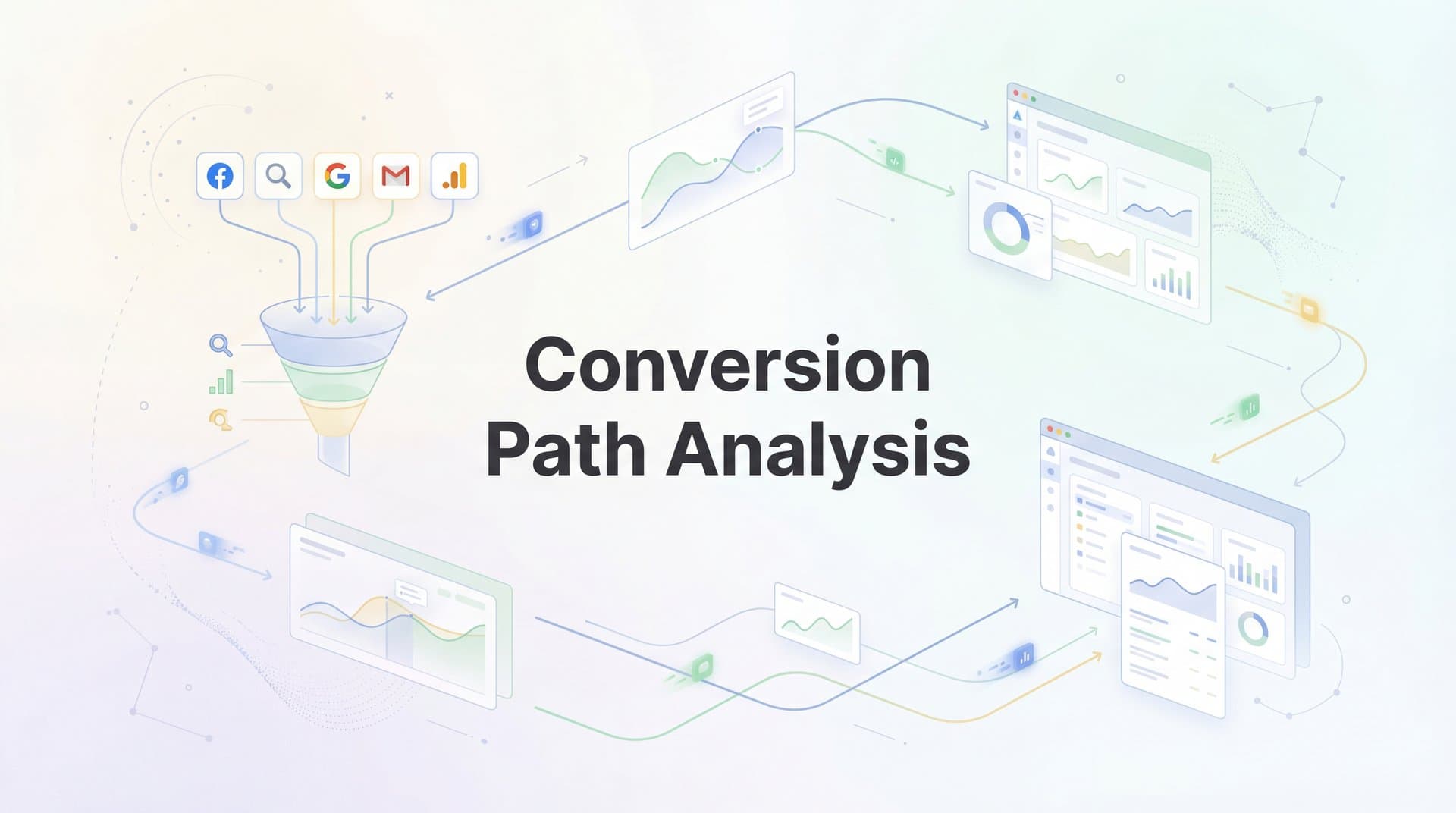
Conversion path analysis fixes this by mapping every touchpoint a customer interacts with before converting. Instead of guessing which channels matter, you see the actual sequences that drive revenue.
This guide walks you through running conversion path analysis from start to finish. You'll learn how to set up proper tracking, collect meaningful data, identify your highest-performing paths, and turn those insights into budget decisions that improve ROI. Whether you're managing campaigns across Meta, Google, LinkedIn, or all three, these steps will help you understand what's really driving your conversions.
Step 1: Set Up Cross-Channel Tracking Infrastructure
Before you can analyze conversion paths, you need to capture them. That means connecting every marketing channel to a central tracking system that records each touchpoint in the customer journey.
Start by integrating all your ad platforms into one attribution system. This includes Meta Ads, Google Ads, TikTok, LinkedIn, and any other paid channels you're running. Each platform should send conversion data to your central tracking hub so you can see interactions across channels, not just within them. Understanding how to track conversions across platforms is essential for building this foundation.
Here's where most marketers hit a wall: browser-based pixel tracking alone won't cut it anymore. iOS privacy updates and ad blockers have created significant data gaps. If you're relying solely on pixels, you're likely missing 20-40% of your actual conversions.
Server-side tracking solves this problem. Instead of depending on browser pixels that users can block, server-side tracking captures data directly from your server to ad platforms. This approach bypasses browser restrictions and gives you more complete, accurate conversion data. Learn more about conversion API implementation to overcome these tracking limitations.
Next, connect your CRM to your tracking system. This step is critical because many valuable conversions happen after the initial form fill. A demo request might come through your website, but the real conversion—the closed deal—happens in your CRM weeks later. Without CRM integration, you're only seeing part of the story.
Track these post-click events: demos booked, proposals sent, opportunities created, and deals closed. When you connect these back to the original marketing touchpoints, you can finally see which channels drive actual revenue, not just form fills. This is especially important when tracking offline conversions that happen outside your digital ecosystem.
Verify everything is working correctly before you start collecting data. Run test conversions through each channel and confirm they appear in your tracking system with the correct source attribution. Check that timestamps are accurate and that each touchpoint in a test journey shows up in the path data.
This verification step saves you from collecting weeks of incomplete data that you'll have to throw out later.
Step 2: Define Your Conversion Events and Touchpoint Categories
Not all conversions are created equal, and not all touchpoints deserve the same classification. You need clear definitions before you start analyzing paths.
Start by identifying which actions count as conversions for your business. An ecommerce company might track purchases, add-to-carts, and email sign-ups. A B2B SaaS company might focus on demo requests, free trial starts, and paid conversions. A service business might track consultation bookings and proposal acceptances.
We compare the leading options in our ecommerce Facebook ad generator roundup.
Choose conversion events that align with revenue, not just engagement. Pageviews and video watches are interesting, but they don't pay the bills. Focus your path analysis on actions that lead to actual business outcomes. Understanding purchase conversion value helps you prioritize the events that matter most.
If you're evaluating vendors, our ecommerce Meta ad tool breakdown can help.
Categorize your touchpoints by channel type. Create clear buckets: paid search, paid social, organic search, organic social, direct traffic, email, referral, and display. Within paid channels, separate by platform—Meta, Google, LinkedIn, TikTok—so you can see which platforms play which roles in the conversion path.
Establish a consistent naming convention across all platforms. This sounds basic, but inconsistent campaign names create chaos when you're trying to analyze paths. If your Meta campaigns use one naming structure and your Google campaigns use another, you'll waste hours trying to match them up.
Use a standardized format like: [Channel]_[Campaign Type]_[Audience]_[Objective]. For example: "Meta_Retargeting_WebsiteVisitors_Conversions" or "Google_Search_BrandTerms_Conversions". Consistency here makes path analysis exponentially easier.
Set attribution windows that match your sales cycle. If you're selling a $20 product, a 7-day window might work. If you're selling enterprise software with a 90-day sales cycle, you need a longer window—typically 60 to 90 days—to capture the full path. Learn more about conversion window attribution to set appropriate timeframes for your business.
Think about your typical customer journey length. How long does it usually take from first touch to conversion? Add a buffer to that timeframe. If most customers convert within 45 days, set your attribution window to 60 days to avoid cutting off legitimate touchpoints.
Step 3: Collect and Organize Your Path Data
Once your tracking infrastructure is live and your definitions are set, it's time to collect path data. The key question: how long should you wait before analyzing?
The answer depends on your conversion volume. If you're generating 500+ conversions per month, 30 days of data might be sufficient. If you're closer to 50-100 conversions monthly, you'll need 60 to 90 days to gather enough paths for meaningful patterns to emerge.
Low conversion volume leads to misleading conclusions. Three conversions from a specific path sequence doesn't prove anything. Thirty conversions following a similar pattern? Now you're onto something worth investigating.
Access your path reports through your attribution platform. Most modern conversion path analytics tools provide reports that show the sequence of touchpoints for each conversion. Look for reports that display: the full touchpoint sequence, timestamps for each interaction, the channel and campaign for each touchpoint, and the final conversion value.
Filter out noise before you analyze. Incomplete paths—where tracking started midway through the journey—will skew your analysis. If someone cleared their cookies or switched devices, you might only see the last few touchpoints. Mark these as incomplete and either exclude them or analyze them separately.
Remove obvious outliers. If 95% of your conversion paths contain 2-8 touchpoints, and one path shows 47 touchpoints, that's likely a data error or an extreme edge case. Don't let outliers distort your understanding of typical customer behavior. Addressing inaccurate conversion tracking early prevents these issues from compounding.
Segment your data for deeper insights. Analyze paths separately by customer type (new vs. returning), product category, geographic region, or campaign objective. A path that works for acquiring new customers might look completely different from a path that drives repeat purchases.
Organize your data in a way that makes patterns visible. Export to a spreadsheet or use your platform's visualization tools to group similar paths together. You want to spot recurring sequences, not just look at individual journeys one by one.
Step 4: Identify Your Top-Performing Conversion Paths
With clean, organized path data in hand, you can finally see which customer journeys drive the most conversions. This is where the insights get interesting.
Start by sorting paths by conversion volume. Which sequences appear most frequently? If you see the same pattern—Facebook ad → Google search → email → conversion—showing up dozens of times, that's a proven path worth understanding and replicating.
Look at path length across your conversions. How many touchpoints typically precede a conversion? B2B companies often see longer paths, with customers interacting 7-13 times before converting. Ecommerce typically sees shorter paths, often 2-5 touchpoints. Knowing your typical path length helps you set realistic expectations and budget accordingly. Analyzing the customer path to purchase reveals these critical patterns.
If your average path length is eight touchpoints, you can't expect someone who just discovered you yesterday to convert today. You need to build campaigns that nurture prospects through multiple interactions.
Analyze touchpoint positions. Which channels appear most frequently as the first touch? Which ones typically close the deal? Which channels consistently show up in the middle of paths, playing an assist role?
You might discover that LinkedIn ads are excellent at initiating interest but rarely close deals. Meanwhile, Google search almost always appears as the last touch. This doesn't mean Google is "better"—it means they serve different roles in the conversion path. You need both. Understanding how to measure assisted conversions helps you value these mid-funnel touchpoints properly.
Look for high-performing channel combinations. Do paths that include both paid social and paid search convert at higher rates than paths with just one? Do customers who interact with email mid-journey convert faster than those who don't?
Pay attention to sequence patterns. Sometimes the order matters as much as the channels themselves. A path that goes organic search → retargeting ad → email might convert better than email → organic search → retargeting ad, even though it contains the same touchpoints.
Identify your most valuable paths by conversion value, not just volume. If one path sequence drives 50 conversions worth $500 each, and another drives 30 conversions worth $2,000 each, the second path is more valuable even though it appears less frequently. Focus your optimization efforts on paths that drive the highest total revenue.
Step 5: Compare Attribution Models to Validate Insights
Running your conversion path data through multiple attribution models reveals which channels get overvalued or undervalued depending on how you measure success. This comparison prevents you from making budget decisions based on incomplete information.
Start with the most common models. Last-touch attribution gives 100% credit to the final touchpoint before conversion. First-touch gives all credit to the initial interaction. Linear attribution distributes credit equally across all touchpoints. Time-decay gives more credit to touchpoints closer to conversion.
Run your path data through each model and note what changes. You'll likely see dramatic shifts in channel performance.
Channels that look amazing under last-touch often lose credit in other models. Google search might appear to drive 60% of conversions under last-touch attribution. Switch to linear attribution, and that number might drop to 30%. Why? Because Google search frequently appears as the final click, but it's not the only touchpoint driving those conversions.
This is the trap many marketers fall into. They optimize for last-touch performance, pour budget into bottom-funnel channels, and wonder why overall conversion volume decreases. You've starved the channels that create demand in favor of channels that capture existing demand.
Look for channels that gain credit under first-touch and linear models. Paid social, display advertising, and content marketing often show dramatically better performance when you account for their role in initiating customer journeys. These channels might look weak under last-touch attribution but prove essential when you see the full path. Exploring multi-touch conversion value helps you understand the true impact of each channel.
For a deeper dive into this space, see our AI display ad generator guide.
Identify channels that consistently assist conversions without closing them. These mid-funnel touchpoints keep your brand top-of-mind, move prospects closer to a decision, and make the final conversion more likely. Email sequences, retargeting campaigns, and organic social often play this role.
No single attribution model tells the complete truth. Last-touch overvalues closing channels. First-touch overvalues awareness channels. Linear attribution might give too much credit to low-value touchpoints. Time-decay assumes recent interactions matter more, which isn't always true.
The goal isn't to find the "right" model—it's to understand how your channel performance changes based on how you measure it. When you see consistent patterns across multiple models, you've found reliable insights worth acting on.
Step 6: Turn Path Insights Into Budget and Strategy Decisions
Analyzing conversion paths is pointless unless you use those insights to improve your marketing. This final step transforms data into action.
Start by reallocating budget toward channels that initiate your highest-converting paths. If you've discovered that paths starting with LinkedIn ads convert at 3x the rate of paths starting with display ads, shift budget accordingly. You're not guessing anymore—you're investing in proven customer journey patterns.
Build campaign sequences that mirror your best-performing paths. If your analysis shows that customers who see a Facebook ad, then visit your blog, then see a retargeting ad convert at high rates, create campaigns that deliberately recreate this sequence. Run awareness campaigns on Facebook, create content that targets the same audience, and retarget blog visitors with conversion-focused ads. Implementing conversion rate optimization strategies at each stage amplifies these results.
Create retargeting audiences based on path stage completion. Instead of generic "website visitors" audiences, build audiences for people who've completed specific steps in your top-performing paths. Retarget people who clicked a paid social ad but haven't searched for your brand yet. Retarget people who visited from organic search but haven't engaged with email.
This approach moves prospects deliberately through the stages that lead to conversion, rather than hoping they stumble through the right sequence on their own.
Adjust your campaign objectives based on each channel's role in the path. If LinkedIn consistently initiates paths but rarely closes them, optimize LinkedIn campaigns for reach and awareness, not conversions. If Google search always appears as the last touch, optimize those campaigns for conversion volume and efficiency.
Stop judging every channel by the same metric. An awareness channel should be measured by how many high-quality paths it starts, not how many conversions it closes. A closing channel should be measured by conversion efficiency, not by how much new demand it creates.
Set up ongoing monitoring to track how path patterns change over time. Customer behavior shifts. New competitors enter the market. Platform algorithms change. The paths that work today might not work the same way in six months. Review your conversion path analysis quarterly and watch for emerging patterns or declining path performance. Using a data analysis dashboard makes this ongoing monitoring manageable.
Test new channel combinations based on your insights. If paths containing both paid search and email convert well, but you haven't tested paid social plus email, run that experiment. Use your existing path data to inform new hypotheses about what might work.
Your Roadmap to Smarter Marketing Decisions
Conversion path analysis transforms how you understand marketing performance. Instead of crediting the last click, you now see the full journey—and can invest accordingly.
Here's your quick-reference checklist: tracking infrastructure connected across all channels, conversion events and touchpoints clearly defined, sufficient path data collected and organized, top-performing paths identified and analyzed, attribution models compared for validation, and budget decisions informed by actual customer journeys.
Start with the basics: get your tracking right and collect clean data. The insights that follow will show you exactly which channel combinations drive revenue—so you can scale what works and cut what doesn't.
Your next step? Audit your current tracking setup and identify any gaps in your customer journey visibility. Are you capturing every touchpoint? Do you have server-side tracking in place to overcome browser limitations? Is your CRM connected so you can track the full path to revenue?
Once you have complete path visibility, the patterns will emerge. You'll see which channels work together, which sequences convert best, and where your budget should really go.
Ready to elevate your marketing game with precision and confidence? Discover how Cometly's AI-driven recommendations can transform your ad strategy—Get your free demo today and start capturing every touchpoint to maximize your conversions.