You just launched a Facebook campaign that drove 50 new customers last month. Success, right? But here's what you're missing: those customers didn't just see your Facebook ad and convert. They discovered you through that ad, researched your solution via Google search three days later, clicked a LinkedIn post from your CEO the following week, and finally converted after opening your email newsletter. If you're only tracking last-click conversions, you're crediting email for 100% of that sale—and you might be on the verge of cutting your Facebook budget because it "doesn't convert."
This is the assisted conversion blind spot that costs marketers millions in misallocated budget every year.
Most attribution systems default to last-click reporting because it's simple. The problem? It's also misleading. Customers interact with an average of 6-8 touchpoints before converting, yet last-click attribution gives all the credit to whichever channel happened to be last. It's like watching a relay race and only acknowledging the final runner—ignoring the three teammates who got them to the finish line.
Without measuring assisted conversions, you can't see which channels are actually influencing buying decisions. You'll over-invest in bottom-funnel channels that capture existing demand while starving the awareness channels that create it. Your Facebook ads might be generating qualified interest that Google Search converts three days later, but you'll never know if you're only looking at last-click data.
This guide walks you through exactly how to set up, track, and analyze assisted conversions across your entire marketing mix. You'll learn how to identify which touchpoints contribute to conversions even when they don't get final-click credit, calculate the true value of each channel, and make budget decisions based on the full customer journey—not just the last step. By the end, you'll have a framework for understanding what's really driving results and where to invest for maximum impact.
Step 1: Define Your Conversion Goals and Tracking Windows
Before you can measure assisted conversions, you need crystal clarity on what you're measuring and over what timeframe. This sounds obvious, but most marketers skip this step and end up with muddied data that tells them nothing useful.
Start by identifying your primary conversion events—the actions that directly indicate business value. For e-commerce, this is typically purchases. For SaaS companies, it might be demo bookings or trial sign-ups. For lead generation businesses, it could be form submissions or consultation requests. Pick 2-4 primary conversions maximum. More than that and you'll dilute your analysis.
Then document your micro-conversions—smaller actions that indicate progress toward a primary conversion. These might include email list sign-ups, content downloads, product page views, or adding items to cart. Micro-conversions help you understand the journey stages, but they shouldn't carry equal weight with primary conversions in your analysis.
Now comes the critical decision: setting your lookback window. This determines how far back in time you'll credit touchpoints for assisting a conversion. Too short, and you miss early-funnel interactions. Too long, and you over-attribute touchpoints that had minimal influence.
Your lookback window should match your actual sales cycle length. If you're selling $20 impulse purchases, a 7-day window makes sense—customers decide quickly. If you're selling enterprise software with 90-day sales cycles, you need a 60-90 day window to capture the full journey. B2B SaaS companies typically use 30-60 days, while e-commerce often sticks to 7-30 days.
Here's a practical approach: pull your CRM data and calculate the average time between first touch and conversion for your last 100 customers. That's your baseline. Then add 20-30% buffer to account for longer consideration periods. If your average is 25 days, use a 30-35 day lookback window.
Document everything in a simple tracking plan. List each conversion event, its business value, and the lookback window you're applying. This becomes your single source of truth when analyzing assisted conversions across different platforms and attribution models.
Verify success: You should have a clear list of 2-4 primary conversions with defined lookback windows, plus documented micro-conversions. If someone asks "What conversions are we tracking and over what period?" you can answer in 30 seconds.
Step 2: Implement Cross-Channel Tracking Infrastructure
You can't measure assisted conversions if you're not capturing the full journey. This step is about building the technical foundation that connects every touchpoint—from first ad impression to final conversion—into a unified view.
Start by connecting all your advertising platforms to a centralized tracking system. This means Meta Ads, Google Ads, LinkedIn Ads, TikTok, Pinterest—every platform where you're spending money. Most marketers make the mistake of analyzing each platform in isolation, which means they see Facebook's version of the customer journey, then Google's version, but never the actual journey that spans both platforms. Understanding how to track conversions across platforms is essential for accurate assisted conversion measurement.
The technical reality is that each ad platform wants to take credit for conversions. Facebook's attribution window might claim a conversion that Google also claims because both platforms touched the customer at different points. Without unified tracking, you're double-counting conversions and making decisions on inflated data.
This is where server-side tracking becomes essential. Client-side tracking (browser cookies and pixels) is increasingly unreliable thanks to iOS privacy updates, browser tracking prevention, and ad blockers. If you're only using pixel-based tracking, you're missing 20-40% of your actual touchpoints—particularly from mobile users. Learning what a tracking pixel is and how it works helps you understand these limitations.
Server-side tracking captures conversion data on your server before sending it to ad platforms, which means it's not blocked by browsers or privacy settings. It creates a more complete picture of the customer journey by capturing touchpoints that client-side tracking misses entirely. For assisted conversion measurement, this completeness is non-negotiable.
Next, standardize your UTM parameters across every campaign and channel. UTM parameters are the tracking codes in your URLs (like utm_source=facebook&utm_medium=cpc) that tell you where traffic came from. Without consistent UTM tagging, you can't trace customer paths across channels. A comprehensive guide on UTM tracking and how it helps marketing can accelerate your implementation.
Create a UTM naming convention document and enforce it religiously. Use consistent values for source (facebook, google, linkedin), medium (cpc, display, email, social), and campaign names. Inconsistent tagging—like using both "facebook" and "fb" as source values—will fragment your data and make assisted conversion analysis impossible.
Don't forget to connect your CRM and email platform. Many assisted conversions involve email touchpoints, and if your email system isn't feeding data into your attribution system, you're missing a major piece of the puzzle. The same goes for offline conversions if you have them—phone calls, in-store purchases, or sales team interactions should all feed into your unified tracking. Learn how to track offline conversions to capture these critical touchpoints.
Finally, implement conversion sync to send enriched conversion data back to your ad platforms. When you capture a conversion with additional context (like customer lifetime value or which product was purchased), sending that data back to Meta or Google helps their algorithms optimize for higher-value conversions while giving you richer assisted conversion insights.
Verify success: Test a sample customer journey by clicking through multiple channels yourself (Facebook ad → website → email → conversion) and confirm that all touchpoints appear in your tracking system. If you can trace your own multi-touch path, your infrastructure is working.
Step 3: Map the Customer Journey Touchpoints
Now that you're capturing data, it's time to understand what that data is telling you about how customers actually move through your funnel. This step is about identifying patterns in the chaos.
Start by listing every marketing channel in your mix that could potentially influence a conversion. This includes paid channels (search ads, social ads, display, retargeting), organic channels (SEO, social media, email), and direct traffic. Don't leave anything out—even channels you're not actively managing might be assisting conversions.
Next, categorize each touchpoint by its typical role in the customer journey. Think in terms of funnel stages, but be specific about what each channel actually does for your business.
Awareness stage touchpoints introduce your brand to new audiences. These typically include display advertising, social media content, influencer partnerships, podcast sponsorships, and top-of-funnel content marketing. These channels rarely convert directly but play a critical role in starting customer journeys.
Consideration stage touchpoints engage prospects who are actively researching solutions. Search ads, retargeting campaigns, comparison content, webinars, and case studies usually fit here. These channels help move awareness into active evaluation.
Decision stage touchpoints capture ready-to-buy intent. This includes branded search, email campaigns to engaged prospects, demo requests, and direct traffic from people who already know they want your solution. These channels often get last-click credit because they're closest to conversion.
Pull your actual conversion path data and look for patterns. Most attribution platforms can show you the sequence of touchpoints that led to conversions. You're looking for common paths—the routes that multiple customers take. Understanding how to capture every customer touchpoint ensures you're not missing critical journey data.
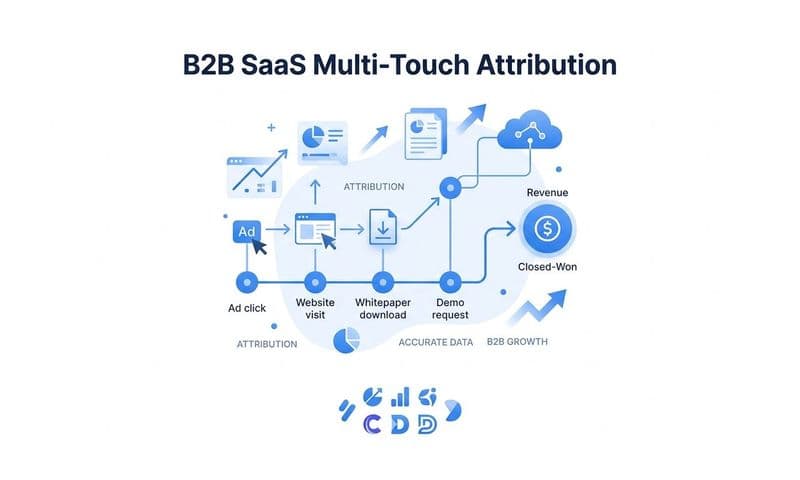
You might discover that a typical path looks like: Facebook ad (awareness) → Google search (consideration) → retargeting ad (consideration) → email click (decision) → conversion. Or maybe it's: LinkedIn post (awareness) → direct visit (consideration) → Google search (consideration) → email (decision) → conversion.
Create a visual map showing your three most common multi-touch paths. This doesn't need to be fancy—a simple flowchart showing channel sequence works perfectly. The goal is to visualize how customers actually move through your ecosystem, not how you wish they would move.
Pay special attention to the time gaps between touchpoints. If there's typically a 5-day gap between first touch and second touch, that tells you something about your consideration period. If customers hit 4-5 touchpoints in a single day before converting, that's a completely different buying behavior that requires different optimization strategies.
Verify success: You should be able to trace at least 3 common multi-touch paths in your data and articulate which channels typically play awareness, consideration, and decision roles in your customer journey.
Step 4: Analyze Assisted Conversion Reports
This is where you finally get to see which channels are driving value beyond last-click attribution. The insights here often surprise marketers because they reveal "hidden heroes"—channels that look mediocre in last-click reports but are actually critical to your conversion engine.
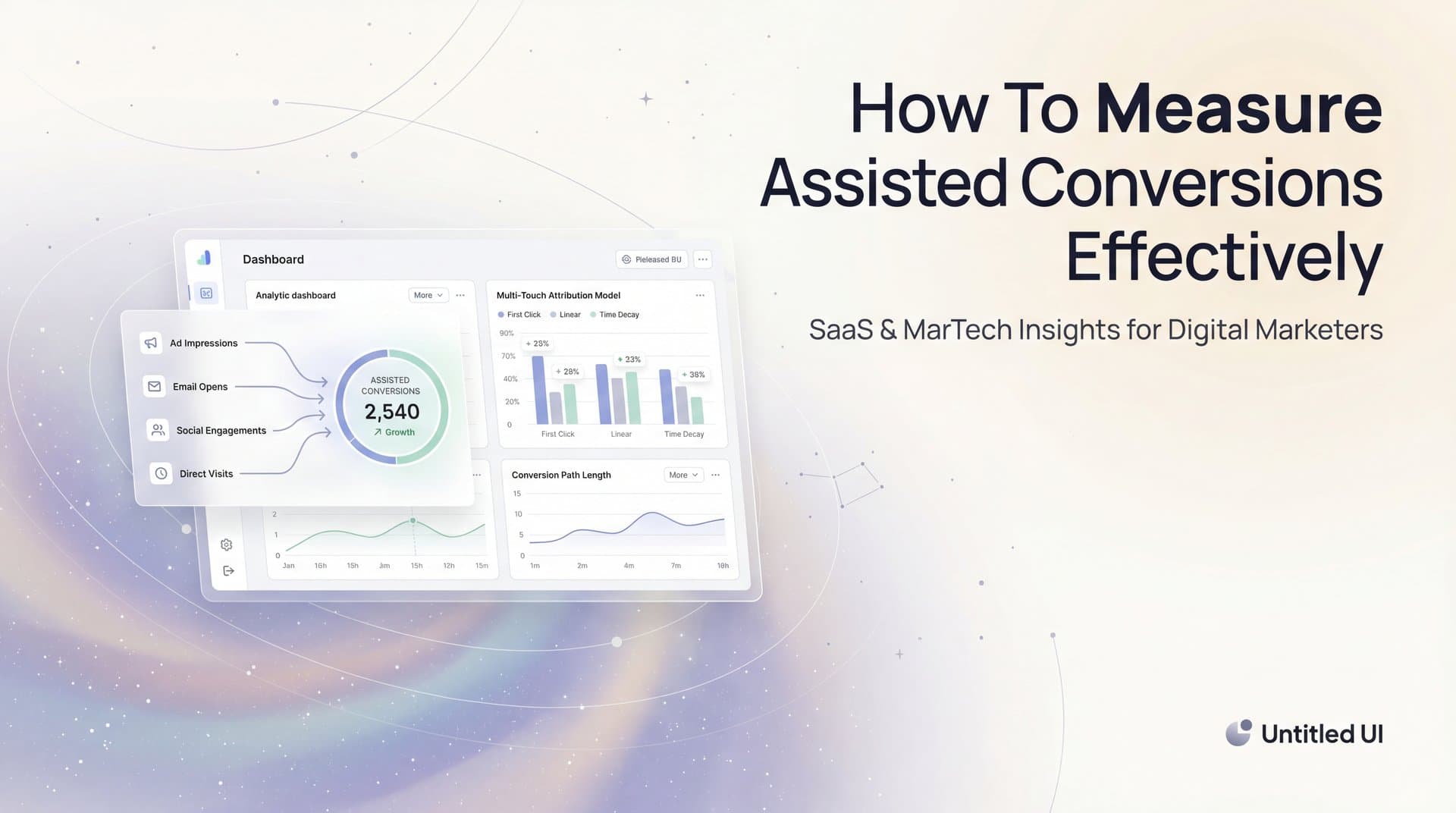
Pull your assisted conversion data from your attribution platform. You're looking for reports that show which channels appear in conversion paths without being the last click. Most platforms break this down into three metrics: last-click conversions (where the channel got final credit), assisted conversions (where the channel appeared earlier in the path), and first-click conversions (where the channel started the journey). If you're new to this concept, understanding what assisted conversions are provides essential foundational knowledge.
The magic metric is the assist-to-conversion ratio. Calculate this by dividing assisted conversions by last-click conversions for each channel. A ratio of 1.0 means the channel assists as often as it converts directly. Above 1.0 means it assists more than it converts—a classic supporting player. Below 1.0 means it captures more conversions than it assists.
Let's say your Facebook campaigns show 50 last-click conversions and 200 assisted conversions. That's a 4.0 assist ratio. Facebook is starting journeys and influencing decisions, but other channels are getting the final-click credit. Meanwhile, your branded search might show 150 last-click conversions and 30 assists—a 0.2 ratio. Branded search captures existing demand but rarely creates it.
Look for channels with assist ratios above 2.0. These are your hidden heroes. They're doing heavy lifting that last-click attribution completely misses. Common culprits include display advertising, social media awareness campaigns, content marketing, and top-of-funnel paid social.
Now flip the script and look at channels with very low assist ratios—below 0.5. These are your demand-capture channels. They're excellent at converting people who already want your product, but they're not creating new demand. Email to engaged subscribers, branded search, and direct traffic typically fall into this category.
Neither type of channel is "better"—they serve different functions. The problem is when you only look at last-click data, you dramatically overvalue demand-capture channels and undervalue demand-creation channels. This leads to the classic mistake of cutting Facebook because "it doesn't convert" while pumping more money into branded search—which only works because Facebook is creating the brand awareness that drives those searches.
Create a simple table showing each channel's last-click conversions, assisted conversions, and assist ratio. Sort by assist ratio descending. The channels at the top are likely underfunded relative to their true contribution. The channels at the bottom are likely over-credited in your current reporting.
Pay attention to the absolute numbers too. A channel with a 5.0 assist ratio but only 10 total assisted conversions isn't as strategically important as a channel with a 2.0 ratio and 500 assists. Scale matters.
Verify success: You should be able to identify at least 2 channels that contribute significantly more assists than direct conversions, and you should understand why those channels play a supporting role in your customer journey.
Step 5: Compare Attribution Models to Validate Findings
Assisted conversion analysis gives you directional insight, but smart marketers validate those insights by running the same data through multiple attribution models. This step builds confidence that you're seeing real patterns, not just artifacts of how you're measuring.
Attribution models are simply different rules for distributing credit across touchpoints. Last-click gives 100% credit to the final touchpoint. First-click gives 100% to the initial touchpoint. But there are several other models that distribute credit more evenly across the journey. Learning how to choose the right attribution model is critical for accurate measurement.
Linear attribution splits credit equally across all touchpoints. If a customer had 4 touches before converting, each touch gets 25% credit. This model treats every interaction as equally valuable, which isn't realistic but helps you see which channels appear most frequently in conversion paths.
Time-decay attribution gives more credit to touchpoints closer to conversion. The logic is that recent interactions influenced the decision more than older ones. This model often reveals which channels are good at moving prospects from consideration to decision.
Position-based attribution (also called U-shaped) gives 40% credit to the first touch, 40% to the last touch, and splits the remaining 20% among middle touches. This model values both demand creation and demand capture while acknowledging that middle touches matter too.
Data-driven attribution uses machine learning to assign credit based on which touchpoints actually correlate with higher conversion rates. This is the most sophisticated model but requires significant data volume to work properly—typically thousands of conversions per month.
Run your conversion data through at least three of these models and create a comparison table. For each channel, show how many conversions it gets credited with under each model. You're looking for patterns in how credit shifts.
Channels that gain significant credit when you switch from last-click to linear or time-decay are your high-assist channels—the ones that were being undervalued. If Facebook gets 50 conversions in last-click but 180 in linear attribution, that's a 3.6x difference that confirms its assisting role.
Channels that lose credit when you switch away from last-click are your demand-capture channels. If email drops from 200 conversions in last-click to 80 in linear, it's capturing conversions but not creating the demand that leads to those conversions.
The goal isn't to pick the "right" attribution model—they're all partially wrong because they're simplifications of complex human behavior. The goal is to use model comparison to triangulate truth. When multiple models agree that a channel is being undervalued in last-click reporting, you can act on that insight with confidence. For a deeper dive, explore how to measure marketing attribution comprehensively.
Pay special attention to data-driven attribution if you have enough volume to use it. This model learns from your actual data rather than applying predetermined rules, so it often surfaces insights that other models miss. If data-driven attribution credits a channel significantly differently than the rule-based models, investigate why—there's usually a real pattern there.
Verify success: You should have a comparison table showing channel performance across at least 3 attribution models, and you should be able to articulate which channels gain or lose credit under different models and what that tells you about their role in the customer journey.
Step 6: Take Action—Reallocate Budget Based on Assisted Value
Data without action is just interesting trivia. This final step is about translating your assisted conversion insights into budget decisions that improve overall performance.
Start by calculating the true value of each channel by weighting its contribution across the entire customer journey, not just last-click conversions. A simple approach: take the conversion value from your preferred attribution model (linear or data-driven work well) and compare it to your current spend in that channel.
Let's say Facebook shows 50 last-click conversions worth $5,000, but linear attribution shows it contributed to 180 conversions worth $18,000. You're spending $3,000 per month on Facebook. Under last-click, that's a $1.67 return per dollar spent. Under linear attribution, it's $6.00 per dollar spent—a dramatically different picture.
Create a spreadsheet with columns for: channel name, current monthly spend, last-click conversions, last-click value, attributed conversions (using your preferred model), attributed value, and return on ad spend (ROAS) under both models. Sort by the delta between last-click ROAS and attributed ROAS. Understanding how to calculate marketing ROI accurately ensures your calculations reflect true performance.
Channels with the biggest positive delta (attributed ROAS much higher than last-click ROAS) are your reallocation opportunities. These are underfunded channels that drive high assist value relative to spend. They're probably awareness or consideration channels that start journeys other channels finish.
Now identify your over-funded channels—those where attributed ROAS is significantly lower than last-click ROAS. These channels are getting credit for conversions they didn't really drive. They're often bottom-funnel channels like branded search or retargeting to recent website visitors. They're not bad channels, but they're over-credited and likely over-funded.
Build a reallocation plan that shifts 10-20% of budget from over-credited channels to high-assist channels. Don't make dramatic moves—attribution insights should inform gradual optimization, not radical pivots. If you cut your branded search budget by 50% overnight, you'll hurt conversions even if that channel is over-credited.
The smart approach is to hold total budget constant while shifting allocation. If you're spending $10,000 monthly across all channels, keep spending $10,000—just redistribute it based on true contribution rather than last-click credit. Increase spend on high-assist channels by 20-30% while decreasing spend on over-credited channels by 10-15%.
Set up ongoing monitoring to track how these changes impact overall conversion volume and revenue. The goal isn't to maximize any single channel's performance—it's to maximize total conversions across all channels. You should expect to see total conversions increase as you properly fund the channels that create demand, even if some individual channels show declining last-click conversions.
Document your reallocation decisions and the reasoning behind them. When someone asks why you're increasing Facebook spend despite its low last-click conversion rate, you need to articulate the assisted conversion data that supports that decision. Data-driven budget decisions require data-driven explanations.
Verify success: You should have a reallocation plan that identifies specific budget shifts based on attributed value, and you should have monitoring in place to track how those changes impact overall conversion performance over the next 30-60 days.
Putting It All Together
Measuring assisted conversions fundamentally changes how you understand marketing performance. Instead of over-crediting last-click channels and under-investing in the awareness drivers that create demand, you now have visibility into the full customer journey—from first impression to final conversion.
Let's recap what you've accomplished. You've defined clear conversion goals with appropriate lookback windows, giving you a consistent framework for measurement. You've implemented cross-channel tracking infrastructure that captures every touchpoint across platforms. You've mapped the customer journey to understand which channels play awareness, consideration, and decision roles. You've analyzed assisted conversion reports to identify hidden heroes with high assist ratios. You've compared attribution models to validate your insights and build confidence in the patterns you're seeing. And you've created a budget reallocation plan based on true channel value rather than last-click credit.
Quick implementation checklist: ✓ Conversion goals defined with lookback windows documented ✓ Cross-channel tracking capturing all touchpoints via server-side implementation ✓ Customer journey mapped by funnel stage with common paths identified ✓ Assisted conversion reports analyzed with assist ratios calculated for each channel ✓ Attribution models compared showing how credit shifts across models ✓ Budget reallocation plan created based on attributed value with monitoring in place
Start with Step 1 today. Even just defining your conversion goals and lookback windows will immediately clarify what you're measuring and why. You don't need to implement all six steps simultaneously—this is a progressive framework you can roll out over weeks.
The biggest mistake marketers make is cutting channels that "don't convert" based on last-click data, only to watch overall conversions decline because they eliminated the awareness drivers that fed their converting channels. Assisted conversion measurement prevents that mistake by showing you which channels create demand versus which channels capture it.
For marketers running campaigns across multiple platforms—Meta, Google, LinkedIn, TikTok, and more—manually connecting all these data sources and calculating assisted conversions can be overwhelming. Tools like Cometly automate this entire process by connecting your ad platforms, CRM, and website to track every touchpoint in real time. The platform provides AI-powered attribution insights that show exactly which channels drive assisted conversions, compares multiple attribution models automatically, and even feeds enriched conversion data back to ad platforms to improve their targeting algorithms.
Ready to elevate your marketing game with precision and confidence? Discover how Cometly's AI-driven recommendations can transform your ad strategy—Get your free demo today and start capturing every touchpoint to maximize your conversions.