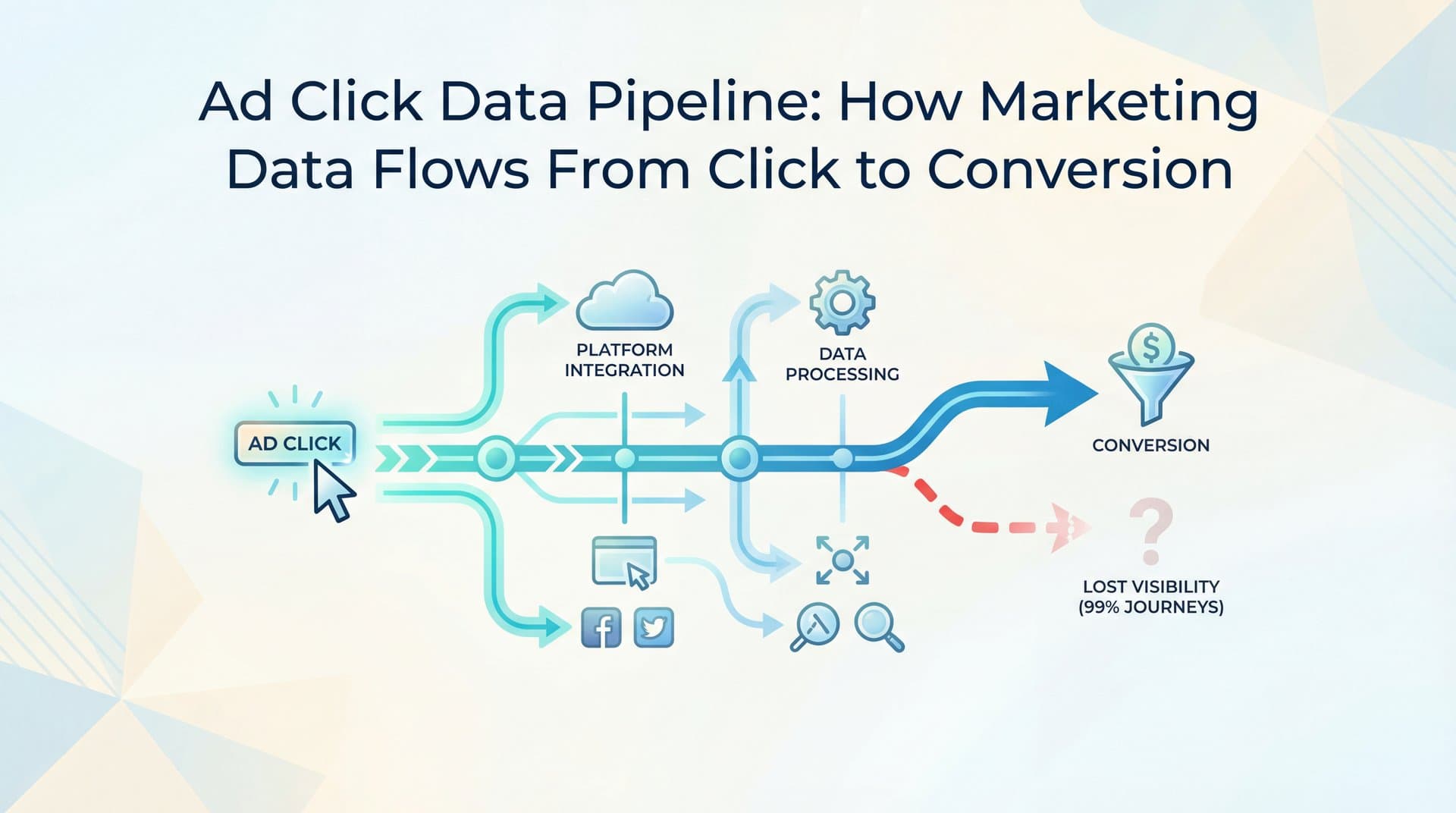
You've just launched a campaign that generated 1,000 ad clicks. Your dashboard shows promising engagement. But when you check your CRM, only 10 conversions appear. What happened to the other 990 customer journeys? Did they bounce? Convert elsewhere? Get lost in tracking gaps?
This isn't just a reporting problem—it's a pipeline problem. Between the moment someone clicks your ad and when they convert, their data travels through a complex infrastructure of platforms, cookies, servers, and attribution systems. Every handoff is a potential failure point.
The ad click data pipeline is the invisible infrastructure that captures, processes, and connects every click to business outcomes. When it works properly, you see the complete customer journey. When it breaks, you're making million-dollar decisions based on incomplete information. Understanding how this pipeline operates—and where it typically fails—is the difference between confident scaling and expensive guesswork.
The Anatomy of a Click: What Happens in Milliseconds
When someone clicks your ad, an entire technical sequence unfolds in milliseconds. This isn't just a simple redirect—it's a carefully orchestrated data collection process that determines whether you'll be able to track that visitor's journey.
The moment the click registers, the ad platform generates a unique click identifier. Google creates a gclid parameter. Meta generates an fbclid. Microsoft uses msclkid. These identifiers serve as digital fingerprints, uniquely identifying this specific ad interaction so it can be matched to future conversions.
Here's what actually happens: The user clicks your ad. The platform's tracking server intercepts the request, appends the click identifier to your destination URL, and redirects the browser to your landing page. That URL now looks something like: yoursite.com/landing?gclid=TeSter123ExAmple456. This parameter travels with the user, at least initially.
The real challenge begins when that click identifier needs to persist beyond the initial page load. Your website's tracking code must capture it immediately and store it somewhere the browser can access later. Most implementations use first-party cookies—small data files stored in the user's browser under your domain.
Modern tracking systems also leverage browser storage mechanisms like localStorage and sessionStorage. These provide more persistent data retention than cookies, which can be deleted or blocked. The click identifier gets written to multiple storage locations as a redundancy measure, increasing the chances it survives long enough to connect to a conversion.
But there's a timing problem. If your tracking script loads slowly or if the user navigates away before the script executes, that click identifier never gets captured. The connection between the ad click and the website session is permanently lost. This happens more often than most marketers realize, especially on mobile devices with slower connections.
Server-side parameters add another layer to this process. When a user lands on your site, your server can also capture and store the click identifier in your backend database, associating it with the user's session. This creates a server-side record that exists independently of browser storage, providing resilience against client-side data loss.
The click identifier must then persist across multiple sessions and devices. If someone clicks your ad on their phone during lunch but converts on their laptop at home three days later, connecting those events requires sophisticated identity resolution. Without it, you see two separate anonymous users instead of one customer journey.
From Raw Clicks to Actionable Insights: Pipeline Stages Explained
Raw click data by itself tells you almost nothing. The real value emerges when that data flows through transformation stages that turn scattered platform events into unified customer intelligence.
Data Collection Layer: This is where clicks from multiple ad platforms converge into a single system. Your pipeline needs to simultaneously capture gclid parameters from Google Ads, fbclid from Meta campaigns, and any other platform identifiers you're using. Each platform has different tracking requirements and data formats, so this layer acts as a universal translator.
The collection layer also captures contextual data that enriches the click record. What was the user's device? Which browser? What time did they click? What was their approximate location? This metadata becomes crucial later when you're analyzing performance patterns or troubleshooting attribution discrepancies.
Many collection systems use tag management platforms to coordinate this data gathering. But there's a critical limitation: these client-side tags only fire if the page loads completely and JavaScript executes successfully. That's why modern pipelines increasingly rely on server-side collection methods that capture data regardless of browser behavior.
Data Transformation Layer: Raw click data is messy. Duplicate records appear when users click multiple times. Bot traffic creates false signals. Incomplete records lack essential fields. The transformation layer cleans and standardizes this data into a consistent format.
Deduplication is particularly important. If someone clicks your ad, lands on your site, immediately hits the back button, then clicks the same ad again, you don't want to count that as two separate customer acquisition costs. The transformation layer identifies these patterns and consolidates them into single user sessions.
Data enrichment happens here too. The pipeline might append geographic data based on IP addresses, classify devices into categories (mobile, tablet, desktop), or match click timestamps against your campaign schedule to verify authenticity. This enrichment transforms basic click records into contextually rich data points.
User identity resolution is one of the most complex transformation challenges. The pipeline must connect anonymous click identifiers to known customer profiles as users authenticate, fill out forms, or convert. This requires matching algorithms that can link sessions across different identifiers while respecting privacy boundaries.
Data Storage and Retrieval Layer: Processed click data needs to live somewhere queryable. Most modern pipelines use data warehouses like Snowflake, BigQuery, or Redshift that can handle massive volumes of event data while supporting fast analytical queries. Understanding how to setup a datalake for marketing attribution can significantly improve your data infrastructure.
The storage architecture matters significantly for performance. Click data gets structured into tables that optimize for common query patterns—looking up all clicks for a specific campaign, finding all touchpoints for a converted customer, or aggregating performance metrics across date ranges.
Historical data retention policies determine how long click records remain accessible. Some businesses keep click-level data for months or years, enabling long-term trend analysis. Others aggregate older data into summary tables to reduce storage costs while preserving high-level insights.
The retrieval layer must serve multiple consumers simultaneously. Your attribution system queries it to build customer journey maps. Your analytics dashboard pulls from it for performance reporting. Your data science team accesses it for predictive modeling. The storage architecture must support all these use cases without performance degradation.
Where Pipelines Break: Common Data Loss Points
Even well-designed pipelines leak data. Understanding where these leaks typically occur helps you diagnose why your conversion numbers don't match across platforms.
Browser and Privacy Restrictions: Apple's App Tracking Transparency framework, introduced with iOS 14.5 in 2021, fundamentally changed mobile tracking. Users must explicitly opt in to cross-app tracking, and many don't. When someone clicks your ad in a mobile app but lands on your website without tracking permission, the connection breaks.
Third-party cookie blocking creates similar gaps. Safari's Intelligent Tracking Prevention and Firefox's Enhanced Tracking Protection automatically delete or restrict cookies from domains other than the one the user is directly visiting. If your tracking relies on third-party cookies, you're losing attribution data on a significant portion of traffic.
Even first-party cookies face limitations now. Safari caps first-party cookie lifespans at seven days for link-decorated URLs (those with click parameters). If your sales cycle exceeds a week, conversions may not connect back to the originating click. This particularly impacts B2B companies with longer consideration periods.
Cross-Device and Cross-Session Gaps: Modern customer journeys rarely happen in a single session. Someone might click your ad on their phone during their morning commute, research on their work laptop during lunch, and convert on their home computer that evening. Without authenticated user sessions, your pipeline sees three separate anonymous visitors.
Session timeout policies create artificial breaks in customer journeys. Most analytics platforms end a session after 30 minutes of inactivity. If someone clicks your ad, gets distracted, then returns 45 minutes later and converts, many systems treat that as a direct conversion rather than attributing it to the ad click.
App-to-web transitions are particularly problematic. A user might click an ad in Instagram, which opens your site in an in-app browser. If they later return via Safari or Chrome, the pipeline often can't connect these as the same person. Each appears as a separate user journey with different identifiers.
Platform Discrepancies: Your Meta Ads dashboard shows 50 conversions. Google Analytics reports 42. Your CRM logged 38. Which number is real? All of them—and none of them. Each platform measures conversions differently, creating discrepancies that confuse attribution. Learning how to fix attribution discrepancies is essential for accurate reporting.
Attribution windows vary by platform. Meta defaults to a 7-day click and 1-day view attribution window. Google Ads uses different windows depending on campaign type. Your analytics platform might use last-click attribution with no time limit. When comparing numbers across platforms, you're often comparing fundamentally different measurement methodologies.
Conversion counting logic differs too. Some platforms count every conversion event, while others deduplicate by user. If someone converts twice, one platform might report two conversions while another reports one converted user. Neither is wrong—they're just measuring different things.
Data sampling adds another layer of discrepancy. Some platforms sample data when query volumes get high, providing estimated rather than exact numbers. Your data warehouse might show precise counts while platform dashboards show sampled approximations, creating gaps that look like data loss but are actually measurement differences.
Server-Side Tracking: Building a More Resilient Pipeline
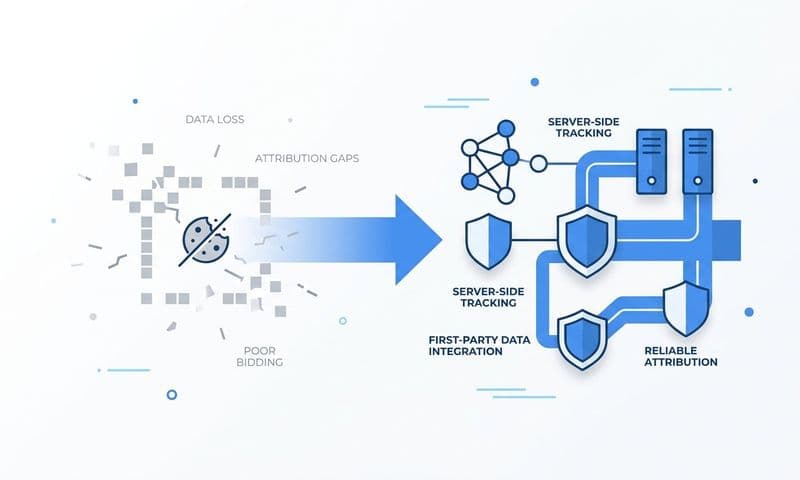
Client-side tracking—JavaScript tags running in browsers—dominated digital marketing for years. But browser restrictions have made this approach increasingly unreliable. Server-side tracking offers a more resilient alternative by moving data collection to your backend infrastructure.
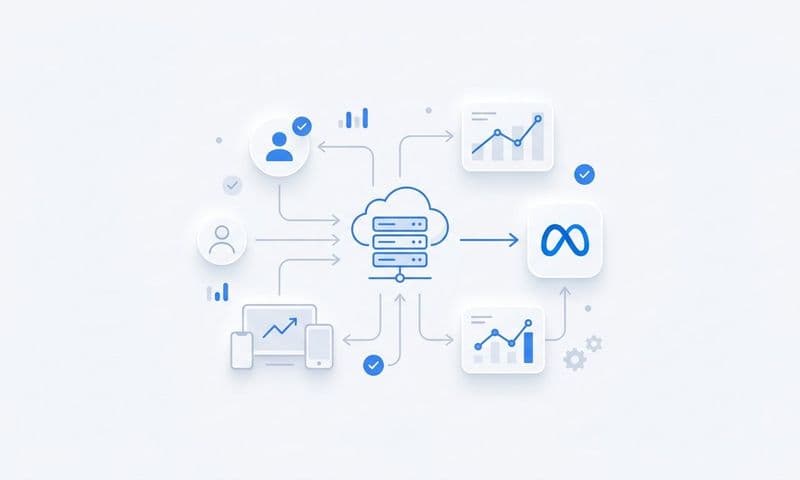
Here's the fundamental difference: Instead of relying on browser-based code to capture and send data, your server directly communicates with ad platforms and analytics systems. When someone clicks an ad and lands on your site, your server captures the click identifier and stores it in your database. When a conversion happens, your server sends that event directly to the relevant platforms.
This architecture bypasses most browser restrictions. Ad blockers can't prevent your server from communicating with ad platforms. Cookie limitations don't matter because data persistence happens in your database, not in browser storage. iOS privacy restrictions don't interfere because the data flow never depends on client-side tracking permission.
Server-side tracking also enables first-party data tracking that you control completely. Instead of sending user data through multiple third-party domains, everything flows through your infrastructure. This improves data accuracy, reduces latency, and gives you complete visibility into what data is being collected and how it's being used.
Platform Integration: Meta's Conversions API (CAPI) and Google's offline conversion imports allow you to send conversion data directly from your server to their systems. Instead of relying on pixel-based tracking, you POST conversion events to their APIs with the original click identifiers, user information, and conversion details. Understanding how to sync conversion data to Facebook Ads is critical for maximizing campaign performance.
This server-to-server communication is more reliable than browser-based tracking. Network issues on the user's device don't affect data transmission. Ad blockers can't interfere. The data reaches the platform even if the user closes their browser immediately after converting.
The real power emerges when you combine client-side and server-side tracking. Browser-based pixels provide real-time signals and enable features like dynamic remarketing. Server-side tracking fills the gaps, capturing conversions that client-side methods miss. Together, they create a more complete picture than either approach alone.
The Feedback Loop: Server-side tracking doesn't just improve your attribution reporting—it makes your ad campaigns perform better. When you send accurate conversion data back to ad platforms, their algorithms learn which types of users are most likely to convert. This improves targeting, bidding, and creative optimization. Mastering how to feed quality data to ad algorithms can dramatically improve your campaign results.
Many marketers don't realize that incomplete conversion data actively hurts campaign performance. If the platform only sees 40% of your actual conversions because the other 60% are lost to tracking gaps, its optimization algorithms are making decisions based on incomplete information. They might pause ads that are actually profitable or scale ads that aren't.
Feeding enriched conversion data back to platforms creates a virtuous cycle. Better data leads to better optimization. Better optimization leads to more efficient conversions. More conversions provide more data to further improve the algorithms. This feedback loop compounds over time, creating sustainable performance improvements.
Connecting Clicks to Revenue: The Attribution Layer
Raw click data shows you traffic sources. The attribution layer tells you which sources actually drive revenue. This distinction matters enormously when you're deciding where to invest your next dollar.
Multi-touch attribution models use your pipeline data to credit the touchpoints that contributed to conversions. A customer might click a Facebook ad, later click a Google search ad, then convert after receiving an email. Which channel deserves credit? The answer depends on your attribution model.
Linear attribution spreads credit equally across all touchpoints. Time-decay gives more credit to interactions closer to the conversion. Position-based (U-shaped) emphasizes the first and last touches. Data-driven attribution uses machine learning to determine credit based on actual conversion patterns in your data. Each model interprets the same pipeline data differently, producing different insights about channel performance.
The attribution layer must match anonymous clicks to known customers as they progress through your funnel. Someone might interact with your ads multiple times as an anonymous visitor before filling out a form that identifies them. At that moment, the pipeline needs to retroactively connect all their previous anonymous sessions to their now-known identity.
This identity resolution process is technically complex. It requires matching patterns across different identifiers—cookies, device IDs, IP addresses, user agents—while avoiding false positives that incorrectly merge different people's journeys. The algorithms must balance accuracy with coverage, connecting as many sessions as possible without creating phantom users.
Revenue Attribution: The most sophisticated attribution systems connect clicks not just to conversions, but to actual revenue. This requires integrating your pipeline with your CRM, payment processor, or e-commerce platform to capture transaction values.
Revenue attribution reveals which campaigns drive high-value customers versus low-value ones. You might discover that one channel generates twice as many conversions but half the average order value. Without revenue data in your pipeline, you'd optimize for the wrong metric, scaling low-value traffic at the expense of high-value opportunities.
Long-term value attribution takes this further by connecting initial acquisition clicks to customer lifetime value. Which campaigns attract customers who stick around and buy repeatedly? This requires your pipeline to maintain customer identity across months or years, connecting the original ad click to all subsequent purchases and calculating true ROI.
The attribution layer also surfaces hidden insights by analyzing journey patterns through attribution data analysis. You might discover that customers who interact with both paid search and paid social convert at twice the rate of those who only see one channel. This insight—invisible without unified pipeline data—could inform your entire channel strategy.
Putting Your Pipeline to Work: Practical Next Steps
Understanding pipeline architecture is valuable, but the real question is: how healthy is your current setup? These diagnostic questions help you assess where improvements would have the biggest impact.
Pipeline Health Audit: Start by checking data completeness. What percentage of your ad clicks successfully make it into your analytics system? If you're seeing significant discrepancies between platform-reported clicks and tracked sessions, you have a collection layer problem.
Test your cross-device tracking. Click one of your ads on your phone, then convert on your computer. Does your system connect these as a single journey? If not, you're undercounting the effectiveness of your top-of-funnel campaigns.
Examine your attribution window coverage. What's your average time from first click to conversion? If it's longer than your attribution windows, you're systematically undervaluing campaigns that start customer journeys. Consider extending windows or implementing longer-term tracking.
Check for duplicate conversion counting. Are the same conversions being credited to multiple platforms? This inflates your reported results and makes ROI calculations meaningless. Your pipeline should deduplicate conversions at the source of truth level. Implementing marketing data accuracy improvement methods can help resolve these issues.
Key Metrics to Monitor: Track your click-to-session match rate—the percentage of ad clicks that successfully create tracked sessions on your site. Rates below 80% indicate significant data loss in your collection layer.
Monitor your conversion tracking success rate. What percentage of conversions in your CRM have associated attribution data? If it's below 90%, you're making decisions based on incomplete information about what's driving results.
Measure cross-platform discrepancy ranges. Some variance between platforms is normal, but if your numbers differ by more than 15-20%, you have fundamental measurement inconsistencies that need resolution.
Unified Attribution Platforms: Building and maintaining a robust ad click data pipeline requires significant technical infrastructure. Modern attribution platforms unify these pipeline stages into a single system, handling collection, transformation, storage, and attribution automatically.
These platforms connect directly to your ad accounts, website, and CRM, capturing every touchpoint in real time. They implement server-side tracking to bypass browser restrictions while maintaining client-side collection for immediate signals. The result is a more complete view of customer journeys without requiring you to build and maintain complex data infrastructure.
The AI layer in advanced platforms goes beyond just tracking what happened. It analyzes patterns in your pipeline data to identify which campaigns and channels are actually driving revenue, then provides specific recommendations for optimization. This transforms your pipeline from a passive data collection system into an active intelligence layer that guides data-driven decision making.
Taking Control of Your Marketing Data
The ad click data pipeline isn't just technical infrastructure—it's the foundation of every marketing decision you make. When your pipeline captures complete, accurate data, you can scale with confidence. When it's broken or incomplete, you're flying blind, making expensive decisions based on partial information.
The shift from fragmented platform data to unified attribution isn't just about better reporting. It's about fundamentally changing how you approach marketing investment. Instead of trusting platform dashboards that show different numbers and credit the same conversions multiple times, you build a single source of truth that shows the complete customer journey.
This matters more as privacy restrictions tighten and browser-based tracking becomes less reliable. Marketers who invest in robust server-side pipelines and first-party data strategy now will have sustainable competitive advantages as third-party tracking continues to degrade. Those who rely solely on platform pixels will see their visibility decrease over time.
The good news? You don't need to build this infrastructure from scratch. Modern attribution platforms have solved these pipeline challenges, providing the complete data foundation you need to make confident decisions about where to invest your next dollar.
Ready to elevate your marketing game with precision and confidence? Discover how Cometly's AI-driven recommendations can transform your ad strategy—Get your free demo today and start capturing every touchpoint to maximize your conversions.