

Your marketing team just closed a record month. The dashboard shows your Google Search campaigns crushing it—hundreds of conversions, stellar ROI, everyone's celebrating. You double down on search budget, cut spending on those "underperforming" social campaigns, and wait for next month's results to blow the roof off.
Except they don't.
What you didn't see? Those search conversions weren't creating demand. They were capturing it. The real heavy lifting happened weeks earlier when prospects first discovered your brand through content, engaged with your social ads, watched your videos, and slowly moved toward a buying decision. By the time they searched for your brand name and clicked that final ad, the sale was already made. You just killed the campaigns that were actually building your pipeline.
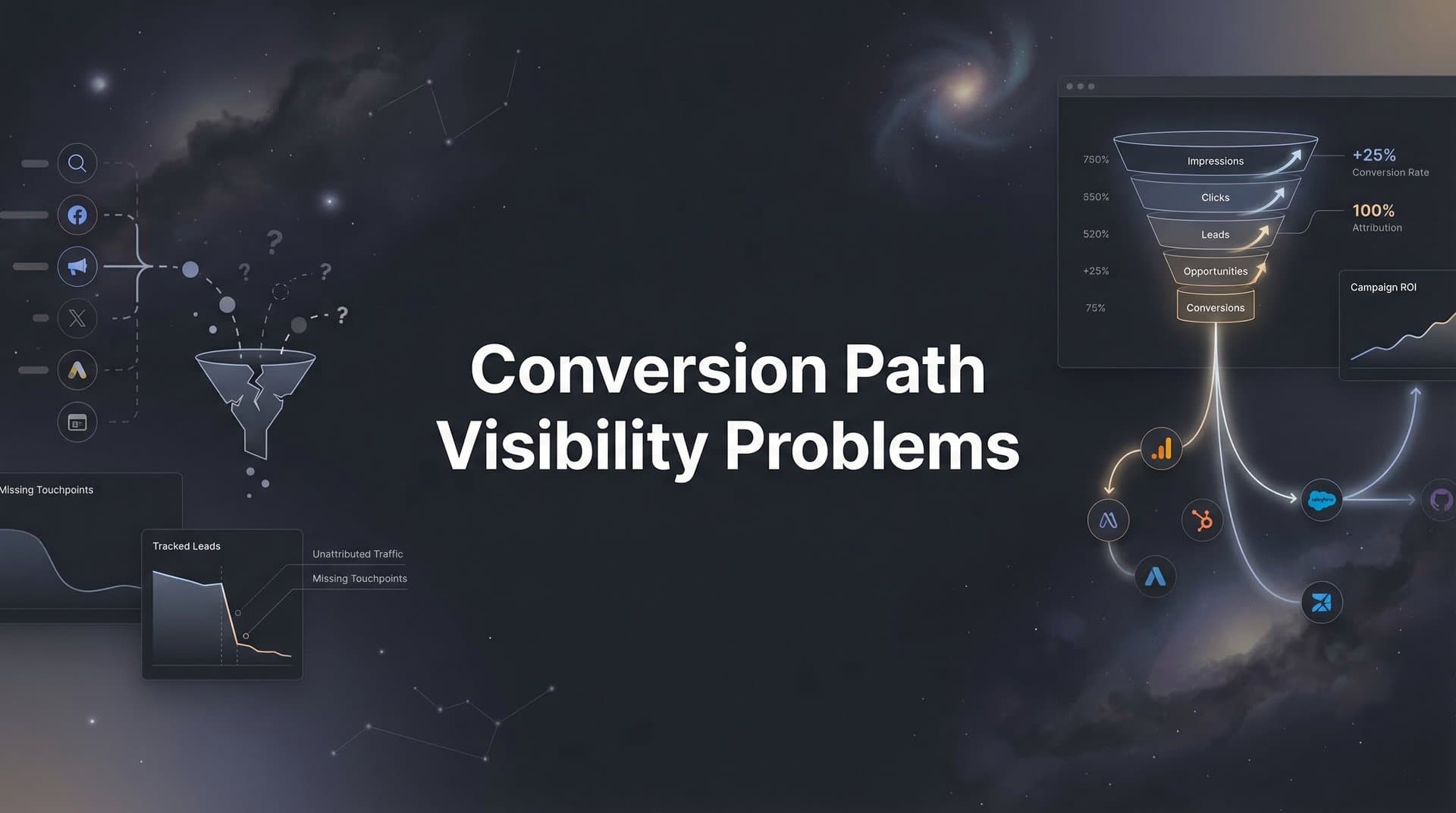
This is the reality of conversion path visibility problems—the inability to see and connect all the touchpoints that actually drive your results. And it's costing marketers real money every single day.
The Real Business Impact of Journey Blindness
Conversion path visibility problems represent one of the most expensive blind spots in modern marketing. At its core, this challenge is simple: you can't see the complete sequence of interactions a customer has with your brand before they convert. You're making million-dollar budget decisions based on fragments of the story.
Think about how your customers actually buy. They don't see one ad and immediately purchase. They discover your brand on Instagram during their morning scroll. Three days later, they click a Facebook retargeting ad and browse your site. A week after that, they watch a YouTube video about your product. Two weeks in, they finally search for your brand name, click your Google ad, and convert.
Traditional tracking sees that final Google click and declares victory. Everything else? Invisible. Understanding conversion path analysis is essential for seeing the complete picture of how customers actually move through your funnel.
The modern customer journey isn't a straight line—it's a web of interactions spanning multiple devices, platforms, and sessions over days or weeks. Your prospect might research on their phone during lunch, compare options on their work laptop, and finally purchase on their tablet at home. Each device switch creates a tracking gap. Each platform operates in its own silo.
The business consequences are brutal and immediate. Marketing teams systematically misallocate budgets, pouring money into channels that look effective but are merely intercepting demand created elsewhere. They kill campaigns that appear to underperform but are actually doing the crucial work of creating awareness and consideration. They over-invest in bottom-funnel capture tactics while starving the top-of-funnel activities that actually generate new opportunities.
Consider the math. If you're spending $50,000 monthly on paid advertising and your visibility problems cause you to misallocate just 30% of that budget, you're burning $15,000 every single month on the wrong channels. That's $180,000 annually making decisions based on incomplete data. And that's a conservative estimate.
The impact extends beyond wasted spend. When you can't see the full conversion path, you can't answer fundamental questions that should drive your strategy. Which campaigns are actually initiating new demand versus capturing existing intent? Which touchpoints move prospects closer to purchase? What sequence of interactions produces the highest-value customers? Without visibility into the complete journey, these questions remain unanswerable guesses.
Why Your Tracking Infrastructure Is Failing You
The tools that worked five years ago are fundamentally broken today. The tracking infrastructure most marketers rely on was built for a different era—one where third-party cookies persisted across sessions, users stayed on single devices, and platforms shared data more freely. That world no longer exists.
Browser privacy changes have systematically dismantled cookie-based tracking. Safari's Intelligent Tracking Prevention strips cookies after just seven days. Firefox's Enhanced Tracking Protection blocks third-party cookies entirely. Chrome has delayed but not abandoned its own cookie deprecation plans. Each update tightens the restrictions, creating larger gaps in your ability to track users across sessions and sites. Many marketers struggle to track conversions after cookie changes have taken effect.
Then came Apple's App Tracking Transparency framework, which fundamentally changed mobile advertising. When iOS users can opt out of tracking with a single tap, the majority do. Suddenly, your ability to connect ad impressions to downstream conversions on mobile devices—where most browsing happens—evaporated almost overnight.
Even if browser and mobile tracking worked perfectly, you'd still face the walled garden problem. Each advertising platform operates as an isolated ecosystem. Meta sees what happens on Facebook and Instagram. Google sees what happens in its network. TikTok sees TikTok. LinkedIn sees LinkedIn. None of them can see what happens on the others, and none of them naturally connect to what happens after the click.
Your prospect might see your LinkedIn ad Monday morning, click your Facebook ad Wednesday afternoon, and convert through a Google search Friday evening. Each platform reports the conversion as theirs. Each claims credit. Your attribution reports show 300% of your actual conversions because three platforms are counting the same sale. This is why so many teams can't track conversions across multiple platforms effectively.
The most critical gap sits between your marketing data and your business outcomes. Ad platforms report clicks and pixel-tracked conversions. But what actually matters lives in your CRM—qualified leads, sales pipeline, closed revenue, customer lifetime value. That disconnect means you're optimizing toward proxy metrics that may or may not correlate with actual business results.
You might drive hundreds of "conversions" that your sales team can't reach, won't qualify, or will never close. Without connecting marketing touchpoints to CRM outcomes, you have no idea which campaigns drive revenue versus which ones just drive form fills from tire-kickers.
The Warning Signs Your Data Is Incomplete
How do you know if conversion path visibility problems are affecting your marketing? The symptoms show up in your daily operations, creating friction and confusion that most teams have learned to accept as normal. They shouldn't.
The first red flag appears when your numbers don't reconcile. Your ad platforms report 150 conversions this month. Your CRM shows 90 new customers. Your analytics tool claims 200 goal completions. Which number is real? When you can't definitively answer that question, you have a visibility problem. If you're asking yourself why your conversions are not tracking, incomplete data is likely the culprit.
These discrepancies aren't small rounding errors—they're often 30-50% gaps that make it impossible to calculate accurate ROI. You can't confidently tell your CFO what you're actually getting for your ad spend when three different systems give you three different answers.
Another telltale symptom: you can't trace individual sales back to their marketing source with confidence. A high-value customer converts today. Your sales team asks which campaign drove them. You pull up your reports and find contradictory data. Google Analytics attributes them to organic search. Facebook claims the conversion. Your CRM notes they came through a direct visit. The real answer? They probably touched all three, but you can't see the sequence.
This inability to connect specific outcomes to specific marketing activities paralyzes decision-making. Should you increase budget on the campaign that "drove" that big sale? You have no idea because you don't actually know what drove it.
Perhaps the most frustrating symptom shows up when you compare attribution models. You run the same data through first-click attribution, last-click attribution, and linear attribution. Each model produces wildly different results. First-click says your awareness campaigns are crushing it. Last-click crowns your search campaigns as champions. Linear spreads credit everywhere, helping no one make decisions. Understanding conversion window attribution can help clarify how different models interpret the same data.
When attribution models contradict each other this dramatically, the underlying problem isn't the model—it's incomplete data. Every attribution model requires the same foundation: a complete, accurate record of every touchpoint in the customer journey. Without that foundation, even sophisticated models produce unreliable outputs.
Teams experiencing these symptoms often respond by picking one metric and ignoring the rest, defaulting to last-click attribution because it's simple, or making budget decisions based on gut feel rather than data. These workarounds don't solve the visibility problem. They just mask it while the underlying issues continue bleeding budget and opportunity.
Engineering Complete Journey Visibility
Solving conversion path visibility problems requires rebuilding your tracking foundation from the ground up. The solution isn't tweaking your existing setup—it's implementing infrastructure designed for today's privacy-first, multi-platform reality.
Server-side tracking forms the bedrock of reliable data collection. Unlike browser-based pixels that privacy tools can block, server-side tracking captures events directly on your servers before sending them to your analytics and advertising platforms. When a user interacts with your site, your server records the event and forwards it to your tracking systems. Browser restrictions can't interfere because the browser isn't doing the tracking. Implementing privacy-compliant conversion tracking methods ensures your data collection remains effective and legally sound.
This approach delivers several critical advantages. First, it's privacy-compliant by design—you control exactly what data gets collected and shared. Second, it's reliable—ad blockers and cookie restrictions can't break it. Third, it's accurate—you capture events that client-side tracking would miss entirely.
But server-side tracking alone isn't enough. You need to connect data across every system where customer interactions happen. That means integrating your ad platforms, website analytics, CRM, email marketing tools, and any other touchpoint where prospects engage with your brand. Each system holds pieces of the journey puzzle. Complete visibility requires assembling all the pieces into a unified view.
Modern attribution platforms accomplish this by creating a single source of truth that ingests data from every channel. When someone clicks your Facebook ad, that event gets recorded. When they visit your site, that session connects to the ad click. When they fill out a form, that conversion links to both previous events. When they become a customer in your CRM, that outcome ties back to the entire sequence of touchpoints that preceded it. The right conversion path analysis tools make this unified tracking possible.
This unified tracking enables multi-touch attribution models that distribute credit across the actual customer journey. Instead of giving 100% credit to the last click, you can see how awareness-stage touchpoints, consideration-stage interactions, and conversion-stage activities all contributed to the outcome.
Different attribution models serve different strategic questions. Linear attribution spreads credit evenly, useful for understanding which channels consistently appear in successful journeys. Time-decay attribution gives more weight to recent touchpoints, helping identify what pushes prospects over the finish line. Position-based attribution credits both the first and last touch heavily, recognizing that creating demand and capturing it both matter.
The key insight: no single attribution model is universally "correct." The right model depends on your business, sales cycle, and the questions you're trying to answer. But every model requires the same foundation—complete, connected data across all touchpoints. Build that foundation first, then experiment with models that illuminate different aspects of your marketing performance.
From Visibility to Velocity
Complete conversion path visibility isn't valuable because it makes prettier reports. It's valuable because it enables fundamentally better decisions that directly impact revenue growth.
With full journey visibility, you can finally distinguish between channels that create demand and channels that capture it. Your brand awareness campaigns might not show impressive last-click conversion numbers, but when you see that 70% of your high-value customers first discovered you through those campaigns, their strategic importance becomes clear. You stop making the mistake of cutting awareness spend because it doesn't show immediate returns.
This distinction changes everything about budget allocation. Instead of pouring money into bottom-funnel tactics that intercept demand created elsewhere, you can invest appropriately across the entire funnel. You fund the campaigns that create new opportunities, nurture the ones that advance consideration, and maintain the capture mechanisms that convert ready buyers. Learning how to track conversions across channels is the first step toward this strategic clarity.
The feedback loop to advertising platforms matters more than most marketers realize. When you send accurate, complete conversion data back to Meta, Google, and other platforms, you dramatically improve their machine learning optimization. These platforms use conversion signals to identify patterns in who converts and serve ads to similar audiences. Feed them incomplete data, and they optimize toward the wrong signals. Feed them accurate data, and they get smarter with every campaign.
Platforms like Cometly excel at this feedback mechanism. By connecting ad clicks to actual CRM outcomes, you can send conversion events back to ad platforms that reflect real business value—not just form fills or pixel fires that may or may not matter. When Facebook's algorithm knows which clicks led to closed deals versus which ones led to junk leads, it optimizes toward revenue instead of vanity metrics. Knowing how to sync conversions with ad platforms is critical for maximizing this optimization potential.
This creates a compounding advantage. Better data leads to better platform optimization. Better optimization drives better results. Better results provide more data to further refine the system. Teams that implement complete tracking infrastructure don't just see incremental improvements—they unlock exponential gains as their systems get smarter over time.
Perhaps most importantly, complete visibility enables confident scaling decisions. When you know with certainty which campaigns drive profitable outcomes, you can increase budget aggressively without fear. When you can see the full customer journey, you understand which touchpoints matter most and deserve more investment.
Marketing leaders operating with complete visibility move faster than competitors stuck in analysis paralysis. They make data-driven decisions daily instead of quarterly. They optimize in real-time instead of waiting for month-end reports. They scale winners immediately instead of letting opportunities pass while they debate attribution methodology.
Making the Invisible Visible
Conversion path visibility problems aren't a minor technical inconvenience. They're actively causing you to make wrong decisions with real budget consequences every single day. When you can't see the complete customer journey, you misallocate spend, kill effective campaigns, and over-invest in channels that merely capture demand created elsewhere.
The solution requires more than tweaking your existing setup. It demands rebuilding your tracking infrastructure on a foundation designed for today's reality—server-side tracking that bypasses browser restrictions, unified data that connects every touchpoint, and attribution models that reveal the full story of how customers actually buy.
The marketers winning today aren't the ones with the biggest budgets. They're the ones with the clearest visibility into what's actually working. They see the complete journey from first impression to closed revenue. They feed accurate data back to advertising platforms to improve optimization. They make confident decisions based on truth instead of guesses.
Your competitors are solving this problem right now. Every day you operate with incomplete visibility is another day of misallocated budget and missed opportunities. The question isn't whether you need complete conversion path visibility—it's how quickly you can implement it.
Ready to elevate your marketing game with precision and confidence? Discover how Cometly's AI-driven recommendations can transform your ad strategy—Get your free demo today and start capturing every touchpoint to maximize your conversions.


