You're running ads on Meta, Google, TikTok, and LinkedIn. Each platform's dashboard shows conversions. You add them up, and suddenly you've got 247 conversions this month. But your actual sales? Only 89. What's happening here isn't magic—it's attribution chaos.
Every ad platform wants to take credit for every conversion. Meta says the Facebook ad drove the sale. Google claims it was the search click. TikTok insists their video sealed the deal. The reality? That customer probably saw all three before buying, and now each platform is counting the same purchase as their own win.
This isn't just a reporting headache. When you can't see which channels actually drive revenue, you waste budget on platforms that look good in isolation but don't contribute to real growth. You over-invest in last-click winners while starving the awareness channels that started the journey. You make decisions based on inflated numbers that bear no resemblance to reality.
The solution isn't choosing one platform's version of truth over another. It's building a unified tracking system that captures the complete customer journey across every channel, attributes conversions accurately, and shows you what's genuinely working.
This guide walks through the exact six-step process to implement cross-channel conversion tracking that actually works. You'll learn how to define meaningful conversion events, implement server-side tracking that bypasses browser limitations, connect all your data sources into one system, and configure attribution models that reveal the full story. By the end, you'll have a clear framework for seeing which channels truly drive revenue—not just which ones happened to be last in line.
Step 1: Define Your Conversion Events and Tracking Goals
Before connecting any platforms or implementing tracking code, you need absolute clarity on what you're measuring and why. This isn't about tracking everything possible—it's about identifying the specific actions that indicate business progress.
Start by distinguishing between primary conversions and micro-conversions. Primary conversions directly generate revenue or qualified leads: completed purchases, demo bookings, consultation requests, subscription sign-ups. These are your money events. Micro-conversions indicate interest and engagement: add to cart, video views beyond 50%, pricing page visits, email sign-ups. These don't generate immediate revenue but signal movement toward a primary conversion.
Here's where most marketers go wrong: they track everything equally. A video view gets the same weight as a $5,000 purchase. When you feed that data to your attribution system, you get nonsense insights.
Map each conversion to business value. If your average purchase is $200, assign that value to the purchase event. If demo bookings close at 30% and average deal size is $10,000, assign $3,000 expected value to each demo booking. For micro-conversions, estimate their contribution—if 20% of people who add to cart eventually purchase, that micro-conversion carries roughly 20% of your purchase value. Following best practices for tracking conversions accurately ensures your data reflects real business outcomes.
Document which conversions matter for each channel based on their role in your funnel. Top-of-funnel channels like TikTok or display ads might optimize for video views or landing page visits. Mid-funnel channels like retargeting should focus on add-to-cart or email sign-ups. Bottom-funnel channels like branded search should drive primary conversions directly.
Create a simple conversion hierarchy document. List every conversion event you'll track, its assigned value, which channels should optimize for it, and how it connects to revenue. This becomes your source of truth when questions arise about what to measure.
The success indicator for this step: you can explain to anyone on your team exactly which conversions matter, why they matter, and what they're worth to the business. If there's ambiguity here, everything downstream will be muddy.
Step 2: Implement Server-Side Tracking as Your Foundation
Browser-based tracking is dying. Not slowly—rapidly. And if you're still relying entirely on pixels and cookies loaded in users' browsers, you're losing a massive chunk of your conversion data without realizing it.
The problem starts with iOS App Tracking Transparency, which requires apps to ask permission before tracking users across other apps and websites. Most users decline. Learning how to fix iOS 14 tracking issues has become essential for modern marketers. Then there are browser privacy features—Safari's Intelligent Tracking Prevention, Firefox's Enhanced Tracking Protection, Chrome's upcoming cookie restrictions. Add ad blockers used by a significant portion of web users, and you're looking at substantial data loss.
When a conversion fires only through browser-based tracking, it depends on that tracking code successfully loading and executing in the user's browser. If they've blocked third-party cookies, disabled tracking, or use a browser with aggressive privacy settings, that conversion never gets recorded. Your ad platforms never see it. Your analytics never capture it. It's invisible.
Server-side tracking solves this by capturing conversion events directly from your backend systems—your website server, your app backend, your order processing system. When someone completes a purchase, your server knows it happened regardless of what's happening in their browser. That server then sends the conversion data to your tracking systems and ad platforms directly, server-to-server.
Implementation means connecting your website or application to send conversion events from your server infrastructure to a central tracking system. When a user completes a checkout, your backend triggers an event containing the conversion details: user identifier, conversion type, value, timestamp, and any relevant metadata. For a detailed walkthrough, check out our guide on how to set up server-side tracking.
The technical setup varies by platform, but the concept remains consistent: instead of relying on JavaScript pixels firing in browsers, your server becomes the source of truth. This captures conversions that browser-based tracking would miss entirely.
You'll still use browser-based tracking for initial touchpoint capture—understanding which ads users clicked requires browser-level data. But for conversion confirmation, server-side tracking ensures accuracy. Think of it as a two-layer system: browsers track the journey, servers confirm the destination.
The success indicator here is straightforward: your conversion events fire reliably regardless of user browser settings, ad blockers, or privacy configurations. Test by completing a conversion with tracking disabled in your browser—if your system still records it, you've implemented server-side tracking correctly.
Step 3: Connect All Your Ad Platforms to a Central Hub
Right now, your conversion data lives in silos. Meta has its version of events. Google has another. TikTok, LinkedIn, and every other platform maintains separate tracking with different attribution windows and counting methods. This fragmentation is exactly why you're seeing inflated conversion numbers.
The solution is connecting all your ad platforms to a central attribution system that becomes your single source of truth. This hub receives conversion data from your server-side tracking, matches it to the original ad interactions from each platform, and shows you the complete picture. Our cross-platform tracking setup guide walks through this process in detail.
Start by integrating your active ad platforms—Meta, Google Ads, TikTok, LinkedIn, and any others where you run campaigns. Most attribution platforms offer direct integrations that pull campaign data, ad spend, and click/impression data automatically. This creates the foundation for connecting ad interactions to conversions.
But here's the critical piece that determines whether this works: UTM parameter consistency. Every campaign link you create must follow standardized naming conventions. If your Meta campaigns use "utm_source=facebook" while your agency uses "utm_source=meta" for similar campaigns, your attribution system can't group them correctly.
Create a UTM naming convention document that specifies exactly how to tag campaigns across all channels. Define your source names (facebook, google, tiktok, linkedin), campaign naming structure (brand_product_audience_objective), medium categories (cpc, social, display, email), and content labeling for ad variations. Understanding what UTM tracking is and how UTMs help your marketing is fundamental to getting this right. Share this document with everyone who creates campaign links—internal team members, agencies, contractors.
Once your platforms are connected and UTM parameters are standardized, verify data flow. Compare the clicks reported in each ad platform to the sessions showing up in your central hub for those same campaigns. The numbers won't match exactly—some clicks don't result in landing page loads—but they should be reasonably close. If Meta reports 1,000 clicks but your hub shows only 300 sessions from Meta campaigns, something's broken in your tracking implementation.
Check that conversion events are properly attributed back to the originating campaigns. Run a test conversion from a specific ad, then confirm it appears in your central dashboard with correct source attribution.
The success indicator: all your active ad platforms show data in your central dashboard, campaign performance is visible across channels in one view, and conversions are correctly attributed to their source campaigns. You should be able to answer "which channel drove this conversion?" with confidence.
Step 4: Link Your CRM to Track Revenue, Not Just Leads
Here's a scenario that plays out constantly in marketing teams: you run lead generation campaigns, track form submissions, celebrate when lead volume increases, and optimize toward more leads. Then sales tells you the leads are terrible quality and nothing's closing. You're optimizing for quantity while revenue stays flat.
This disconnect happens because marketing tracks the lead creation event, but never sees what happens after. Did that lead become an opportunity? Did it close? What was the deal value? Without this visibility, you're flying blind.
Connecting your CRM—whether that's HubSpot, Salesforce, Pipedrive, or another system—closes this loop. It allows you to attribute actual closed revenue back to the marketing touchpoints that generated it, not just count leads and hope they're valuable. Learning how to track sales leads through your entire funnel transforms marketing effectiveness.
The implementation involves integrating your CRM with your attribution system so that CRM events flow into your marketing data. When a lead is created, when it moves to opportunity stage, when a deal closes, and what the final value was—all of this becomes visible alongside the marketing interactions that preceded it.
Map CRM stages to conversion events in your tracking system. "Lead Created" becomes a conversion event. "Opportunity Opened" becomes another. "Deal Closed Won" becomes your ultimate conversion. Each carries different value based on your sales funnel conversion rates.
The real power comes from bi-directional sync. Marketing sees sales outcomes—which campaigns generated opportunities that actually closed, what the revenue was, how long the sales cycle took. Sales sees marketing context—which ads the customer saw, what content they engaged with, the complete journey before they entered the CRM. Understanding how to track customer journey data makes this visibility possible.
This visibility transforms optimization. Instead of optimizing Meta campaigns toward lead volume, you optimize toward leads that become closed deals. You discover that Google campaigns generate fewer leads but higher deal values. You find that certain ad creative attracts leads that never close, while other creative drives fewer but better-qualified prospects.
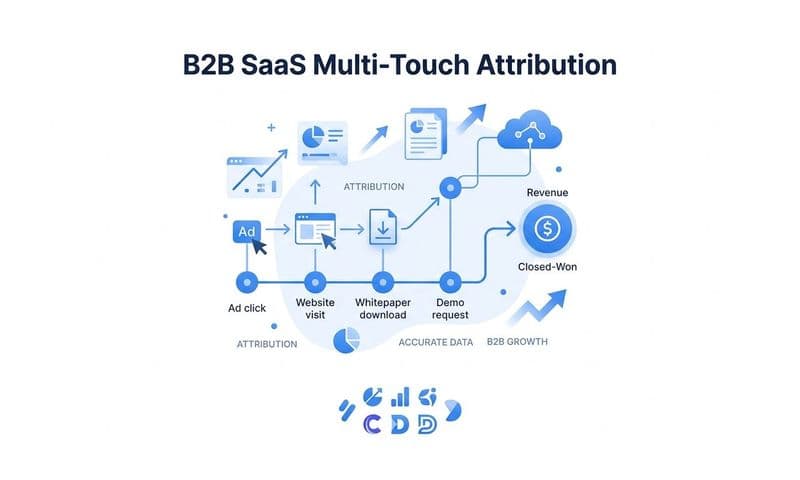
For B2B companies or any business with a sales process longer than a few days, this connection is essential. The lag between ad click and revenue means last-click attribution is essentially worthless—the final touchpoint before a deal closes is usually a sales call or email, not an ad. CRM integration lets you see the marketing touches that happened weeks or months earlier.
The success indicator: you can view which ad campaigns generate the highest-value customers, not just the most leads. You can calculate true customer acquisition cost by dividing ad spend by closed deals, not just by leads generated. Marketing and sales share a common view of the customer journey from first touch to closed revenue.
Step 5: Configure Multi-Touch Attribution Models
Every attribution model tells a different story about which channels deserve credit for conversions. The question isn't which model is "correct"—it's which model helps you make better decisions for your specific business.
First-touch attribution gives all credit to the initial interaction that brought someone into your ecosystem. This model favors awareness channels—the blog post they found through search, the TikTok video they discovered, the display ad that introduced your brand. It answers the question: "What made them aware we exist?"
Last-touch attribution gives all credit to the final interaction before conversion. This model favors bottom-funnel channels—branded search, retargeting, direct traffic. It answers: "What convinced them to convert right now?"
Linear attribution distributes credit equally across all touchpoints in the journey. If someone saw five ads before converting, each gets 20% credit. This model acknowledges that multiple interactions contributed, but assumes they all mattered equally.
Time-decay attribution gives more credit to recent interactions and less to older ones. The logic: touchpoints closer to conversion had more influence on the final decision. This model often resonates with marketers who believe the last few interactions matter most.
Data-driven attribution uses machine learning to analyze patterns across thousands of customer journeys and assign credit based on which touchpoints actually increase conversion probability. This is the most sophisticated approach, but requires substantial conversion volume to work effectively. Our comprehensive attribution marketing tracking guide covers these models in greater depth.
Choose your primary model based on your sales cycle and business goals. Short sales cycles—purchases that happen within hours or days of first interaction—often work well with last-touch attribution because the journey is compressed. Long sales cycles—B2B purchases, high-consideration products, anything with a weeks-long decision process—benefit from multi-touch models that credit the awareness and nurturing phases.
But here's the key insight: don't choose just one model. Run multiple attribution models simultaneously and compare how they distribute credit. When you see that first-touch attributes 40% of conversions to content marketing while last-touch attributes only 5%, you learn something valuable about content's role in starting journeys even if it doesn't close them. Understanding how to measure assisted conversions effectively reveals these hidden contributions.
Use these comparative insights to inform budget allocation. If linear attribution shows that customers typically interact with 4-6 touchpoints before converting, and cutting your awareness budget reduces the number of touchpoints per customer, you'll eventually see bottom-funnel performance decline too. The channels work together.
Configure your attribution windows appropriately. A 7-day click window means conversions are attributed to ad clicks that happened within the past 7 days. For impulse purchases, this works. For considered purchases, you need 30-day or even 90-day windows to capture the full decision timeline.
The success indicator: you have clear visibility into the full customer journey, not just the final click. You can explain which channels start relationships, which ones nurture consideration, and which ones close conversions. You understand how channels work together rather than viewing them as independent conversion drivers.
Step 6: Feed Enriched Data Back to Ad Platforms
Your ad platforms use machine learning to optimize campaign performance. They test different audiences, adjust bids, and show ads to people most likely to convert. But they can only optimize based on the data they receive. If you're only sending conversion counts without context about value or quality, their algorithms optimize toward volume, not revenue.
Feeding enriched conversion data back to ad platforms—often called conversion APIs or offline conversion tracking—solves this by sending detailed conversion information that helps platforms optimize more effectively. Learning how to sync conversions to ad platforms is crucial for maximizing algorithm performance.
Instead of just telling Meta "a conversion happened," you send conversion value, customer lifetime value predictions, product categories purchased, or lead quality scores. Meta's algorithm learns that conversions from certain audiences are worth more, and shifts budget toward finding similar high-value customers.
The same principle applies to Google, TikTok, LinkedIn, and other platforms. When you send conversion value data, their automated bidding strategies can optimize toward value rather than just conversion volume. A campaign might generate fewer conversions but higher revenue per conversion—exactly what you want.
Implementation requires setting up automated syncing between your attribution system and your ad platforms. When a conversion happens in your system, it sends that data back to the originating platform with enriched details. For CRM-connected systems, this means conversions that happen days or weeks after the initial ad click still get attributed correctly, improving the platform's understanding of which audiences convert. This approach is essential for improving ROAS with better tracking.
Include quality signals beyond just value. If you're a B2B company, send data about company size, industry, or fit score. If you're e-commerce, send product category, repeat purchase status, or predicted lifetime value. The more context platforms receive about what makes a valuable conversion, the better they optimize.
Set up automated syncing so this happens continuously without manual intervention. Every closed deal in your CRM should automatically feed back to the ad platforms that contributed to that customer's journey. This creates a learning loop where platforms continuously improve targeting based on your best customers.
The impact shows up in campaign performance over time. As platforms receive better conversion data, their algorithms get smarter about audience targeting and bid optimization. You'll see improved ROAS as campaigns shift budget toward audiences and placements that drive high-value conversions rather than just high conversion volume.
The success indicator: your ad platforms are optimizing toward high-value conversions, not just conversion counts. You see ROAS improving over time as platform algorithms learn from enriched data. Campaigns automatically adjust toward audiences that generate better customers, without constant manual optimization.
Your Cross-Channel Tracking Checklist
Cross-channel conversion tracking isn't a set-it-and-forget-it implementation. It's a system that requires initial setup, ongoing monitoring, and continuous optimization as your marketing evolves. But once it's working, you gain clarity that transforms decision-making.
Here's your quick-reference checklist for implementation:
Foundation: Define conversion events with assigned business values. Document which conversions matter for each channel. Create a conversion hierarchy that everyone understands.
Technical Setup: Implement server-side tracking to capture conversions regardless of browser limitations. Connect all ad platforms to a central attribution hub. Integrate your CRM to track revenue, not just leads.
Data Quality: Standardize UTM parameters across all campaigns and team members. Verify data flow from each platform to your central system. Test conversion tracking with ad blockers enabled to confirm server-side capture works.
Analysis: Configure multiple attribution models to compare how credit is distributed. Set appropriate attribution windows based on your sales cycle. Review which channels start journeys versus which ones close conversions.
Optimization: Feed enriched conversion data back to ad platforms to improve their algorithms. Include conversion value and quality signals, not just conversion counts. Monitor ROAS improvements as platforms learn from better data.
The marketers who win aren't the ones running the most campaigns or spending the biggest budgets. They're the ones who see clearly which efforts drive real business results, and they double down on what works while cutting what doesn't. Cross-channel tracking gives you that clarity.
Ready to elevate your marketing game with precision and confidence? Discover how Cometly's AI-driven recommendations can transform your ad strategy—Get your free demo today and start capturing every touchpoint to maximize your conversions.