

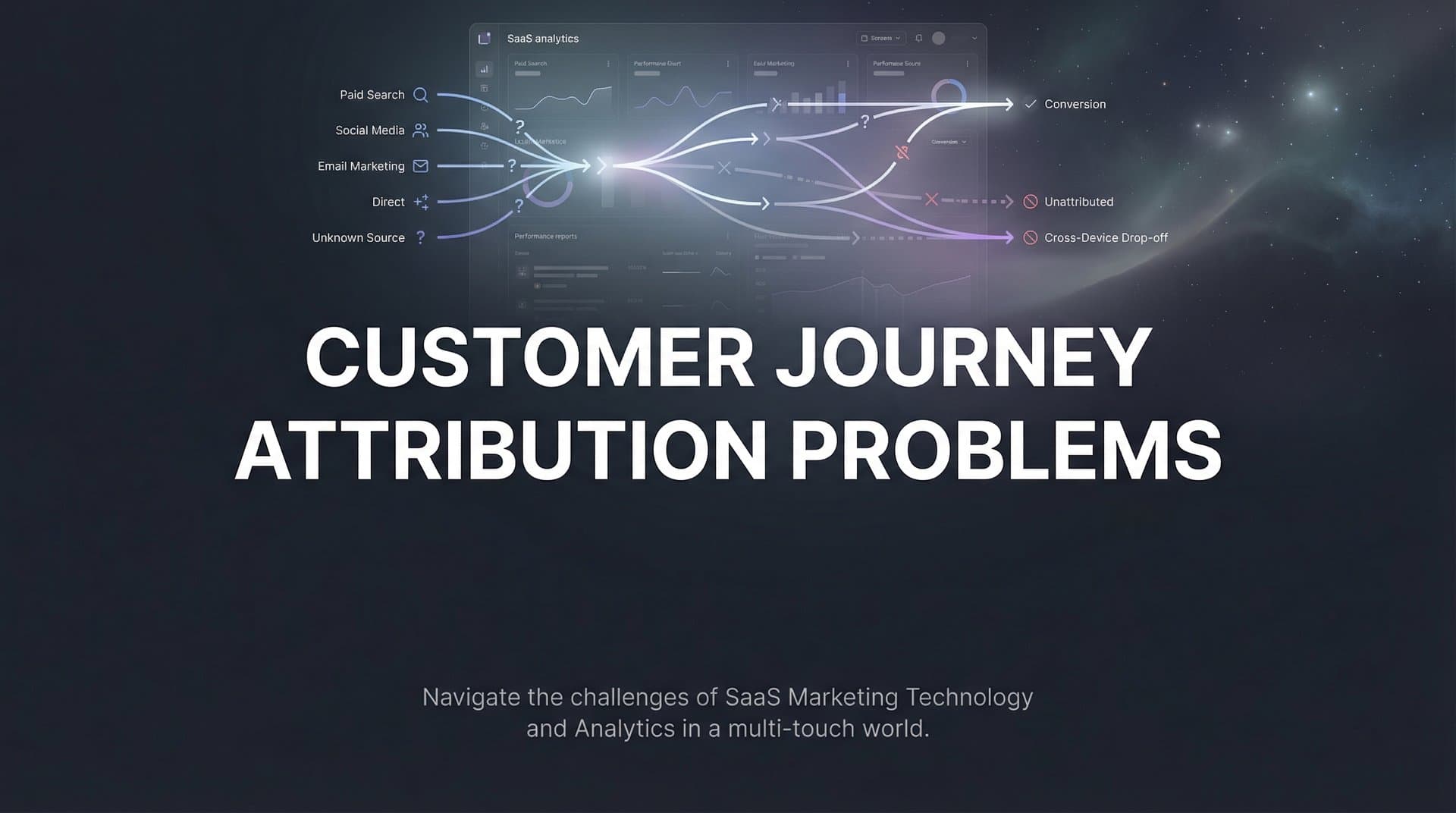
Your marketing team is celebrating. Last month's Facebook campaign crushed it—Meta's dashboard shows 247 conversions at a $32 cost per acquisition. You're already planning to triple the budget. Then your sales team drops a bomb: only 89 of those "conversions" actually became customers, and when they pull the CRM data, it turns out most of those buyers first discovered you through a LinkedIn post three weeks earlier, clicked a Google ad for comparison shopping, and only then converted via Facebook.
Which number do you trust? Which channel deserves the credit? And more importantly, where should you actually spend next month's budget?
This isn't a hypothetical scenario. It's the daily reality for marketing teams in 2026, where customer journeys span dozens of touchpoints across weeks or months, yet most attribution systems still operate like customers make instant decisions after seeing a single ad. These aren't minor reporting discrepancies—they're fundamental measurement problems that cost businesses real revenue through misallocated budgets, prematurely killed campaigns, and an inability to prove marketing's actual impact to leadership. The data isn't just incomplete. In many cases, it's actively lying to you.
The Broken Promise of Modern Marketing Measurement
Remember when marketing attribution seemed simple? A customer clicked your ad, landed on your website, and bought something. Clean. Linear. Measurable. That world doesn't exist anymore, and hasn't for years.
Today's customer journey looks nothing like the funnel diagrams in marketing textbooks. A B2B buyer might see your LinkedIn ad on their phone during their morning commute, research your solution on their work laptop that afternoon, discuss it with colleagues in a Slack channel, attend your webinar from a tablet, download a whitepaper using a different email address, and finally convert two weeks later after a sales call—clicking through from a retargeting ad they saw on their personal computer at home.
That's one customer. Seven devices. Multiple platforms. Dozens of touchpoints. And here's the problem: most attribution systems were never designed to connect those dots. Understanding customer journey touchpoints is essential, yet traditional tracking fails to capture them accurately.
Traditional browser-based tracking tries to follow users through cookies, but those cookies don't transfer between devices. To your analytics system, that single buyer looks like five completely different people. When they finally convert, your attribution tool has to guess which of those disconnected sessions deserves the credit. Usually, it picks the last one—because that's the only connection it can definitively prove.
Meanwhile, every ad platform you're running campaigns on has its own version of reality. Google Ads claims 180 conversions this month using their 30-day attribution window. Meta reports 247 conversions with their 7-day click window. TikTok says they drove 93 conversions. LinkedIn attributes 64 conversions to their campaigns. Add those up and you get 584 conversions—except your actual revenue data shows you only closed 156 new customers.
The math doesn't math. And this isn't just an academic problem about whose dashboard looks prettier.
When your attribution data is fundamentally broken, every strategic decision you make is built on quicksand. You scale campaigns that aren't actually profitable because the platform over-reports their impact. You cut awareness channels that seem "inefficient" without realizing they're feeding your entire pipeline. You can't prove marketing ROI to your CFO because your claimed conversions are triple your actual revenue. These multi-platform attribution problems plague marketing teams across industries.
The consequences compound over time. Misallocated budgets mean missed growth opportunities. Scaling the wrong campaigns means burning cash on diminishing returns. And when leadership loses trust in your data, they stop trusting your strategic recommendations entirely.
Five Attribution Blind Spots Sabotaging Your Campaigns
Let's get specific about where attribution breaks down. These aren't edge cases affecting a small percentage of your data—they're systematic blind spots that distort the majority of customer journeys you're trying to measure.
The Cross-Device Identity Crisis: Your attribution system sees devices, not people. When someone browses on their phone during lunch, researches on their work laptop that afternoon, and converts on their home computer that evening, traditional tracking treats this as three separate users. The awareness ad that introduced them to your product? Never gets connected to the conversion. Solving customer journey tracking across devices requires fundamentally different approaches than legacy analytics tools provide.
The iOS Privacy Apocalypse: Apple's iOS privacy changes didn't just make tracking harder—they blew massive holes in your attribution data that most marketers still haven't fully addressed. When users opt out of tracking (and most do), you lose visibility into their journey until they land on your website. Every social media interaction, every ad view, every click that happened in-app becomes invisible. You're essentially flying blind through the awareness and consideration stages, only regaining visibility at the very end of the funnel. And here's the twist: the campaigns generating those invisible early touchpoints still cost you money—you're just unable to measure their contribution.
Cookie Deprecation's Slow-Motion Disaster: While everyone focuses on iOS, browser-based cookie tracking is crumbling too. Safari and Firefox already block third-party cookies by default. Chrome keeps delaying full deprecation, but the writing's on the wall. As cookies disappear, browser-based analytics tools lose their primary mechanism for tracking users across sessions. These customer journey tracking gaps create massive blind spots in your measurement strategy.
The Offline Conversion Black Hole: Not every conversion happens with a click. Someone sees your ad, calls your sales line, and closes a deal three weeks later. A potential customer visits your booth at a conference, takes your business card, and emails your team directly. A prospect downloads your app after seeing a billboard, then converts through an in-app purchase. These are real conversions driven by your marketing—but most attribution systems never connect them back to the campaigns that initiated the journey. Your offline channels become a data dead zone where marketing dollars go in but attribution insights never come out.
The Platform Attribution Window Chaos: Every ad platform uses different attribution windows and methodologies, creating a measurement tower of Babel. Meta counts conversions within 7 days of a click or 1 day of a view. Google Ads uses 30-day click and 1-day view windows. Understanding Google Ads attribution window problems is just the beginning—TikTok and LinkedIn have their own standards too. When the same customer converts within multiple platforms' attribution windows, they all claim credit. The result? Your total platform-reported conversions are often 2-3x higher than your actual revenue.
Why Last-Click Attribution Is Costing You Money
Default attribution models in most analytics platforms use last-click attribution. It's simple. It's definitive. And it's systematically destroying the effectiveness of your marketing strategy.
Here's the fundamental flaw: last-click attribution gives 100% of the credit to whichever touchpoint happened immediately before the conversion. That final retargeting ad gets full credit. The branded search click gets full credit. The email link that closed the deal gets full credit. Meanwhile, the awareness campaign that introduced your brand, the educational content that built trust, the comparison ad that positioned you against competitors—all of that gets zero credit.
Think about how you actually make purchase decisions. When you bought your last car, did you see one ad and immediately drive to the dealership? Or did you research models, read reviews, visit multiple websites, watch comparison videos, and gradually narrow your options over weeks before finally making a decision? The marketing that influenced your awareness and consideration stages was crucial—but in a last-click model, only the final touchpoint would matter.
This creates a systematic bias that undervalues top-of-funnel marketing. Your content marketing efforts that generate awareness? Last-click says they're worthless because people rarely convert immediately after reading a blog post. Your display advertising that builds brand recognition? Inefficient, according to last-click data, because most people don't click display ads and immediately purchase. Understanding the difference between single-source attribution and multi-touch attribution models reveals why these biases exist.
The damage compounds when you act on this distorted data. You see that branded search campaigns have an amazing cost per acquisition, so you increase that budget. Makes sense, right? Except branded search is almost entirely demand capture, not demand creation. You're bidding on people who already know your brand and are actively looking for you. When you cut awareness campaigns because they "don't convert," you're starving the pipeline that feeds those high-performing branded searches.
Six months later, your branded search volume starts declining. Your cost per click increases because you're competing for a shrinking pool of aware customers. Your overall customer acquisition costs rise even as you're spending more on "efficient" channels. Last-click attribution told you to optimize toward the end of the funnel, and in doing so, you unknowingly killed the top of your funnel.
This isn't theoretical. Marketing teams make these exact mistakes constantly because last-click attribution creates a distorted reality where only demand capture looks valuable and demand creation appears wasteful. You end up with a marketing strategy that's all harvest and no planting.
Multi-Touch Attribution Models: Progress, Not Perfection
Multi-touch attribution attempts to solve last-click's blindness by distributing credit across multiple touchpoints in the customer journey. It's a significant improvement over last-click—but it comes with its own complexities and limitations that you need to understand before implementing.
Linear Attribution: This model gives equal credit to every touchpoint in the journey. The first awareness ad gets the same credit as the middle consideration content and the final conversion click. The upside? It acknowledges that multiple touchpoints matter. The downside? It assumes they all matter equally, which often isn't true. The ad that introduced someone to your brand probably deserves more credit than the fourteenth retargeting impression they saw.
Time-Decay Attribution: This approach gives more credit to touchpoints closer to the conversion, with earlier interactions receiving progressively less credit. It reflects the reality that recent interactions often have more influence on the final decision. But it can still undervalue crucial early-stage touchpoints that initiated the entire journey. If someone discovered your product six weeks ago but only recently started seriously considering it, time-decay might give that initial discovery too little credit.
Position-Based (U-Shaped) Attribution: This model gives 40% credit to the first touchpoint, 40% to the last touchpoint, and distributes the remaining 20% among middle interactions. It recognizes that both introducing someone to your brand and closing the deal are critical moments. The challenge? Those percentages are arbitrary. Why 40/20/40 instead of 50/10/40? Exploring multi-touch attribution models helps you understand which structure best reflects your actual customer journey dynamics.
Data-Driven Attribution: This is where it gets interesting. Data-driven models use machine learning to analyze your actual conversion data and determine which touchpoints statistically correlate with conversions. Instead of applying arbitrary rules, the algorithm learns from your specific customer journeys. The catch? You need substantial conversion volume for the model to work reliably. If you're only generating 50 conversions per month, there isn't enough data for meaningful statistical analysis.
Here's the uncomfortable truth: even the most sophisticated multi-touch attribution model is still making educated guesses. You can never know with absolute certainty which touchpoints were truly influential versus merely present in the journey. Someone might have seen your ad but actually decided to buy because their colleague recommended you. The ad gets credit in your attribution model, but the real influence was word-of-mouth that your system never captured.
The implementation challenge makes this even harder. Most marketing teams struggle to operationalize multi-touch insights even when they have the data. It's one thing to see that your LinkedIn awareness campaigns contribute to 23% of conversions in a time-decay model. It's another thing entirely to translate that insight into specific budget allocation decisions across seven different channels with different costs, conversion rates, and strategic purposes. Proper customer attribution modeling requires both the right technology and strategic expertise.
So which model should you use? It depends on your business context. If you have a short sales cycle where most conversions happen within days, time-decay makes sense. If you're focused on building long-term brand awareness alongside performance marketing, position-based attribution helps you value both. If you have high conversion volume and sophisticated analytics capabilities, data-driven attribution provides the most accurate insights. But regardless of which model you choose, remember: you're aiming for better measurement, not perfect measurement.
Building an Attribution System That Actually Works
Improving attribution isn't about finding the perfect model or buying the most expensive analytics platform. It's about building a measurement foundation that captures more of the customer journey and connects the dots between marketing touchpoints and actual revenue.
Server-Side Tracking as Your Foundation: The first step is moving beyond browser-based tracking that depends on cookies and pixels. Server-side tracking sends conversion data directly from your server to ad platforms and analytics tools, bypassing the browser entirely. This matters because it captures data that browser-based tracking misses due to ad blockers, privacy settings, and cookie restrictions. When someone converts on your site, server-side tracking ensures that conversion gets recorded and sent to your ad platforms—even if their browser is blocking third-party cookies or they've opted out of app tracking. This isn't a nice-to-have feature anymore. It's the baseline for accurate measurement in a privacy-first world.
Connecting the Full Journey: Attribution only works when you can see the complete customer journey from first touch to closed revenue. This requires integrating three critical data sources that most teams keep siloed. Your ad platform data shows which campaigns people interacted with. Your website analytics reveals how they behaved once they arrived. Your CRM tracks which leads actually converted to customers and generated revenue. Learning how to track customer journey data across these systems is essential for accurate attribution.
Feeding Better Data Back to Ad Platforms: Here's where attribution becomes a competitive advantage rather than just a reporting exercise. Modern ad platforms use machine learning to optimize delivery and targeting. But those algorithms are only as good as the data you feed them. When you send accurate, enriched conversion data back to Meta, Google, and TikTok—including which conversions actually generated revenue and how much—their algorithms can optimize toward real business outcomes instead of low-quality conversions. This creates a virtuous cycle: better attribution data leads to better algorithmic optimization, which leads to better campaign performance, which generates more data to improve attribution further.
Capturing Offline Conversions: If your business includes phone calls, in-store visits, or sales team interactions, you need mechanisms to connect those offline conversions back to the online marketing that initiated them. Call tracking systems that assign unique phone numbers to different campaigns. CRM integrations that capture the original traffic source when a lead first entered your database. Implementing post-purchase attribution tracking solutions ensures you capture the complete revenue picture.
Implementing Cross-Device Identity Resolution: You need technology that can recognize when the same person interacts with your brand across multiple devices. This typically involves combining deterministic matching (when someone logs in with the same email address on different devices) with probabilistic matching (using behavioral patterns and contextual signals to infer that different sessions belong to the same person). Robust customer attribution tracking can connect 60-70% of multi-device journeys—a massive improvement over treating every device as a separate user.
Putting It All Together: From Attribution Chaos to Clarity
If you're feeling overwhelmed by attribution complexity, focus on solving these three critical problems first: cross-device journey tracking, integrating ad platform data with CRM revenue data, and implementing server-side tracking to capture conversions that browser-based systems miss. Fix these fundamentals and you'll immediately improve attribution accuracy by 40-50%, even before optimizing attribution models or building sophisticated analytics dashboards.
Start with immediate action steps you can implement this week. Audit your current attribution setup to identify where data gaps exist—are you losing visibility into mobile app conversions, phone calls, or cross-device journeys? Set up server-side conversion tracking for your primary ad platforms if you haven't already. Connect your CRM to your analytics system so you can track which marketing touchpoints correlate with actual closed revenue, not just form submissions. These aren't months-long implementation projects. They're foundational improvements you can make quickly that immediately improve data quality.
Remember that perfect attribution is impossible, but better attribution is achievable and valuable. You don't need to track every micro-interaction across every possible touchpoint. You need to capture enough of the customer journey to make informed budget allocation decisions and prove marketing's impact on revenue. The right customer journey attribution software makes this achievable without requiring a data science team.
The competitive advantage goes to teams who solve attribution problems while competitors are still arguing about whose dashboard is correct. When you have accurate data connecting marketing touchpoints to revenue, you can confidently scale what works, cut what doesn't, and prove marketing's value to leadership with numbers that hold up to scrutiny. That's not just better reporting—it's a fundamental strategic advantage.
Ready to elevate your marketing game with precision and confidence? Discover how Cometly's AI-driven recommendations can transform your ad strategy—Get your free demo today and start capturing every touchpoint to maximize your conversions.



