You've just wrapped up a major product launch campaign. Facebook, Google, LinkedIn, your email list—you hit every channel hard. Sales came in. The campaign "worked." But here's the question that keeps you up at night: which part of it actually worked?
Was it the LinkedIn ad that first introduced prospects to your brand? The retargeting campaign that reminded them you existed? Or that final email that pushed them over the edge? Without knowing which touchpoints genuinely influenced the sale, you're flying blind with your budget. You might be doubling down on channels that barely move the needle while starving the ones that actually drive revenue.
This is where customer attribution modeling comes in. It's the system that connects the dots between every marketing interaction and the conversions that follow. Instead of guessing which campaigns deserve credit—or worse, giving all the credit to whichever channel happened to be last—attribution modeling shows you the complete picture of how customers actually find and buy from you.
Understanding the Core Components of Attribution
Customer attribution modeling is the process of assigning credit to the marketing touchpoints that influence a conversion. Think of it as forensic accounting for your marketing budget—you're tracing every dollar back to the specific interactions that contributed to a sale.
At its foundation, attribution modeling relies on four key components that work together to paint a complete picture of your marketing effectiveness.
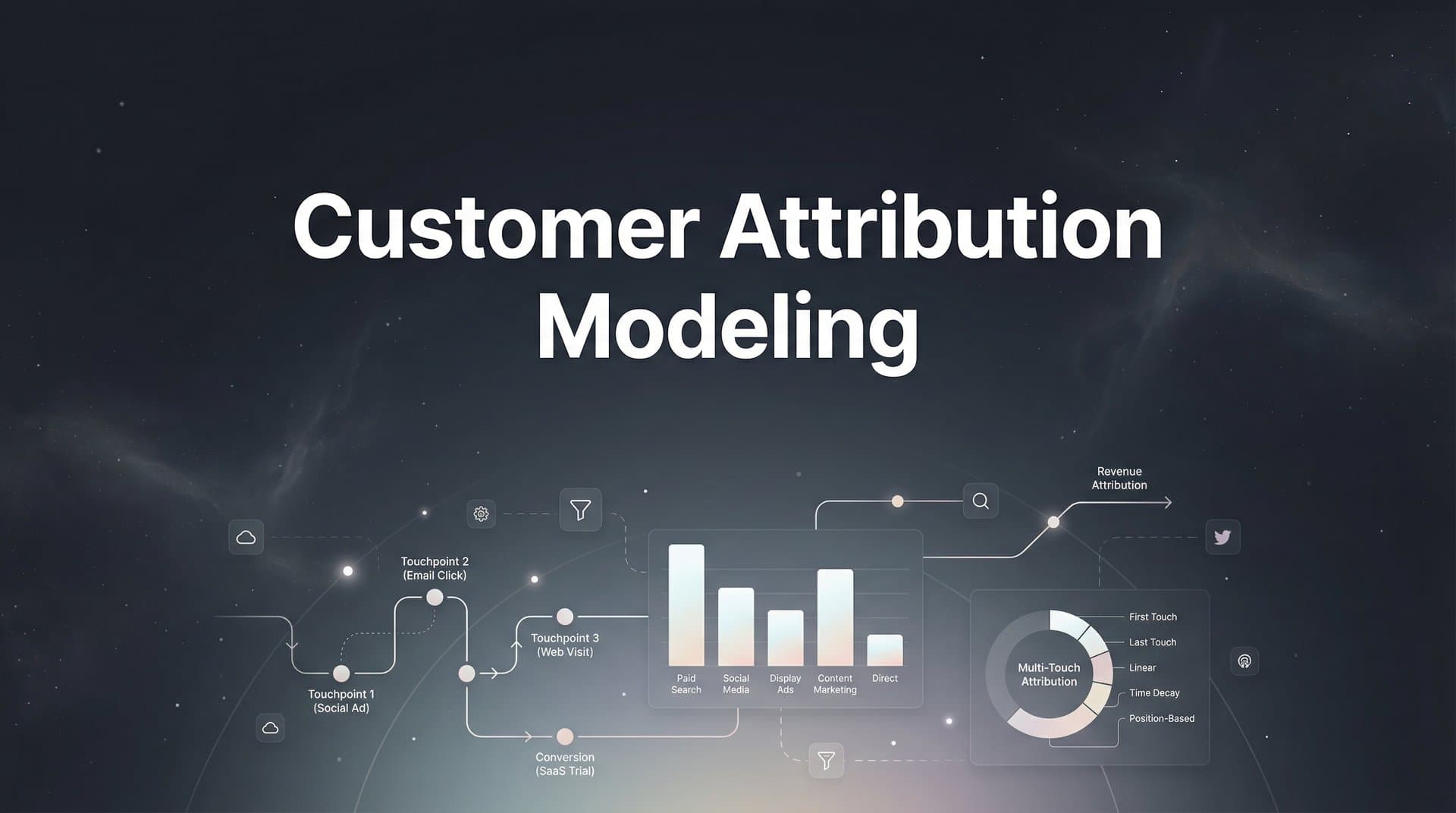
Touchpoints: These are every interaction a prospect has with your marketing before converting. A touchpoint might be clicking a Facebook ad, visiting your pricing page, opening an email, or attending a webinar. The average B2B buyer now interacts with numerous touchpoints before making a purchase decision, which is why customer attribution tracking matters.
Conversion Events: These are the actions you're trying to drive—whether that's a purchase, a demo request, a trial signup, or a qualified lead. Your attribution model needs to know what counts as success so it can work backwards to identify which touchpoints contributed.
Attribution Windows: This is the timeframe during which you'll give credit to touchpoints. If someone clicks your ad today but converts three weeks later, should that ad get credit? Your attribution window determines the answer. Set it too short and you'll miss important early-stage touches. Set it too long and you'll give credit to interactions that had nothing to do with the conversion.
Credit Distribution: This is the logic that determines how much credit each touchpoint receives. Did the first ad they saw deserve 100% of the credit? Should you split credit evenly across all touches? Or should recent interactions get more weight than older ones? This is where different attribution models come into play.
Here's what makes attribution modeling different from basic analytics tracking: Google Analytics can tell you that 500 people visited your site from Facebook last month. Attribution modeling tells you that 50 of those visitors went on to convert, but only after also interacting with your email campaign and clicking a retargeting ad. It's the difference between counting traffic and understanding actual influence.
Without attribution modeling, you're looking at each marketing channel in isolation. With it, you're seeing how they work together to move prospects through your funnel.
Single-Touch vs. Multi-Touch Models: Finding Your Fit
Not all attribution models are created equal, and choosing the wrong one for your business can lead to seriously misguided budget decisions. Let's break down the two major categories and when each makes sense.
Single-Touch Attribution: These models give 100% of the credit to one touchpoint—either the first or the last. They're simple, easy to understand, and completely inadequate for most modern marketing scenarios.
First-click attribution gives all credit to whatever brought the customer into your ecosystem initially. If someone clicked your Google ad six months ago, browsed your site, left, came back through five different channels, and finally converted after a retargeting campaign—first-click still gives 100% credit to that original Google ad. This model makes sense if you're primarily focused on awareness and top-of-funnel activities, or if your sales cycle is extremely short with minimal consideration time.
Last-click attribution does the opposite—it gives all credit to the final touchpoint before conversion. In the scenario above, the retargeting campaign gets 100% credit while the Google ad that started the relationship gets zero. This is the default model in many analytics platforms, which is why so many marketers over-invest in bottom-funnel tactics while their awareness channels slowly die from neglect.
The problem with single-touch models? They ignore reality. Modern customer journeys are messy, non-linear, and multi-channel. Giving all the credit to one interaction is like saying the only important player in football is whoever scores the touchdown—completely ignoring the offensive line, the quarterback, and everyone else who made it possible. For a deeper dive into this topic, explore single source attribution and multi touch attribution models.
Multi-Touch Attribution: These models recognize that multiple touchpoints contribute to a conversion and distribute credit accordingly. They're more complex but far more accurate for businesses with consideration-based purchases.
Linear attribution splits credit evenly across all touchpoints. If a customer had five interactions before converting, each gets 20% credit. This model is democratic but arguably too simplistic—it assumes every touchpoint has equal influence, which rarely reflects reality.
Time-decay attribution gives more credit to recent touchpoints while still acknowledging earlier ones. The logic here is that interactions closer to the conversion had more influence on the final decision. This works well for products with a defined consideration period where momentum builds over time.
Position-based attribution (also called U-shaped) gives the most credit to the first and last touchpoints—typically 40% each—while distributing the remaining 20% among middle touches. This model recognizes that awareness and conversion moments are critical while still acknowledging the nurture phase in between.
Data-driven attribution uses machine learning to analyze actual conversion patterns and assign credit based on what the data reveals about touchpoint influence. Instead of following predetermined rules, it learns from your specific customer journeys. If your data shows that webinar attendees convert at 10x the rate of people who skip the webinar, that touchpoint gets weighted accordingly. Learn more about algorithmic attribution modeling to understand how these systems work.
So which model should you choose? If you're running a simple, short-cycle business where customers typically convert on their first or second visit, single-touch might suffice. But if your customers research, compare, and consider before buying—which describes most B2B companies and many B2C businesses—you need multi-touch attribution modeling to understand what's really working.
The Tracking Crisis Facing Modern Marketers
Here's an uncomfortable truth: traditional tracking methods are breaking down, and if you're still relying solely on pixels and cookies, you're probably making decisions based on incomplete data.
The perfect storm of privacy changes has fundamentally altered how tracking works. iOS App Tracking Transparency now requires apps to ask permission before tracking users across apps and websites. Most users decline. Third-party cookies—the backbone of cross-site tracking for years—are being phased out by major browsers. Google has delayed the deprecation timeline multiple times, but the writing is on the wall.
What does this mean for attribution? A growing percentage of your customer journey is now invisible to traditional tracking methods. Someone might click your Facebook ad on their iPhone, research your product on their iPad, and convert on their laptop—and your attribution system sees these as three completely unrelated visitors rather than one customer journey. This is why cross device attribution tracking has become essential.
Then there's the platform reporting problem. Each ad platform wants to take credit for conversions, and they're not exactly conservative about it. Facebook's attribution window might overlap with Google's attribution window, meaning the same conversion gets claimed by both platforms. Add up all the conversions reported by your individual platforms, and you'll often see 150% or more of your actual conversion total. This isn't fraud—it's just platforms using different attribution logic and overlapping windows.
The result? Marketers are making budget decisions based on inflated, conflicting data. You think Facebook drove 200 conversions and Google drove 180, so you increase spend on both—but in reality, you only had 250 total conversions, and many customers touched both platforms. Understanding how to fix attribution discrepancies in data is crucial for accurate reporting.
This is where server-side tracking becomes critical. Instead of relying on browser pixels that can be blocked or cookies that expire, server-side tracking sends conversion data directly from your server to ad platforms and analytics tools. When a conversion happens, your server—not the user's browser—reports it. This bypasses many privacy restrictions because you're not tracking users across the web; you're simply reporting conversions that happened on your own property.
Server-side tracking also enables better data enrichment. You can connect marketing touches to CRM data, append customer lifetime value information, and send back richer conversion events that help ad platforms optimize more effectively. Instead of just telling Facebook "someone converted," you can tell them "someone converted and became a $10,000 annual customer"—which helps the algorithm find more high-value prospects.
The marketers who adapt to this new tracking reality will have a massive advantage over those who keep pretending pixel-based tracking still works perfectly.
Building Your Attribution System: A Step-by-Step Framework
Understanding attribution models is one thing. Actually implementing a system that tracks touchpoints accurately and delivers actionable insights? That's where most marketers get stuck. Let's break down the practical steps to build an attribution system that actually works.
Step 1: Establish Unified Tracking Across All Channels
Your attribution system is only as good as the data feeding it. This means implementing consistent tracking across every marketing channel—paid ads, organic search, email, social, content, partnerships, everything. Each channel needs to pass data in a standardized format so your attribution platform can connect the dots.
This starts with UTM parameters. Every external link—every ad, email, social post, or partner referral—should include UTM tags that identify the source, medium, and campaign. But here's the key: your UTM conventions need to be consistent. If your Facebook team uses "facebook" as the source while your paid search team uses "google-ads" but your SEO team uses "Google," your attribution data will be a mess.
Create a UTM naming convention document and make everyone follow it religiously. Define exactly how you'll name sources, mediums, campaigns, and content parameters. Then audit your existing campaigns to ensure compliance.
Step 2: Integrate Your CRM and Revenue Data
Marketing attribution without revenue data is just traffic attribution. You need to connect marketing touchpoints to actual dollars—which means integrating your attribution platform with your CRM and payment systems.
This integration enables you to track not just which channels drive conversions, but which channels drive valuable conversions. You might discover that LinkedIn drives fewer leads than Facebook but generates 3x the average deal size. Without CRM integration, you'd just see "Facebook is winning" and potentially over-invest in the wrong channel. Explore channel attribution in digital marketing revenue tracking for more insights.
Set up your integration to pass customer data both ways. Marketing touches should flow into your CRM so sales teams can see how leads discovered you. Revenue data should flow back to your attribution platform so you can analyze channel performance by actual return on ad spend, not just conversion counts.
Step 3: Map Your Customer Journey and Identify Key Touchpoints
Before you can attribute credit properly, you need to understand what a typical customer journey looks like for your business. Sit down with your sales and marketing teams and map out the common paths prospects take from awareness to purchase.
Identify the critical moments: What's the typical first touchpoint? Do prospects usually visit your pricing page before converting? Is there a key piece of content that consistently appears in winning journeys? Do demo requests correlate with higher close rates? Understanding marketing attribution valuing the customer journey helps you prioritize what matters most.
This mapping exercise helps you configure your attribution model intelligently. If you discover that prospects typically research for 30-45 days before converting, you'll know to set your attribution window to at least 60 days. If you find that webinar attendees convert at dramatically higher rates, you'll want to ensure webinar registrations are tracked as key touchpoints.
Step 4: Configure Attribution Windows Based on Your Sales Cycle
Your attribution window should reflect your actual sales cycle, not some arbitrary default. If you're selling enterprise software with a 90-day average sales cycle, a 7-day attribution window will miss most of the journey. If you're selling impulse-buy consumer products where people convert within hours, a 90-day window will give credit to irrelevant touchpoints.
Look at your historical conversion data to understand typical timeframes. Calculate the median time from first touch to conversion. Then set your attribution window to cover most customer journeys—typically somewhere between the median and the 75th percentile. You want to capture the full journey for most customers without extending so far that you're attributing credit to ancient, irrelevant interactions.
Different conversion events might warrant different windows. A newsletter signup might have a 7-day window while a demo request gets 60 days. Configure your attribution system to handle these nuances rather than applying one-size-fits-all logic.
From Data to Decisions: Making Attribution Actionable
You've implemented your attribution system. Data is flowing. Reports are generating. Now what? The real value of attribution modeling isn't in the dashboards—it's in the decisions you make because of them.
Identify Your True High-Performers
Start by comparing what attribution data reveals versus what you previously believed about channel performance. You'll often find surprises. That "underperforming" content marketing channel might actually be responsible for initiating 40% of your high-value customer journeys—it just wasn't getting credit in last-click attribution.
Look for channels that consistently appear in winning customer journeys, even if they're not the final touchpoint. These are your unsung heroes—the channels doing the heavy lifting of awareness and consideration while other channels swoop in for the conversion credit.
Analyze performance by attribution model. If a channel looks strong in first-click but weak in last-click, it's an awareness driver. If it's strong in last-click but weak in first-click, it's a conversion accelerator. The channels that show up strong across multiple models? Those are your true all-stars.
Reallocate Budget Based on True Contribution
This is where attribution modeling pays for itself. Armed with accurate data about which channels actually drive revenue, you can shift budget from over-credited channels to under-credited ones.
But do this gradually and test your hypotheses. If attribution data suggests you should increase spend on a channel that's been under-invested, don't immediately 10x the budget. Increase by 25-50%, monitor results, and iterate. Attribution models are powerful but not infallible—they're based on historical patterns that might not perfectly predict future performance at different scale levels.
Watch for diminishing returns as you scale. A channel that's incredibly efficient at $5,000/month might become less efficient at $20,000/month as you exhaust the highest-intent audiences and expand to broader targeting.
Feed Better Data Back to Ad Platforms
Here's a leverage point many marketers miss: modern ad platforms use machine learning to optimize campaigns, but they can only optimize based on the conversion data you feed them. If you're only sending basic "conversion happened" events, you're leaving performance on the table.
Use your attribution insights to send enriched conversion data back to platforms. When someone converts, don't just tell Facebook a conversion occurred—tell them it was a high-value conversion from a customer who's likely to spend $500 in their first 90 days. This helps the platform's algorithm learn to find more customers who match that high-value pattern.
This is particularly powerful with server-side tracking, which lets you append CRM data and customer lifetime value information to conversion events. The ad platform gets better data, its optimization improves, and your ROI increases—all because you're feeding the algorithm more context about what makes a valuable conversion.
Compare performance before and after implementing enriched conversion events. Many marketers see significant improvements in cost per acquisition and customer quality simply by giving ad platforms better data to learn from.
Avoiding the Attribution Traps That Sink Most Marketers
Even with a solid attribution system in place, there are common pitfalls that can lead you astray. Let's address the mistakes that trip up even sophisticated marketing teams.
The Single Model Trap
The biggest mistake? Picking one attribution model and treating it as absolute truth. Every attribution model makes assumptions and has blind spots. Last-click ignores the awareness journey. First-click ignores conversion optimization. Even data-driven models can miss important context.
Smart marketers compare results across multiple models. When you see a channel performing well in first-click, linear, and time-decay attribution, you can be confident it's genuinely contributing. When a channel only shows up in one model, dig deeper before making major budget decisions based on that signal alone. Review multi-touch attribution models for data to understand your options.
Think of attribution models like different camera angles on the same game. You need multiple perspectives to understand what's really happening.
Ignoring Offline and Dark Social Touchpoints
Not every touchpoint is trackable. Someone might see your billboard, hear about you from a friend, or read an article about your company in a trade publication—and none of that shows up in your attribution data. Then they Google your brand name and convert, and your attribution system gives 100% credit to that branded search ad.
Be humble about what your attribution system can't see. If you're running significant offline marketing, brand campaigns, or PR efforts, recognize that they're contributing to conversions even if they don't show up in your attribution reports. Look for proxy signals—spikes in branded search, direct traffic increases, or survey data about how customers heard about you. Understanding common attribution challenges in marketing analytics helps you navigate these blind spots.
Dark social—shares in private messaging apps, email forwards, text messages—is another major blind spot. These touchpoints look like direct traffic in your analytics but are actually social referrals. Don't over-penalize these channels in your attribution analysis just because they're harder to track.
Forgetting That Attribution Models Are Guides, Not Gospel
Attribution modeling is sophisticated, but it's not magic. It's a mathematical model trying to approximate a messy human decision-making process. Use attribution insights to inform your decisions, but don't let them override common sense or qualitative feedback.
If your attribution model says a channel isn't working but your sales team consistently reports that customers mention that channel as influential, investigate the discrepancy. Maybe there's a tracking gap. Maybe the channel influences decisions in ways that don't show up in clickstream data. Maybe your attribution window is too short for that channel's impact to register.
Combine attribution data with customer interviews, sales feedback, and market research. The best marketing decisions come from triangulating multiple data sources, not blindly following a single model's recommendations.
Moving From Attribution Confusion to Marketing Clarity
Customer attribution modeling isn't about achieving perfect precision in credit assignment—that's impossible in a world of complex, non-linear customer journeys. It's about moving from complete guesswork to informed decision-making. It's about understanding which channels genuinely contribute to revenue so you can invest more in what works and less in what doesn't.
The marketers winning in this environment aren't the ones with the most sophisticated attribution models. They're the ones who've built systems that capture accurate data, implemented tracking that works despite privacy changes, and developed the discipline to make budget decisions based on evidence rather than assumptions.
Start with the basics: unified tracking, consistent UTM conventions, and CRM integration. Choose an attribution model that matches your customer journey complexity. Then use the insights to gradually optimize your marketing mix, always testing your hypotheses and watching for real-world results that validate or challenge what the data suggests.
The goal isn't to know exactly which touchpoint deserves precisely 23.7% credit for a conversion. The goal is to know that your LinkedIn campaigns are initiating valuable customer relationships, that your retargeting is accelerating conversions, and that your email nurture sequences are worth the investment—even if they're not the final click.
With that clarity, you can scale your marketing with confidence instead of hope. You can defend budget increases with data instead of intuition. And you can finally answer the question that's been haunting marketers for decades: which half of your marketing budget is actually working?
Ready to elevate your marketing game with precision and confidence? Discover how Cometly's AI-driven recommendations can transform your ad strategy—Get your free demo today and start capturing every touchpoint to maximize your conversions.