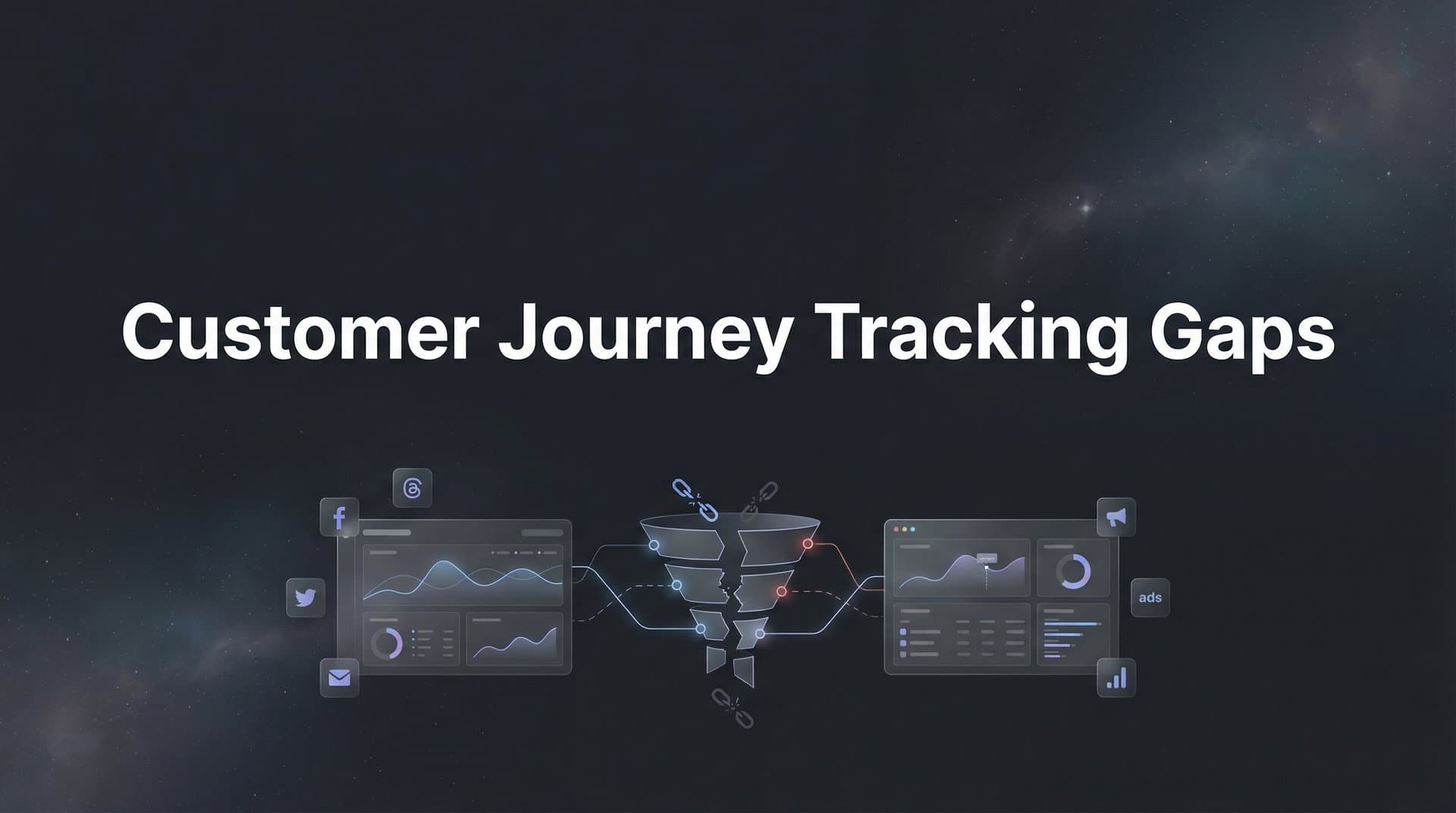
Every marketer knows the frustration: a customer converts, but you can't trace which touchpoints actually drove the sale. These customer journey tracking gaps aren't just annoying—they're costing you money. When you can't see the full path from first click to final purchase, you're essentially flying blind with your ad spend.
You might be pouring budget into channels that look good on paper but contribute nothing to revenue, while starving the touchpoints that actually convert. The problem has only intensified with iOS privacy changes, cookie deprecation, and customers bouncing between devices and platforms before buying.
This guide walks you through seven battle-tested strategies to identify and close these tracking gaps, giving you the complete picture you need to optimize campaigns with confidence. Each approach tackles a specific blind spot in your attribution infrastructure, building toward a complete view of how customers actually find and buy from you.
1. Audit Your Current Tracking Infrastructure
The Challenge It Solves
Most marketing teams operate with hidden blind spots they don't even know exist. You might think your tracking is comprehensive because pixels fire and events populate dashboards. But beneath that surface-level functionality, gaps lurk everywhere—missing UTM parameters, broken integrations, untracked referral sources, and channels that never connect to your CRM.
The danger isn't just incomplete data. It's making confident decisions based on incomplete data, believing you're seeing the full picture when you're actually looking at fragments.
The Strategy Explained
A systematic tracking audit maps every customer entry point, interaction, and conversion event across your entire marketing ecosystem. Think of it like an inspection of your home's foundation—you're looking for cracks before they become structural problems.
Start by documenting every channel where customers can discover you: paid ads, organic search, social media, email campaigns, referral partners, direct traffic. For each channel, trace the path from initial click through to conversion, checking whether data flows correctly at every step.
The goal isn't perfection—it's awareness. You need to know exactly where your visibility ends and your blind spots begin.
Implementation Steps
1. Create a comprehensive list of all traffic sources and marketing channels you currently use, including paid platforms, organic channels, email, partnerships, and offline touchpoints.
2. Test the tracking flow for each channel by simulating customer journeys—click through ads, fill out forms, complete purchases—while monitoring whether events fire correctly in your analytics platform and CRM.
3. Document every gap you discover: missing tracking parameters, platforms that don't connect to your analytics, conversion events that fire inconsistently, or customer actions that happen completely off your radar. Understanding fixing conversion tracking gaps requires this systematic documentation approach.
4. Prioritize gaps based on traffic volume and revenue impact—focus first on high-traffic channels with poor visibility rather than low-volume sources that track perfectly.
Pro Tips
Run your audit across multiple devices and browsers. A tracking setup that works flawlessly on desktop Chrome might fail completely on mobile Safari. Test both logged-in and logged-out states, since authentication can dramatically affect tracking behavior. Schedule quarterly audits—tracking infrastructure degrades over time as platforms update, integrations break, and new channels get added without proper setup.
2. Implement Server-Side Tracking
The Challenge It Solves
Browser-based tracking is dying, and it's taking your data accuracy with it. iOS users who opt out of tracking, browsers that block third-party cookies, and ad blockers that strip pixels all create massive holes in your customer journey data. When your tracking relies entirely on browser pixels and cookies, you're missing significant portions of your traffic—sometimes 30-40% or more.
The problem compounds when customers switch devices mid-journey. That prospect who clicked your Facebook ad on mobile, researched on tablet, and converted on desktop? Browser-based tracking sees three different people.
The Strategy Explained
Server-side tracking moves data collection from the user's browser to your server, bypassing privacy restrictions and browser limitations entirely. Instead of relying on pixels that can be blocked or cookies that expire, your server captures and sends event data directly to your analytics platforms and ad networks.
This approach doesn't just improve data accuracy—it fundamentally changes what you can track. Server-side tracking captures events that happen completely outside the browser: CRM updates, subscription renewals, support interactions, and backend conversions that browser pixels never see. If you're concerned about losing tracking data from cookies, server-side implementation is your solution.
Implementation Steps
1. Set up a server-side tracking container using Google Tag Manager Server-Side or a similar solution that sits between your website and your marketing platforms.
2. Configure your server to capture key conversion events—purchases, form submissions, sign-ups—and send them directly to ad platforms like Meta and Google without relying on browser pixels.
3. Implement user identification that persists across devices and sessions, using hashed email addresses or customer IDs to connect touchpoints that browser cookies would treat as separate users.
4. Test thoroughly by comparing server-side event data against your existing browser-based tracking to ensure accuracy before fully transitioning to the new infrastructure. A proper first-party data tracking setup is essential for this comparison.
Pro Tips
Don't abandon browser-based tracking entirely—run both in parallel for maximum coverage. Server-side tracking excels at capturing conversions accurately, while browser pixels still provide valuable behavioral data for users who allow tracking. Focus your server-side implementation on high-value conversion events first rather than trying to track every pageview and click immediately.
3. Unify Data Sources Into Single Customer View
The Challenge It Solves
Your customer data lives in silos: ad platforms report clicks and impressions, your website analytics tracks sessions and pageviews, your CRM contains lead information and deal stages, and your email platform monitors opens and clicks. Each system sees a fragment of the customer journey, but none of them talk to each other.
This fragmentation makes it impossible to understand the complete path from awareness to purchase. You can see that someone clicked an ad, but not whether they became a qualified lead. You know a deal closed, but can't trace it back to the original ad campaign.
The Strategy Explained
Data unification connects your disparate marketing systems into a single source of truth, building complete customer identity profiles that persist across platforms and touchpoints. Instead of seeing disconnected events, you see continuous journeys: this person clicked this ad, visited these pages, downloaded this resource, had this sales conversation, and ultimately purchased.
The foundation is customer identity resolution—using email addresses, phone numbers, and customer IDs to recognize the same person across different systems. Once you can identify individuals consistently, you can stitch together their complete journey regardless of where interactions happen. This is especially critical when you can't track customer journey across platforms using traditional methods.
Implementation Steps
1. Choose a central attribution platform that can ingest data from all your marketing sources—ad platforms, website analytics, CRM, email marketing, and any other customer touchpoint systems you use.
2. Connect each data source through native integrations or APIs, ensuring that customer identifiers (email, phone, customer ID) flow consistently across all systems for accurate identity matching.
3. Map conversion events across platforms so that a "purchase" in your CRM connects to the "add to cart" event in your website analytics and the "click" event in your ad platform.
4. Implement identity resolution rules that determine how to match customers across systems—when to merge profiles, how to handle conflicts, and which data sources take priority for specific attributes.
Pro Tips
Start with your highest-value conversion events and work backward. It's more valuable to perfectly track the journey for customers who actually buy than to have partial visibility across all traffic. Establish data governance rules early—decide how long to retain data, how to handle duplicate profiles, and who owns data quality. Clean CRM data dramatically improves unification accuracy, so invest time in deduplication and standardization before connecting systems.
4. Deploy Multi-Touch Attribution
The Challenge It Solves
Last-click attribution lies to you constantly. It credits 100% of conversion value to whatever touchpoint happened right before purchase, completely ignoring every interaction that built awareness, consideration, and intent along the way. That Facebook ad that introduced your brand to a cold prospect? Zero credit. The blog post that educated them about your solution? Invisible. The retargeting campaign that kept you top-of-mind? Doesn't exist in your reports.
This distorted view leads to catastrophically bad decisions. You cut channels that generate awareness because they don't show last-click conversions, while over-investing in bottom-funnel tactics that only work because earlier touchpoints did the heavy lifting.
The Strategy Explained
Multi-touch attribution distributes conversion credit across all the touchpoints that influenced a customer's journey, revealing which channels work together to drive results. Instead of asking "what got the last click?" you're answering "what combination of touchpoints led to this conversion?"
Different attribution models distribute credit differently. Linear attribution splits credit evenly across all touchpoints. Time-decay gives more weight to recent interactions. Position-based (U-shaped) emphasizes first and last touch while acknowledging middle interactions. Data-driven attribution uses machine learning to assign credit based on actual influence. Understanding marketing attribution valuing the customer journey helps you choose the right model for your business.
The model you choose matters less than simply moving beyond last-click. Even a basic multi-touch model reveals dramatically more about what's actually working.
Implementation Steps
1. Ensure you have complete journey tracking in place—multi-touch attribution only works if you can see all the touches, which requires the data unification and tracking infrastructure from previous strategies.
2. Choose an attribution model that matches your business complexity—start with linear or time-decay for simplicity, graduate to position-based as you understand your funnel better, and consider data-driven models once you have sufficient conversion volume.
3. Compare results across different attribution models to understand how credit shifts—channels that look weak in last-click often emerge as critical awareness drivers in multi-touch views.
4. Use multi-touch insights to rebalance budget allocation, investing more in upper-funnel channels that drive awareness and consideration even if they don't capture final clicks. The right customer journey attribution software makes this analysis straightforward.
Pro Tips
Don't abandon last-click entirely—use it alongside multi-touch to understand both direct response performance and full-journey contribution. Set different attribution windows for different channels: social media influence might fade after 7 days, while content marketing impact can persist for months. Review attribution model performance quarterly and adjust as your marketing mix evolves.
5. Bridge Online and Offline Touchpoints
The Challenge It Solves
Digital tracking tools are blind to everything that happens offline. That phone call from a prospect who saw your ad? Not tracked. The in-person demo that closed a six-figure deal? Invisible. The sales conversation that happened after someone filled out a form? Completely disconnected from the marketing touchpoints that generated the lead.
For B2B companies, high-ticket products, or any business with a meaningful sales process, these offline interactions represent the most critical parts of the customer journey. Ignoring them doesn't just create tracking gaps—it makes your entire attribution model useless for understanding what actually drives revenue.
The Strategy Explained
Bridging online and offline touchpoints means capturing every customer interaction regardless of where it happens, then connecting those offline events back to the digital marketing activities that initiated the journey. When someone calls your business, you need to know which ad campaign prompted that call. When a salesperson closes a deal, you need to trace it back to the original traffic source.
This requires tight integration between your marketing platforms and your CRM, with clear processes for logging offline interactions and maintaining customer identity across the digital-to-human handoff. The goal is creating a continuous thread from first digital touch through offline conversations to final purchase.
Implementation Steps
1. Implement call tracking that captures phone conversations and attributes them to specific marketing campaigns using dynamic number insertion or unique tracking numbers for each channel. Our guide on marketing attribution for phone calls covers this in detail.
2. Create CRM workflows that capture every offline interaction—sales calls, demos, in-person meetings, support conversations—and associate them with the correct customer record and original traffic source.
3. Train your sales team to log activities consistently in your CRM, emphasizing that this data directly informs marketing decisions and budget allocation that generates their leads.
4. Build reports that combine online and offline touchpoints into unified customer journeys, showing the complete path from initial ad click through sales conversations to closed revenue.
Pro Tips
Use UTM parameters and hidden form fields to capture campaign data when prospects submit forms, then pass that information to your CRM so offline activity stays connected to its source. For phone calls, consider conversation intelligence tools that not only track calls but analyze content to understand which marketing messages resonate in actual sales conversations. Create feedback loops where sales insights inform marketing strategy—if certain campaigns generate leads that close at higher rates, that's attribution gold.
6. Feed Enriched Data Back to Ad Platforms
The Challenge It Solves
Ad platform algorithms—Meta's Advantage+, Google's Smart Bidding, LinkedIn's automated targeting—are only as good as the data you feed them. When they optimize based on incomplete conversion data, they make bad decisions at scale. They might optimize for clicks that never convert, target audiences that generate low-quality leads, or bid aggressively on placements that drive vanity metrics instead of revenue.
The problem intensifies with privacy restrictions. As browser-based tracking deteriorates, ad platforms receive less signal about what's actually working, making their optimization increasingly blind. You end up with algorithms confidently optimizing toward the wrong outcomes.
The Strategy Explained
Conversion API implementation sends enriched, accurate conversion data directly from your server to ad platforms, giving their algorithms complete visibility into what happens after someone clicks your ad. Instead of relying on browser pixels that miss conversions, you're feeding platforms comprehensive data about purchases, qualified leads, high-value actions, and even offline conversions that happen days or weeks later.
This isn't just about tracking—it's about improving ad performance. When platforms know which clicks led to actual revenue, they optimize toward better audiences, placements, and creative variations. Your campaigns get smarter because the AI driving them has better information.
Implementation Steps
1. Set up Conversion APIs for your primary ad platforms—Meta Conversions API, Google Ads Enhanced Conversions, TikTok Events API—using server-side tracking to send conversion data directly from your server.
2. Send enriched conversion events that include customer value data—not just "purchase occurred" but "purchase of $500 from a customer with 85% likelihood to renew based on CRM data."
3. Include offline conversions in your API feeds so ad platforms can optimize toward outcomes that happen outside the browser, like phone sales, in-person purchases, or deals that close weeks after initial contact.
4. Monitor platform optimization behavior after implementing Conversion APIs—you should see improved ROAS, better audience targeting, and more efficient budget allocation as algorithms learn from complete data. Explore how ad tracking tools can help you scale ads using this accurate data.
Pro Tips
Send conversion events as quickly as possible—real-time data helps algorithms optimize faster than batch uploads that happen hours or days later. Include event deduplication to prevent double-counting when both browser pixels and Conversion APIs fire for the same conversion. Test different conversion event definitions to find what drives best optimization—sometimes platforms perform better optimizing toward qualified leads rather than all form submissions.
7. Establish Continuous Monitoring
The Challenge It Solves
Tracking infrastructure doesn't stay fixed—it degrades constantly. Platforms update their APIs and break integrations. Developers push code changes that disable tracking tags. Marketing teams launch new campaigns without proper UTM parameters. Privacy regulations shift and create new blind spots. A tracking setup that works perfectly today can be completely broken three months from now, and you might not notice until you've already made bad decisions based on incomplete data.
The insidious part is that partial tracking looks normal in your dashboards. Events still fire, numbers still populate reports, and everything appears functional even as significant gaps emerge.
The Strategy Explained
Continuous monitoring means implementing automated systems that constantly check your tracking health, alert you to anomalies, and catch issues before they corrupt your decision-making. Instead of discovering problems during quarterly audits, you identify and fix them within hours or days of occurrence.
This requires establishing baseline metrics for normal tracking behavior, then setting up alerts that trigger when data deviates significantly. You're not just monitoring whether events fire—you're watching for patterns that indicate hidden problems, like sudden drops in specific traffic sources, conversion rate anomalies, or discrepancies between different tracking systems.
Implementation Steps
1. Define key tracking health metrics that indicate normal operation—conversion rates by channel, event volume by source, data match rates between platforms, and time delays between events and reporting.
2. Set up automated alerts that trigger when metrics fall outside normal ranges—a 20% drop in tracked conversions, significant discrepancies between platform-reported clicks and analytics sessions, or sudden changes in attribution patterns.
3. Create a weekly tracking health dashboard that shows data quality metrics across all your systems, making it easy to spot degradation trends before they become critical problems. The right customer journey tracking software includes these monitoring capabilities.
4. Establish a response protocol for different alert types—who investigates, what troubleshooting steps to follow, and how quickly different issues need resolution based on their impact on decision-making.
Pro Tips
Monitor discrepancies between systems rather than absolute numbers—if your ad platform reports 100 conversions but your CRM only shows 70, that 30% gap indicates a tracking problem even if both systems are technically functioning. Set different alert thresholds for different channels based on their normal variability—high-volume channels need tighter monitoring than experimental campaigns with naturally volatile metrics. Schedule monthly review sessions where your team examines tracking health trends and proactively addresses emerging issues before they escalate.
Putting It All Together
Closing customer journey tracking gaps isn't a one-time project—it's an ongoing commitment to data accuracy that directly impacts your ability to scale profitably. The strategies in this guide build on each other, creating a comprehensive approach to complete visibility.
Start with the audit to understand where you're losing visibility right now. Those findings will guide your priorities for everything else. Next, implement server-side tracking and data unification as your foundation—these two strategies solve the majority of technical tracking limitations and data fragmentation issues.
From there, multi-touch attribution reveals the full path customers take, showing you which channel combinations actually drive conversions. CRM integration captures what happens offline, bridging the gap between digital marketing and human sales conversations. Feeding enriched data back to ad platforms turns your improved tracking into better campaign performance, as algorithms optimize based on complete information rather than fragments.
Finally, continuous monitoring ensures your tracking infrastructure stays healthy as platforms evolve, campaigns launch, and your marketing ecosystem grows more complex. This isn't paranoia—it's recognition that tracking degrades constantly without active maintenance.
Marketers who close these gaps don't just see more data—they make fundamentally different decisions. They allocate budget with confidence because they know what's working. They scale campaigns that actually drive revenue instead of vanity metrics. They spot opportunities and problems faster because their visibility is complete rather than partial.
The competitive advantage isn't having tracking—it's having accurate tracking that shows the complete customer journey from first touch to final purchase and beyond. That visibility transforms how you think about marketing performance, channel contribution, and growth strategy.
Ready to elevate your marketing game with precision and confidence? Discover how Cometly's AI-driven recommendations can transform your ad strategy—Get your free demo today and start capturing every touchpoint to maximize your conversions.