

Your marketing team just wrapped a campaign that drove 500 new customers. The dashboard shows your latest Facebook ad was the hero, generating 60% of conversions. You celebrate, double down on that channel, and cut budget from earlier-stage content. Three months later, revenue hasn't scaled as expected. What went wrong?
The answer lies in what you couldn't see. Those Facebook conversions didn't happen in isolation. Many of those customers discovered you through a podcast mention, researched you via organic search, compared you against competitors on review sites, and engaged with your email sequence before finally clicking that Facebook ad. Your tracking only caught the final click.
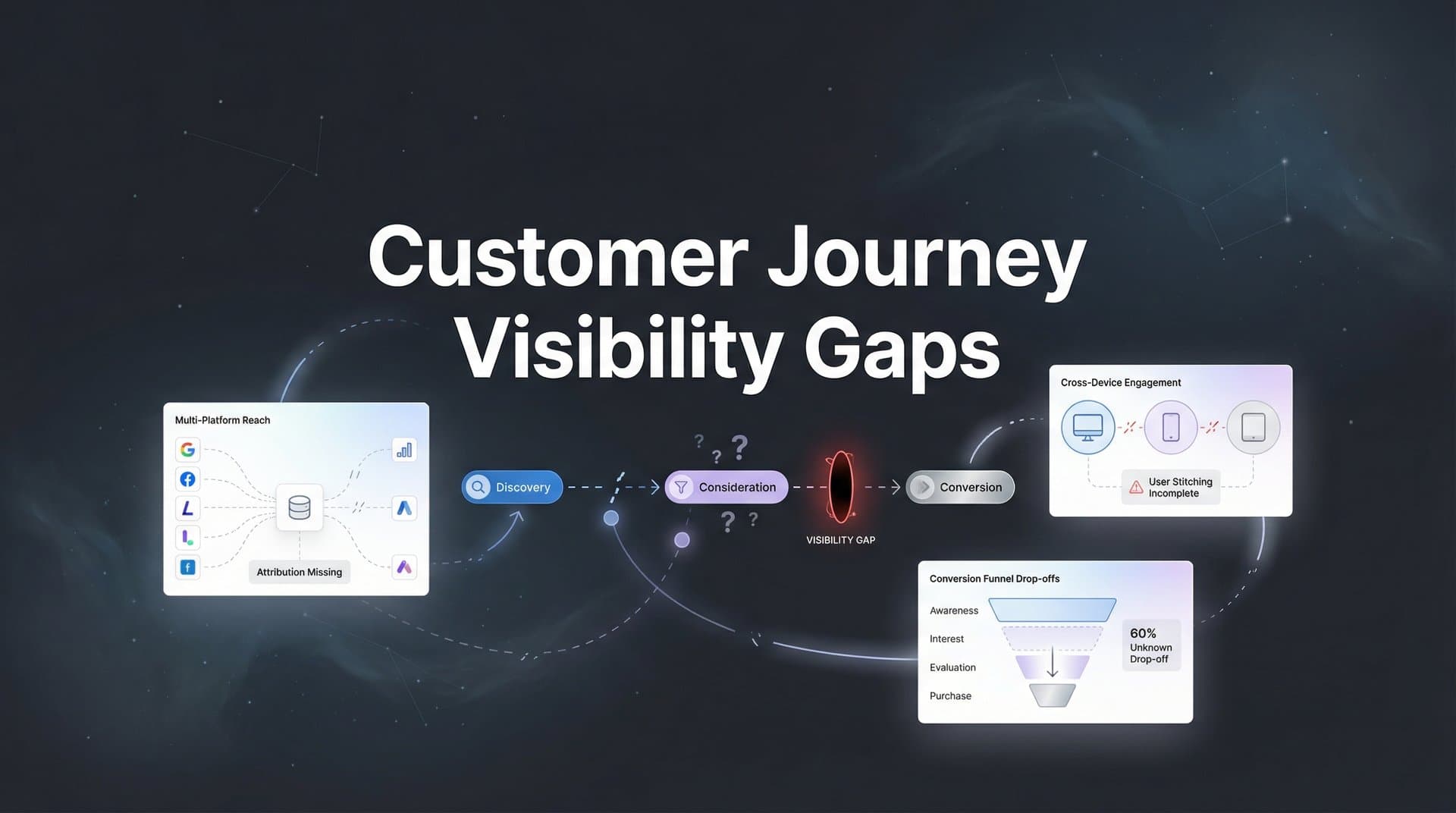
These are customer journey visibility gaps, and they're quietly sabotaging marketing decisions at companies of every size. They represent the missing pieces in your attribution puzzle: the touchpoints, interactions, and influences that shape buying decisions but never show up in your analytics. When you can't see the complete journey, you can't make informed decisions about where to invest, what to optimize, or how to scale.
The stakes are higher than most marketers realize. Visibility gaps lead to misallocated budgets, inflated acquisition costs, and strategic decisions based on incomplete data. You might be starving the channels that actually build your pipeline while overfeeding the ones that simply capture existing demand.
This article breaks down what customer journey visibility gaps really are, why they happen more often than you think, and most importantly, how to close them with practical solutions that work in today's privacy-focused landscape.
The Hidden Blind Spots in Your Marketing Data
Customer journey visibility gaps are the missing or incomplete data points between a prospect's first interaction with your brand and their final conversion. Think of them as the chapters torn out of a book. You see the beginning and the end, but the crucial middle that explains how the story unfolds is simply gone.
Here's what makes this challenging: modern customer journeys are messy. A B2B buyer might discover your brand through a LinkedIn post on their phone during their morning commute. Later that day, they Google your company name on their work laptop and read three blog posts. Two weeks pass. They see a retargeting ad, ignore it, but then attend your webinar after a colleague forwards the invitation. They download your comparison guide, engage with a nurture email sequence, and finally request a demo after reading a case study on their tablet.
That's eight touchpoints across three devices, multiple channels, and several weeks. Traditional tracking methods capture maybe three of them. Understanding customer journey touchpoints is essential for identifying where your data collection fails.
The gap between what marketers think they see and reality is staggering. Your analytics dashboard might show that 40% of conversions came from organic search, 30% from paid ads, and 30% from email. Clean, simple, actionable. Except it's not accurate. What you're actually seeing is the last touchpoint before conversion, not the complete journey that led there.
Most attribution systems default to showing you the easiest data to collect: the final click, the last session, the most recent interaction. This creates a dangerous illusion of clarity. You believe you understand what's working when you're actually looking at a heavily edited version of reality.
The fragmentation happens naturally. Every time a prospect switches devices, your tracking often starts fresh. When they clear cookies, use incognito mode, or interact with your brand through a channel you're not monitoring, you lose the thread. Privacy features actively prevent you from connecting these dots. Your CRM knows about their demo request, your email platform knows they opened six emails, and your ad platform knows they clicked three ads, but none of these systems talk to each other.
This isn't just a technical problem. It's a strategic blindness that affects every marketing decision you make. When you can't see the full customer journey, you can't accurately measure what's working, understand true customer acquisition costs, or confidently allocate budget to the channels that actually drive results.
Why Your Tracking Falls Short: Common Causes of Data Gaps
The reasons your tracking breaks down are more numerous and complex than most marketers realize. Let's start with the most common culprit: cross-device tracking limitations.
Picture this scenario: a prospect discovers your brand through a mobile ad while scrolling Instagram on their phone. They're interested but not ready to convert on a small screen. Three days later, they remember your name, search for it on their work laptop, and complete a purchase. Your analytics sees two completely separate users. The mobile session and desktop session never connect, so the Instagram ad gets zero credit for initiating that journey.
This happens constantly. Research shows that users regularly switch between an average of three devices throughout their buying journey. Without a way to connect these sessions to the same person, each device interaction looks like a new, unrelated visitor. Solving customer journey tracking across devices is one of the most critical challenges marketers face today.
Then there are the privacy changes that have fundamentally altered the tracking landscape. Apple's iOS updates introduced App Tracking Transparency, requiring apps to explicitly ask permission before tracking user activity across other apps and websites. Most users decline. Safari's Intelligent Tracking Prevention limits cookie lifespans and blocks third-party cookies entirely. Firefox and Brave browsers have implemented similar restrictions.
The result? A growing percentage of your audience is essentially invisible to traditional tracking methods. When someone using Safari with default privacy settings visits your site, your ability to track their journey across sessions is severely limited. If they interact with your brand through an iOS app, you might not see that interaction at all unless they explicitly opt in to tracking.
Cookie consent requirements add another layer of complexity. GDPR and similar regulations require explicit consent before placing tracking cookies. Many visitors either decline consent or leave your site before the consent banner even loads fully. For those users, you're flying completely blind from the first interaction.
Beyond technical limitations, organizational silos create some of the most persistent visibility gaps. Your marketing team uses one analytics platform, sales uses a CRM, customer success uses a different tool, and each ad platform has its own reporting dashboard. These systems rarely communicate effectively.
Your CRM knows that a lead came from a trade show and had three sales calls before closing. Your email platform knows they engaged with your nurture sequence. Your advertising dashboard shows they clicked two retargeting ads. But none of these systems share data with each other, so nobody in your organization can see the complete picture. Marketing claims credit for the conversion based on the last ad click. Sales claims credit because they closed the deal. The trade show team claims credit because that's where the lead originated. Everyone is partially right and completely wrong.
This fragmentation extends to how different channels are measured. Offline interactions like trade shows, direct mail, or phone calls are particularly difficult to connect to digital touchpoints. A prospect might attend your conference booth, later visit your website, and eventually convert. But unless you have sophisticated tracking in place, that conference interaction becomes invisible in your attribution model. These customer journey tracking challenges require systematic solutions rather than quick fixes.
Even within digital channels, gaps emerge. Social media engagement, podcast listens, YouTube views, and community forum interactions all influence buying decisions but rarely show up in standard attribution reports. Your prospect might spend hours researching your brand through these channels before ever visiting your website, but that entire research phase remains hidden from your analytics.
The Real Cost of Flying Blind on Attribution
When you can't see the complete customer journey, you don't just lose visibility. You lose money, efficiency, and competitive advantage. The consequences of attribution blind spots compound over time, creating a cycle of increasingly poor marketing decisions.
Start with the most direct impact: misallocated budgets. When your attribution data is incomplete, you inevitably over-invest in channels that appear to drive conversions while starving the channels that actually build your pipeline. This happens because last-click attribution naturally favors bottom-funnel activities.
Consider a typical scenario. Your content marketing team creates in-depth guides, comparison articles, and educational resources that introduce prospects to your solution category. These pieces drive significant traffic and engagement. Meanwhile, your paid search campaigns target high-intent keywords and capture people actively looking for solutions like yours. In a last-click attribution model, paid search gets credit for nearly every conversion it touches, while content marketing shows minimal direct conversions.
The logical response seems clear: increase paid search budget, reduce content investment. But this decision is based on incomplete data. Many of those paid search conversions were people who first discovered and educated themselves through your content, then later searched for your brand name or solution category. Content built the demand that paid search captured. By cutting content budget, you're actually undermining the channel that feeds your conversion funnel. These customer journey attribution problems lead to systematically flawed budget decisions.
This misattribution creates a false sense of channel performance. Bottom-funnel tactics look like heroes while top and mid-funnel activities appear to underperform. Over time, this leads to an increasingly narrow marketing strategy focused solely on capturing existing demand rather than building new awareness and consideration.
The problem extends to how you calculate customer acquisition costs. If you're only seeing the final touchpoint, your CAC calculations are fundamentally wrong. You might think you're acquiring customers for $200 each through Facebook ads, but when you account for all the invisible touchpoints that contributed to those conversions, the true CAC might be $400 or higher.
This matters enormously for unit economics and growth planning. If you believe your CAC is $200 and your customer lifetime value is $800, you have what looks like a healthy 4:1 LTV:CAC ratio. You confidently scale spending. But if your real CAC is $400, that ratio drops to 2:1, which is barely sustainable. You scale based on misleading data and wonder why profitability doesn't materialize as expected.
Visibility gaps also prevent you from understanding which marketing activities actually influence high-value customers versus low-value ones. Without complete journey data, you can't identify the patterns that predict customer quality. Maybe customers who engage with your educational webinars have 3x higher lifetime value than those who convert directly from ads, but you'll never discover this insight if you can't track webinar attendance through to conversion and beyond.
The strategic implications ripple outward. When leadership asks which marketing investments are working, you provide answers based on incomplete data. Budget decisions, hiring plans, and strategic priorities all flow from this flawed foundation. You might shut down promising initiatives because they don't show direct conversions, or double down on tactics that are actually just harvesting demand created elsewhere.
Perhaps most frustrating is the opportunity cost. While you're optimizing based on partial data, competitors who have solved their visibility gaps are making smarter decisions. They know which channels actually drive results, how different touchpoints work together, and where to invest for maximum impact. They're playing chess while you're playing checkers, and the gap widens over time.
Server-Side Tracking: Bypassing Browser Limitations
The solution to many tracking limitations doesn't live in the browser at all. It lives on the server. Server-side tracking represents a fundamental shift in how marketing data gets collected, and it solves problems that browser-based tracking simply cannot.
Here's how it works. Traditional client-side tracking relies on JavaScript code that runs in a visitor's browser. When someone lands on your site, that code fires, attempts to set cookies, and sends data to your analytics platform. This approach is vulnerable to everything we've discussed: ad blockers, privacy browser settings, cookie restrictions, and consent requirements. The browser controls what data you can collect.
Server-side tracking flips this model. Instead of collecting data in the browser, your server captures interactions directly. When someone visits your site, their browser communicates with your server to load the page. At that moment, your server can record the visit, track the source, and log the interaction without relying on browser cookies or JavaScript that can be blocked.
Think of it like the difference between asking someone to write down their own information versus recording it yourself. Client-side tracking asks the browser to collect and report data, which means the browser can refuse or limit what gets shared. Server-side tracking observes the interaction directly from your server's perspective, which browsers cannot block.
The benefits are substantial. Ad blockers become largely irrelevant because they block client-side scripts, not server-level data collection. Privacy browser features that limit cookie lifespans or block third-party tracking don't affect server-side data collection in the same way. iOS tracking prevention, which has devastated many marketers' ability to track mobile users, has minimal impact on properly implemented server-side solutions. Implementing robust customer journey tracking software with server-side capabilities is now essential for accurate attribution.
This approach captures touchpoints that client-side tracking misses entirely. When a user has aggressive privacy settings enabled, traditional tracking might see only a fraction of their journey. Server-side tracking sees the full picture: every page view, every session, every interaction with your site, regardless of browser settings.
Server-side tracking also improves data accuracy and reliability. Client-side tracking depends on JavaScript executing properly in sometimes unpredictable browser environments. Slow connections, browser extensions, and compatibility issues can all cause tracking failures. Server-side tracking operates in a controlled environment where you can ensure data collection happens consistently.
There's another critical advantage: server-side tracking enables you to enrich data before sending it to ad platforms and analytics tools. You can combine server-side interaction data with information from your CRM, email platform, and other systems, then send a complete, enriched event to platforms like Meta or Google Ads. This gives their algorithms better signals to work with, improving targeting and optimization.
For example, when someone converts on your site, server-side tracking can immediately check your CRM to see if they're a high-value lead based on company size, industry, or other qualifying factors. You can then send Meta not just a generic conversion event, but a qualified conversion event with additional context. Meta's algorithm learns to optimize for these higher-quality conversions rather than treating all conversions equally.
Implementation does require technical setup. You need server infrastructure capable of handling tracking requests, code to capture and process events, and integration with your existing marketing tools. But the payoff is substantial: more complete data, better attribution accuracy, and improved ad platform performance.
Connecting the Dots with Multi-Touch Attribution
Seeing all the touchpoints is only half the solution. You also need a way to understand how they work together to drive conversions. This is where multi-touch attribution transforms your marketing intelligence.
Multi-touch attribution models assign credit across all the touchpoints in a customer journey rather than giving 100% credit to a single interaction. Instead of declaring that Facebook or organic search or email "drove" a conversion, these models recognize that multiple channels contributed and distribute credit accordingly. Learning customer journey attribution fundamentals helps you select the right model for your business.
The simplest multi-touch approach is linear attribution, which gives equal credit to every touchpoint. If someone had five interactions before converting, each gets 20% credit. This is more accurate than last-click attribution, but it treats all touchpoints as equally important, which isn't realistic.
More sophisticated models include time-decay attribution, which gives more credit to touchpoints closer to conversion, and position-based attribution, which emphasizes both the first interaction that created awareness and the last interaction that drove conversion while giving less credit to middle touchpoints.
The real power emerges when you can compare different attribution models side by side. You might discover that a channel looks mediocre in last-click attribution but proves highly valuable in first-click attribution, revealing its role in generating new awareness. Or you might find that a channel you thought was driving conversions is actually just capturing demand created elsewhere.
Multi-touch attribution requires integrating data from multiple sources into a unified view. Your ad platforms need to talk to your website analytics, which needs to connect to your CRM, which should link to your email platform. When these systems share data, you can track a prospect from their first anonymous website visit through multiple marketing touchpoints to sales conversations and eventually to closed revenue.
This integration is where many attribution efforts break down. Each platform has its own user identification system, its own way of tracking conversions, and its own reporting format. Creating a unified view requires either sophisticated data infrastructure or a customer journey attribution software specifically designed to connect these disparate systems.
The payoff is worth the effort. With complete multi-touch attribution, you can answer questions that were previously impossible: Which channels are best at generating new awareness? Which touchpoints are most effective at moving prospects from consideration to decision? How many touchpoints does the average customer need before converting? Do high-value customers follow different journeys than low-value ones?
These insights transform how you allocate budget and optimize campaigns. Instead of simply increasing spend on whatever shows the most last-click conversions, you can strategically invest across the entire funnel based on each channel's actual contribution to the customer journey.
Multi-touch attribution also enables you to feed better data back to ad platforms. When you understand which conversions came from customers with complete, high-quality journeys versus those who converted impulsively with minimal research, you can send different signals back to Meta, Google, and other platforms. This helps their algorithms optimize for the conversions you actually want, not just any conversion.
Modern attribution platforms use AI to analyze these complex journeys and surface patterns you might miss manually. AI can identify which combinations of touchpoints are most likely to lead to conversion, which sequences work best for different customer segments, and where gaps or drop-offs occur in typical journeys. These insights become recommendations for optimization: which channels to scale, which touchpoints to add, and which parts of the journey need improvement.
Building a Complete View of Every Customer Journey
Closing visibility gaps isn't a single fix. It's a systematic approach to how you collect, connect, and analyze marketing data. Here's how to build a complete view of your customer journeys.
Start with an honest audit of your current tracking setup. Map out all the tools you use: analytics platforms, ad accounts, CRM, email software, marketing automation, and any other systems that touch customer data. For each one, document what data it collects, how it identifies users, and whether it shares data with other systems. This audit usually reveals surprising gaps. You'll discover touchpoints you're not tracking at all, systems that don't communicate, and data that lives in isolated silos.
Next, identify where your data breaks occur. Walk through typical customer journeys and note where tracking fails. Does it break when users switch devices? Do you lose visibility when they move from anonymous browsing to known lead? Are offline interactions like phone calls or events completely disconnected from digital touchpoints? Create a list of specific gaps you need to close. A comprehensive customer journey mapping guide can help you visualize these break points systematically.
Implementing server-side tracking should be a priority for most organizations. This requires technical resources but solves multiple problems simultaneously. Work with your development team or a marketing operations specialist to set up server-side data collection that captures interactions regardless of browser restrictions. Ensure this server-side data flows into your attribution system and can be enriched with information from your CRM and other sources.
Focus on creating a unified customer identifier across systems. This is often the hardest technical challenge but the most important. You need a way to recognize that the anonymous visitor from last week, the email subscriber from your newsletter, and the demo request in your CRM are all the same person. Solutions include customer data platforms, identity resolution services, or custom integration work depending on your technical sophistication and budget.
Integrate your ad platforms, CRM, and analytics into a connected system. This might mean using native integrations where available, building custom connections via APIs, or adopting a marketing attribution platform designed to unify these data sources. The goal is creating a single source of truth where every touchpoint, from first website visit to closed deal, lives in one place. A dedicated customer journey analytics platform can serve as this central hub for all your attribution data.
Once you have complete data flowing in, implement multi-touch attribution models that reflect your actual business. Don't just default to whatever model your analytics platform offers. Think about your sales cycle, typical journey length, and which touchpoints actually matter for your business. Test different attribution models and compare results to develop a nuanced understanding of channel performance.
Use AI to analyze the complete journey data you're now collecting. Modern AI can process thousands of customer journeys, identify patterns, and surface insights that would take humans months to discover manually. Look for AI-powered attribution platforms that provide specific recommendations: which channels to scale, which audience segments to prioritize, and which parts of the journey need optimization.
Create a feedback loop where better attribution data improves your marketing execution. When you identify which touchpoints actually drive high-value conversions, use that information to optimize your campaigns. Send enriched conversion data back to ad platforms so their algorithms can learn what good looks like. Adjust budget allocation based on true multi-touch contribution rather than last-click data. Brief your content team on which topics and formats appear in successful customer journeys.
This isn't a set-it-and-forget-it process. Customer behavior evolves, new channels emerge, and privacy regulations continue changing the landscape. Schedule regular reviews of your attribution data quality. Check for new gaps that have appeared, validate that integrations are still working properly, and update your approach as needed.
Turning Data Into Confident Decisions
Customer journey visibility gaps are not an inevitable cost of doing modern marketing. They're a solvable challenge that comes down to implementing the right combination of tracking technology, data integration, and attribution modeling.
The solutions are clear. Server-side tracking bypasses browser limitations to capture touchpoints that traditional methods miss entirely. Multi-touch attribution models credit all the interactions that influence conversions rather than oversimplifying complex journeys into single-click attribution. Unified data systems connect your ad platforms, CRM, website analytics, and every other tool into a complete view of each customer's path to purchase.
When you close these gaps, marketing transforms from educated guesswork into confident, data-driven decision making. You know which channels actually drive results, not just which ones get credit in flawed attribution models. You can calculate true customer acquisition costs, optimize budget allocation based on real performance, and identify the patterns that predict high-value customers.
The competitive advantage is substantial. While others optimize based on partial data, you're making decisions with complete information. You're feeding better signals to ad platform algorithms, which improves their targeting and optimization. You're investing in the touchpoints that actually build your pipeline rather than just the ones that capture existing demand.
Most importantly, you're building a foundation for sustainable growth. Every marketing dollar gets allocated based on its true contribution to revenue. Every optimization decision is informed by complete journey data. Every strategic discussion starts from a shared understanding of what actually works.
The path forward is implementation. Audit your current setup, identify your specific gaps, and systematically close them with server-side tracking, proper integration, and multi-touch attribution. The marketing landscape will continue evolving, privacy restrictions will likely tighten further, and customer journeys will grow more complex. But with the right attribution foundation, you'll have the visibility needed to navigate whatever comes next.
Ready to elevate your marketing game with precision and confidence? Discover how Cometly's AI-driven recommendations can transform your ad strategy. Get your free demo today and start capturing every touchpoint to maximize your conversions.


