

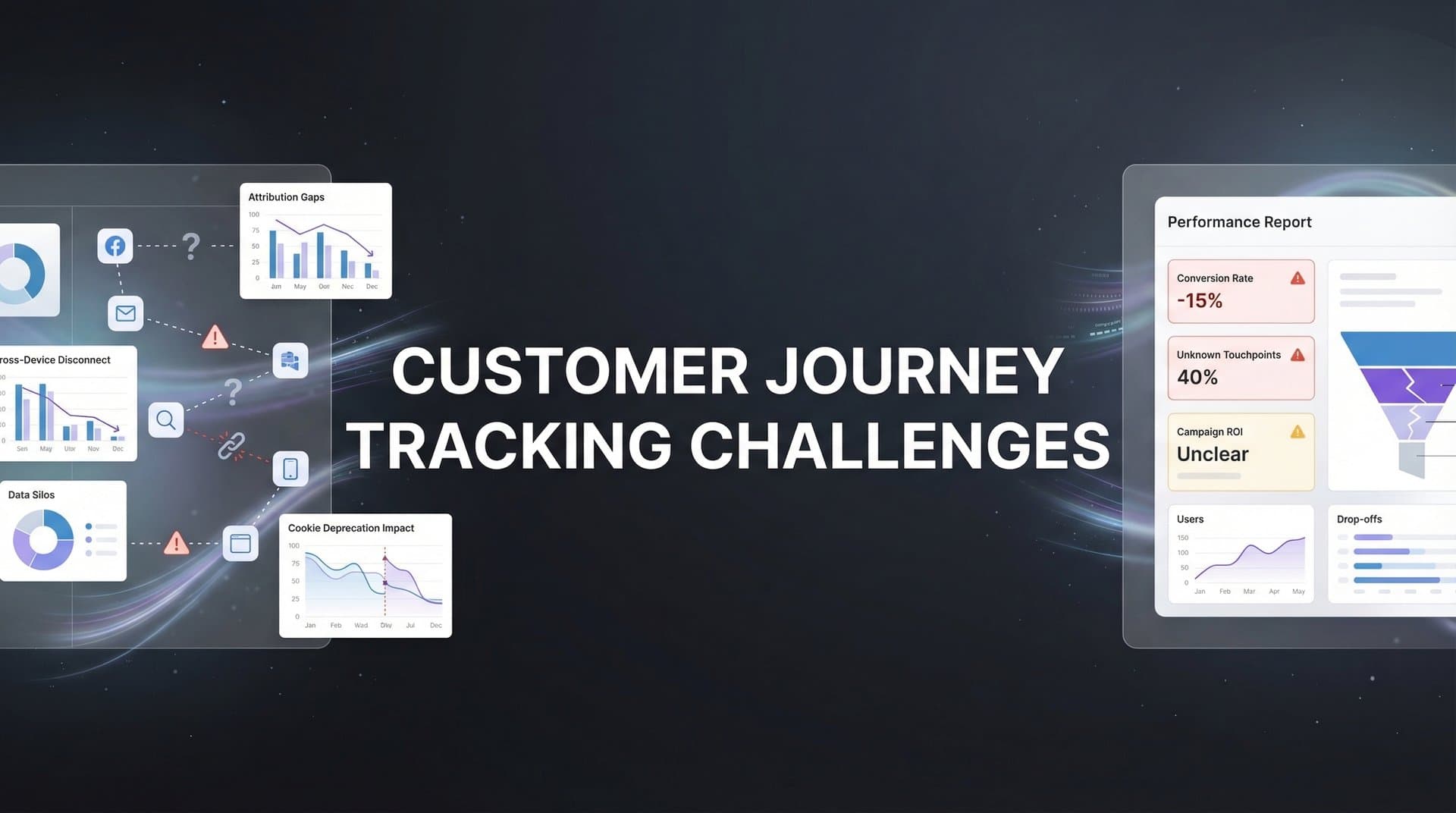
Your marketing dashboard shows 500 conversions this month. Google Ads claims 320 of them. Meta says it drove 280. TikTok reports 150. You do the math—that's 750 conversions from three platforms that somehow produced 500 actual sales. Your CFO wants to know which channels are actually working, and you're staring at numbers that don't add up.
This isn't a data glitch. It's the reality of modern customer journey tracking.
Today's buyers don't follow neat, linear paths from ad click to purchase. They discover your brand on TikTok during their morning scroll, research on Google during lunch, compare options on their laptop that evening, and convert three days later through a Meta retargeting ad on their tablet. Each platform sees a fragment of this journey and claims full credit for the conversion.
The tracking systems most marketers rely on were built for a simpler era—when customers stayed on one device, third-party cookies worked reliably, and privacy regulations didn't exist. That era is over. Yet many businesses still make million-dollar budget decisions based on incomplete, conflicting data that fundamentally misrepresents how customers actually behave.
This guide breaks down the specific challenges breaking your customer journey tracking and shows you how to build a system that captures reality instead of fiction.
The Fragmented Reality of Modern Buyer Behavior
The average B2B buyer interacts with a brand across multiple channels before making a purchase decision. They might see your LinkedIn ad at work, visit your website on their phone during their commute, attend a webinar on their home computer, and finally convert after receiving a retargeting email.
Each of these touchpoints happens in a different environment—different devices, different browsers, different sessions separated by hours or days. Traditional tracking methods treat each interaction as isolated because they can't reliably connect the dots across these contexts.
Here's where it gets messy: every ad platform operates in its own silo. Meta's pixel tracks interactions within the Meta ecosystem. Google Ads tracks clicks and conversions within its attribution window. TikTok does the same. Each platform uses its own methodology, its own conversion window, and its own definition of what counts as an "assisted conversion."
When that customer finally converts, all three platforms may claim credit because each one touched the journey at some point. Meta says the retargeting ad drove the sale. Google says the search ad was the deciding factor. TikTok claims its discovery ad started the entire journey.
They're all technically correct—and completely misleading.
This fragmentation creates a dangerous gap between platform-reported metrics and actual business outcomes. Your ad dashboards might show healthy conversion numbers while your CRM tells a different story about actual revenue, customer quality, and lifetime value. Understanding customer journey tracking gaps is essential to bridging this disconnect.
The consequence? Marketing teams optimize campaigns based on inflated, overlapping conversion data. Budgets flow toward channels that appear to perform well in isolation but may not actually drive incremental revenue. The platforms that truly build awareness and consideration get underfunded because they don't capture the final click.
Without a unified view of the complete customer journey—from first touch to final conversion—you're essentially flying blind, making budget decisions based on each platform's self-reported scorecard rather than reality.
Privacy Changes That Shattered Traditional Tracking
If fragmented customer behavior created cracks in tracking accuracy, privacy changes turned those cracks into canyons.
Apple's App Tracking Transparency framework, introduced with iOS 14.5 in April 2021, fundamentally changed how tracking works on mobile devices. Apps now must explicitly ask users for permission to track their activity across other apps and websites. Most users decline.
The impact was immediate and severe. Meta publicly stated that iOS changes would significantly affect its ad targeting and measurement capabilities. Advertisers running campaigns on Meta, TikTok, Snapchat, and other platforms suddenly found their conversion tracking incomplete—sometimes missing the majority of mobile conversions.
This isn't a temporary disruption. It's the new baseline. When your tracking pixel can't fire because users haven't granted permission, those conversions simply vanish from your reporting. The sales still happen, but your attribution system has no record of the journey that led there.
Browser-based privacy protections compound the problem. Safari's Intelligent Tracking Prevention limits how long cookies persist and blocks many third-party tracking scripts. Firefox's Enhanced Tracking Protection does similar work. Even Chrome, despite Google's delayed timeline for deprecating third-party cookies, has introduced privacy features that limit tracking capabilities.
The result? Client-side tracking—the foundation of most marketing measurement for the past decade—has become fundamentally unreliable. Pixels get blocked. Cookies expire prematurely. Cross-domain tracking breaks. The data you're seeing represents an incomplete sample of actual customer behavior.
Privacy regulations add another layer of complexity. GDPR in Europe and CCPA in California require explicit consent before collecting personal data. Users can decline tracking entirely, and many do. Even when they consent, regulations limit what data you can collect, how long you can store it, and how you can use it.
These aren't obstacles you can work around with clever technical tricks. They're permanent shifts in how digital tracking operates. The consent-based, privacy-first approach is here to stay, and it will only expand as more regions adopt similar regulations. These attribution tracking challenges require fundamentally new approaches to measurement.
For marketers, this creates a painful paradox: customer journeys are becoming more complex and multi-touchpoint, while your ability to track those journeys is simultaneously degrading. You need more complete data to make smart decisions, but privacy changes are giving you less complete data than ever before.
The tracking infrastructure that worked in 2019 is broken in 2026. Relying on it means making decisions based on increasingly incomplete information.
The Attribution Model Dilemma
Even if you could magically capture every touchpoint in the customer journey—no privacy blockers, no fragmentation—you'd still face a fundamental question: which touchpoints actually deserve credit for the conversion?
Last-click attribution is the default for most platforms because it's simple. The last ad or channel the customer clicked before converting gets 100% of the credit. Your customer saw ten different ads across three platforms over two weeks, but only the final retargeting ad gets counted as driving the sale.
This approach systematically undervalues awareness and consideration channels. That TikTok ad that introduced your brand? Zero credit. The educational YouTube video that built trust? Ignored. The comparison blog post that moved them from consideration to decision? Invisible.
Last-click attribution tells you which channels close deals, but it doesn't tell you which channels make those deals possible in the first place. Optimize purely for last-click performance, and you'll gradually starve the top-of-funnel channels that feed your entire pipeline.
First-click attribution flips the script—giving all credit to the channel that started the journey. This sounds appealing for understanding awareness-building efforts, but it creates the opposite problem. The channel that introduced your brand gets full credit even if it took five more touchpoints to actually drive the conversion.
A customer might discover you through a broad awareness campaign, forget about you for a month, then later search your brand name directly and convert. First-click attribution says the awareness campaign drove that sale. Last-click says the branded search did. Neither tells the complete story.
Multi-touch attribution promises to solve this by distributing credit across all touchpoints in the journey. Linear models split credit evenly. Time-decay models give more weight to recent interactions. Position-based models emphasize first and last touch while acknowledging the middle. Understanding marketing attribution and valuing the customer journey requires grasping these nuances.
The theory is elegant. The practice is complicated.
Multi-touch attribution only works if you have complete visibility into every touchpoint. But as we've established, modern tracking is fragmented and incomplete. If your attribution model only sees 60% of the actual journey because of privacy restrictions and cross-device gaps, its credit distribution is based on partial information.
You end up with sophisticated math applied to incomplete data—which produces confidently wrong conclusions.
There's another problem: multi-touch models require you to define the rules. How much credit does the first touch deserve versus the last? Should middle touches count equally or decay over time? These aren't technical questions—they're strategic judgments that vary by business model, sales cycle, and industry.
Get the model wrong, and you'll systematically misallocate budget. Even if you get it right for your current situation, customer behavior evolves. The attribution model that accurately reflected your customer journey last year might be obsolete today.
The uncomfortable truth is that no attribution model can give you perfect answers. They're all frameworks for making educated guesses about cause and effect in complex, multi-variable systems. The best you can do is choose models that align with your business reality and acknowledge their limitations.
Data Silos and Integration Nightmares
Your ad platforms don't talk to your website analytics. Your website analytics don't talk to your CRM. Your CRM doesn't talk back to your ad platforms. Each system sits in its own silo, collecting its own version of the truth.
This fragmentation isn't just annoying—it's dangerous. Without integrated data, you can't build complete customer profiles. You know someone clicked a Meta ad, but you don't know if they're the same person who filled out a form last week. You can see a Google Ads conversion, but you can't connect it to the actual deal value in your CRM.
Marketing teams end up with disconnected metrics that don't map to business outcomes. Your ad dashboard shows cost per lead. Your CRM shows revenue per customer. But you can't reliably connect them to understand cost per acquisition or return on ad spend at the individual customer level. This is why many teams struggle because they can't track customer journey across platforms effectively.
This gap between marketing metrics and revenue metrics creates organizational tension. Marketing celebrates hitting lead generation targets while sales complains about lead quality. The CFO asks which channels drive profitable growth, and nobody has a confident answer because the data lives in separate systems that don't connect.
Some teams try to bridge these gaps manually—exporting data from multiple platforms, matching records in spreadsheets, building custom reports that attempt to unify everything. This approach is heroic and completely unsustainable.
Manual data stitching is time-consuming. It's error-prone. It requires constant maintenance as platforms update their APIs and data structures. And it's always backward-looking—by the time you've compiled last week's unified report, you've already spent this week's budget based on incomplete information.
Even with sophisticated business intelligence tools, creating a unified view requires technical expertise most marketing teams don't have in-house. You need someone who understands data warehousing, API integrations, identity resolution, and data modeling. Hiring for this skill set is expensive, and maintaining these systems is a full-time job.
The consequence of these data silos is that most marketers optimize campaigns based on partial information. You might pause a campaign because its platform-reported CPA looks high, not realizing that channel drives customers with twice the lifetime value. You might scale a campaign that shows strong conversion numbers without knowing that most of those conversions never become paying customers.
Without unified tracking that connects ad interactions to website behavior to CRM outcomes, you're making budget decisions in the dark. Each platform gives you a piece of the puzzle, but nobody shows you the complete picture.
Building a Tracking System That Actually Works
The problems are clear. The question is: what actually works in 2026?
Server-side tracking has emerged as the foundation of reliable measurement in the privacy-first era. Instead of relying on browser-based pixels that can be blocked or restricted, server-side tracking sends data directly from your server to analytics and ad platforms.
This approach bypasses the limitations that break client-side tracking. Browser privacy features can't block server-to-server communication. Ad blockers can't interfere. Cookie restrictions don't apply. You capture more complete data because the tracking happens in an environment you control, not in the user's browser.
Server-side tracking also enables better identity resolution. When someone visits your site on mobile, then later converts on desktop, server-side systems can connect those sessions using first-party identifiers—email addresses, account IDs, or other data points that don't rely on third-party cookies. This directly addresses cross-device tracking challenges that plague traditional measurement.
But capturing complete data is only half the solution. You also need to connect that data to actual business outcomes.
This is where CRM integration becomes critical. Your ad platforms optimize for the conversions they can see—form submissions, button clicks, page views. But these proxy metrics don't always correlate with revenue. A lead that fills out a form might never respond to sales outreach. A trial signup might never convert to a paying customer.
By connecting your ad platforms directly to CRM events—qualified opportunities, closed deals, revenue amounts—you shift optimization from proxy metrics to actual business outcomes. Instead of optimizing for "leads," you optimize for "customers." Instead of measuring cost per conversion, you measure cost per acquisition and return on ad spend based on real revenue. Effective customer attribution tracking makes this connection possible.
This connection needs to flow both ways. Pulling CRM data into your analytics shows you which channels drive valuable customers. Pushing conversion data back to ad platforms through conversion sync feeds their algorithms better information.
Real-time conversion syncing is particularly powerful. When someone becomes a customer in your CRM, that event gets sent back to Meta, Google, TikTok, and other platforms within minutes or hours—not days or weeks. These platforms use that signal to improve targeting, find similar high-value audiences, and optimize bidding strategies.
The ad platform algorithms are sophisticated, but they're only as good as the data you feed them. If you're only sending pixel-based conversions that miss 40% of actual customers due to privacy restrictions, the algorithms optimize based on incomplete information. Feed them complete, revenue-connected conversion data, and they optimize for the outcomes that actually matter to your business.
This infrastructure—server-side tracking for complete data capture, CRM integration for revenue connection, and conversion sync for algorithm optimization—creates a measurement system designed for modern reality rather than fighting against it.
It's not about trying to recreate the tracking capabilities of 2019. It's about building something better that works within today's privacy constraints while delivering more actionable insights than fragmented platform reporting ever could.
Putting It All Together: From Chaos to Clarity
The transformation from fragmented tracking to unified customer journey visibility isn't just about better data—it's about better decisions.
When you can see the complete journey from first touch to final revenue, budget allocation stops being guesswork. You know which channels actually drive profitable growth, not just which ones claim credit for conversions. You understand how awareness channels feed consideration channels, which feed conversion channels.
This visibility reveals patterns that fragmented data obscures. You might discover that customers who engage with multiple channels convert at higher rates and have better retention. You might find that certain channel combinations work synergistically—customers who see both Google and Meta ads convert faster than those who only see one. Learning how to analyze customer journeys effectively unlocks these insights.
These insights let you optimize the entire customer journey rather than individual channel performance in isolation. You stop asking "which channel drove this conversion?" and start asking "which combination of touchpoints creates the most valuable customers?"
The competitive advantage is significant. While competitors make decisions based on each platform's self-reported scorecard, you're optimizing based on actual customer behavior and real revenue outcomes. While they struggle with attribution conflicts and data silos, you have a unified view that connects every touchpoint to business results.
Cometly solves these challenges by capturing every touchpoint across your customer journey—from initial ad clicks to CRM events—and connecting them to actual revenue. The platform uses server-side tracking to bypass privacy restrictions and browser limitations, ensuring you see complete data rather than fragmented samples.
AI-powered attribution analyzes your customer journeys to identify which touchpoints and channel combinations truly drive conversions. Instead of choosing between last-click, first-click, or multi-touch models, you get recommendations based on what actually works for your specific business and customer behavior patterns.
Conversion sync feeds enriched conversion data back to Meta, Google, and other ad platforms in real time, improving their targeting algorithms and reducing wasted spend. You're not just measuring performance—you're actively improving it by giving ad platforms the signals they need to find and convert high-value customers.
Your Next Move: Stop Guessing, Start Knowing
Customer journey tracking challenges aren't getting easier. Privacy regulations will continue tightening. Customer behavior will grow more complex as new channels emerge. Ad platforms will keep operating in silos, each claiming credit for conversions they only partially influenced.
The marketers who thrive in this environment won't be those who try to recreate the tracking capabilities of the past. They'll be the ones who build measurement infrastructure designed for current reality—systems that work within privacy constraints, connect fragmented data, and optimize for actual business outcomes rather than platform-reported metrics.
Every day you operate with fragmented tracking is another day of budget decisions based on incomplete information. Another day of optimizing campaigns toward proxy metrics that don't correlate with revenue. Another day of competitive disadvantage against businesses that have already solved these challenges.
The gap between what your dashboards show and what's actually happening in your business isn't going to close on its own. It requires infrastructure that captures complete customer journeys, connects them to CRM outcomes, and feeds better data back to ad platforms for continuous optimization.
Ready to elevate your marketing game with precision and confidence? Discover how Cometly's AI-driven recommendations can transform your ad strategy—Get your free demo today and start capturing every touchpoint to maximize your conversions.



