You've just spent $50,000 on a multi-channel campaign. Facebook says it drove 200 conversions. Google Ads claims 180. Your analytics platform shows 150. Your actual sales? Only 120. Which number do you trust? Which campaigns do you scale? Which do you kill?
This isn't a hypothetical scenario. It's the daily reality for digital marketers navigating attribution tracking challenges that have turned what should be straightforward measurement into a confusing puzzle of conflicting data and incomplete customer journeys.
The promise of digital marketing was supposed to be perfect measurement. Unlike traditional advertising, every click, view, and conversion would be tracked with precision. But that promise has fractured under the weight of privacy changes, cross-platform complexity, and fragmented data systems that leave marketers making million-dollar decisions based on educated guesses rather than certainty.
This article cuts through the confusion. We'll examine the core attribution tracking challenges that prevent accurate measurement, explore why traditional tracking methods are failing, and provide a clear path toward attribution systems that actually work. Because understanding what drives revenue isn't just about better reporting—it's about scaling campaigns with confidence instead of hope.
The Privacy Revolution That Broke Traditional Tracking
Apple's iOS 14.5 update in April 2021 didn't just change tracking rules. It fundamentally rewired how user data flows between apps and advertising platforms, creating blind spots that traditional pixel-based tracking simply cannot overcome.
App Tracking Transparency (ATT) requires apps to ask explicit permission before tracking users across other apps and websites. The result? The majority of users decline. When users opt out, the identifier that connected their in-app behavior to ad interactions disappears. Facebook lost visibility into conversions happening in iOS apps. Google's tracking became fragmented. The clean data trail marketers relied on for years vanished overnight.
But mobile apps weren't the only battlefield. Browser manufacturers launched their own privacy crusades that hit web-based tracking just as hard.
Safari's Intelligent Tracking Prevention strips third-party cookies and limits first-party cookie lifespans to just seven days. Firefox's Enhanced Tracking Protection blocks tracking scripts by default. These aren't minor adjustments—they fundamentally break the cookie-based attribution systems that powered digital advertising for two decades.
Then came Google's announcement about phasing out third-party cookies in Chrome, the world's most popular browser. While the timeline has shifted multiple times, the direction is clear: the tracking infrastructure marketers built their measurement strategies on is being systematically dismantled. Understanding cookieless attribution tracking has become essential for forward-thinking marketers.
Privacy regulations added another layer of complexity. GDPR in Europe requires explicit consent before tracking users. CCPA in California gives users the right to opt out. Similar laws are emerging globally, each with their own requirements and penalties.
The technical impact is straightforward but devastating: fewer users can be tracked, conversion windows are shortened, and the data that does come through is incomplete and delayed. When your tracking pixel can only see 60% of actual conversions, every optimization decision you make is based on partial information.
This isn't a temporary disruption that will resolve itself. Privacy-first tracking is the new permanent reality. The question isn't whether these changes will affect your attribution—it's whether you've adapted your tracking infrastructure to work within these new constraints or you're still relying on methods that are fundamentally broken.
Cross-Platform Blind Spots: When Customer Journeys Disappear
Your customer sees your Instagram ad on their phone during their morning commute. They Google your brand name on their work laptop at lunch. They click a retargeting ad on Facebook that evening from their tablet. Finally, they convert on their desktop computer the next day after receiving an email.
One customer. Four devices. Multiple touchpoints. And in your attribution reports? Chaos.
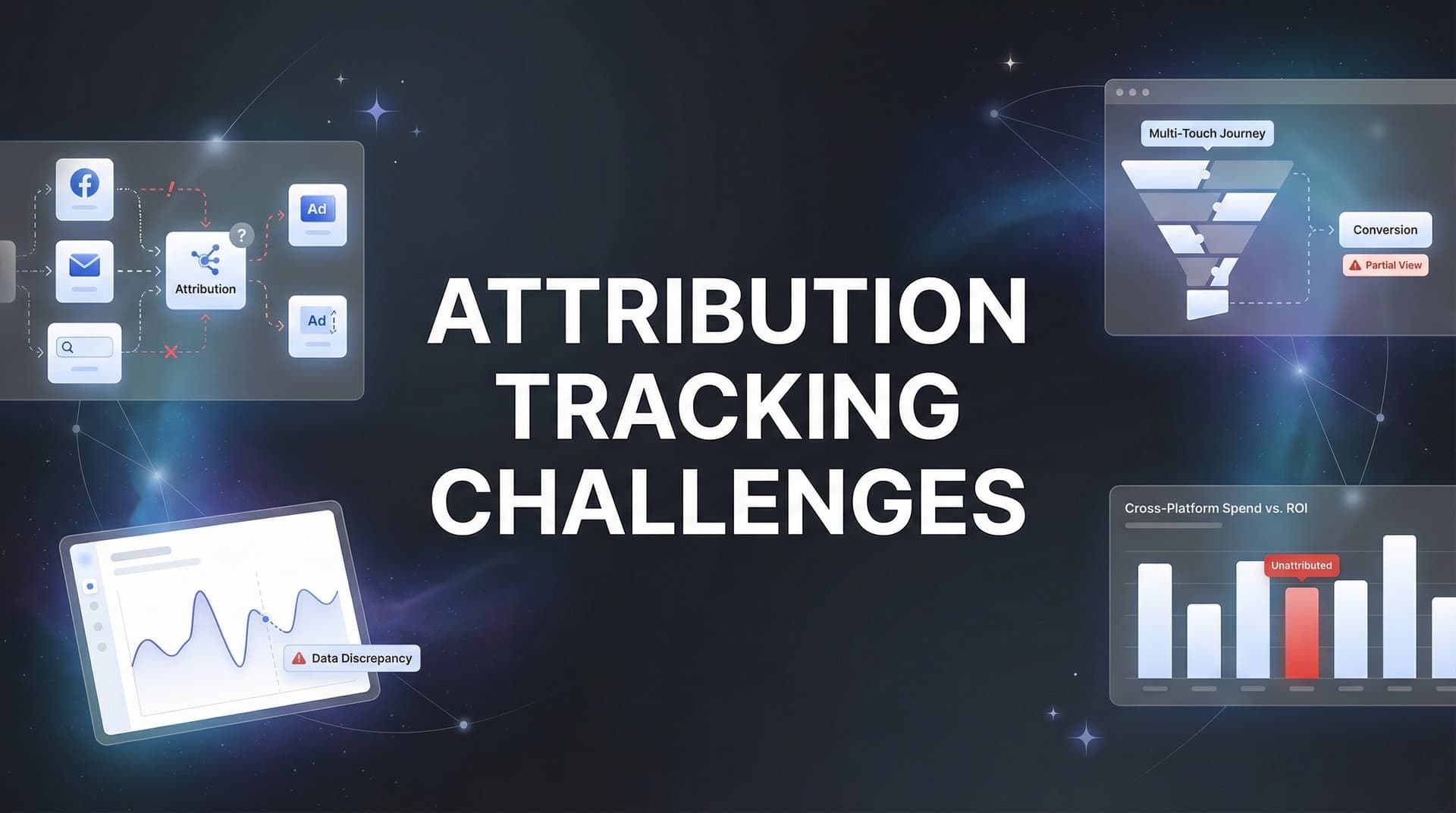
Each advertising platform only sees its own slice of this journey. Facebook claims the conversion came from their retargeting ad. Google attributes it to the branded search click. Your email platform takes credit for the final touchpoint. Meanwhile, the Instagram ad that started the entire journey gets zero recognition because the conversion happened on a different device days later.
This cross-device fragmentation creates a fundamental attribution tracking challenge: the customer journey you're trying to measure doesn't exist in any single platform's data. It's scattered across walled gardens that refuse to share user-level information with each other. Solving cross-device user tracking challenges requires a fundamentally different approach to data collection.
Meta uses a 7-day click and 1-day view attribution window by default. Google Ads uses 30-day click attribution. TikTok has its own methodology. These platforms don't just use different attribution windows—they use completely different tracking technologies and can't see each other's touchpoints at all.
The result? Duplicate attribution and inflated performance reports. When three platforms each claim 100% credit for the same conversion, your total reported conversions can exceed actual sales by 200% or more. Suddenly, campaigns that look profitable in platform dashboards are actually losing money when you check your bank account.
But digital touchpoints aren't the only blind spots. Phone calls, in-store visits, and offline conversions create even bigger gaps in attribution data. A customer might research online, call your sales team, and close the deal in your CRM weeks later. Without proper integration between your ad platforms and CRM, that revenue remains completely unattributed to the marketing touchpoints that generated it. Implementing marketing attribution for phone calls can help close these critical gaps.
This fragmentation doesn't just create reporting headaches. It destroys your ability to make confident optimization decisions. When you can't see the complete customer journey, you can't identify which touchpoints actually matter and which are just taking credit for conversions they didn't influence.
The Attribution Model Dilemma: Which Touchpoint Deserves Credit?
Even if you could track every touchpoint perfectly, you'd still face a fundamental question: which interaction actually deserves credit for the conversion?
Last-click attribution is the default model for most platforms because it's simple. The final touchpoint before conversion gets 100% of the credit. But this oversimplification ignores the entire journey that led to that final click.
Think about your own buying behavior. When you purchase a high-ticket item, do you convert on the first ad you see? Or do you research, compare options, read reviews, and interact with multiple touchpoints before making a decision? The awareness-building ad you saw three weeks ago influenced your purchase just as much as the retargeting ad you clicked yesterday—but last-click attribution gives the retargeting ad all the credit.
This creates perverse incentives. Marketers optimize for bottom-funnel touchpoints because those get credited with conversions, while top-funnel awareness campaigns that actually generate demand get starved of budget because they don't show direct attribution. Understanding marketing funnel attribution challenges helps explain why so many campaigns underperform.
First-click attribution swings to the opposite extreme, giving all credit to the initial touchpoint. This overvalues awareness campaigns while ignoring the nurturing and retargeting that converted consideration into action. Linear attribution tries to split the difference by dividing credit equally across all touchpoints, but this assumes every interaction has equal value—which rarely matches reality.
Multi-touch attribution models offer a more sophisticated approach. They assign fractional credit across touchpoints based on their actual influence on conversion. Time-decay models give more credit to recent interactions. Position-based models emphasize first and last touch while acknowledging middle touchpoints. Custom algorithmic models use machine learning to determine credit based on historical conversion patterns. Learning the difference between single source attribution and multi-touch attribution models is crucial for selecting the right approach.
Here's the catch: multi-touch attribution only works if you can actually track all the touchpoints in the first place. You need unified data collection across every channel, device, and platform. You need to connect ad clicks to website visits to CRM events to revenue. Without that infrastructure, even the most sophisticated attribution model is just guessing based on incomplete data.
The attribution model you choose fundamentally shapes how you allocate budget and optimize campaigns. Choose wrong, and you'll systematically underinvest in the touchpoints that actually drive growth while pouring money into channels that are just claiming credit for conversions they didn't create.
Data Fragmentation: The Silent Budget Killer
Your marketing data doesn't live in one place. It's scattered across a dozen platforms, each with its own dashboard, reporting methodology, and definition of success.
Facebook Ads Manager shows one set of conversion numbers. Google Analytics shows different numbers. Your CRM has its own revenue data. Your payment processor knows what actually got paid. Your email platform tracks its own conversions. None of these systems talk to each other automatically.
This data fragmentation creates a measurement nightmare. You spend hours each week manually pulling reports from different platforms, copying numbers into spreadsheets, and trying to reconcile discrepancies that never quite add up. By the time you've assembled a complete picture, the data is already outdated and the optimization opportunity has passed.
But the real damage isn't the time wasted on manual reporting. It's the erosion of confidence in your data that makes decision-making feel like gambling rather than strategy.
Platform-reported metrics are inherently biased toward making their own performance look good. Ad platforms use attribution methodologies that maximize their claimed conversions. Analytics tools count sessions and pageviews but struggle to connect those interactions to actual revenue. CRMs track deals but can't tell you which marketing touchpoints generated them. Understanding how to fix attribution discrepancies in data becomes essential for accurate reporting.
Delayed reporting compounds the problem. Some platforms update conversion data in real-time. Others have 24-48 hour delays. Attribution windows vary from 1 day to 30 days, meaning the "final" conversion count for a campaign keeps changing for weeks after it runs. When you're trying to make fast optimization decisions, this reporting lag means you're always flying partially blind.
Attribution windows themselves create discrepancies. A conversion that happens 8 days after a click gets credited in Google Ads (30-day window) but not in Facebook (7-day window). The same customer journey produces different attribution results depending on which platform's window you use. Many marketers struggle with Facebook attribution challenges specifically because of these window limitations.
Without a unified source of truth, you're stuck with platform-reported metrics that overstate performance and mask true ROI. Facebook might report a 5X return on ad spend, but when you check your actual revenue against total ad spend across all channels, you're barely breaking even. The disconnect between reported performance and business results creates a trust gap that paralyzes scaling decisions.
Data fragmentation isn't just an inconvenience. It's a systematic erosion of your ability to identify what's working, allocate budget effectively, and scale campaigns with confidence. When you can't trust your data, every optimization decision becomes a guess.
Building an Attribution System That Actually Works
The attribution tracking challenges we've explored aren't insurmountable obstacles. They're problems with proven solutions—but those solutions require moving beyond the default tracking methods that most marketers still rely on.
Server-side tracking fundamentally changes how conversion data flows from your business to advertising platforms. Instead of relying on browser-based pixels that get blocked by privacy tools, server-side tracking sends conversion events directly from your servers to ad platforms through secure APIs.
This approach bypasses browser limitations entirely. When a conversion happens, your server captures it and sends the data to Meta, Google, TikTok, and other platforms regardless of whether the user has tracking blocked. You're not dependent on third-party cookies or client-side JavaScript that privacy tools strip away. The result is dramatically more complete conversion data that reflects actual business outcomes rather than just the subset of conversions that traditional pixels can see. Proper first-party data tracking setup forms the foundation of this approach.
But server-side tracking alone doesn't solve attribution. You still need to connect the dots across platforms, devices, and touchpoints to understand the complete customer journey.
This is where unified data infrastructure becomes essential. You need a system that captures every touchpoint—ad clicks, website visits, email opens, CRM events, and revenue—and connects them to individual customer journeys. Not in separate platform dashboards, but in a single source of truth that shows how all these interactions work together to drive conversions. Exploring the best software for tracking marketing attribution can help you identify the right solution for your needs.
When your ad platforms, website analytics, CRM, and payment systems feed into a unified attribution system, you can finally see the complete picture. You can track a customer from their first Facebook ad click through multiple website visits and email interactions all the way to the CRM deal that closes three weeks later. You can accurately assign credit across touchpoints using multi-touch attribution models that reflect real influence rather than platform-biased last-click reporting.
Here's where it gets even more powerful: feeding enriched conversion data back to ad platforms improves their optimization algorithms. When you send platforms complete, accurate conversion data that includes revenue values, customer lifetime value, and attribution to specific touchpoints, their machine learning systems can identify patterns and optimize for the audiences and creative that actually drive business results.
This creates a virtuous cycle. Better data leads to better targeting. Better targeting leads to higher-quality leads. Higher-quality leads convert at better rates and generate more revenue. That revenue data feeds back into the system, further improving optimization. Instead of fighting against platform algorithms that are optimizing based on incomplete data, you're empowering them with the information they need to find your best customers.
The technical implementation requires connecting multiple systems, but the payoff is transformative. You move from fragmented, conflicting reports to unified attribution data you can actually trust. You move from gut-feel budget allocation to data-driven decisions backed by complete customer journey visibility. You move from wondering which campaigns work to knowing exactly what drives revenue and scaling with confidence.
Your Path to Attribution Clarity
Attribution tracking challenges have evolved from minor measurement annoyances into fundamental obstacles that prevent marketers from scaling with confidence. Privacy changes, cross-platform fragmentation, attribution model complexity, and data silos have broken the tracking infrastructure that digital marketing was built on.
But these challenges aren't permanent roadblocks. They're solvable problems that require modern attribution infrastructure built for the privacy-first, multi-platform reality of current digital marketing.
Server-side tracking captures the conversions that browser-based pixels miss. Unified data systems connect the fragmented touchpoints scattered across platforms into complete customer journeys. Multi-touch attribution models assign credit based on actual influence rather than platform bias. Feeding enriched data back to ad platforms turns their algorithms into allies rather than sources of inflated metrics.
The marketers who solve attribution aren't just getting better reports. They're gaining the confidence to scale campaigns knowing exactly what drives revenue, which channels deserve more budget, and which touchpoints actually matter in their customer journeys. They're making optimization decisions based on complete data rather than educated guesses. They're feeding their ad platforms the information needed to find higher-quality customers at lower costs.
Accurate attribution isn't a nice-to-have reporting feature. It's the foundation for profitable growth in an environment where wasted ad spend and misallocated budgets kill campaigns before they reach their potential.
Ready to elevate your marketing game with precision and confidence? Discover how Cometly's AI-driven recommendations can transform your ad strategy—Get your free demo today and start capturing every touchpoint to maximize your conversions.