You're running enterprise marketing campaigns across Meta, Google, LinkedIn, and half a dozen other platforms. Every click, impression, and conversion generates data that flows into your systems. Your data team has built a sophisticated Databricks lakehouse that processes terabytes of information daily. The infrastructure is there. The data is there. So naturally, the question emerges: why not build marketing attribution directly on Databricks?
It's a logical thought. You've already invested in the platform. Your engineering team knows it inside and out. Centralizing attribution logic alongside your other analytics seems efficient. But here's the reality that many marketing leaders discover after months of development: building effective attribution on a data lakehouse platform is fundamentally different from deploying a purpose-built attribution solution.
This article cuts through the hype to explain what Databricks marketing attribution actually means, what you can realistically build, and most importantly, what it takes to make it work. Whether you're evaluating the build-versus-buy decision or trying to understand why your current Databricks attribution project is taking longer than expected, you'll find clarity on the technical requirements, resource demands, and strategic trade-offs involved.
The Data Lakehouse Approach to Attribution
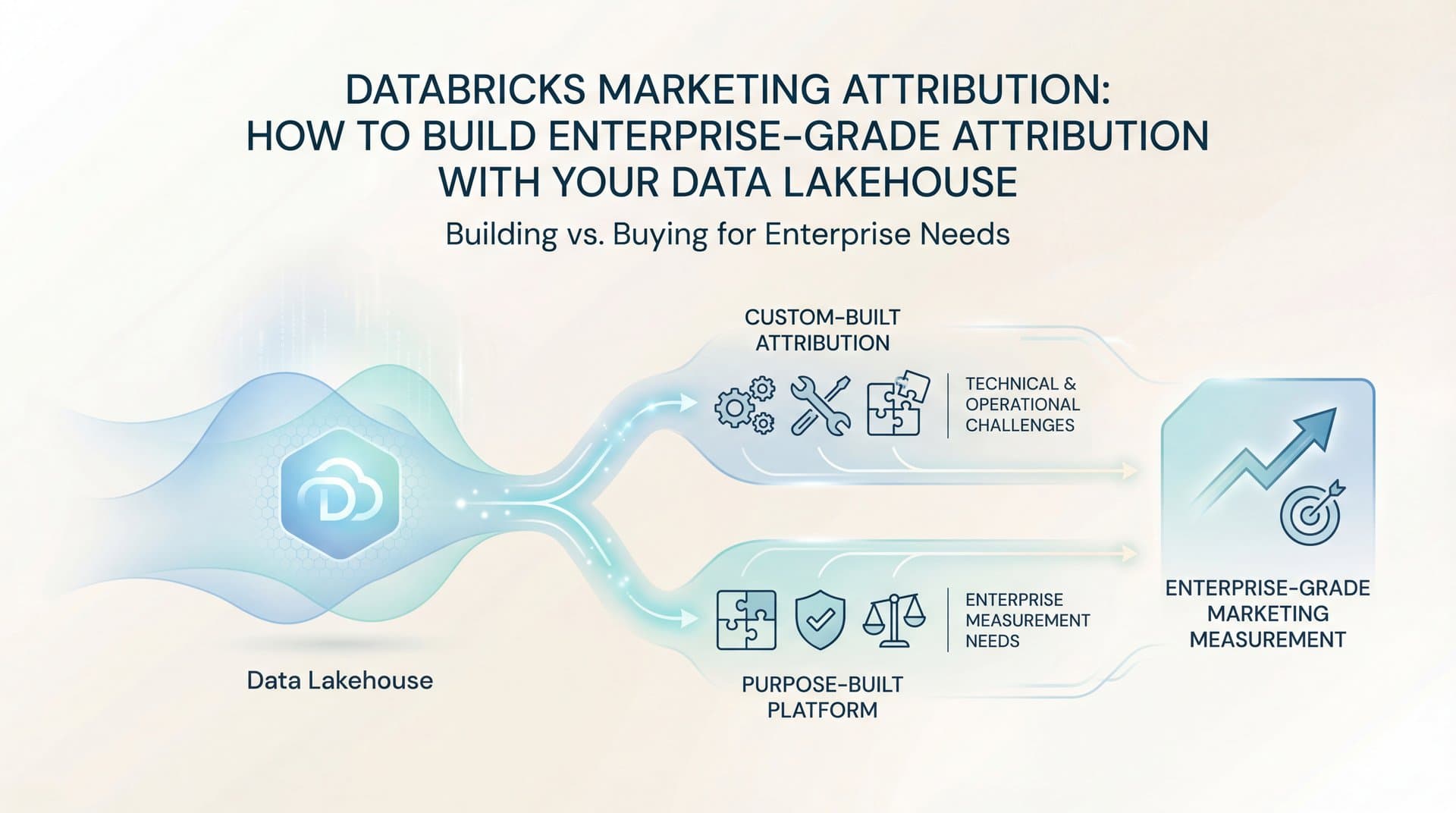
Databricks marketing attribution refers to using the Databricks unified analytics platform to centralize marketing touchpoint data, build custom attribution models, and analyze cross-channel campaign performance. Instead of relying on a dedicated attribution tool, you're essentially building your own attribution system on top of your data lakehouse infrastructure.
The core concept is straightforward: Databricks serves as the central repository where data from all your marketing channels converges. Ad platform data, website analytics, CRM records, and conversion events all flow into Delta Lake tables. From there, you use Spark SQL and machine learning libraries to construct attribution logic that assigns credit to different touchpoints along the customer journey.
But here's the critical distinction that many teams underestimate: Databricks is a data infrastructure platform, not a purpose-built attribution solution. It provides the computational power and storage architecture to process massive datasets, but it doesn't come with pre-configured marketing attribution capabilities. There's no "install attribution" button. Everything must be built from scratch.
Think of it like the difference between buying a finished house and purchasing land with construction materials. Databricks gives you an incredibly powerful foundation and all the raw materials you need. But you still have to design the architecture, build every room, install the plumbing, and wire the electricity yourself.
The essential components of a Databricks attribution system include data ingestion pipelines that connect to each advertising platform's API, identity resolution logic that matches anonymous visitors to known customers, attribution modeling algorithms that distribute credit across touchpoints, and reporting layers that make the insights accessible to marketing teams. Understanding how to setup datalake for marketing attribution effectively is crucial before diving into implementation.
Each of these components requires significant development work. Your data engineering team needs to build custom connectors for Meta Marketing API, Google Ads API, LinkedIn Campaign Manager, and every other platform you advertise on. They must handle authentication, rate limiting, pagination, and the inevitable API changes that platforms roll out regularly.
The identity resolution layer presents its own complexity. When someone clicks a Facebook ad on their phone, visits your website later from a laptop, and eventually converts after a Google search, how do you connect those three events to the same person? This requires sophisticated probabilistic matching algorithms, device fingerprinting strategies, and deterministic linking when possible.
Attribution modeling itself can range from simple rule-based approaches to complex machine learning models. Databricks excels at running these computations at scale, but someone still needs to write the code, tune the models, and validate the results against business outcomes.
What You Can Build: Attribution Capabilities on Databricks
Once you've invested the engineering resources, Databricks offers impressive flexibility for custom attribution modeling. You're not constrained by the limitations of off-the-shelf tools. If your business has unique requirements or complex customer journeys, you can build exactly what you need.
Multi-Touch Attribution Models: You can implement any attribution model your team can conceptualize. First-touch models that credit the initial interaction, last-touch models that emphasize the final conversion touchpoint, or linear models that distribute credit evenly across all interactions. Time-decay models that give more weight to recent touchpoints are straightforward to implement with Spark SQL date functions. For a deeper understanding of the various types of marketing attribution models, it helps to evaluate which approach aligns with your business goals.
For more sophisticated approaches, you can leverage Spark MLlib to build algorithmic attribution models. These machine learning approaches analyze patterns in conversion paths to determine which touchpoint combinations are most predictive of success. You might discover that certain channel sequences consistently lead to higher-value customers, insights that simple rule-based models would miss.
Cross-Channel Journey Mapping: The lakehouse architecture shines when unifying data from disparate sources. Your Meta campaign data, Google Ads performance, LinkedIn engagement, email interactions, and website behavior all converge in Delta Lake tables. This unified view enables comprehensive journey analysis that shows how channels work together rather than in isolation. Implementing cross channel attribution becomes significantly more manageable when all your data lives in one place.
You can build custom dashboards that visualize the complete path to conversion. Marketing teams can see that enterprise customers typically engage with three LinkedIn ads, visit the pricing page twice, and download a whitepaper before requesting a demo. These journey insights inform budget allocation and campaign sequencing decisions.
Custom Attribution Windows: Different businesses have vastly different sales cycles. A B2C e-commerce brand might care about the seven days before purchase, while an enterprise SaaS company needs to analyze touchpoints across six months. With Databricks, you define attribution windows that match your actual business reality.
You can even implement multiple attribution windows simultaneously, comparing 30-day, 60-day, and 90-day lookback periods to understand how attribution credit shifts over time. This flexibility helps you calibrate models to your specific conversion patterns rather than accepting arbitrary defaults.
Business-Specific Weighting: Perhaps your sales team has discovered that demo requests from paid search convert at twice the rate of those from social media. You can build custom weighting logic that reflects these conversion quality differences, not just conversion volume. Your attribution model can account for customer lifetime value, deal size, or any other business metric that matters to your organization.
The Technical Reality: Resources and Expertise Required
Here's where the theoretical capabilities meet practical constraints. Building and maintaining marketing attribution on Databricks demands substantial engineering resources that many organizations underestimate during the planning phase.
Data Engineering Requirements: Each advertising platform has its own API with unique authentication methods, data structures, and rate limits. Your team needs to build reliable connectors for every platform you advertise on. This isn't a one-time development effort. When Meta updates their Marketing API or Google changes their attribution reporting structure, your connectors break until someone fixes them.
Data freshness becomes a constant consideration. Marketing teams need near-real-time insights to optimize campaigns effectively. This means your ingestion pipelines must run frequently, handle failures gracefully, and alert the team when data stops flowing. Building robust error handling and monitoring requires additional engineering time.
Then there's the schema evolution challenge. Ad platforms regularly add new fields, deprecate old ones, and restructure their data formats. Your Databricks tables and transformation logic must adapt to these changes without breaking downstream attribution calculations. This ongoing maintenance burden never disappears.
Identity Resolution Challenges: This is arguably the most complex technical challenge in DIY attribution. When someone visits your website, you typically see an anonymous session with a device identifier and IP address. When they fill out a form or make a purchase, you finally connect that session to a known identity in your CRM.
But what about all their previous anonymous sessions? What about visits from different devices? Building identity resolution logic requires combining deterministic matching (when you have clear identifiers like email addresses) with probabilistic matching (using behavioral patterns, device fingerprints, and statistical models to infer that two sessions belong to the same person). These attribution challenges in marketing analytics represent some of the most difficult problems to solve at scale.
The accuracy of your entire attribution system depends on getting identity resolution right. Attribute touchpoints to the wrong person, and your attribution models produce misleading insights. Marketing teams make budget decisions based on flawed data, and campaign performance suffers.
Ongoing Maintenance Burden: Attribution isn't a build-it-once project. Your models need continuous tuning as your marketing mix evolves. When you launch campaigns in new channels, your attribution logic must account for them. When customer behavior shifts seasonally, your models may need recalibration.
Data quality monitoring becomes a full-time concern. Are all platforms reporting data correctly? Has a tracking pixel stopped firing? Did an API connector fail silently? Someone needs to build dashboards that monitor data completeness and alert the team to anomalies before they corrupt attribution insights.
The total cost of ownership extends far beyond the initial development sprint. Many enterprises discover that maintaining their Databricks attribution system requires one to two full-time data engineers indefinitely. That's a significant ongoing investment that must be factored into the build-versus-buy decision.
When Databricks Attribution Makes Sense
Despite the challenges, certain organizations genuinely benefit from building attribution on Databricks. The key is honest assessment of whether your situation matches the ideal use case.
Existing Infrastructure and Expertise: If your organization already runs Databricks for analytics and has a strong data engineering team, you've cleared the biggest hurdle. Your team knows the platform, understands its quirks, and can leverage existing infrastructure investments. The incremental cost of adding attribution logic is substantially lower than starting from scratch.
Companies with dedicated data teams that support marketing analytics are better positioned to maintain custom attribution systems. When you have engineers who understand both the technical architecture and the marketing use cases, they can build solutions that truly fit your needs.
Complex Custom Requirements: Some enterprises have attribution needs that off-the-shelf tools simply can't accommodate. Maybe you're a multi-brand conglomerate that needs to attribute credit across different business units with complex cost allocation rules. Perhaps you're in a heavily regulated industry with unique data residency requirements that make third-party attribution tools impractical.
If your attribution logic involves proprietary algorithms, integration with custom internal systems, or business rules that are genuinely unique to your organization, building on Databricks provides the flexibility you need. You're not constrained by the features that attribution vendors choose to prioritize. Organizations exploring this path should also understand how machine learning can be used in marketing attribution to maximize their custom implementations.
Cost-Benefit Analysis: The financial equation matters. If you're already paying for Databricks compute and storage, the marginal cost of running attribution workloads might be lower than subscribing to a specialized attribution platform. However, this calculation must include the fully loaded cost of engineering time for development and maintenance.
A realistic cost comparison accounts for opportunity cost. Those data engineers building attribution could be working on other high-value projects. Is custom attribution the best use of their time, or would purpose-built tools free them to focus on more strategic initiatives?
Hybrid Approaches: Many sophisticated organizations adopt hybrid strategies. They use Databricks as the central data repository and long-term analytics platform while leveraging specialized tools for real-time attribution and operational needs. This approach combines the flexibility of a data lakehouse with the speed and convenience of purpose-built solutions.
For example, a dedicated attribution platform might handle real-time tracking, identity resolution, and feeding conversion data back to ad platforms. Meanwhile, Databricks stores the historical data for deep-dive analysis, custom reporting, and integration with broader business intelligence systems. Each tool does what it does best.
Purpose-Built Attribution vs. DIY: Making the Right Choice
The build-versus-buy decision ultimately comes down to time, resources, and strategic priorities. Understanding the trade-offs helps you make the choice that serves your marketing organization best.
Time-to-Value Comparison: Building attribution on Databricks typically requires three to six months of development before marketing teams can access reliable insights. That timeline includes building data connectors, implementing identity resolution, developing attribution models, and creating reporting interfaces. Then add ongoing refinement as you discover edge cases and data quality issues.
Purpose-built attribution platforms deploy in days or weeks. Modern solutions offer pre-built integrations with major ad platforms, proven identity resolution algorithms, and ready-to-use attribution models. Marketing teams start seeing insights almost immediately, which means they can begin optimizing campaigns months sooner. When evaluating options, reviewing the best marketing attribution tools available helps establish a baseline for comparison.
For fast-moving marketing organizations, those months matter. The campaigns you could have optimized, the budget you could have reallocated, and the insights you could have acted on represent real opportunity cost. Time-to-value isn't just about convenience. It's about competitive advantage.
Feature Gaps to Consider: Even after significant development effort, DIY attribution systems often lack capabilities that specialized platforms provide out of the box. Real-time tracking that captures every website interaction as it happens requires sophisticated infrastructure that goes beyond basic data ingestion pipelines.
Server-side tracking has become essential for accuracy in the iOS privacy era. When browser-based tracking pixels fail due to privacy restrictions, server-side implementations maintain data fidelity. Building this capability on Databricks requires additional infrastructure for event collection, validation, and forwarding to both your lakehouse and ad platforms. Understanding the broader digital marketing attribution problem helps contextualize why these technical challenges exist.
Conversion sync represents perhaps the most significant gap. Purpose-built attribution platforms don't just analyze which ads drove conversions. They send enriched conversion data back to Meta, Google, and other advertising platforms. This feedback loop improves the ad algorithms' understanding of what constitutes a valuable conversion, leading to better automated optimization.
Your Databricks attribution system can tell you which campaigns performed well, but it doesn't automatically help those campaigns perform better going forward. Modern attribution platforms close this loop, feeding better data to ad platform AI so future campaigns benefit from past learnings.
Complementary Strategies: The most sophisticated marketing organizations recognize that attribution platforms and data lakehouses serve different purposes. They're not competitors but complementary components of a modern marketing data stack.
A dedicated attribution platform excels at real-time tracking, identity resolution, and operational attribution that informs daily campaign decisions. It captures every touchpoint, resolves identities accurately, and feeds conversion data back to ad platforms to improve targeting and optimization. Exploring marketing attribution platforms for revenue tracking reveals how specialized solutions handle these complex requirements.
Databricks excels at historical analysis, custom reporting, and integration with broader business data. It's where you combine marketing attribution data with sales pipeline information, customer lifetime value calculations, and product usage patterns to understand the complete business impact of marketing investments.
Using both tools strategically means marketing teams get immediate, actionable insights from purpose-built attribution while data teams can perform deep-dive analysis and custom modeling in Databricks. Each platform does what it does best, and your organization benefits from both.
Making Attribution Work for Your Marketing Strategy
Databricks can technically support marketing attribution for organizations with substantial data engineering resources and complex custom requirements. The platform provides the computational power and flexibility to build sophisticated attribution models that precisely match your business needs.
But technical capability doesn't always translate to practical value. Most marketing teams need attribution insights now, not after months of development. They need systems that adapt automatically when ad platforms change their APIs. They need solutions that not only analyze past performance but actively improve future campaign results by feeding better data to advertising algorithms.
The reality is that purpose-built attribution platforms deliver these capabilities immediately while still integrating with your broader data infrastructure. They handle the complex engineering challenges of real-time tracking, identity resolution, and conversion sync so your team can focus on strategy rather than maintenance. For enterprise organizations weighing their options, evaluating enterprise marketing attribution software alongside DIY approaches provides valuable perspective.
If you're currently running campaigns across multiple platforms without clear visibility into what's driving revenue, you're making decisions in the dark. Every day without accurate attribution means wasted ad spend on underperforming channels and missed opportunities to scale what's working.
Ready to elevate your marketing game with precision and confidence? Discover how Cometly's AI-driven recommendations can transform your ad strategy—Get your free demo today and start capturing every touchpoint to maximize your conversions.