You're spending thousands—maybe tens of thousands—on digital ads every month. Your campaigns are running across Meta, Google, TikTok, maybe LinkedIn. Traffic is flowing to your website. Leads are coming in. But here's the question that keeps you up at night: which of those campaigns is actually driving revenue?
Most marketers can't answer that question with confidence. They know their click-through rates, their cost per click, their impressions. But when it comes to connecting those metrics to actual closed deals and revenue? That's where the clarity disappears.
Digital marketing without analytics isn't just inefficient—it's expensive guesswork. You're making budget decisions based on incomplete information, optimizing for metrics that might not correlate with business outcomes, and missing opportunities to double down on what's actually working. The good news? It doesn't have to be this way. By the end of this guide, you'll understand how to build a marketing analytics foundation that connects every touchpoint to measurable business outcomes—and gives you the confidence to make smarter, faster decisions.
Why Data Has Become the Marketer's Most Valuable Currency
The marketing landscape has fundamentally changed. A decade ago, you could run campaigns, track some basic metrics, and make reasonably informed decisions about what was working. Today, that approach is a recipe for wasted budget.
The shift from intuition-based to data-driven marketing isn't just a trend—it's a survival requirement. Your customers don't follow linear paths anymore. They discover your brand on Instagram, research you on Google, click an ad on Facebook, visit your website three times across two devices, and finally convert after receiving an email. Each of those touchpoints matters, but if you're only looking at last-click attribution or platform-reported conversions, you're missing the full story.
This fragmentation creates massive blind spots. When a customer journey spans multiple devices, platforms, and sessions over days or weeks, traditional tracking methods struggle to connect the dots. You might see that a Google ad drove a conversion, but you're missing that the customer first discovered you through an organic social post, then clicked a Meta ad, then searched your brand name before finally converting on that Google click.
The cost of these blind spots is significant. Without complete visibility, you might cut budgets from channels that are actually driving awareness and consideration—just because they're not getting credit for the final conversion. Or you might pour more money into last-click channels that are simply capturing demand created by your other marketing efforts.
Think about it: if you're spending $50,000 a month on paid advertising but can't accurately attribute which campaigns drive revenue, you're essentially operating on faith. You're guessing which 50% of your budget is working and which 50% is waste. In a competitive market where margins matter and every dollar counts, that's not just inefficient—it's unsustainable.
The marketers who win in this environment are the ones who treat data as their most valuable asset. They build systems that capture every touchpoint, connect those touchpoints to revenue, and use that complete picture to make confident optimization decisions. They don't rely on gut feelings or vanity metrics—they follow the data to real business outcomes.
The Core Components of a Marketing Analytics Ecosystem
Building a marketing analytics ecosystem that actually delivers clarity requires understanding three foundational layers. Each layer serves a distinct purpose, and together they create the complete picture you need to make smart decisions.
Traffic and Engagement Metrics: This is where most marketers start, and it's important—but it's only the beginning. Traffic metrics tell you who's coming to your site, how they're finding you, and what they're doing once they arrive. Page views, session duration, bounce rates, and traffic sources all fall into this category.
These metrics help you understand user behavior and identify potential issues. If you're driving traffic from an ad campaign but seeing high bounce rates on the landing page, that's valuable information. If organic traffic is growing but engagement is declining, that signals a content quality issue. But here's the critical limitation: traffic metrics alone don't tell you anything about business outcomes. A million visitors means nothing if none of them convert.
Conversion Tracking: This is where you start connecting actions to business outcomes. Conversion tracking monitors specific events that matter to your business—form submissions, demo requests, trial signups, purchases, or any other action that represents progress toward a sale.
Proper conversion tracking requires defining what conversions mean for your business and implementing tracking that captures those events accurately. For an e-commerce brand, conversions might include add-to-cart actions, checkout initiations, and completed purchases. For a SaaS company, conversions could be trial signups, product tours, and meeting bookings.
The challenge with conversion tracking is ensuring accuracy across platforms and devices. When a customer clicks an ad on their phone but converts on their laptop two days later, your tracking needs to connect those dots. When someone converts after interacting with multiple campaigns, you need to know which touchpoints contributed.
Attribution Modeling: This is where analytics becomes truly powerful. Attribution modeling determines which touchpoints in the customer journey deserve credit for driving conversions and revenue. It answers the question: "Of all the marketing activities this customer experienced, which ones actually influenced their decision to buy?"
Different attribution models tell different stories. First-touch attribution gives all credit to the initial interaction—useful for understanding what drives awareness but terrible for understanding what closes deals. Last-touch attribution credits only the final touchpoint before conversion—great for understanding what captures demand but blind to everything that created that demand in the first place.
Multi-touch attribution distributes credit across multiple touchpoints based on various methodologies. Linear models split credit evenly. Time-decay models give more weight to recent interactions. Position-based models emphasize first and last touches while acknowledging middle interactions. The right model depends on your sales cycle, customer journey complexity, and business goals.
Here's what matters most: no single attribution model is universally "correct." The goal isn't to find the perfect model—it's to understand how different models reveal different insights about your marketing performance. When you can compare multiple attribution views of the same data, you gain a much richer understanding of what's actually working.
Connecting the Dots: From Ad Click to Closed Deal
The single biggest challenge in modern marketing analytics is maintaining identity resolution across the entire customer journey. When someone clicks your ad, visits your site, fills out a form, receives emails, and eventually converts—potentially across multiple devices and sessions—your analytics needs to recognize that these are all the same person.
This is harder than it sounds. Traditional browser-based tracking relies on cookies to identify users, but cookies have significant limitations. They don't work across devices. They get deleted regularly. They're blocked by privacy features and ad blockers. And with iOS privacy changes and the gradual deprecation of third-party cookies, cookie-based tracking is becoming increasingly unreliable.
Picture this scenario: A potential customer sees your Instagram ad on their phone during their morning commute. They're interested but not ready to act. Later that day, they search for your brand on their work computer and click a Google ad. They browse your site but don't convert. That evening, they see a retargeting ad on Facebook, click through on their tablet, and finally submit a form. Three days later, they return directly to your site on their laptop and make a purchase.
With cookie-based tracking alone, this looks like four different people. Your analytics might credit the Instagram ad, the Google ad, the Facebook ad, and the direct visit as separate conversion paths. You have no idea these interactions represent a single customer journey. This fragmentation makes it nearly impossible to understand what's actually driving conversions.
Server-Side Tracking: The Privacy-First Solution
Server-side tracking has emerged as a more reliable approach in this privacy-first environment. Instead of relying solely on browser cookies, server-side tracking sends data directly from your server to analytics platforms. This approach is more resistant to ad blockers, doesn't depend on third-party cookies, and provides more accurate data collection.
When someone submits a form on your site, server-side tracking can capture that conversion event and associated data—like UTM parameters, referral sources, and session information—without relying on browser cookies that might be blocked or deleted. This data is then sent to your analytics platform and synced back to your ad platforms, creating a more complete and accurate picture of performance.
The real power comes from combining server-side tracking with proper identity resolution. When you can connect ad clicks to form submissions to CRM records to closed deals—all tied to the same customer identity—you finally see the complete journey. You understand not just which campaigns drove clicks, but which campaigns contributed to actual revenue.
Building Unified Customer Journey Views
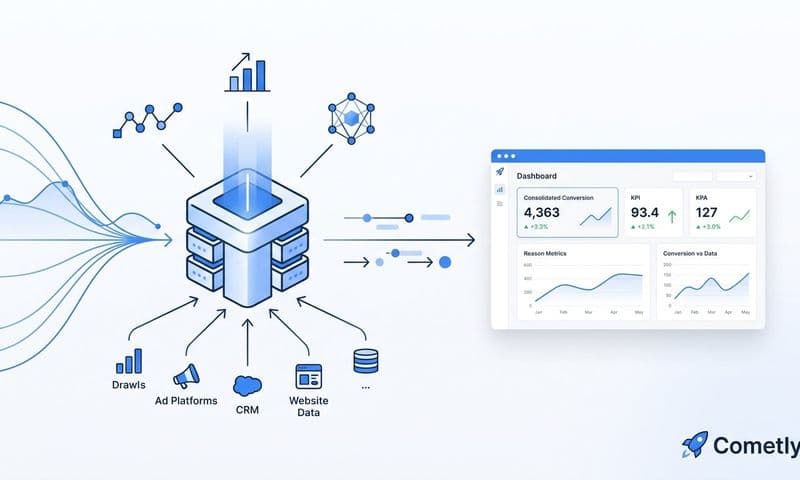
Creating this unified view requires connecting multiple data sources. Your ad platforms hold click and impression data. Your website analytics captures on-site behavior. Your CRM contains lead and customer information. Your marketing automation platform tracks email engagement. Each system has pieces of the puzzle, but none has the complete picture alone.
The solution is building integrations that flow data between these systems and creating a unified customer record that tracks the entire journey. When all your touchpoints feed into a single source of truth, you can finally see which marketing activities drive real business outcomes—not just clicks or visits, but qualified leads and closed revenue.
Turning Raw Data Into Actionable Marketing Decisions
Having complete data is valuable, but only if you can translate it into better decisions. The goal of marketing analytics isn't to generate reports—it's to identify opportunities, eliminate waste, and scale what works.
Identifying True Revenue Drivers
The first critical insight your analytics should provide is distinguishing between campaigns that drive clicks and campaigns that drive revenue. These are often not the same thing. A campaign might generate impressive click-through rates and website traffic while contributing minimally to actual conversions. Another campaign might have modest traffic numbers but consistently attract high-intent prospects who convert at higher rates.
This is where proper attribution becomes essential. When you can track campaigns all the way through to closed deals, you stop optimizing for vanity metrics and start optimizing for outcomes. You might discover that your thought leadership content on LinkedIn doesn't drive immediate conversions but plays a crucial role in warming up prospects who later convert through other channels. Or you might find that certain ad creatives drive cheaper clicks but lower-quality leads that rarely close.
The marketers who understand these nuances make fundamentally different decisions than those who only look at platform-reported metrics. They allocate budgets based on contribution to revenue, not just cost per click or cost per lead. They recognize that some channels play supporting roles in the customer journey even when they don't get last-click credit.
Optimizing Budget Allocation Across Platforms
Once you understand which campaigns and channels truly drive revenue, the next question is: how should you allocate your budget? This is where analytics transforms from descriptive to prescriptive.
With complete attribution data, you can calculate the actual return on ad spend for each campaign, channel, and even individual ad creative. You can identify which audiences convert at the highest rates and which targeting strategies consistently deliver qualified leads. You can spot when a channel reaches saturation and returns start diminishing.
This enables sophisticated budget optimization strategies. Instead of spreading budgets evenly or making gut-feel adjustments, you can systematically shift dollars from underperforming campaigns to high-performers. You can test new channels with confidence because you'll know exactly how they contribute to revenue. You can scale winning campaigns aggressively while quickly cutting losers.
The difference in outcomes between marketers who optimize based on complete attribution data versus those who rely on platform metrics alone is substantial. When you're making decisions based on true revenue contribution, every optimization move compounds your results.
Leveraging AI-Powered Insights
As marketing data grows more complex, AI marketing analytics tools have become increasingly valuable for surfacing insights that humans might miss. Machine learning algorithms can analyze patterns across thousands of campaigns, identify correlations between variables, and generate optimization recommendations in real-time.
AI excels at spotting subtle patterns in large datasets. It might notice that campaigns targeting specific audience segments perform dramatically better during certain times of day, or that certain combinations of ad creative and landing page drive outsized results. These insights often hide in the noise when you're manually analyzing data, but AI can surface them automatically.
Beyond pattern recognition, AI can provide proactive recommendations for budget allocation, bid adjustments, and campaign optimizations. Instead of spending hours analyzing data to decide where to shift budgets, AI can continuously monitor performance and suggest specific actions to improve results. This doesn't replace human judgment—it augments it, allowing marketers to make faster, more informed decisions.
Building Your Analytics Foundation: A Practical Framework
Understanding analytics concepts is one thing. Actually implementing a system that delivers clarity is another. Here's a practical framework for building an analytics foundation that connects all your marketing touchpoints to revenue outcomes.
Step 1: Connect Your Essential Data Sources
Start by integrating the core systems that hold pieces of your customer journey data. At minimum, this typically includes your ad platforms (Meta, Google, LinkedIn, etc.), your website analytics, your CRM, and any marketing automation tools you use. Each integration serves a specific purpose in building the complete picture.
Ad platform integrations capture click and impression data, allowing you to track which campaigns drive initial engagement. Website tracking captures on-site behavior and conversion events. CRM integration connects marketing touchpoints to leads, opportunities, and closed revenue. Marketing automation integration tracks email engagement and nurture sequence interactions.
The goal is creating bidirectional data flow. Marketing data flows into your CRM so sales teams see which campaigns influenced each lead. Conversion data flows back to ad platforms so their algorithms can optimize for actual business outcomes, not just clicks or form fills.
Step 2: Define and Implement Proper Conversion Events
Next, clearly define what conversions mean for your business and implement tracking for those events. This requires thinking beyond basic form submissions to capture the full range of actions that indicate progress toward a sale.
For most businesses, conversion events should include multiple stages: initial engagement actions (content downloads, video views), qualification actions (demo requests, trial signups), and revenue actions (purchases, contract signatures). By tracking conversions at each stage, you can analyze which campaigns drive top-of-funnel awareness versus bottom-of-funnel conversions.
Implement tracking that captures rich context with each conversion: which campaigns the user interacted with, what content they consumed, how long their journey took, and which touchpoints occurred along the way. This context is what enables sophisticated attribution analysis later.
Step 3: Establish Your Attribution Methodology
Decide which attribution models make sense for your business and implement tracking that supports those models. For most businesses, this means moving beyond last-click attribution to multi-touch models that credit multiple touchpoints in the customer journey. Understanding attribution meaning in digital marketing is essential for making this transition effectively.
If you have a short sales cycle and customers typically convert quickly, simpler attribution models might suffice. If you have a complex B2B sales process with long cycles and multiple stakeholders, you need more sophisticated attribution that accounts for all the touchpoints that influence a deal.
The key is having the flexibility to view your data through multiple attribution lenses. Being able to compare first-touch, last-touch, and multi-touch views of the same campaigns reveals insights that any single model would miss.
Step 4: Build Dashboards That Answer Your Critical Questions
Finally, create dashboards that surface the insights you need to make decisions. Resist the temptation to build dashboards that show everything—focus on the metrics that actually drive action.
A good marketing analytics dashboard answers specific questions: Which campaigns are driving qualified leads? What's our true cost per acquisition across all touchpoints? Which channels contribute most to revenue? Where should we increase or decrease budget? How are our key campaigns trending over time? The right data visualization tools for marketing analytics can make these insights immediately actionable.
Build dashboards that segment data in useful ways—by campaign, by channel, by audience, by time period. Include comparison views that show performance against goals and historical benchmarks. Make the data visual and intuitive so insights jump out rather than hiding in tables of numbers.
The goal is creating a system where you can log in, quickly assess performance, and make confident optimization decisions without spending hours digging through data. Your analytics should make decision-making faster and clearer, not more complex.
Your Path to Marketing Clarity
The difference between marketers who consistently scale their results and those who struggle often comes down to one thing: clarity. When you have complete visibility into which marketing activities drive revenue, you can make confident decisions about where to invest, what to optimize, and what to cut.
This clarity doesn't happen by accident. It requires building proper analytics infrastructure that captures every touchpoint, connects those touchpoints to conversions and revenue, and presents insights in ways that drive action. It means moving beyond platform-reported metrics to unified attribution that tells the complete story of your customer journeys.
The marketers who invest in this foundation gain a significant competitive advantage. They're not guessing which campaigns work—they know. They're not spreading budgets based on intuition—they're allocating based on proven revenue contribution. They're not reacting to performance issues days or weeks after they occur—they're optimizing in real-time based on accurate, complete data.
As privacy regulations tighten and tracking becomes more complex, this advantage will only grow. The marketers who build robust, privacy-compliant tracking systems now will thrive while others struggle with increasingly incomplete data. The ones who master attribution will scale efficiently while competitors waste budget on campaigns that don't drive real outcomes. Understanding the future of marketing analytics can help you stay ahead of these shifts.
Start by evaluating your current analytics setup honestly. Can you confidently answer which campaigns drove your last ten customers? Do you know which channels assist conversions even when they don't get last-click credit? Can you track customer journeys across devices and sessions? If the answer to any of these questions is no, you have an opportunity to gain clarity that transforms your marketing performance.
The path to marketing clarity starts with capturing every touchpoint, connecting those touchpoints to revenue, and using complete data to make smarter decisions. When you can see the full picture of how your marketing drives business outcomes, you unlock the ability to scale with confidence and precision.
Ready to elevate your marketing game with precision and confidence? Discover how Cometly's AI-driven recommendations can transform your ad strategy—Get your free demo today and start capturing every touchpoint to maximize your conversions.