You're running five different campaigns across Meta, Google, and TikTok. Conversions are rolling in. Revenue is up. But when your CMO asks which campaigns are actually working, you freeze. Was it the Facebook ad they saw last week? The Google search they clicked yesterday? The retargeting ad that sealed the deal? Without a clear answer, you're flying blind—and probably wasting budget on channels that aren't pulling their weight.
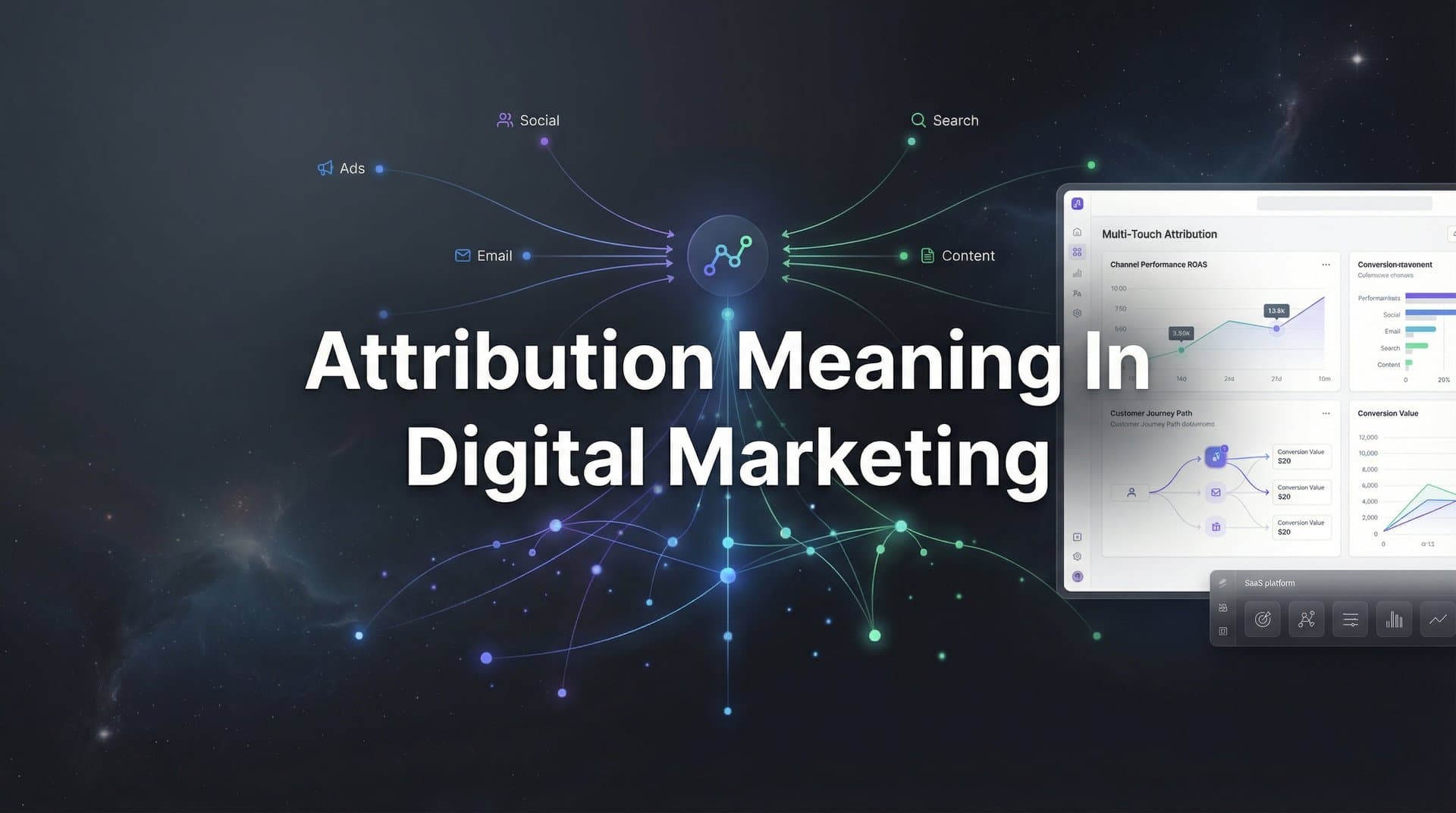
This is where attribution becomes your compass. Attribution meaning in digital marketing is the process of identifying which touchpoints in the customer journey contribute to conversions. It's the difference between guessing which campaigns work and knowing with confidence where every dollar should go.
Think of attribution as your marketing detective. It follows prospects from their first interaction with your brand all the way through to conversion, assigning credit to the moments that mattered most. For modern marketers juggling multiple channels, attribution isn't optional—it's the foundation of every smart budget decision you'll make.
The Core Concept: How Attribution Connects Marketing Actions to Business Results
Attribution tracks the complete customer journey from first ad impression to final conversion, mapping every touchpoint along the way. When someone converts, attribution tells you which ads they clicked, which emails they opened, which landing pages they visited, and which retargeting campaigns brought them back. Each of these moments gets assigned a portion of credit for the final outcome.
Here's what makes this powerful: you're not just seeing patterns in your data—you're proving causation. Correlation shows you that conversions increased when you ran a specific campaign. Attribution shows you that the campaign actually caused those conversions by tracking individual user paths. That distinction transforms how you allocate budget.
Consider a typical customer journey in 2026. Someone sees your Instagram ad on Monday but doesn't click. Tuesday, they search your brand name on Google and visit your site. Wednesday, they receive your welcome email and click through to a product page. Thursday, a retargeting ad reminds them what they were looking at. Friday, they search again, click your ad, and convert.
Which touchpoint "worked"? Without attribution, most analytics platforms would credit only that final Google search—the last click before conversion. But that's like giving the final pass in soccer all the credit for the goal while ignoring the entire play that made it possible.
Attribution reveals the full story. It shows you that the Instagram ad created initial awareness, the branded search indicated interest, the email nurtured consideration, and the retargeting ad provided the crucial reminder. Each played a role. Each deserves credit. Each informs your next budget decision.
Modern multi-channel campaigns make attribution essential because customers rarely convert from a single touchpoint anymore. The average customer interacts with a brand multiple times across different platforms before making a purchase decision. They might discover you on social media, research you via search, compare you through review sites, and convert through a retargeting campaign.
Without attribution, you're making decisions based on incomplete information. You might cut spending on awareness channels because they don't show last-click conversions, not realizing they're essential for starting journeys that convert later. Or you might over-invest in retargeting because it captures the final click, missing that you're just harvesting demand created by other channels.
Attribution closes this gap by connecting every marketing action to its actual business result. It answers the questions that keep marketers up at night: Which channels should I scale? Where am I wasting money? What's the real ROI of my awareness campaigns? Which combinations of touchpoints convert best? Understanding why attribution is important in digital marketing helps teams move from guesswork to data-driven confidence.
Single-Touch vs. Multi-Touch: Choosing Your Attribution Approach
Attribution models fall into two broad categories: single-touch and multi-touch. Understanding the difference helps you choose the right approach for your business.
First-touch attribution gives all credit to the initial interaction—the moment someone first discovered your brand. If a prospect clicked your Facebook ad three weeks ago and converts today after multiple other touchpoints, first-touch attributes 100% of that conversion to Facebook. This model excels at answering one specific question: which channels are best at creating awareness and starting customer journeys?
First-touch makes sense when you're primarily concerned with top-of-funnel performance. If you're launching a new brand or expanding into new markets, knowing which channels introduce you to new audiences matters more than understanding the full journey. It helps you invest in discovery channels that bring fresh prospects into your ecosystem.
The limitation? First-touch ignores everything that happened after that initial click. It can't tell you which nurture sequences work, which retargeting campaigns seal deals, or which content moves prospects from consideration to conversion. You're crediting the introduction but missing the entire relationship that followed.
Last-touch attribution sits at the opposite end. It credits the final touchpoint before conversion with 100% of the value. This is the default model for most analytics platforms because it's simple to implement and easy to understand. If someone clicked your Google search ad and immediately converted, Google gets all the credit.
Last-touch is common but often misleading for complex customer journeys. It systematically over-credits bottom-of-funnel channels like branded search and retargeting while under-crediting the awareness and consideration channels that made those conversions possible. You end up thinking your retargeting campaign is a revenue machine when it's actually just capturing demand created elsewhere.
Picture this scenario: You run a podcast ad that introduces someone to your product. They visit your site but don't convert. A week later, they see your Facebook ad and visit again. Still not ready. Two weeks after that, they search your brand name, click your Google ad, and convert. Last-touch gives Google 100% of the credit. The podcast and Facebook ad that created and nurtured that demand? Zero credit.
This is where multi-touch attribution transforms your understanding. Multi-touch models distribute credit across the entire journey, recognizing that conversions rarely happen because of a single interaction. Instead of asking which touchpoint deserves all the credit, multi-touch asks how much credit each touchpoint deserves based on its role in the journey.
Multi-touch attribution requires more robust tracking infrastructure because you need to follow users across sessions, devices, and platforms. You're not just recording the last click—you're building a complete timeline of every interaction. This means implementing proper tracking pixels, maintaining consistent UTM parameters, and often using server-side tracking to capture data that browser-based methods miss.
The payoff is accuracy. Multi-touch attribution shows you the real value of every channel in your mix. You discover that your podcast ads don't convert immediately but start journeys that convert at high rates two weeks later. You learn that your educational blog content rarely gets last-click credit but plays a crucial role in moving prospects from awareness to consideration. You see which combinations of touchpoints work best together.
Choosing between single-touch and multi-touch isn't about which is "better"—it's about which answers the questions you're asking. If you need to understand awareness channel performance, first-touch works. If you want to optimize for immediate conversions, last-touch has value. But if you want to understand what's really driving revenue across your entire marketing mix, multi-touch attribution is the only approach that delivers complete visibility.
Common Attribution Models and When Each Makes Sense
Within multi-touch attribution, several models distribute credit differently based on various assumptions about how customer journeys work. Understanding these models helps you choose the one that matches your business reality.
The linear attribution model splits credit equally across all touchpoints in the journey. If someone interacted with five different campaigns before converting, each campaign gets 20% of the credit. This approach assumes every touchpoint contributes equally to the final outcome—no single moment matters more than another.
Linear attribution works best for businesses where touchpoint value remains relatively consistent throughout the funnel. If your product requires multiple educational interactions before someone's ready to buy, and each interaction plays an equally important role in building understanding, linear makes sense. It prevents you from over-crediting the beginning or end of the journey at the expense of the middle.
The limitation of linear attribution is that it treats all touchpoints the same even when they clearly aren't. The ad that introduced someone to your brand probably played a different role than the retargeting ad that reminded them to complete their purchase. Linear attribution can't distinguish between these different functions.
Time-decay attribution addresses this by weighting recent interactions more heavily than older ones. The closer a touchpoint is to conversion, the more credit it receives. An interaction that happened yesterday gets more credit than one from last week, which gets more credit than one from last month.
Time-decay models work well for short sales cycles and promotional campaigns where recency matters. If you're running a limited-time sale, the touchpoints closest to the conversion deadline naturally carry more weight—they're the ones that created urgency and drove action. Time-decay reflects this reality by giving them more credit.
This model also makes sense when you're primarily concerned with what's working right now. If you're constantly testing new campaigns and want to understand which recent efforts are driving results, time-decay focuses your attention on the touchpoints that matter most in the current moment.
The challenge with time-decay is that it can undervalue the awareness and consideration touchpoints that started the journey. Someone might have discovered your product through a podcast ad a month ago and spent weeks researching before converting. Time-decay gives that crucial introduction minimal credit because it happened early in the timeline.
Position-based attribution, often called U-shaped attribution, takes a different approach. It emphasizes both the first and last touchpoints—typically giving each 40% of the credit—while distributing the remaining 20% across all the middle interactions. This model assumes that two moments matter most: the introduction that created awareness and the final interaction that drove conversion.
Position-based attribution works well when both awareness and conversion moments carry special significance in your customer journey. If you know that getting someone to discover your brand is hard, and getting them to finally convert is also hard, but the middle of the journey is relatively straightforward, U-shaped attribution reflects that reality.
Many businesses find position-based attribution practical because it balances the insights of first-touch and last-touch models. You understand which channels are best at creating awareness and which are best at closing deals, without completely ignoring the nurture touchpoints in between. For a deeper dive into selecting the right approach, explore the top attribution models in digital marketing to enhance your campaign effectiveness.
The downside? Position-based attribution can undervalue the middle of the journey. If your business requires extensive education and nurture before someone's ready to buy—think complex B2B software or high-consideration purchases—the touchpoints that build understanding and trust might deserve more credit than a position-based model provides.
Here's the truth about choosing an attribution model: there's no universally "correct" answer. The best model matches your typical customer journey. If most customers convert quickly after discovery, time-decay or last-touch might work fine. If you have a long, complex journey with multiple important touchpoints, linear or custom multi-touch models make more sense. If awareness and conversion moments matter most, position-based attribution aligns with your reality.
The key is to choose a model and stick with it long enough to gather meaningful insights. Constantly switching attribution models makes it impossible to compare performance over time. Pick the model that best represents how your customers actually move through their journey, then use it consistently to inform your decisions.
The Technical Side: What Makes Attribution Actually Work
Understanding attribution models matters, but none of them work without the technical infrastructure to track users across their entire journey. Let's break down what's happening behind the scenes when attribution actually functions properly.
Tracking pixels are small pieces of code placed on your website that record when someone visits a page or takes an action. When you add the Meta Pixel or Google tag to your site, you're enabling those platforms to see what happens after someone clicks your ad. The pixel fires when someone lands on your site, when they view a product, when they add to cart, and when they complete a purchase.
UTM parameters work alongside pixels to identify where traffic comes from. These are the tags you add to your URLs—utm_source, utm_medium, utm_campaign—that tell your analytics platform which specific ad or email or link drove each visit. When someone clicks a link with UTM parameters, your analytics platform records that information and associates it with everything that user does during their session.
Cookies tie it all together by following individual users across sessions. When someone visits your site, a cookie is stored in their browser with a unique identifier. When they return tomorrow or next week, the cookie tells your tracking system "this is the same person who visited before," allowing you to build a complete timeline of their interactions.
This combination of pixels, UTM parameters, and cookies creates the foundation for attribution. You can see that User A clicked your Facebook ad on Monday, returned via email on Tuesday, and converted through a Google search on Friday. Each touchpoint gets recorded, and your attribution model distributes credit accordingly.
But here's where modern attribution gets complicated: this traditional browser-based tracking is increasingly unreliable. Apple's iOS privacy changes block tracking across apps and websites by default. Browser updates limit cookie lifespans. Privacy regulations restrict data collection. Users clear cookies or browse in private mode. The result is that browser-based tracking often misses significant portions of the customer journey.
Server-side tracking addresses these limitations by moving data collection from the browser to your server. Instead of relying on a pixel in someone's browser to send data to ad platforms, your server sends that data directly. This bypasses browser restrictions, ad blockers, and cookie limitations that break traditional tracking.
Here's how it works: When someone converts on your site, your server receives that information. Instead of hoping a browser pixel fires correctly, your server sends the conversion data directly to Meta, Google, and other platforms using their server-side APIs. The data is more reliable, more complete, and less affected by privacy restrictions.
Server-side tracking also captures data that browser-based methods miss entirely. If someone converts on a different device than where they clicked your ad—they clicked on mobile but converted on desktop—browser cookies can't connect those sessions. Server-side tracking can match them using email addresses, phone numbers, or other identifiers that persist across devices.
CRM integration completes the attribution picture by connecting marketing touchpoints to actual revenue outcomes, not just form fills or website conversions. Many marketers optimize for leads without knowing which leads actually become customers and generate revenue. CRM integration closes that loop.
When your attribution platform integrates with your CRM, it can see the full lifecycle. You track not just which campaign generated a lead, but which campaign generated a lead that became a qualified opportunity, closed as a customer, and generated specific revenue. This transforms attribution from "which campaigns drive form fills" to "which campaigns drive profitable customers." Platforms focused on marketing revenue attribution specialize in connecting these dots across your entire tech stack.
The technical infrastructure for proper attribution isn't trivial to implement, but it's essential for making attribution actually work. Pixels and UTM parameters provide the foundation. Server-side tracking ensures reliability despite privacy restrictions. CRM integration connects marketing actions to revenue outcomes. Together, they create the complete data foundation that makes attribution meaningful rather than just theoretical.
Putting Attribution Data to Work: Practical Applications
Understanding attribution is valuable, but the real power comes from using attribution insights to make better marketing decisions. Here's how attribution data transforms from interesting information into actionable strategy.
Budget reallocation becomes data-driven instead of guesswork. When you see which channels and campaigns actually drive revenue—not just clicks or impressions—you can confidently move money from underperforming channels to proven revenue drivers. Attribution shows you that Channel A generates lots of traffic but rarely contributes to conversions, while Channel B drives fewer visits but plays a crucial role in high-value customer journeys.
This gets specific fast. You might discover that your podcast ads don't show immediate conversions but consistently start journeys that convert at high rates two weeks later. Without attribution, you'd cut podcast spending because it doesn't show last-click results. With attribution, you double down because you understand its real value in the customer journey.
Or you learn that your educational blog content rarely gets last-click credit but appears in 80% of your highest-value customer journeys. Attribution reveals that this content plays an essential role in moving prospects from awareness to consideration. You invest more in content creation because you can prove its contribution to revenue.
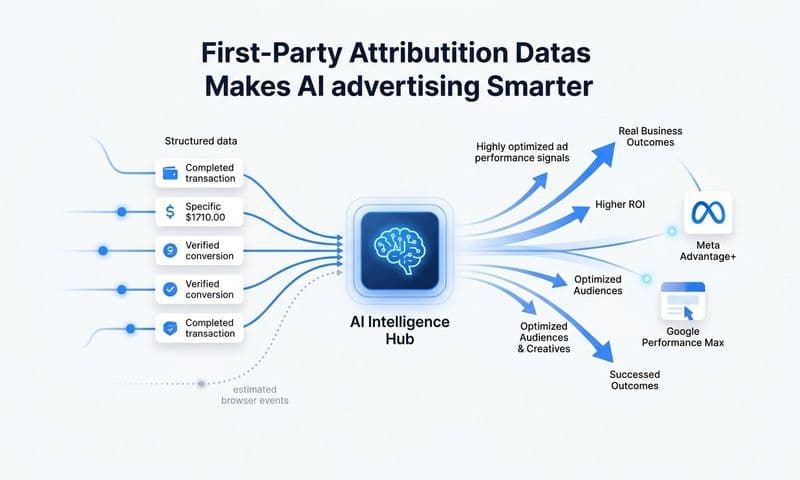
Feeding accurate conversion data back to ad platforms improves their algorithms and targeting. Meta's algorithm and Google's Smart Bidding work better when they receive complete, accurate information about which clicks led to conversions. When browser-based tracking misses conversions or attributes them incorrectly, ad platforms optimize for the wrong outcomes.
Attribution platforms with server-side tracking solve this by sending enriched conversion data back to ad platforms through Conversion APIs. Instead of ad platforms seeing only the conversions that browser pixels managed to track, they see all conversions with complete attribution data. This helps their algorithms identify better audiences and optimize for actual business results.
The impact is measurable. When ad platforms receive better data, they find better prospects. Their targeting becomes more precise. Their bid strategies optimize for the outcomes you actually care about. You're not just improving your internal understanding—you're improving how the platforms themselves perform on your behalf.
Attribution also reveals which content and creative combinations move prospects through the funnel most effectively. You might learn that prospects who see your product demo video are three times more likely to convert than those who don't. Or that the combination of a problem-focused ad followed by a solution-focused ad converts better than either ad alone.
These insights inform your creative strategy. You create more content that matches what's working. You structure campaigns to expose prospects to the combinations that convert best. You stop guessing which messages resonate and start knowing based on actual journey data.
Attribution data also helps you understand channel synergies—how different platforms work together rather than in isolation. Understanding multi-channel attribution in digital marketing reveals that prospects who interact with both your Facebook ads and your Google search ads convert at much higher rates than those who see only one. This insight changes your strategy from optimizing each channel independently to orchestrating them together for maximum impact.
The goal isn't to obsess over attribution data for its own sake. The goal is to use attribution insights to make better decisions every week: where to spend more, where to spend less, which creative to scale, which audiences to target, which channels to pair together. Attribution transforms marketing from an art based on intuition to a science based on evidence.
Putting It All Together: Building Your Attribution Strategy
Attribution isn't something you set up once and forget. It's an ongoing practice that evolves as you gather more data and your business grows. Here's how to approach building your attribution strategy.
Start with clear goals. Are you optimizing for awareness, lead generation, or revenue? Your goal determines which attribution model makes sense and which metrics matter most. If you're focused on awareness, first-touch attribution helps you understand which channels introduce new prospects. If you're optimizing for revenue, multi-touch attribution with CRM integration shows you which campaigns drive profitable customers.
Be specific about what you're trying to optimize. "Better marketing results" is too vague. "Increase revenue from paid channels by identifying and scaling the campaigns that drive highest-value customers" gives you a clear target. Your attribution strategy should directly support this goal.
Match your attribution model to your typical customer journey length and complexity. If most customers convert within a day or two of first discovering you, simpler models work fine. If your sales cycle spans weeks or months with multiple touchpoints, you need multi-touch attribution to understand what's really working.
Consider your business model too. E-commerce businesses with short consideration periods might succeed with time-decay or position-based models. B2B companies with long sales cycles and multiple stakeholders need robust multi-touch attribution that tracks the entire journey from first visit to closed deal.
Implement proper tracking infrastructure before you try to interpret attribution data. That means consistent UTM parameters across all campaigns, tracking pixels properly installed, server-side tracking to ensure data reliability, and CRM integration to connect marketing touchpoints to revenue. Without solid data collection, even the best attribution model produces unreliable insights. Reviewing a comprehensive attribution marketing tracking guide can help you establish this foundation correctly.
Treat attribution as an ongoing practice, not a one-time setup. Your customer journey evolves. New channels emerge. Privacy regulations change. What worked last year might not work today. Review your attribution data regularly—weekly or monthly depending on your volume—and adjust your strategy based on what you learn.
Look for patterns over time rather than reacting to individual data points. One campaign might show poor attribution results because it's new and hasn't had time to demonstrate its role in customer journeys. Another might show strong results temporarily before regressing to the mean. Focus on sustained patterns that appear consistently across multiple time periods.
Don't let perfect be the enemy of better. Attribution will never be 100% accurate—there will always be offline touchpoints you can't track, cross-device journeys you can't fully connect, and data gaps you can't completely close. That's fine. The goal isn't perfect attribution. The goal is better attribution than you had before, which means better decisions than you made before. Understanding the common attribution challenges in digital marketing prepares you to navigate these limitations effectively.
Moving Forward: From Guesswork to Confidence
Understanding attribution meaning in digital marketing transforms how teams make decisions. Instead of relying on gut feelings about which campaigns work, you have data-driven confidence about where every dollar should go. Instead of crediting the last click and missing the full journey, you see which touchpoints actually contribute to revenue.
This shift matters because marketing budgets are too important to waste on guesswork. When you understand which channels start valuable customer journeys, which content moves prospects through consideration, and which campaigns close deals, you make smarter investments. You scale what works. You cut what doesn't. You stop flying blind.
The marketers who master attribution gain a competitive advantage. While others optimize for vanity metrics or last-click conversions, you optimize for actual revenue. While others wonder why their campaigns underperform, you know exactly which changes to make. While others guess at budget allocation, you reallocate with confidence based on proven performance.
Attribution isn't just about understanding the past—it's about improving the future. Every insight you gain from attribution data informs your next campaign, your next creative test, your next budget decision. Over time, these improvements compound. Your marketing becomes more efficient, more effective, and more profitable.
The journey starts with evaluating your current tracking setup. Do you have proper pixels and UTM parameters in place? Is your data reliable despite browser restrictions and privacy changes? Can you connect marketing touchpoints to actual revenue in your CRM? If the answer to any of these questions is no, you have gaps that limit your ability to understand what's really driving results.
A dedicated attribution platform solves these challenges by providing the infrastructure and insights you need in one place. Instead of cobbling together data from multiple sources and trying to build attribution models manually, you get complete visibility into every touchpoint, accurate tracking that works despite privacy restrictions, and clear insights about which campaigns drive revenue. Exploring the best marketing attribution tools helps you identify solutions that match your specific needs.
Ready to elevate your marketing game with precision and confidence? Discover how Cometly's AI-driven recommendations can transform your ad strategy—Get your free demo today and start capturing every touchpoint to maximize your conversions. See exactly which campaigns drive your results, feed better data to your ad platforms, and make budget decisions based on actual revenue impact rather than guesswork. The clarity you need to scale profitably is one demo away.