You've spent months building your marketing tech stack. Your team runs campaigns across Meta, Google, TikTok, and half a dozen other platforms. Revenue is growing, but you can't confidently answer which channels actually drive conversions. So you start researching enterprise attribution solutions—and suddenly you're drowning in quotes that look nothing alike.
One vendor prices by data volume. Another charges per user seat. A third bundles everything into a flat enterprise fee with vague language about "standard integrations." You're comparing proposals that might as well be written in different languages, and the stakes couldn't be higher. Choose wrong, and you're locked into a multi-year contract with a solution that doesn't actually solve your attribution problem.
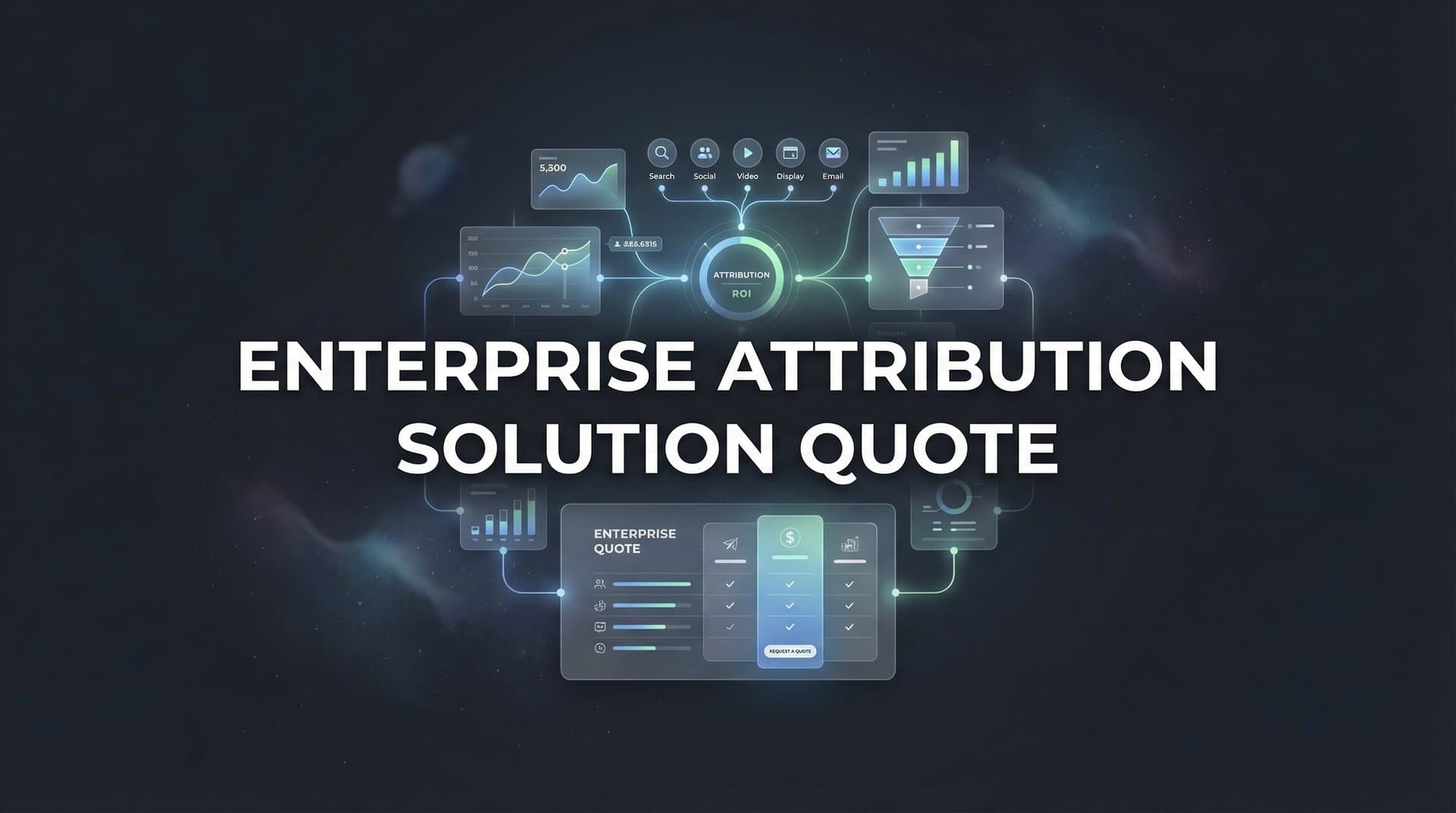
Understanding what goes into an enterprise attribution solution quote isn't just about finding the lowest price. It's about recognizing what you're actually buying, identifying hidden costs before they surprise you, and ensuring the solution will scale with your business. This guide breaks down exactly what to expect in enterprise attribution quotes and how to evaluate them with confidence.
Understanding the Building Blocks of Attribution Pricing
Enterprise attribution quotes rarely come as a single line item. Instead, you're looking at a complex structure of components that vendors price differently based on their business model and target market.
The core platform license typically covers your access to the attribution dashboard, basic reporting capabilities, and foundational tracking features. Think of this as your entry fee—it gets you in the door, but it doesn't necessarily include everything you need to run sophisticated attribution analysis. Some vendors bundle extensive features into this base license, while others keep it minimal and charge separately for capabilities you might consider essential.
Add-on modules and premium features often include the capabilities that actually make attribution valuable for enterprise teams. Multi-touch attribution models beyond basic last-click? That might be an add-on. AI-powered optimization recommendations? Another module. Advanced audience segmentation or custom attribution windows? You guessed it—potentially separate line items. When you're evaluating quotes, pay close attention to what's included in the base platform versus what requires additional investment.
Data volume tiers represent one of the most significant variables in enterprise attribution pricing. Most platforms charge based on the number of events they track—clicks, page views, form submissions, purchases, and every other touchpoint in your customer journey. A growing business might start at 10 million events per month but quickly scale to 50 million or 100 million as campaigns expand. Understanding your current data volume and projected growth is crucial, because overage charges can dramatically increase your actual cost.
User seat licensing determines how many team members can access the platform. Some vendors charge per seat with tiered permission levels—viewers, editors, and admins each priced differently. Others offer unlimited users within the enterprise license. For large marketing teams or agencies managing multiple clients, seat costs can add up quickly. Consider not just your current team size but how many stakeholders across sales, product, and executive leadership might need access to attribution data.
Implementation and onboarding costs often appear as separate line items, and they vary wildly based on the complexity of your tech stack. A straightforward implementation connecting Meta and Google Ads might include basic onboarding in the platform license. But integrating with your CRM, data warehouse, multiple e-commerce platforms, and custom internal tools? That typically requires dedicated implementation services, technical support, and custom integration development—all priced separately. Understanding the full scope of enterprise attribution implementation helps you anticipate these costs accurately.
Training and ongoing support represent another cost category that's easy to overlook. Some vendors include comprehensive training as part of implementation, while others charge hourly rates for training sessions. Ongoing support might be tiered—basic email support included, but priority phone support or a dedicated customer success manager requiring an upgraded plan. For enterprise teams managing complex attribution needs, the level of support can make or break your success with the platform.
Essential Features Your Quote Should Include
Not all attribution platforms are built equally, and your quote should clearly outline the specific capabilities included in your package. These features directly impact whether the solution will actually solve your attribution challenges or leave you with more questions than answers.
Multi-touch attribution models form the foundation of meaningful attribution analysis. Your quote should specify which attribution models are available—first-touch, last-touch, linear, time decay, position-based, and ideally custom models you can configure based on your specific customer journey. Enterprise marketers need flexibility to compare different attribution perspectives, not just accept a single default model. If a vendor's quote doesn't clearly state which models are included, that's a question worth asking before you sign. For deeper insight into model selection, explore how multi-touch attribution models impact your data analysis.
Cross-channel tracking coverage determines whether you'll see the complete customer journey or just fragments. The quote should list every ad platform, analytics tool, and marketing channel the solution integrates with. Meta and Google Ads are table stakes—but what about TikTok, LinkedIn, Pinterest, Snapchat, or emerging platforms your team might test? Does the solution track organic search, email marketing, affiliate channels, and offline conversions? Gaps in channel coverage mean blind spots in your attribution data. A comprehensive marketing channel attribution solution guide can help you identify what coverage you actually need.
Server-side tracking capabilities have become increasingly critical as browser privacy changes and iOS tracking limitations erode the accuracy of client-side tracking. Your quote should explicitly address whether the platform offers server-side tracking, how it's implemented, and whether there are additional costs or data volume limits. Server-side tracking isn't just a nice-to-have anymore—it's essential for accurate attribution in a privacy-first world.
Integration depth with your CRM and data warehouse matters more than simple connectivity. Can the platform ingest CRM data to track conversions that happen offline or through sales calls? Does it integrate with your data warehouse to combine attribution data with other business intelligence? The quote should specify not just which integrations exist, but how deeply they connect and what data flows between systems.
AI-powered optimization features represent the difference between passive reporting and actionable intelligence. Look for clear language in the quote about AI capabilities—does the platform provide automated recommendations for budget allocation? Can it identify high-performing audience segments or underperforming campaigns? Does it predict conversion likelihood or suggest optimization strategies? AI features vary dramatically between vendors, and vague promises about "machine learning" aren't enough.
Real-time reporting capabilities determine how quickly you can act on attribution insights. Some platforms process data in batches, meaning you might wait hours or even a day to see updated attribution. Others offer real-time or near-real-time processing. For enterprise teams running aggressive testing and optimization cycles, reporting latency directly impacts your ability to make fast decisions. Your quote should specify data processing speed and reporting refresh rates.
Conversion sync functionality allows you to feed enriched conversion data back to ad platforms like Meta and Google, improving their algorithm optimization. This capability transforms attribution from a reporting tool into an optimization engine. Your quote should clarify whether conversion sync is included, which platforms it supports, and any limitations on the types or volume of events you can sync back. Understanding enterprise conversion tracking solutions helps you evaluate this critical feature.
Warning Signs and Unexpected Expenses
Reading between the lines of an enterprise attribution quote often reveals costs and limitations that aren't immediately obvious. Knowing what to watch for protects you from surprises six months into your contract.
Vague language around data limits should immediately raise questions. Phrases like "standard data volumes" or "typical enterprise usage" mean nothing without specific numbers. You need to know exactly how many events are included, how overages are calculated, and what happens if you exceed your tier. Some vendors charge steep overage fees—doubling or tripling your monthly cost if you exceed your event limit. Others automatically upgrade you to the next tier without notification. Get specific numbers and overage policies in writing.
Long-term contracts without flexibility lock you into commitments before you've fully validated the solution. Multi-year contracts are common in enterprise software, but they should include reasonable exit clauses or downgrade options. If your business priorities shift, your marketing stack changes, or the platform doesn't deliver expected value, you need a path to adjust or exit without paying the full contract value. Watch for auto-renewal clauses that extend contracts without explicit approval.
Missing details on support levels and SLAs often become painful once you're live and need help. The quote should specify your support tier, response time commitments, and channels available for support requests. Will you get email-only support with 48-hour response times, or do you have access to phone support with same-day resolution? Is there a dedicated customer success manager, or are you submitting tickets to a general queue? For enterprise implementations, support quality directly impacts your time to value.
Separate charges for "premium integrations" can add significant cost if the platforms you need fall into this category. Some vendors include standard integrations but charge extra for newer platforms, custom APIs, or data warehouse connections. Your quote should clearly list which integrations are included and which require additional fees. If a critical integration for your business is marked as premium, factor that cost into your total investment.
Implementation timelines that seem unrealistic often indicate either oversimplification of your needs or hidden costs for expedited service. A vendor promising a two-week implementation for a complex enterprise tech stack is either not accounting for the actual work required or planning to charge separately for the resources needed to meet that timeline. Realistic implementation estimates demonstrate that the vendor understands your complexity.
Training that's billed separately or limited to a fixed number of hours can leave your team struggling to use the platform effectively. Enterprise attribution platforms are sophisticated tools—your team needs comprehensive training to extract value. If training is limited or costs extra beyond a basic orientation, budget for the actual training time your team will need to become proficient.
Critical Questions Before You Commit
Before you sign any enterprise attribution contract, these questions help you validate that the solution truly fits your needs and that the quote accurately reflects the total investment required.
How does the platform handle server-side tracking and privacy compliance? This isn't just about whether server-side tracking exists—you need to understand the implementation process, whether it requires engineering resources from your team, and how the platform ensures compliance with GDPR, CCPA, and other privacy regulations. Does the platform provide consent management tools, or do you need to integrate with a separate consent platform? How does it handle data residency requirements if you operate globally?
What does the implementation timeline look like, and who owns each phase? Get specific about the implementation process. What work does the vendor handle versus what requires your team's time? Are there dependencies on your engineering team for server-side tracking setup or custom integrations? What's the typical timeline from contract signing to full production deployment? Understanding the implementation workload helps you plan resources and set realistic expectations for when you'll start seeing attribution value.
How will the solution feed better data back to ad platform algorithms? Conversion sync capabilities vary significantly between platforms. Ask specifically which ad platforms support conversion sync, what types of events can be synced, and whether there are volume limitations. Can you sync custom conversion events beyond standard purchases? Does the platform enrich conversion data with attribution insights before syncing back? This functionality directly impacts your ad platform optimization and ROI.
What happens to your data if you decide to leave the platform? Data portability matters more than most buyers consider upfront. Can you export your historical attribution data? In what format? Are there limitations on bulk exports or API access for data extraction? Understanding your exit options before you enter a contract gives you leverage and protects your investment in attribution data.
How does pricing scale as your business grows? Your marketing efforts will evolve—new channels, higher volumes, more team members. Ask how pricing adjusts as you scale. Are there volume discounts at higher tiers? Can you add users or integrations mid-contract without triggering a full contract renegotiation? Understanding the scaling model helps you project long-term costs and avoid surprises as you grow.
What's included in ongoing platform updates and feature releases? Enterprise software evolves constantly. Are platform updates, new features, and new integrations included in your license, or do major feature releases require upgrade fees? Some vendors include all updates in the base license, while others charge for access to new capabilities. Knowing the update policy helps you understand whether you're buying the platform as it exists today or investing in continuous improvement.
Technical Validation Questions
Can the platform handle your specific data volume and complexity? Share your actual numbers—events per month, number of campaigns, number of conversion types, number of customer touchpoints. Ask whether the vendor has customers with similar scale and complexity. Request references from comparable implementations. This validates that the platform can actually handle your needs, not just theoretically support them.
How does the attribution logic work, and can you customize it? Attribution models sound simple in theory but involve complex logic about credit allocation, attribution windows, and handling of direct traffic. Ask the vendor to explain their attribution methodology in detail. Can you adjust attribution windows? How does the platform handle multi-session journeys? Can you create custom rules for specific conversion types? Understanding the attribution logic helps you evaluate whether the platform's approach aligns with your business model.
Building Your Attribution Solution Scorecard
Comparing enterprise attribution quotes requires a structured evaluation framework that goes beyond price comparison. Creating a weighted scorecard helps you objectively assess which solution delivers the best value for your specific needs.
Start by identifying your must-have requirements versus nice-to-have features. Must-haves might include server-side tracking, specific platform integrations, or real-time reporting. Nice-to-haves could be advanced AI features, custom attribution models, or white-label reporting. Weight these categories based on their importance to your business. If server-side tracking is critical for your iOS traffic, it should carry more weight than a feature you might use occasionally.
Calculate total cost of ownership beyond the sticker price in the quote. Include implementation costs, training expenses, the value of your team's time during setup, and projected costs as you scale. A lower-priced platform that requires extensive internal engineering resources might actually cost more than a higher-priced solution with comprehensive implementation support. Factor in the opportunity cost of delayed insights if one platform takes significantly longer to implement than another. When evaluating pricing structures, reviewing a detailed marketing attribution software quote breakdown can provide helpful benchmarks.
Evaluate how well each solution integrates with your existing marketing stack. The best attribution platform isn't the one with the most features—it's the one that works seamlessly with the tools you already use. If you're heavily invested in a specific CRM or data warehouse, deep integration with those systems might be more valuable than a broader but shallower integration catalog. Consider the technical debt of maintaining multiple disconnected tools versus a solution that centralizes your attribution data.
Assess the vendor's track record and roadmap. How long has the company been in business? Do they have customers similar to you in size and industry? What's their product development velocity—are they actively releasing new features and improvements? A platform that's stagnant or from a vendor with financial instability might be risky even if the current quote looks attractive. You're not just buying software today—you're choosing a partner for the next several years. Conducting a thorough enterprise attribution platform comparison reveals these differences clearly.
Consider the learning curve and adoption requirements for your team. The most sophisticated attribution platform delivers zero value if your team can't use it effectively. Evaluate the user interface, reporting flexibility, and how easily team members can extract insights without requiring data science skills. Some platforms excel at providing intuitive dashboards for marketers, while others require more technical expertise. Match the platform's complexity to your team's capabilities and available training time.
Compare the flexibility of attribution models and reporting capabilities. Can you easily switch between attribution models to analyze the same data from different perspectives? Can you create custom reports that answer your specific business questions? How easily can you segment data by campaign, channel, audience, or time period? The platform should adapt to your analytical needs, not force you into rigid reporting structures. Exploring enterprise attribution modeling tools helps you understand what flexibility to expect.
Creating Your Decision Matrix
Build a simple spreadsheet with vendors in columns and your weighted criteria in rows. Score each vendor on each criterion using a consistent scale—perhaps 1-10, where 10 represents perfect alignment with your needs. Multiply each score by the criterion's weight, then sum the weighted scores for each vendor. This quantitative approach doesn't make the decision for you, but it surfaces which solutions genuinely align with your priorities versus which ones just have compelling sales presentations.
Don't ignore qualitative factors that are harder to score. Your gut feeling about the vendor relationship matters. Did they listen to your specific needs, or did they pitch a generic enterprise package? Were they transparent about limitations, or did they overpromise capabilities? The vendor relationship will matter throughout your contract, especially when you need support or want to influence the product roadmap.
Making Your Final Decision with Confidence
You've collected quotes, asked hard questions, and built your evaluation framework. Now it's time to synthesize everything and make a decision that you can confidently defend to your team and leadership.
Start by eliminating any vendors that don't meet your must-have requirements, regardless of price. A cheaper solution that lacks critical capabilities isn't a bargain—it's a waste of time and money. Your shortlist should include only vendors who can genuinely solve your attribution challenges.
For your remaining candidates, request live demos focused on your specific use cases. Don't accept generic demo environments—ask the vendor to show exactly how their platform would handle your campaigns, your data volume, and your reporting needs. Bring technical questions from your team and watch how the vendor responds. Can they answer confidently, or do they need to follow up with their technical team? This reveals how well they actually understand their own platform.
Negotiate terms with your top choice, but keep your second choice warm. Enterprise software pricing is often negotiable, especially on contract length, payment terms, or included services. If you're signing a multi-year contract, you have leverage to request better pricing, additional user seats, or enhanced support. But don't get so focused on negotiating that you lose sight of value—a 10% discount doesn't matter if the platform doesn't deliver results.
Plan your implementation before you sign. Work with the vendor to create a detailed implementation plan with milestones, resource requirements, and success metrics. This planning process often surfaces hidden complexity or additional costs before you're locked into a contract. It also sets clear expectations for both sides about what success looks like and who's responsible for each phase.
Your Path to Attribution Clarity
An enterprise attribution solution quote isn't just a price tag—it's a detailed blueprint of what you're buying, how it will be implemented, and what ongoing costs you'll incur. The vendors with the most transparent quotes, clearest feature descriptions, and most realistic implementation timelines are often the ones who will become genuine partners in solving your attribution challenges.
The evaluation framework you've built here—breaking down quote components, identifying essential features, watching for red flags, asking critical questions, and scoring solutions objectively—transforms what could be an overwhelming decision into a manageable process. You now have the tools to compare quotes accurately, negotiate from a position of knowledge, and choose a solution that will scale with your business.
Remember that the goal isn't finding the cheapest attribution platform or the one with the longest feature list. It's finding the solution that will give your team accurate, actionable insights into which marketing efforts actually drive revenue. That clarity is worth investing in—both the financial investment in the right platform and the time investment in evaluating your options thoroughly.
Ready to see what transparent, comprehensive attribution pricing should look like? Cometly provides enterprise marketing teams with AI-driven attribution that captures every touchpoint, connects all your marketing channels, and feeds better data back to your ad platforms for improved optimization. Get your free demo today and discover how clear attribution insights can transform your marketing decisions and maximize your ROI.