You check your Facebook Ads Manager and see 50 conversions from yesterday's campaign. Your analytics platform shows 35. Your CRM records 42 actual sales. Three different numbers for the same day—and you're left wondering which one to trust when deciding whether to scale your budget.
This isn't a technical glitch. It's the direct result of how Facebook's attribution model assigns credit to conversions. Every time someone purchases after seeing or clicking your ad, Facebook's system decides whether that ad deserves credit—and those decisions shape the performance data you use to make budget calls.
The challenge has intensified since Apple's iOS 14.5 update changed the tracking landscape. Facebook now operates with less visibility into user behavior, relies on statistical modeling to fill gaps, and uses attribution windows that may not align with your actual sales cycle. Understanding how this system works isn't just academic—it's the foundation for interpreting your ad performance accurately and making confident scaling decisions.
How Facebook Assigns Credit to Your Conversions
Facebook's attribution model is the rulebook that determines which ad interaction gets credit when someone converts. Think of it as a referee deciding which player on a team gets credit for a goal—except in this case, the referee is Facebook's algorithm, and the goal is your conversion.
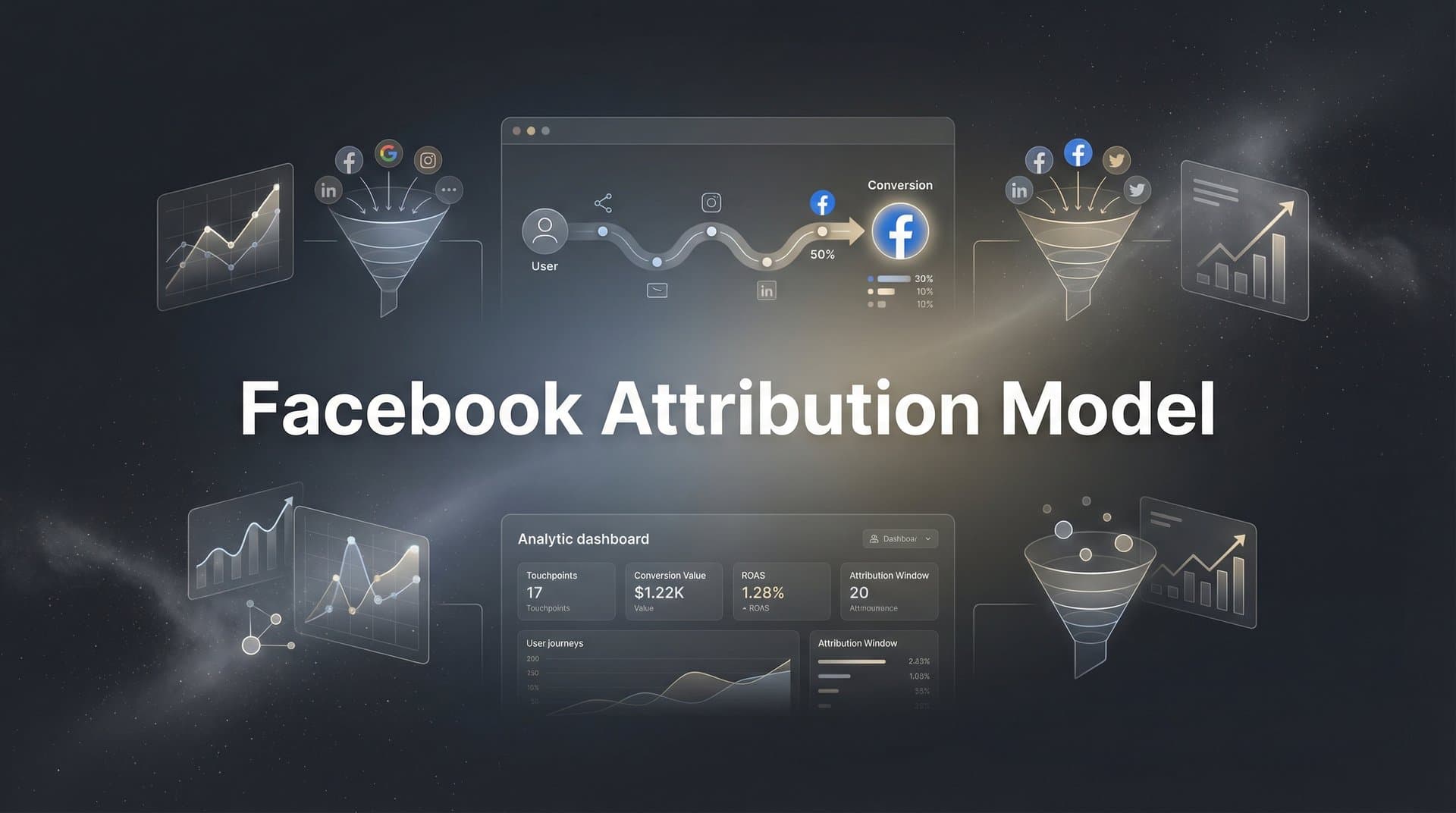
The default setting is a 7-day click and 1-day view attribution window. This means Facebook will credit an ad for a conversion if someone clicked that ad within the last 7 days before converting, or viewed it within the last 1 day before converting. The clock starts ticking from the moment of interaction and counts forward until the conversion happens.
Here's what this looks like in practice: Someone clicks your ad on Monday. They don't purchase immediately—maybe they get distracted or want to think it over. They return to your site on Thursday and complete the purchase. Since only three days have passed since the click, Facebook attributes that conversion to the original ad. The ad gets credit in your reporting, and Facebook's algorithm registers this as a successful outcome worth optimizing toward.
Click-through attribution tracks users who actively clicked your ad. This is straightforward: they saw your ad, took action, and later converted. The connection between ad exposure and conversion is direct and measurable through that click event.
View-through attribution is more nuanced. It credits conversions to ads that someone saw in their feed but didn't click. Let's say someone scrolls past your ad on Tuesday morning. They don't click, but the message registers. Later that same day, they search for your brand directly and purchase. Facebook counts this as a view-through conversion because the ad exposure happened within the 1-day window.
View-through attribution exists because Facebook's data shows that ad exposure influences behavior even without clicks. Someone might see your ad multiple times, building familiarity and intent, before converting through a different path. The challenge is distinguishing between ads that genuinely influenced the decision and ads that happened to be shown to someone who would have converted anyway. Understanding Facebook attribution tracking mechanics helps clarify these distinctions.
The attribution window acts as a cutoff point. Conversions happening after the window closes don't get attributed to the ad, even if that ad was the initial touchpoint. This matters significantly for products with longer consideration periods—a fact we'll explore when looking at how attribution windows affect different business models.
Facebook uses last-touch attribution within its ecosystem. If someone clicks multiple ads from your account before converting, the most recent ad interaction gets the credit. Earlier touchpoints in the Facebook journey don't appear in standard reporting, even though they contributed to moving the customer forward.
The Attribution Windows You Can Actually Choose
Facebook offers several attribution window configurations, each affecting how conversions get counted. The options available are 1-day click, 7-day click, and 1-day view—and you can combine click and view windows in different ways.
The most restrictive setting is 1-day click only. This credits conversions that happen within 24 hours of someone clicking your ad. It excludes all view-through conversions and any click-through conversions that occur after the first day. This setting gives you the most conservative conversion count—only the fastest-moving prospects who convert within a day get attributed.
The default 7-day click, 1-day view setting is Facebook's recommended balance. It captures conversions from users who need a few days to decide (up to a week from the click) while including same-day view-through conversions. This window works well for e-commerce products with moderate consideration periods—items that aren't impulse purchases but don't require weeks of research.
You can also select 7-day click only, which extends the click attribution window but removes view-through conversions entirely. This is useful if you're skeptical about view-through attribution's accuracy or want to focus budget on ads that drive direct engagement.
Choosing the right window depends on your sales cycle. For low-cost impulse purchases like phone accessories or digital downloads, a 1-day click window often captures most real conversions. People decide quickly, and conversions happening days later are less likely to be directly caused by the ad. Businesses selling online should explore attribution model ecommerce marketing strategies tailored to their purchase patterns.
For considered purchases like software subscriptions or premium products, a 7-day window better reflects reality. Your prospects might click an ad, read reviews, compare alternatives, and return several days later to purchase. A 1-day window would miss these conversions entirely, making successful ads appear to underperform.
Facebook removed the 28-day attribution window in 2021. This change significantly impacted businesses with longer sales cycles—B2B services, high-ticket coaching programs, and complex products where the consideration period stretches beyond a week. Conversions that previously would have been attributed to Facebook ads now fall outside the window and appear as direct or organic traffic instead.
The practical effect is that Facebook appears less effective for longer-cycle businesses than it did under the old system. The ads might still be working—creating awareness and starting customer journeys—but the attribution system no longer connects those initial touchpoints to eventual conversions. This creates a measurement challenge that requires looking beyond Facebook's native reporting to understand true ad impact.
Your attribution window choice also affects Facebook's optimization algorithm. The algorithm uses attributed conversions as feedback to improve targeting and bidding. A shorter window means less conversion data for the algorithm to learn from, potentially slowing optimization. A longer window provides more data but includes conversions that might be less directly connected to ad exposure.
Why Your Facebook Numbers Don't Match Reality
The discrepancy between Facebook's reported conversions and your actual sales data stems from multiple sources. The most significant is the iOS 14.5 update that fundamentally changed how Facebook can track iPhone and iPad users.
When Apple released iOS 14.5 in April 2021, apps had to ask users for permission to track their activity across other apps and websites. Most users declined. This meant Facebook lost the ability to track conversions for a large portion of mobile users through its traditional pixel-based methods. Instead of observing actual conversion events, Facebook now estimates conversions for opted-out users using statistical modeling.
These modeled conversions appear in your reporting alongside observed conversions, but they're educated guesses based on patterns from users who did allow tracking. The model might be reasonably accurate in aggregate, but individual campaign performance becomes less precise. You're making budget decisions based partly on actual data and partly on statistical estimates. Many advertisers now face persistent Facebook ads attribution issues stemming from these privacy changes.
Reporting delays compound the issue. Conversions from iOS users can take up to three days to appear in Facebook's reporting due to how Apple's privacy framework batches and delays data. This means your day-one performance numbers will look worse than reality, then get revised upward over the following days as delayed conversions trickle in. For marketers who check performance daily and make quick optimization decisions, this delay creates a distorted view of what's actually working.
Facebook's attribution system also has an inherent bias—it's designed to show Facebook's value. The platform naturally emphasizes conversions it can claim credit for while having no visibility into touchpoints that happened outside its ecosystem. If someone saw your Google ad first, then your Facebook ad, then converted, Facebook reports a conversion. Google also reports a conversion. Both platforms claim full credit for the same sale.
Cross-device journeys create blind spots. Someone might click your Facebook ad on their phone during a commute, then complete the purchase on their laptop at home. If they're not logged into Facebook on the laptop, or if they use a different browser, Facebook can't connect these two events. The conversion happens, but Facebook doesn't attribute it to the ad that initiated the journey.
Ad blockers and privacy-focused browsers like Brave or Safari with tracking prevention strip out Facebook's tracking pixels. Users browsing with these tools can click your ad, land on your site, and convert—but Facebook never receives the conversion signal. From Facebook's perspective, the ad didn't lead to a conversion, even though it directly caused one. These represent ongoing Facebook attribution challenges that affect nearly every advertiser.
Cookie deletion and browser settings that automatically clear cookies after each session break the tracking chain. The Facebook pixel relies on cookies to recognize returning visitors. When cookies are cleared, a returning customer looks like a new visitor, and Facebook can't attribute their conversion to the original ad interaction.
The result is systematic underreporting in Facebook's data. The platform shows fewer conversions than actually occurred because it can't see the full picture. This makes successful campaigns appear less effective than they are, potentially leading you to cut budget from ads that are actually profitable.
Single-Touch vs. Multi-Touch: What Facebook Won't Show You
Facebook's attribution model is single-touch within its own ecosystem. When someone converts, Facebook looks at their recent ad interactions within Facebook and Instagram, picks the most recent qualifying touchpoint, and assigns full credit to that ad. Everything else in the customer journey—before Facebook, after Facebook, or on other platforms entirely—remains invisible.
This creates a distorted view of how customers actually find and choose your product. Real customer journeys are rarely linear. Someone might discover your brand through a Google search, see your Facebook ad later that day, receive a follow-up email the next morning, and finally convert after clicking through from that email. In this scenario, Google search started the journey, Facebook reinforced the message, and email closed the sale.
But here's what each platform reports: Google claims a conversion (last non-direct click). Facebook claims a conversion (7-day click attribution). Your email platform claims a conversion (direct click to purchase). Three platforms, three conversion claims, one actual sale. If you add up the conversions each platform reports, you'd think you generated three times your actual revenue.
Multi-touch attribution solves this by tracking the entire customer journey across all channels and assigning fractional credit to each touchpoint based on its role. Instead of one touchpoint getting 100% credit, the model might assign 30% to the initial Google search, 30% to the Facebook ad, and 40% to the email that drove the final conversion. Learning about multi-touch attribution models helps marketers understand these credit distribution approaches.
Different multi-touch models distribute credit differently. Linear attribution splits credit evenly across all touchpoints. Time-decay attribution gives more credit to touchpoints closer to the conversion. Position-based attribution emphasizes the first and last touchpoints while giving some credit to middle interactions. Each model offers different insights into how your marketing channels work together. A thorough comparison of attribution models can help you identify which approach fits your business.
The value of multi-touch attribution becomes clear when you're running campaigns across multiple platforms. Let's say you're spending money on Facebook, Google, and email marketing. Facebook's dashboard shows strong conversion numbers. Google's dashboard also shows strong numbers. Both platforms suggest you should increase budget. But when you look at your actual sales growth, it doesn't match the combined conversion claims.
Multi-touch attribution reveals the overlap. You discover that 60% of your Facebook conversions also had a Google touchpoint earlier in the journey. The channels aren't generating independent conversions—they're working together to convert the same customers. This insight changes your budget allocation strategy entirely. Instead of scaling both platforms proportionally, you might invest more heavily in the channel that initiates journeys or the one that closes sales most efficiently.
Facebook's single-touch view also hides the impact of your organic content, referral traffic, and brand-building efforts. If someone discovers you through a podcast mention, researches you organically, then clicks a Facebook retargeting ad and converts, Facebook claims full credit. The podcast and organic research—which did the heavy lifting of building trust and intent—don't appear in the attribution story. Understanding the difference between single source attribution and multi-touch attribution models reveals why this matters for budget decisions.
Making Smarter Decisions With Better Attribution Data
The first step toward accurate attribution is comparing Facebook's reported conversions against your source of truth—your CRM, payment processor, or backend analytics. Run this comparison weekly. Export Facebook's conversion data and line it up against actual transactions in your system. The gap between these numbers tells you how much Facebook is over-claiming or under-reporting.
Track this discrepancy over time. If Facebook consistently reports 30% more conversions than your backend shows, you know to mentally adjust Facebook's numbers downward when evaluating performance. If Facebook shows fewer conversions than reality, you're likely dealing with tracking gaps that need fixing. Comparing Facebook attribution vs third party tools can illuminate where discrepancies originate.
Server-side tracking through Facebook's Conversions API addresses many tracking limitations. Instead of relying on browser pixels that can be blocked or fail to fire, server-side tracking sends conversion data directly from your server to Facebook. This captures conversions that ad blockers would otherwise hide, reduces the impact of iOS limitations, and provides more reliable data.
Implementing server-side tracking requires technical setup, but the payoff is significant. You'll see more complete conversion data, which means better optimization signals for Facebook's algorithm. The algorithm makes smarter bidding decisions when it has accurate feedback about which ads drive real conversions. Proper Facebook attribution setup ensures your tracking infrastructure captures these signals correctly.
First-party data collection strengthens your attribution foundation. When users create accounts, subscribe to emails, or provide contact information, you can track their journey with greater precision. You're no longer dependent solely on cookies and pixels—you have identified user data that persists across sessions and devices.
Feeding enriched conversion data back to Facebook improves ad performance beyond just measurement. When you send back conversion events with higher value (actual purchase amounts rather than generic conversion signals), Facebook's algorithm can optimize for revenue rather than just conversion volume. This shifts the focus from generating cheap conversions to generating profitable ones.
Use conversion value optimization when your transaction values vary significantly. Instead of telling Facebook "get me conversions," you're telling it "get me high-value conversions." The algorithm learns to identify and bid more aggressively for users likely to make larger purchases, improving your return on ad spend.
Build a single source of truth outside Facebook. Whether it's a dedicated attribution platform or a well-structured analytics setup, you need one place where all marketing touchpoints flow together. This system should capture clicks and conversions from every channel, match them to individual customer journeys, and show you the complete path to purchase. Investing in marketing attribution modeling software provides this unified visibility.
With this unified view, you can answer questions Facebook alone can't address: Which channel initiates the most high-value customer journeys? How many touchpoints does your average customer need before converting? Which channel combinations produce the best results? Are your Facebook ads more effective at starting journeys or closing them?
Test attribution windows empirically rather than assuming the default is optimal. Run the same campaign with different attribution windows and compare the reported conversions against your actual sales. If 7-day click attribution shows 100 conversions but your backend only confirms 70 sales, while 1-day click shows 60 conversions with 58 confirmed sales, the shorter window gives you more accurate data for decision-making.
Moving Forward With Confidence
Facebook's attribution model is a starting point, not the complete picture. It shows you how Facebook sees your ad performance—which conversions it can track and claim credit for within its attribution rules. Understanding these rules helps you interpret the data correctly and recognize its limitations.
The real challenge isn't Facebook's attribution system itself—it's making decisions based solely on what Facebook reports without validating against your actual business results. When you know that Facebook's numbers include modeled conversions, miss cross-device journeys, and ignore other marketing touchpoints, you can use that data more intelligently.
Accurate attribution requires looking beyond any single platform's reporting. Your customers don't experience marketing in isolated channels—they see your Google ad, your Facebook retargeting, your email, and your organic content as part of one continuous experience with your brand. Your attribution system should reflect that reality.
The marketers who scale confidently are the ones who trust their data because they've built systems that track the complete customer journey. They know which channels work together, which touchpoints matter most at different journey stages, and where to invest the next dollar for maximum impact.
Ready to elevate your marketing game with precision and confidence? Discover how Cometly's AI-driven recommendations can transform your ad strategy—Get your free demo today and start capturing every touchpoint to maximize your conversions.