You've spent thousands on Facebook ads, Google search campaigns, and email sequences. Your analytics show conversions happening, but here's the question that keeps you up at night: which marketing touchpoint actually deserves credit for that sale?
Picture this: A potential customer sees your Facebook ad during their morning scroll. Three days later, they Google your product category and click your paid search ad. A week passes, and they open your nurture email with a case study. Finally, they see a retargeting ad and convert. Your last-touch attribution model gives 100% credit to that final retargeting ad. Your budget shifts heavily toward retargeting. Meanwhile, the Facebook ad that started the entire journey? It looks like a waste of money in your reports.
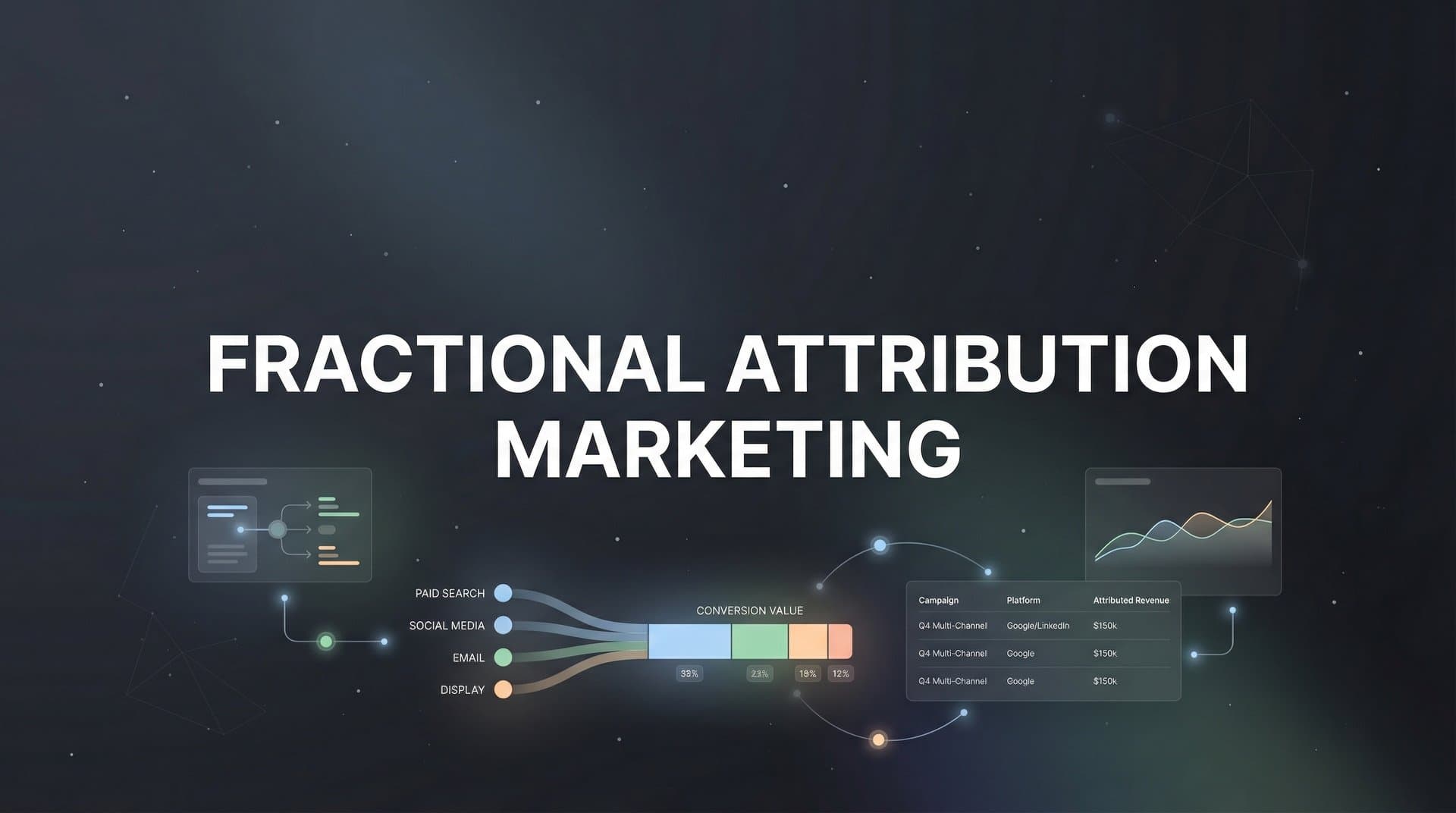
This is the attribution blind spot that's quietly draining marketing budgets across every industry. Fractional attribution marketing solves this problem by distributing credit across every touchpoint that contributed to the conversion—not just the last one. Instead of declaring a single winner, it acknowledges the reality of modern customer journeys: people need multiple interactions across different channels before they're ready to buy.
In this guide, we'll break down how fractional attribution works, which models fit different business scenarios, and how to implement this approach to make smarter budget decisions. If you've ever wondered whether your attribution model is lying to you, you're about to find out.
Why Single-Touch Attribution Creates Expensive Blind Spots
Most marketing platforms default to single-touch attribution models because they're simple. First-touch attribution gives 100% credit to the initial interaction—the first ad click, the first website visit, the first touchpoint that introduced your brand. Last-touch attribution does the opposite, crediting only the final interaction before conversion.
These models feel intuitive. First-touch tells you what's bringing people in the door. Last-touch tells you what's closing the deal. But here's the problem: they both ignore everything that happened in between, and that middle section is where most of your marketing actually works.
Think about how you personally make purchase decisions. You rarely see one ad and immediately buy, especially for considered purchases. You research. You compare. You read reviews. You see the brand again in different contexts. Each of these interactions builds familiarity and trust, moving you closer to conversion. Yet single-touch models pretend these middle interactions don't exist.
The consequences show up in your budget allocation. If you're using last-touch attribution, channels that appear late in the journey—like branded search, retargeting, or email—look incredibly efficient. They get credit for conversions that were actually set up by earlier awareness campaigns. You start shifting budget toward these "high-performing" channels, starving the top-of-funnel activities that were actually driving initial interest.
The reverse happens with first-touch attribution. Display ads and social campaigns that generate initial awareness look great, while the nurture emails and retargeting that actually close deals appear worthless. You end up with plenty of awareness but weak conversion rates because you've under-invested in the channels that move people from interested to ready-to-buy.
Modern customer journeys make this problem worse. People switch between devices—they see your ad on mobile, research on desktop, and convert on tablet. They move across channels—social to search to email to direct traffic. A typical B2B buyer might interact with your brand 7-12 times across multiple channels before converting. For e-commerce, that number might be 3-5 touchpoints. Single-touch models compress this entire journey into one moment, one channel, one decision point.
The result? You're making budget decisions based on incomplete information. You're rewarding channels that happen to be present at the beginning or end of the journey while penalizing the ones doing the heavy lifting in the middle. You're essentially flying blind, using a map that only shows you the starting point or destination but none of the route in between. Understanding attribution challenges in marketing analytics is the first step toward solving this problem.
How Fractional Models Distribute Credit Based on Real Customer Behavior
Fractional attribution takes a fundamentally different approach: instead of giving 100% credit to one touchpoint, it distributes credit across all the interactions that contributed to the conversion. Think of it like splitting a commission among everyone who helped close a deal, not just the person who shook hands at the end.
The simplest fractional model is linear attribution. If a customer had five touchpoints before converting—Facebook ad, organic search, email click, retargeting ad, direct visit—each touchpoint receives 20% of the credit. It's straightforward: every interaction gets equal weight. This model works well when you want a balanced view of how all your channels work together, particularly for awareness-focused campaigns where you're trying to understand which channels contribute to the overall journey.
Time-decay attribution adds sophistication by recognizing that touchpoints closer to conversion typically have more influence. Using the same five-touchpoint journey, the direct visit right before purchase might get 40% credit, the retargeting ad 25%, the email 20%, organic search 10%, and the initial Facebook ad 5%. The logic makes sense: the interactions that happened when the customer was closest to making a decision probably had more impact on that decision.
This model particularly suits businesses with shorter sales cycles where recent interactions genuinely matter more. If you're selling products with quick consideration periods—think impulse purchases or straightforward solutions—time-decay attribution reflects how your marketing actually influences behavior.
Position-based attribution, sometimes called U-shaped attribution, takes a different stance. It gives more credit to both the first and last touchpoints while distributing the remaining credit among middle interactions. A common split is 40% to first touch, 40% to last touch, and 20% divided among everything in between. This model acknowledges that introducing your brand and closing the sale are both crucial moments, while still recognizing that the middle matters.
Position-based works well when you want to value both awareness and conversion activities. It's particularly useful for businesses that need strong top-of-funnel activity to fill the pipeline but also require effective bottom-of-funnel tactics to close deals. You're essentially saying: getting someone's attention matters, closing the deal matters, and everything that kept them engaged in between deserves some credit too.
Then there's data-driven attribution, which throws out predetermined rules entirely. Instead of deciding upfront how to split credit, data-driven models use machine learning to analyze thousands of conversion paths and determine which touchpoints actually correlate with higher conversion rates. If the data shows that people who interact with email after seeing a social ad convert at much higher rates than those who don't, email gets more credit in that sequence. This approach represents the cutting edge of data science for marketing attribution.
Data-driven attribution requires substantial conversion volume to work effectively—typically hundreds of conversions per month at minimum. The algorithm needs enough data to identify patterns and distinguish between touchpoints that genuinely influence conversions versus those that just happen to be present. When you have sufficient data, though, this approach provides the most accurate picture of how your marketing actually drives results.
The key insight across all fractional models: they acknowledge that marketing is a team sport. Rarely does a single channel or campaign deserve all the credit for a conversion. By distributing credit more fairly, you get a clearer picture of which channels contribute to revenue, even if they don't directly close the sale.
Matching Your Attribution Model to Your Marketing Reality
Choosing the right fractional attribution model isn't about picking the most sophisticated option—it's about matching the model to how your business actually works. The wrong model can be just as misleading as single-touch attribution, just in different ways. Understanding what a marketing attribution model is helps you make this critical decision.
Start with your sales cycle length. If you're selling products with quick consideration periods—hours or days rather than weeks or months—time-decay attribution often makes the most sense. When someone decides to buy quickly, the touchpoints closest to conversion genuinely carry more weight. That retargeting ad they saw an hour before purchasing probably influenced their decision more than the display ad they saw three days ago.
For longer sales cycles, particularly in B2B or high-consideration purchases, position-based attribution tends to provide better insights. When someone takes weeks or months to decide, that initial touchpoint that introduced your solution matters significantly. So does the final interaction that pushed them over the edge. But all those middle touches—the webinar they attended, the case study they read, the demo they watched—also played crucial roles in building trust and demonstrating value. Companies in this space should explore B2B marketing attribution fundamentals to optimize their approach.
Linear attribution works best when you're focused on understanding overall channel contribution rather than optimizing for specific conversion points. If you're running broad awareness campaigns and want to see which channels consistently appear in conversion paths, linear gives you that high-level view without overweighting any particular stage of the journey.
Data-driven attribution makes sense when you have three things: sufficient conversion volume (typically 300+ conversions per month), a complex multi-channel marketing mix, and the technical infrastructure to implement it. If you're running campaigns across five or more channels and have enough data for the algorithm to identify meaningful patterns, data-driven models will outperform rule-based approaches.
However, if you're working with smaller conversion volumes or a simpler channel mix, data-driven models might not have enough signal to work with. In those cases, you're better off with a rule-based fractional model that at least distributes credit more fairly than single-touch, even if it's not perfectly optimized.
Consider your team's data literacy too. More sophisticated models require more sophisticated interpretation. If your team struggles to act on complex attribution data, starting with linear or position-based models provides actionable insights without overwhelming analysis paralysis. You can always graduate to more advanced models as your data maturity increases.
Think about your primary marketing challenge. If you're struggling to justify top-of-funnel spending, position-based attribution helps demonstrate the value of awareness activities. If you're trying to understand which middle-funnel content actually influences conversions, linear attribution reveals those contributions. If you're optimizing a performance marketing program with clear conversion goals, time-decay shows you which recent interactions drive action.
The reality is that many sophisticated marketers use multiple attribution models simultaneously, comparing results across different views. You might use position-based as your primary model for budget allocation while checking time-decay to understand recent campaign performance and reviewing linear to ensure you're not missing channel contributions. The models aren't mutually exclusive—they're different lenses for examining the same customer journey data.
Building the Data Foundation for Accurate Fractional Attribution
Fractional attribution only works if you can actually track the entire customer journey. That sounds obvious, but it's where most implementations break down. You need unified tracking across every channel, consistent user identification, and the technical infrastructure to connect all these data points into coherent conversion paths.
Start with your tracking foundation. Every marketing touchpoint needs to be captured: ad clicks from paid channels, organic visits from search and social, email interactions, direct traffic, referrals. This requires implementing tracking pixels or tags across your ad platforms, website analytics, and marketing automation systems. More importantly, these tracking systems need to use consistent identifiers so you can recognize when the same person interacts across different channels. Implementing proper attribution marketing tracking is essential for accurate data collection.
User identification is where things get complicated. When someone clicks your Facebook ad on their phone, searches for your brand on their laptop, and converts on their tablet, you need to recognize that these are three touchpoints from the same person, not three different people. This requires cross-device tracking capabilities, typically through authenticated user IDs (like email addresses or account logins) or probabilistic matching based on behavioral patterns.
CRM integration becomes essential for B2B companies or any business with a multi-step conversion process. If someone fills out a lead form, receives nurture emails, has sales conversations, and eventually becomes a customer, you need to connect all these touchpoints back to the original marketing interactions that started the relationship. Without CRM integration, your attribution stops at the lead form, missing everything that happened afterward.
Here's where modern privacy changes make everything harder. iOS App Tracking Transparency means many mobile users opt out of cross-app tracking. Cookie deprecation in browsers limits your ability to track users across websites. GDPR and other privacy regulations restrict how you can collect and use personal data. These changes don't make fractional attribution impossible, but they do require different approaches.
Server-side tracking provides one solution. Instead of relying on browser cookies or device identifiers, server-side tracking sends conversion data directly from your server to ad platforms and analytics tools. This approach is more privacy-compliant and more reliable because it doesn't depend on client-side tracking that can be blocked by browsers or privacy settings.
First-party data strategies become increasingly important. When users create accounts, sign up for emails, or authenticate in any way, you gain a reliable identifier that persists across sessions and devices. Building your attribution model around these authenticated interactions provides more accurate data than trying to track anonymous users across the web.
The technical setup typically involves connecting multiple systems: your website analytics (like Google Analytics), ad platform conversion tracking (Meta Pixel, Google Ads conversion tracking), marketing automation platform, CRM, and potentially a dedicated attribution platform that consolidates all this data. Each connection point introduces potential data quality issues—missing parameters, incorrect event tracking, broken integrations—that need regular monitoring and maintenance. Learning how to setup a datalake for marketing attribution can help centralize this information effectively.
Data hygiene matters enormously. If your UTM parameters are inconsistent, if some campaigns aren't properly tagged, if your CRM doesn't capture lead sources accurately, your attribution data will be garbage regardless of which model you use. Establishing and enforcing naming conventions, tracking standards, and data quality processes isn't glamorous work, but it's what makes fractional attribution actually useful.
Most businesses discover they need to fix their tracking infrastructure before they can implement meaningful fractional attribution. That's normal. The good news is that building this foundation pays dividends beyond attribution—you get better data for optimization, more accurate reporting, and clearer visibility into how your marketing actually performs.
Using Attribution Data to Make Better Budget Decisions
Once you have fractional attribution running, the real value comes from changing how you allocate budget. The goal isn't just to have prettier reports—it's to identify channels that deserve more investment and channels that deserve less, based on their actual contribution to revenue.
Start by looking for channels with high assisted conversion rates but low last-touch conversion rates. These are the channels that help move people toward conversion but rarely get credit in last-touch models. Display advertising often falls into this category—it builds awareness and keeps your brand visible, but people usually convert through other channels later. If your fractional attribution shows display ads appearing in 40% of conversion paths but only getting 10% of last-touch credit, that's a channel you're probably undervaluing.
Compare the cost per acquisition across different attribution models. A channel might look expensive on a last-touch basis but much more efficient when you account for assisted conversions. If your branded search campaigns cost $50 per last-touch conversion but only $20 per fractionally-attributed conversion (because they're getting partial credit for many conversions), they're actually more efficient than they appear in traditional reporting. Robust marketing attribution analytics makes these comparisons possible.
Look at channel combinations that drive higher conversion rates. Fractional attribution reveals which sequences of touchpoints convert best. You might discover that people who see a social ad followed by an email convert at twice the rate of those who only interact with one channel. This insight suggests coordinating your social and email campaigns more closely, ensuring that people who engage with social content get added to relevant email sequences.
The reallocation process should be gradual, not dramatic. If your fractional attribution suggests shifting 20% of budget from one channel to another, don't make that move overnight. Test smaller shifts—maybe 5-10% initially—and monitor how actual conversion volume changes. Attribution models are insights, not guarantees. You still need to validate that increasing spend in "undervalued" channels actually drives more conversions at acceptable costs.
Pay attention to how feeding better conversion data back to ad platforms affects their performance. When you send more complete conversion data to Meta or Google—including assisted conversions, not just last-touch conversions—their algorithms get better signals about which audiences and placements actually drive results. This can improve targeting accuracy and bidding optimization, creating a compounding effect where better attribution leads to better ad performance, which generates more revenue from the same budget.
Many marketing attribution platforms now offer automated budget optimization recommendations based on fractional attribution data. These tools analyze your conversion paths, calculate each channel's true contribution, and suggest specific budget shifts to maximize overall return. While you shouldn't blindly follow automated recommendations, they provide a data-driven starting point for optimization decisions.
Remember that attribution is probabilistic, not perfect. No model can definitively prove that a specific touchpoint caused a specific conversion. What fractional attribution does is provide a more reasonable estimate of contribution than single-touch models. Use it to inform decisions, test hypotheses, and gradually optimize your mix—not as absolute truth about causation.
The most successful approach combines attribution insights with incrementality testing. Use fractional attribution to identify channels that might be undervalued, then run holdout tests or geographic experiments to validate that increasing spend actually drives incremental conversions. This combination of attribution modeling and experimental validation gives you the confidence to make significant budget shifts backed by both correlation and causation evidence.
Moving From Attribution Guesswork to Data-Driven Confidence
Fractional attribution marketing represents a fundamental shift in how you think about channel performance. Instead of asking "which touchpoint gets credit?" you start asking "how do all my touchpoints work together to drive conversions?" This change in perspective reveals opportunities that single-touch models completely miss.
The competitive advantage is real. While your competitors continue over-investing in channels that happen to be present at the end of the customer journey, you're allocating budget based on actual contribution across the entire path to purchase. While they're starving channels that assist conversions but don't close them, you're properly valuing every interaction that moves people closer to converting.
Start with the data you have. You don't need perfect tracking infrastructure or thousands of conversions to benefit from fractional attribution. Even implementing a simple linear or position-based model with your current tracking provides more insight than last-touch attribution. You can iterate toward more sophisticated models as your data foundation improves and your conversion volume increases. Exploring the best marketing attribution tools can accelerate this process significantly.
The goal isn't attribution perfection—it's attribution that's good enough to make better decisions than you're making today. If your current approach is giving 100% credit to the last click, any fractional model represents a significant improvement in understanding how your marketing actually works.
As you implement fractional attribution, focus on building the habits that make it useful: regularly reviewing attribution reports, testing budget reallocation hypotheses, comparing performance across different models, and validating insights with incrementality tests. Attribution is a tool for continuous optimization, not a one-time analysis.
The marketers who win in increasingly complex, multi-channel environments are those who understand the full customer journey and invest accordingly. Fractional attribution gives you that understanding, transforming attribution from a reporting exercise into a strategic advantage that drives smarter budget decisions and better results.
Transform Your Attribution Strategy With AI-Powered Insights
Understanding fractional attribution is one thing. Actually implementing it across your entire marketing operation—connecting data sources, analyzing conversion paths, and turning insights into action—is where most teams struggle. You need infrastructure that tracks every touchpoint, algorithms that distribute credit accurately, and recommendations you can actually act on.
This is where modern attribution platforms make the difference. Instead of manually stitching together data from different sources and calculating fractional credit in spreadsheets, platforms like Cometly automate the entire process. They capture every touchpoint from first ad impression to final conversion, apply sophisticated attribution models, and provide AI-powered recommendations for budget optimization.
The real power comes from closing the loop: not just understanding which channels contribute to conversions, but feeding that enriched conversion data back to ad platforms to improve their optimization algorithms. When Meta and Google receive complete attribution data rather than just last-touch conversions, they can target more effectively and bid more efficiently, turning better attribution into better ad performance.
Ready to elevate your marketing game with precision and confidence? Discover how Cometly's AI-driven recommendations can transform your ad strategy—Get your free demo today and start capturing every touchpoint to maximize your conversions.