You're staring at a conversion in your Google Ads dashboard, feeling good about the result. But then the question hits: which of the five touchpoints this customer encountered actually deserves credit for that sale? Was it the YouTube pre-roll ad that introduced your brand three weeks ago? The generic search ad they clicked mid-research? Or the branded search ad they typed in right before buying?
This is not a hypothetical problem. It plays out in every Google Ads account, every single day. And the answer you choose has real consequences for where your budget goes next month.
Attribution models are how Google Ads answers that question. They are the rules that determine how conversion credit gets distributed across the touchpoints a customer interacts with before completing a goal. Choose one model and your brand awareness campaigns look like winners. Choose another and they look like budget drains. The math changes, and so do your decisions.
Understanding how each model works, why Google has consolidated its options over the past few years, and how to apply this knowledge practically is the difference between optimizing toward real growth and optimizing toward a metric that flatters the wrong campaigns. This guide walks you through all of it: each model, how Google's approach has evolved, where Data-Driven Attribution fits in, and how to build a smarter attribution practice that goes beyond what any single platform can show you.
Why the Way You Assign Credit Changes Everything
Let's start with the fundamental idea. When a customer sees a display ad on Monday, clicks a YouTube ad on Wednesday, searches a generic keyword on Friday, and then converts through a branded search on Sunday, four different touchpoints contributed to that sale. But in most reporting systems, only one of them gets the trophy. The question is: which one?
Attribution models are the rules that answer that question. And here is why it matters so much: the model you use determines which campaigns appear to be working. That directly influences where you allocate budget, which ad groups you scale, and which ones you pause. Get the model wrong, and you can end up cutting the very campaigns that were generating demand in the first place. Understanding the importance of attribution models is essential before making any budget decisions.
Think about what happens when a marketer relies on last-click attribution. The branded search at the end of the journey gets all the credit because it was the final touchpoint before conversion. The display ad and YouTube ad that sparked awareness and built consideration? They show zero conversions. So the marketer cuts them to reduce waste. A few weeks later, overall conversion volume drops because the top-of-funnel pipeline quietly dried up. The model led to a logical-looking decision that produced a damaging outcome.
The reverse is also true. If you over-credit early touchpoints without understanding their actual incremental impact, you might pour budget into awareness campaigns that are reaching people who would have converted anyway through other means.
It is also worth being clear about what Google Ads attribution actually covers. It operates within Google's ecosystem: Search, Display, YouTube, Shopping, Performance Max, and so on. It tracks how credit is distributed across Google's own ad inventory. It does not account for a customer who saw a Meta ad before clicking your Google Search ad, or who received an email that nudged them back into the funnel. That cross-channel picture requires a separate layer of measurement, which we will get into later in this guide.
Within those boundaries, the attribution model you select shapes how Smart Bidding strategies like Target CPA and Target ROAS learn. The algorithm optimizes toward the signals your model defines as conversions. So the model is not just a reporting preference. It is a fundamental input into how Google's machine learning allocates your budget in real time.
Breaking Down Each Google Ads Attribution Model
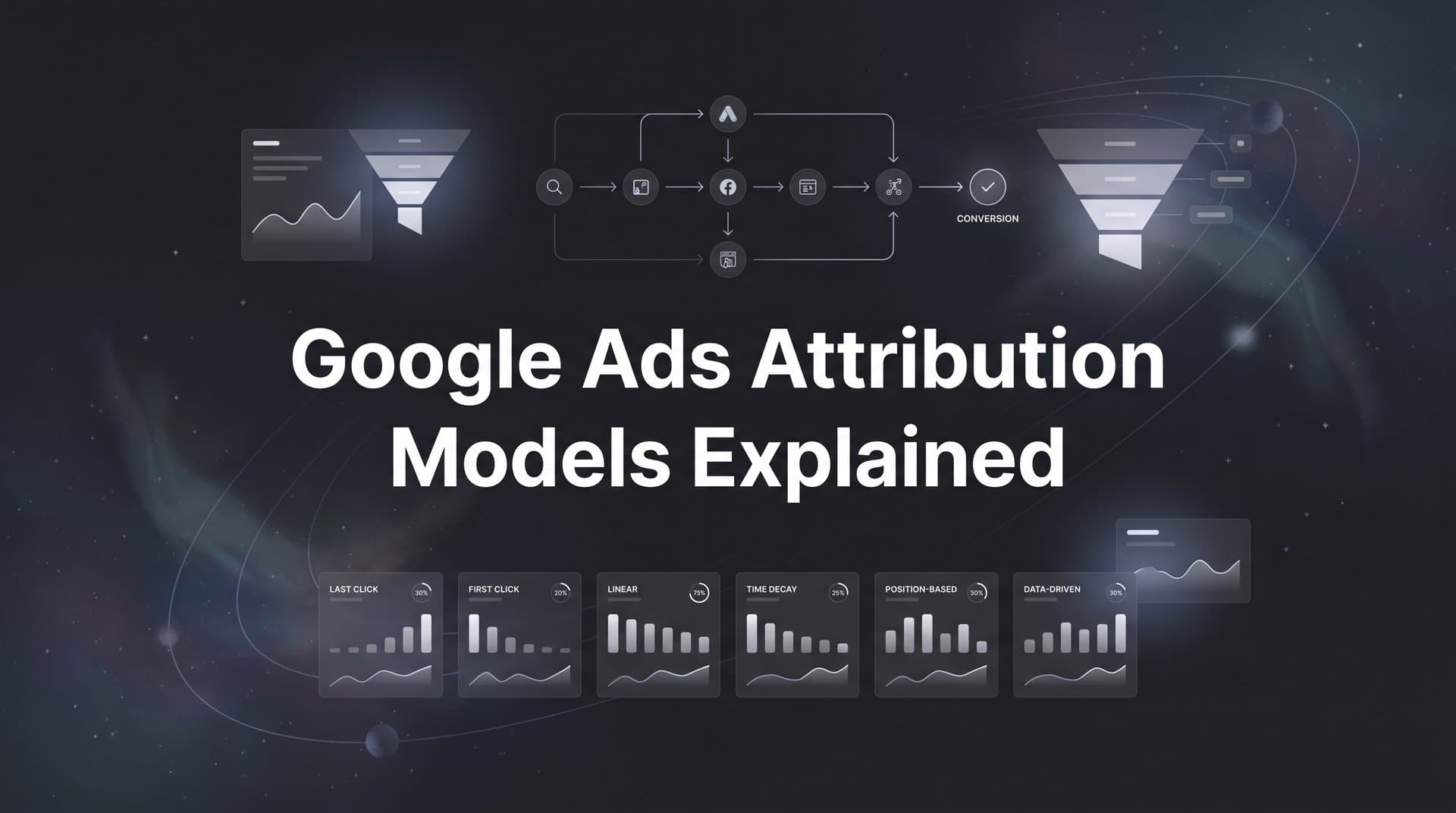
For most of Google Ads' history, advertisers could choose from six attribution models. Understanding each one helps you see why Google eventually moved away from most of them.
Last Click: All conversion credit goes to the final ad touchpoint before the conversion. Simple, easy to understand, and still the default for many accounts. The problem is that it ignores everything that happened earlier in the journey, which systematically undervalues awareness and consideration-stage campaigns. For a deeper look at how single-touch and multi-touch approaches compare, explore the difference between single source and multi-touch attribution.
First Click: The opposite of last click. All credit goes to the first touchpoint. This favors discovery campaigns but ignores the ads that closed the deal. Useful in theory for understanding what drives initial awareness, but equally incomplete.
Linear: Credit is split equally across every touchpoint in the path. A four-touchpoint journey gives 25% credit to each interaction. It treats every touchpoint as equally important, which sounds fair but rarely reflects reality.
Time Decay: Touchpoints closer to the conversion receive more credit, with credit decreasing exponentially the further back in time you go. This model makes intuitive sense for short sales cycles but can still undervalue early-stage interactions in longer journeys.
Position-Based (U-Shaped): Assigns 40% credit to the first touchpoint, 40% to the last, and distributes the remaining 20% equally among any middle touchpoints. This model at least acknowledges that both discovery and conversion moments matter.
Data-Driven Attribution (DDA): Rather than applying a fixed rule, DDA uses machine learning to analyze all the converting and non-converting paths in your account and assigns fractional credit based on each touchpoint's actual incremental contribution. It does not follow a predetermined formula. It learns from your specific data.
Here is the important update every Google Ads advertiser needs to know. In April 2023, Google announced the deprecation of First Click, Linear, Time Decay, and Position-Based attribution models. Removal was completed by September 2023. That leaves Last Click and Data-Driven Attribution as the two active options in Google Ads today.
Google had already been signaling this direction for years. DDA became the default attribution model for new conversion actions starting in 2021, reflecting Google's confidence in machine learning over manual rule-based approaches. The deprecation of the legacy models was a natural continuation of that shift.
For accounts with sufficient conversion volume, DDA is now the recommended path. For accounts that do not yet generate enough conversions to fuel the model reliably, Last Click remains the fallback. Understanding which camp your account falls into is the first practical decision you need to make.
Data-Driven Attribution: What Google's Default Model Actually Does
Data-Driven Attribution sounds like a black box, and to some extent it is. But understanding the core logic helps you use it more confidently and interpret its outputs more critically.
At the heart of DDA is a technique called counterfactual analysis. Google's model looks at the paths that led to conversions and compares them against paths that were similar but did not convert. By identifying what was different between those two groups, the model estimates the incremental contribution of each touchpoint. In other words, it asks: if this touchpoint had not been present, how much less likely would this path have been to convert?
This is meaningfully different from rule-based models. Instead of applying an arbitrary formula, DDA tries to measure actual impact. A touchpoint that appears on nearly every converting path but also on nearly every non-converting path might receive less credit than you would expect, because its presence does not strongly differentiate converters from non-converters. This approach is one reason weighted attribution models have become increasingly popular across the industry.
The strengths of DDA are real. It adapts to your account's unique data rather than applying a one-size-fits-all rule. It removes the guesswork of manually deciding which touchpoints matter most. And because Smart Bidding uses attribution signals to optimize bids, DDA can help the algorithm make better decisions by feeding it more accurate conversion credit information.
The limitations are equally real and worth being honest about. DDA requires sufficient conversion volume to function reliably. Google does not publish an exact minimum threshold, but the general guidance is that accounts should be generating a meaningful number of conversions over a rolling 30-day window for the model to produce stable outputs. Accounts with low conversion volume may see DDA behave erratically or fall back toward last-click-like behavior.
Transparency is another limitation. DDA does not tell you exactly how it weighted each touchpoint or why. You can see the results in your attribution reports, but you cannot audit the model's reasoning. For marketers who want to understand the "why" behind credit distribution, this can be frustrating.
The most important limitation, however, is scope. DDA only measures touchpoints within Google Ads. If a customer interacted with a Meta campaign, opened an email, saw a TikTok ad, and then clicked a Google Search ad before converting, DDA sees only the Google Search click. It has no visibility into what happened before that moment. From DDA's perspective, that customer might look like a simple, direct responder to a single touchpoint. In reality, they went through a much more complex journey that involved other platforms entirely.
This is not a flaw in DDA specifically. It is a fundamental constraint of any single-platform attribution system. The customer journey does not respect platform boundaries, but platform attribution models are built within them.
Common Attribution Mistakes That Drain Ad Budgets
Even with the right model selected, attribution errors are common. Here are the three that cause the most damage.
Killing top-of-funnel campaigns based on last-click data: This is the most expensive mistake in paid media. When you evaluate brand awareness or prospecting campaigns using last-click attribution, they almost always look underperforming. They rarely get the final click before conversion. So they get cut. But a few weeks later, the pipeline thins out because there was nothing feeding new demand into the funnel. The campaigns that looked like waste were actually doing essential work. Switching to DDA or even comparing last-click reports against view-through and assist data can reveal this before the damage is done.
Trusting platform-reported attribution at face value: Every ad platform has an incentive to show you that its ads drove conversions. Google will claim credit. Meta will claim credit. TikTok will claim credit. And because each platform uses its own attribution windows and measurement logic, the same conversion often gets counted multiple times across different dashboards. If you add up the conversions reported by each platform independently, the total will almost certainly exceed your actual conversion count. This overlap is not fraud. It is a natural consequence of each platform measuring within its own ecosystem. But taking any single platform's numbers as ground truth leads to inflated expectations and poor budget decisions.
Setting an attribution model once and never revisiting it: Your business changes. Your campaign mix changes. Your conversion volume changes. An attribution model that made sense when you were running only Search campaigns may not be appropriate after you have added Performance Max, YouTube, and Display to the mix. Similarly, an account that was too small for DDA six months ago might now have the volume to use it effectively. Knowing when to switch attribution models and auditing your settings regularly is critical, not a one-time configuration.
Each of these mistakes shares a common root: treating attribution as a passive reporting setting rather than an active strategic tool. The model you use shapes how you see your campaigns, which shapes how you manage them. It deserves intentional attention.
How to Choose the Right Model for Your Campaigns
The decision framework is more straightforward than it might seem, especially now that Google has narrowed the options to two.
If your account generates sufficient conversion volume, Data-Driven Attribution is the stronger choice for most campaigns. It adapts to your data, feeds better signals to Smart Bidding, and does a more honest job of distributing credit than any fixed rule. If your account is still building volume and DDA does not have enough data to work reliably, Last Click is the pragmatic fallback. It is imperfect but at least consistent and easy to interpret.
Beyond the binary choice between DDA and Last Click, the more important question is whether Google Ads attribution alone gives you the full picture you need to make smart budget decisions. For most businesses running ads across multiple platforms, the answer is no. Exploring tracking for Facebook and Google Ads together is a good starting point for understanding cross-platform measurement challenges.
Consider a typical mid-sized business running Google Search, Meta prospecting, and retargeting campaigns simultaneously. A customer might discover the brand through a Meta video ad, search a generic keyword on Google and click a Search ad, then return directly to the site and convert. Google Ads sees one click and one conversion. Meta sees an ad impression and claims a view-through conversion. Neither platform sees the complete journey. And neither can tell you what the true incremental contribution of each channel was.
This is where cross-channel attribution tools become essential. Platforms like Cometly are built to solve exactly this problem. Cometly connects your ad platforms, CRM, and website to track the complete customer journey across every channel in real time. Instead of looking at Google's version of attribution and Meta's version separately, you get a unified view that shows which sources and campaigns actually drove revenue, not just which ones claimed credit within their own ecosystem.
Cometly's AI-powered attribution captures every touchpoint from initial ad click to CRM conversion, giving you the data to compare channel performance on equal footing. It also feeds enriched conversion data back to platforms like Google and Meta, which improves the quality of signals those platforms use for algorithmic optimization. Better data in means better decisions out, both from your team and from the ad platform's machine learning.
For marketers who are serious about understanding what is actually driving revenue, single-platform attribution is a starting point, not a destination. The combination of DDA within Google Ads and a cross-channel attribution layer gives you the most complete picture available.
Putting Attribution Insights Into Action
Understanding attribution models intellectually is only half the job. The other half is building a practical workflow that turns those insights into better decisions.
Start with an audit of your current attribution settings in Google Ads. Navigate to your conversion actions and check which model each one is using. If you are still on Last Click for campaigns that have been running long enough to generate DDA-eligible volume, that is the first thing to update. Google makes it straightforward to switch models within conversion action settings.
Once you have DDA running, use the Attribution report in Google Ads to compare DDA credit distribution against Last Click. Look specifically for campaigns or ad groups that receive significantly more credit under DDA than under Last Click. Those are your undervalued touchpoints, the ones that are contributing to conversions but not getting recognized in last-click reporting. They are candidates for budget increases, not cuts. For YouTube campaigns specifically, understanding YouTube ads ROI tracking can help you evaluate upper-funnel performance more accurately.
The reverse is also worth examining. Campaigns that receive less DDA credit than last-click credit may be capturing demand that was already generated elsewhere, rather than creating new demand. That does not necessarily mean they should be cut, but it does mean they should be evaluated more carefully.
On the data quality side, investing in server-side tracking pays dividends for attribution accuracy. Browser-based tracking has become less reliable as privacy changes in Safari, Firefox, and other browsers restrict cookie-based measurement. Server-side tracking sends conversion data directly from your server to Google, bypassing browser limitations and capturing events that would otherwise go unrecorded. Better conversion data improves both attribution accuracy and Smart Bidding performance, since the algorithm is learning from a more complete signal.
Finally, treat attribution as an ongoing practice rather than a configuration task. Review your model settings quarterly. Watch for changes in conversion volume that might affect DDA reliability. And regularly cross-reference your Google Ads attribution data against your cross-channel view to catch discrepancies before they lead to bad budget decisions.
Attribution is not a one-time setup. It is a continuous discipline that directly determines how confidently you can scale your ad spend.
The Bottom Line on Google Ads Attribution
Google Ads attribution models are not just a technical setting buried in your account. They are a strategic lens that determines which campaigns get credit, which get budget, and which get cut. Choosing the wrong model, or never revisiting the one you chose years ago, can quietly undermine campaigns that are doing real work.
With the legacy rule-based models now retired, the practical choice in Google Ads is between Last Click and Data-Driven Attribution. For most accounts with sufficient conversion volume, DDA is the stronger foundation because it reflects actual incremental impact rather than a predetermined formula. But even DDA has limits: it only sees what happens inside Google's ecosystem, and the modern customer journey rarely stays there.
The marketers who get attribution right are the ones who use Google's in-platform tools as one layer of measurement while building a broader cross-channel view that connects every touchpoint to real revenue. That means auditing your current settings, comparing attribution models in your reports, and investing in the data infrastructure that makes your measurement more accurate over time.
If you are ready to go beyond single-platform attribution and see exactly which ads and channels are driving real revenue across your entire marketing mix, explore what Cometly can do for your team. Get your free demo today and start capturing every touchpoint to maximize your conversions.