Calculating your customer retention rate is pretty straightforward: take the number of customers you have at the end of a period, subtract any new customers you picked up, divide that by the customers you started with, and multiply by 100.
That one percentage tells you how good you are at keeping the customers you worked so hard to win. Getting a handle on this metric is the first step toward building a business that's not just growing, but is also profitable and built to last.
Why Customer Retention Is Your True North for Growth
 How to Calculate Customer Retention Rate for Sustainable Growth
Before we jump into the formulas and spreadsheets, let’s be clear about why retention isn't just another metric on your dashboard. It's the engine for sustainable growth. While flashy customer acquisition campaigns tend to grab the spotlight, retention is where real, long-term profitability is forged.
It’s no secret that acquiring a new customer is anywhere from five to 25 times more expensive than keeping an existing one. That cost difference alone should be enough to make you obsessed with loyalty.
And the upside is huge. A seemingly small 5% increase in customer retention can boost your profits by a staggering 25% to 95%. Loyal customers don’t just stick around—they tend to spend more over time and become your best marketing channel through word-of-mouth referrals.
The Real-World Impact Across Industries
The financial stakes here are incredibly high. Poor retention costs US businesses a mind-boggling $136.8 billion every year, and that gap between retaining and acquiring is only getting wider.
Different industries see a huge variance in how well they hold onto customers. Media leads the pack at 84% retention, while retail and hospitality lag behind at 63% and 55%, respectively. This just goes to show how much business models and customer expectations shape loyalty.
Retention is the quiet, compounding force behind the most successful brands. It transforms one-time transactions into lasting relationships, turning marketing expenses into long-term investments with predictable returns.
This shift in focus has a profound effect on your entire strategy. It pushes you to improve your product, polish your customer service, and build a genuine community around your brand. To really get a feel for what works, exploring various customer retention strategies can give you a much broader perspective.
Connecting Retention to Lifetime Value
At the end of the day, strong retention directly pumps up your Customer Lifetime Value (LTV). Every customer you keep is a recurring revenue stream.
For a SaaS company, that means another year of subscription fees. For an e-commerce store, it’s repeat purchases that happen without you spending another dime on ads.
For a deeper dive into this all-important metric, check out our guide on customer lifetime value analysis. Mastering how to calculate customer retention rate is the foundational skill you need to optimize LTV and build a truly resilient business.
Mastering the Core Customer Retention Formula
Diving into the numbers doesn't have to be a headache. The first step is getting a handle on the standard, most widely used formula for customer retention. Think of it as the bedrock of your analysis—it gives you a clean, high-level snapshot of how well you’re holding onto your customer base over a specific period.
The formula itself is pretty simple:
Retention Rate = ((Customers at End of Period - New Customers Acquired) / Customers at Start of Period) * 100
Let's quickly break down what each part means. A small slip-up here can throw your entire analysis off, so it’s worth double-checking.
- Customers at Start of Period (S): This is your total count of active customers on day one of your chosen timeframe (e.g., the first of the month).
- Customers at End of Period (E): This is your total count of active customers on the very last day of that same timeframe.
- New Customers Acquired (N): This is simply the total number of brand-new customers you brought in during that period.
The logic here is sound. By subtracting new customers from your final count, you’re left with the number of people you successfully kept from your original group.
A Practical E-commerce Example
Let's put this into action with a real-world scenario. Say you run an online subscription box service and want to figure out your customer retention rate for April.
First, you pull the data:
- On April 1, you had 500 active subscribers (S).
- By April 30, you had 540 active subscribers (E).
- During April, you signed up 80 new subscribers (N).
Now, just plug those numbers into the formula:
- First, find your number of retained customers:
540 (E) - 80 (N) = 460 - Then, divide that by your starting customers:
460 / 500 (S) = 0.92 - Finally, convert it to a percentage:
0.92 * 100 = 92%
Boom. Your customer retention rate for April is 92%. This means you held onto 92% of the customers you started the month with. It’s a crucial number because it tells a completely different story than just looking at churn. For more on how these two metrics are two sides of the same coin, check out our guide on how to calculate customer churn.
Ready-to-Use Spreadsheet Formulas
To make life even easier, you can build a simple calculator right in Google Sheets or Excel. Here are the copy-paste-ready formulas.
Let's assume your data is laid out like this:
- Cell A2: Customers at Start of Period
- Cell B2: Customers at End of Period
- Cell C2: New Customers Acquired
Just enter this formula into cell D2:
=((B2-C2)/A2)
Set the cell format to "Percentage," and you're good to go. This simple setup lets you track your performance month after month with almost no effort.
Moving Beyond Customer Count to Revenue Retention
While counting customers is essential, it doesn’t paint the full picture. This is especially true for subscription businesses like SaaS platforms or agencies with recurring retainers. Let's be real: losing a high-value customer hurts a lot more than losing someone on your lowest-tier plan.
This is where Revenue Retention comes in.
It measures how much of your recurring revenue you’ve kept over a period, factoring in both churn and expansion (upgrades or cross-sells). The two most common flavors are:
- Monthly Recurring Revenue (MRR) Retention: Tracks revenue retention month-to-month.
- Annual Recurring Revenue (ARR) Retention: Tracks revenue retention on a yearly basis.
Calculating revenue retention is an incredibly powerful way to gauge the health of your existing customer base. If your current customers are spending more over time through upgrades, you can even hit a Net Revenue Retention (NRR) rate of over 100%. That’s the sign of a remarkably healthy and scalable business—and it’s a metric investors and stakeholders absolutely love because it screams strong product-market fit.
Gaining Deeper Insights With Cohort Analysis
While the standard retention formula gives you a solid, high-level snapshot of your business health, it’s a bit like looking at a single photo from a marathon. You can see who’s still in the race at that moment, but you’re missing the entire story of how they got there.
To truly understand performance over time, you need to ditch the snapshots and start watching the full motion picture with cohort analysis.
A cohort is just a group of users who share a common trait. For retention, this is almost always when they signed up for your product. For example, the "March Cohort" is simply every customer who joined in March.
Instead of lumping all your customers together, cohort analysis tracks each of these groups independently as they move forward. This approach is incredibly revealing. It helps you pinpoint exactly when and why users drop off, and how specific actions—like a new feature launch or a marketing blitz—actually impact their loyalty long-term.
Building Your First Cohort Retention Table
Creating a cohort table isn't nearly as intimidating as it sounds. It’s basically a grid that shows you what percentage of each cohort is still active in the months after they signed up. This kind of visualization immediately highlights trends that a single, blended retention number would completely hide.
Let's imagine you run a SaaS company and want to see how customers who joined in the first quarter of the year are sticking around. You can organize a simple table to get a clear picture. Here’s a look at what that might look like for your March signups.
Example Cohort Retention Table for March Signups
Signup Month | Month 1 Retention | Month 2 Retention | Month 3 Retention | Month 4 Retention | Month 5 Retention | Month 6 Retention |
|---|---|---|---|---|---|---|
March | 85% | 78% | 72% | 65% | 61% | 58% |
This table shows a clear retention curve for a single group, but the real power comes when you stack multiple cohorts (like January and February) on top of this one. You’d set up your table like this:
- Rows: Each row represents a different cohort (January, February, March).
- Columns: Each column tracks the months since that cohort signed up (Month 1, Month 2, etc.).
- Cells: The data inside each cell shows the retention rate for that specific cohort during that specific month of their journey.
This structure lets you compare apples to apples, seeing how the retention of your March signups stacks up against your January signups at the same point in their lifecycle. It's a fundamental practice for anyone serious about improving user loyalty, and our detailed guide on customer cohort analysis can walk you through more advanced ways to use it.
To do this, you just need to know your customer counts for a given period.
 How to Calculate Customer Retention Rate for Sustainable Growth
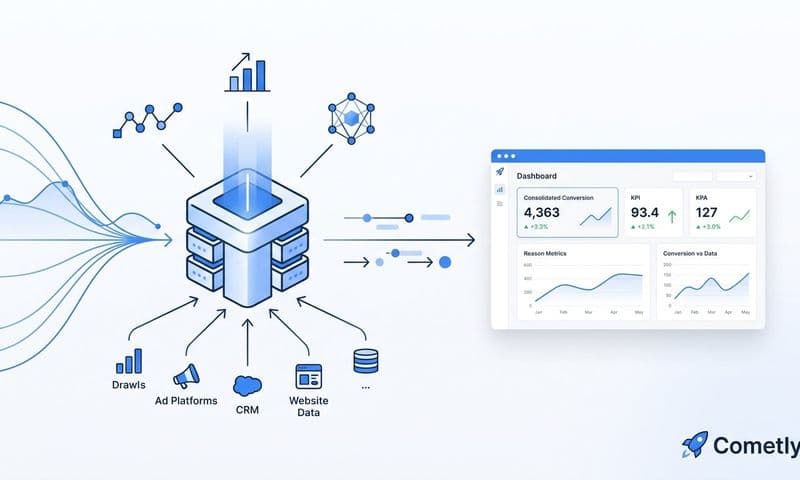
This visual breaks down how retention zeroes in on the customers you started with, effectively filtering out the noise from new acquisitions to give you a clean look at loyalty.
Uncovering Actionable Patterns in Your Data
Once you have your cohort table built, the real fun begins. You can start spotting powerful trends that directly inform your strategy.
For instance, you might notice that the cohort acquired during a huge holiday sale in December has a much lower Month 3 retention rate than other groups. This could be a red flag that the campaign attracted bargain-hunters who weren't a great long-term fit for your product. Armed with that insight, you can tweak future campaigns to target a more loyal audience.
Cohort analysis turns your retention data from a simple grade into a detailed report card. It shows you not only how you’re doing but also points directly to the subjects where you need to improve.
On the flip side, you might see that the cohort that onboarded right after you launched a new feature set shows significantly better retention. That’s strong evidence that the update is genuinely improving the customer experience and making your product stickier.
The Strategic Value of Cohort Retention
Understanding these patterns is critical because keeping customers is fundamentally more profitable than constantly chasing new ones. It’s far easier to sell to existing customers (60-70% probability) than to new prospects (5-20%), and repeat buyers often spend 67% more. Platforms like Cometly make this even clearer by using precise tracking to compute retention, unifying all your customer touchpoints for an accurate view of what drives loyalty.
By analyzing cohorts, you can directly tie your marketing spend and product development efforts to tangible retention outcomes. This elevates the conversation from, "What is our retention rate?" to, "Which of our actions are creating more loyal customers?"
Answering that question is the key to building a sustainable, high-growth business.
Avoiding Common Pitfalls for an Accurate Rate
Calculating customer retention seems straightforward on the surface, but the real challenge is sidestepping the small mistakes that can completely skew your results. A single misstep can turn this powerful metric into a misleading one, causing you to make bad strategic bets based on faulty data. Getting it right means digging into the details.
One of the first and most critical decisions you'll make is choosing the right time period for your calculation. There’s no universal answer here—it all comes down to your business model.
- Weekly: Ideal for businesses with a super short customer lifecycle, like mobile games or fast-paced consumer apps where engagement is measured in days, not months.
- Monthly: This is the most common and balanced choice, perfect for SaaS companies, subscription services, and e-commerce stores. It gives you a regular pulse on customer health without overreacting to short-term blips.
- Quarterly: Best for B2B companies with long sales cycles or annual contracts. A quarterly view smooths out monthly noise and aligns much better with high-level business planning.
Pick a period that’s too short, and you might panic over normal fluctuations. Choose one that’s too long, and you could mask urgent problems until it's too late.
The Churn Versus Retention Confusion
A frequent point of confusion is the relationship between retention and churn. While they are two sides of the same coin, they aren't perfect opposites. Retention measures the percentage of customers you successfully kept, while churn measures the percentage you lost.
Imagine you start a month with 100 customers. You lose 10 but gain 20 new ones. Your churn rate is 10% (10 lost / 100 at start). Simple enough. Your retention rate, however, is 90% ((110 at end - 20 new) / 100 at start). In this clean example, they add up to 100%, but that isn't always the case, especially with more complex scenarios like reactivations.
Getting this distinction right is key to a clear-eyed analysis of customer movement. For a closer look, you can explore the nuances of calculating customer attrition.
Handling Tricky Customer Scenarios
Real-world customer behavior is messy. It rarely fits into the neat boxes of our spreadsheets. To maintain accuracy, your calculation method needs to account for these complexities. How you handle these edge cases will directly impact the reliability of your retention data.
A few common situations that trip people up include:
- Reactivated Customers: What about a customer who canceled their subscription in May but came back in July? Do you count them as "new" or "retained"? The best practice is to treat them as a new acquisition in July. This keeps your cohort data clean and doesn't inflate your numbers by hiding the fact they churned in the first place.
- Paused Subscriptions: Many services let users pause their accounts. These customers haven't churned, but they aren't really active either. You should exclude them from both your starting and ending customer counts for the period they are paused. This prevents them from distorting your rate.
- Freemium Upgrades: When a user on a free plan upgrades to a paid one, they should always be treated as a newly acquired customer for that period. They are new to your paying customer base, which is the group that retention rate almost always measures.
Getting these nuances right is the difference between a vanity metric and a truly actionable insight. The goal isn't just to calculate a number; it's to produce a number that reflects the genuine health and loyalty of your customer base.
Industry benchmarks show just how much retention can vary. E-commerce, for instance, averages a tough 38% retention rate, while subscription e-commerce does much better at 67%. This stark contrast, highlighted in recent reports, underscores how different business models create different loyalty dynamics.
Meanwhile, retail sits at 63%, and SaaS powerhouses can hit 90% with B2B subscriptions, showcasing what's possible when the model itself encourages loyalty. You can find more industry comparisons and customer experience insights in The Petrova Experience's 2025 retention report.
Automating Retention Tracking with Analytics Platforms
 How to Calculate Customer Retention Rate for Sustainable Growth
Manually crunching numbers in a spreadsheet is a great way to get started, but let's be honest—it has its limits. It’s slow, it’s a magnet for human error, and it can’t deliver the real-time insights you need to stay ahead. To really move the needle on retention, you need to go beyond just calculating it and start automating the process.
This is where marketing analytics and attribution platforms come in. These tools do more than just automate formulas; they connect the dots between your ad spend and your long-term customer loyalty. They help you answer the one question every growth-focused team obsesses over: "Which of our acquisition channels are actually bringing in valuable, loyal customers?"
Trying to answer that with a spreadsheet alone is next to impossible. You’re left guessing whether that hot Google Ads campaign brought in a flood of one-time buyers or a new wave of brand advocates.
The Power of Attribution in Retention Analysis
True retention analysis is about more than just a percentage. It’s about knowing the source of your best customers. A platform like Cometly is built to solve this exact problem, meticulously tracking the entire customer journey from the very first ad click to the final conversion and all the repeat purchases that follow.
This unified view connects every touchpoint, letting you trace long-term retention all the way back to its origin. You can finally see, with hard data, that customers from a specific Facebook campaign have a 30% higher retention rate after six months than those who came from an email promotion.
That kind of insight changes everything. Suddenly, your marketing budget isn't just an expense; it's a strategic investment in acquiring high-LTV customers. You can confidently double down on the channels that deliver loyal users and pull back from the ones that only attract churn-prone accounts.
Automating retention tracking isn't just about saving time; it's about gaining the clarity needed to make smarter, more profitable acquisition decisions. It bridges the gap between marketing spend and sustainable business growth.
Visualizing Trends for Faster Insights
One of the biggest wins of using an analytics platform is the ability to visualize your data automatically. Forget wrestling with pivot tables and chart settings in Sheets. You get intuitive, always-on dashboards that surface critical trends at a glance.
These platforms can instantly generate:
- Cohort Retention Charts: Automatically group users by their sign-up month and display their retention curves over time, making it easy to spot the impact of product updates or marketing initiatives.
- Source-Based Retention Reports: Break down retention rates by acquisition channel, campaign, or even specific ad creative, showing you precisely what's working.
- Revenue Retention Dashboards: Track MRR and ARR retention to understand the financial health of your customer base, highlighting expansion revenue and churn.
This instant visualization removes the friction between data and action. You can spot a drop in a key cohort's retention rate the moment it happens and investigate, instead of discovering the problem weeks later during a manual review. If you're looking to upgrade your data strategy, understanding different marketing analytics platforms is a great next step.
Streamlining Your Data Ecosystem
To truly automate retention tracking, your platforms need to talk to each other. Effective CRM Management is the foundation for handling customer data, and advanced analytics platforms integrate directly with your core business systems—your CRM, payment processor, and ad platforms—to create a single source of truth.
For example, Cometly’s one-click integrations with tools like Shopify, Stripe, and Salesforce mean that customer and revenue data flow seamlessly into the attribution engine. This completely eliminates the need for manual data exports and imports, which are notorious sources of errors and headaches.
When your systems are connected, the platform can calculate customer retention rate accurately and without any manual intervention. This ensures your data is not only up-to-date but also trustworthy, giving you the confidence to make critical business decisions based on what the numbers are really telling you.
Answering Your Top Retention Questions
Once you start calculating customer retention and really digging into the data, a few questions almost always come up. Getting straight answers here is the key to turning your numbers into confident, strategic action.
Let's walk through some of the most common ones that pop up when you're on the path to mastering retention analysis.
What Is a Good Customer Retention Rate?
This is the million-dollar question, and the honest-to-goodness answer is: it really depends on your industry. A “good” rate for a SaaS business looks completely different from what a great rate looks like in retail.
For example, SaaS and media companies often aim for 80-90% retention—sometimes even higher—since their models are built on long-term subscriptions. On the flip side, the e-commerce world, with its lower switching costs and more impulse-driven buys, might consider a rate closer to 60% to be fantastic.
The most valuable benchmark you have is your own historical performance. Instead of chasing an arbitrary industry number, focus on achieving consistent, month-over-month improvement. That’s the true sign of a healthy, customer-focused business.
How Often Should I Calculate Retention Rate?
Figuring out the right cadence is crucial for making this metric useful. If you track it too often, you’ll end up overreacting to tiny, meaningless dips. But if you wait too long, you might miss a critical problem until it’s way too late to fix.
For most businesses, a balanced approach works best:
- Monthly Tracking: This gives you a regular, timely pulse on customer health. It’s frequent enough to spot the immediate impact of something new, like a marketing campaign or a product update.
- Quarterly Analysis: Looking at your retention on a quarterly basis smooths out the monthly noise. This gives you a more stable, big-picture view of your long-term loyalty trends.
This dual cadence offers both tactical and strategic insights without completely overwhelming your team.
Is Customer Retention Rate the Same as Churn Rate?
They're two sides of the same coin, but they’re not perfect opposites. Retention and churn measure different things and give you complementary perspectives on your customer base.
Retention rate specifically tells you the percentage of customers you managed to keep from a starting group over a certain period. It answers the question, "How many of our existing customers stuck around?"
Churn rate, on the other hand, measures the percentage of customers who left during that same period. It answers, "How many customers did we lose?" The distinction is important because in any given month, you're not just losing old customers—you're also gaining new ones. They’re related, but each tells a slightly different part of the story.
Can My Retention Rate Be Over 100%?
Great question. When you're talking about the raw number of customers (sometimes called "logo retention"), your rate can never go above 100%. You simply can't keep more customers than you started with.
However, when you shift the focus to revenue, the story changes completely.
For Net Revenue Retention (NRR), the rate absolutely can—and for healthy businesses, it should—surpass 100%. This happens when the new revenue from your existing customers (think upgrades, expansion packs, or cross-sells) is greater than the revenue you lost from the customers who churned.
Getting your NRR over 100% is a massive signal of a healthy, scalable business. It proves your product is so valuable that your current customers are willing to spend more over time, creating growth even without acquiring a single new user.
Ready to stop guessing and start knowing which marketing efforts bring in your most loyal customers? Cometly provides crystal-clear attribution that connects every ad dollar to long-term retention, giving you the power to optimize your spend for sustainable growth. See how it works at https://www.cometly.com.