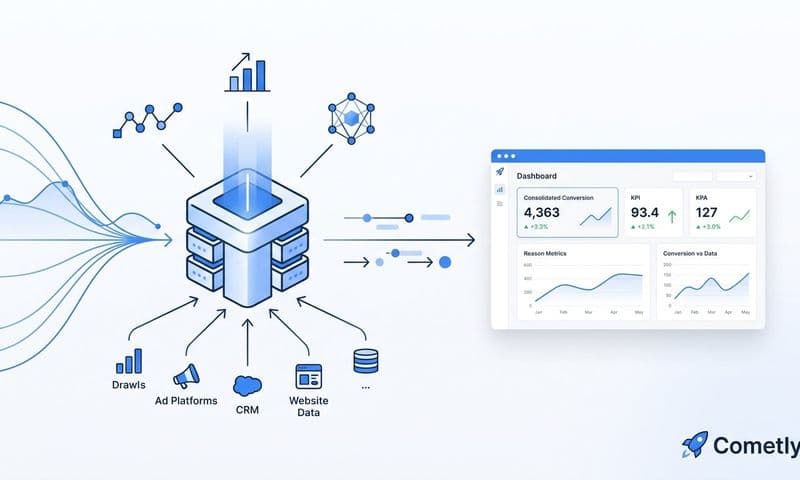
Marketing teams today run campaigns across Meta, Google, TikTok, LinkedIn, and dozens of other platforms. Each one generates its own reports, uses different metrics, and tells a different story about performance. The result? Hours spent downloading CSVs, wrestling with spreadsheets, and still not knowing which campaigns actually drive revenue.
Data consolidation solves this by bringing all your marketing data into a single, unified view. When done right, you can finally see the complete customer journey from first ad click to closed deal.
This guide walks you through the exact steps to consolidate your marketing data, connect it to real business outcomes, and start making decisions based on accurate, complete information. Whether you are managing campaigns for one brand or an entire portfolio of clients, these steps will help you build a system that scales.
Step 1: Audit Your Current Data Sources and Identify Gaps
Before you can consolidate anything, you need to know exactly what you are working with. Start by creating a comprehensive list of every platform that generates marketing data in your organization.
This includes your ad platforms like Meta, Google Ads, TikTok, and LinkedIn. It also includes your CRM, website analytics tools, email marketing platforms, landing page builders, and any other system that touches your customer journey. Many teams are surprised to discover they are using fifteen or more separate tools.
For each platform, document what metrics it tracks and what it misses. Google Ads shows you clicks and conversions but does not know what happens after someone fills out a form. Your CRM knows which leads closed into customers but has no visibility into which ad they clicked three weeks earlier. Your website analytics tracks sessions but cannot connect anonymous visitors to known leads in your database.
These gaps are where your customer journey breaks. A prospect might click a Facebook ad on their phone during lunch, research on their laptop that evening, and convert three days later on their tablet. If you are only looking at platform-level data, you will see three separate visitors and miss the complete story.
Map out how data currently flows between your systems. Does your CRM automatically receive lead source information from your website forms? Do your ad platforms know when a click turned into a qualified lead or a closed sale? In most organizations, this data flow is broken or non-existent.
Create a simple spreadsheet with columns for platform name, what it tracks, what it misses, and where the handoff to the next system fails. This audit becomes your roadmap for connecting all marketing data sources effectively.
Pay special attention to where revenue data lives. If your sales team closes deals in a CRM that never talks to your marketing platforms, you are optimizing campaigns based on incomplete information. You might be scaling ads that generate lots of clicks but zero actual customers.
Step 2: Define Your Core Metrics and Attribution Model
With your audit complete, you now need to decide what success actually looks like. Different stakeholders care about different metrics, and trying to track everything leads to analysis paralysis.
Choose three to five core metrics that directly connect to your business goals. For most marketing teams, this includes cost per acquisition, return on ad spend, customer lifetime value, and conversion rate at key funnel stages. These metrics should answer the question: "Are our marketing efforts profitable?"
Next, select an attribution model that reflects how your customers actually convert. First-click attribution gives all credit to the initial touchpoint. Last-click gives everything to the final interaction before conversion. Neither tells the complete story for complex B2B sales or considered purchases.
Multi-touch attribution models distribute credit across the entire customer journey. Linear attribution splits credit evenly. Time-decay gives more weight to recent interactions. Position-based models emphasize first and last touch while acknowledging middle interactions. Choose the model that best represents your typical customer journey length and complexity.
The key is consistency. Once you pick an attribution model, apply it across all your channels so you are comparing apples to apples. A campaign that looks weak in last-click might be your top performer in first-click or multi-touch models.
Establish naming conventions that work across all platforms. If your team calls something "lead gen campaign" in Meta but "prospecting" in Google and "awareness" in TikTok, your consolidated data will be a mess. Create a standardized taxonomy for campaign types, audience segments, and conversion events.
Build a data dictionary that defines exactly what each metric means. When someone says "conversion," does that mean form fill, qualified lead, demo booked, or closed customer? Understanding marketing analytics data models helps get everyone on the same page now to avoid confusion later.
Document these decisions and share them with your entire team. Your attribution model and metric definitions become the foundation for every decision you make moving forward.
Step 3: Connect Your Ad Platforms to a Central Hub
Now comes the technical work of actually connecting your data sources. Start with your ad platforms since they generate the majority of your marketing data and drive most of your spend.
Modern attribution platforms can integrate directly with Meta, Google, TikTok, LinkedIn, and other major ad networks through API connections. These integrations pull your campaign performance data automatically, eliminating the need for manual CSV downloads and spreadsheet updates.
Set up server-side tracking alongside your standard pixel-based tracking. Browser-based tracking has become increasingly unreliable due to iOS privacy changes, cookie blocking, and ad blockers. Server-side tracking captures conversion data directly from your server, providing a more complete and accurate picture of performance.
This is especially critical for understanding true conversion rates. Platform-reported conversions often undercount actual results because they cannot see conversions that happen after cookie expiration or across different devices. Server-side tracking closes these gaps.
Verify that conversion events are firing correctly across all platforms. Set up test campaigns or use your own ad accounts to trigger conversions, then confirm they appear in both the platform interface and your consolidated system. Check that event parameters like conversion value, product ID, and custom fields are passing through correctly.
Compare platform-reported data with your consolidated view to identify discrepancies. Some variation is normal due to attribution windows and processing delays, but major differences signal a tracking problem that needs immediate attention. Learn more about how ad tracking tools can help you scale ads using accurate data.
Test cross-device and cross-session tracking by simulating realistic customer journeys. Click an ad on mobile, visit the site on desktop later, and convert on tablet the next day. Your consolidated system should connect all three touchpoints to the same user journey.
Document your integration setup including which conversion events you are tracking, what attribution windows you are using, and any custom parameters you have configured. This documentation becomes essential when troubleshooting issues or onboarding new team members.
Step 4: Link Your CRM and Revenue Data
Ad platform data tells you about clicks and conversions, but your CRM holds the truth about revenue. Connecting these systems is where marketing attribution becomes genuinely valuable for business decisions.
Integrate your CRM so that every lead, opportunity, and closed deal connects back to the marketing touchpoints that influenced it. This means passing UTM parameters, click IDs, and source information from your website forms and landing pages into your CRM lead records.
Map the complete customer journey from first anonymous website visit through known lead, qualified opportunity, and closed customer. Each stage should maintain the connection to original marketing sources so you can see which campaigns drive not just leads, but actual revenue.
Set up revenue attribution by connecting marketing data to revenue through your attribution platform. This allows you to calculate true return on ad spend based on actual customer value, not just estimated conversion values.
For B2B teams with long sales cycles, this connection is essential. A campaign might generate expensive leads that look unprofitable based on cost per lead, but when you see that those leads close at twice the rate and three times the deal size, the economics completely change.
Ensure lead source data passes correctly from marketing to sales systems. Sales teams need to know which campaigns are generating their best opportunities so they can prioritize follow-up appropriately. Marketing teams need to see which sources convert through to revenue so they can optimize spend.
Configure your attribution platform to handle common CRM scenarios like lead merging, duplicate records, and opportunity splitting. Your data consolidation system should be smart enough to connect the dots even when CRM data gets messy.
Test the integration by creating test leads with known source information and tracking them through your entire funnel. Verify that source attribution persists through lead status changes, assignment to sales reps, and conversion to opportunities and customers.
Step 5: Implement Cross-Platform Tracking for the Full Journey
Modern customer journeys rarely happen in a single session on a single device. Someone might discover your brand through a TikTok ad on their phone, research on their laptop, and convert days later on their tablet. Without cross-platform tracking, these look like three different people.
Implement user identification strategies that connect anonymous sessions to known users once they provide an email address or other identifier. When someone fills out a form or creates an account, your tracking should retroactively connect their previous anonymous sessions to their user profile.
This gives you visibility into the complete journey, including all the touchpoints that happened before you knew who they were. You can see that the person who just became a customer actually discovered you through an Instagram ad two weeks ago, even though they converted through a Google search.
Use first-party data strategies to maintain tracking accuracy despite privacy changes. First-party cookies set on your own domain are more reliable than third-party tracking pixels. Server-side tracking using customer identifiers from your database provides the most accurate long-term view.
Set up event tracking for every meaningful conversion action, not just final purchases. Track demo requests, content downloads, email signups, pricing page views, and other micro-conversions that indicate buying intent. These events help you understand the full funnel and optimize for actions that lead to revenue.
Validate that touchpoints are being recorded in the correct sequence. Your attribution platform should show customer journeys in chronological order, making it easy to see the typical path from awareness through consideration to conversion. Understanding how to track marketing campaigns properly ensures accurate attribution.
Configure session stitching to handle gaps in the customer journey. If someone visits your site, leaves for three days, then returns and converts, your system should connect both visits to the same journey rather than treating them as separate users.
Test your cross-platform tracking extensively using realistic scenarios. Have team members interact with your campaigns across multiple devices and channels, then verify that your consolidated data accurately reflects their complete journey.
Step 6: Build Your Unified Dashboard and Reporting System
With all your data sources connected, you need a way to actually see and use the consolidated information. A well-designed dashboard transforms raw data into actionable insights.
Create a single view that shows performance across all channels side by side. You should be able to see Meta, Google, TikTok, and LinkedIn performance in the same report using consistent metrics and attribution models. This makes it immediately obvious which channels are actually driving results.
Set up automated reports that pull consolidated data on a schedule. Daily reports keep you on top of performance trends. Weekly reports provide enough data to spot meaningful patterns. Monthly reports give the big picture for stakeholder updates.
Configure alerts for significant performance changes or data anomalies. If your cost per acquisition suddenly spikes, your conversion tracking stops reporting data, or a top-performing campaign dramatically changes performance, you want to know immediately rather than discovering it days later.
Design different views for different stakeholders. Executives want high-level metrics like total revenue, overall ROAS, and channel mix. Marketing managers need campaign-level detail to make optimization decisions. Media buyers need ad-level data to adjust bids and creative.
Include comparison views that show performance against goals, previous periods, and channel benchmarks. Knowing that your Facebook campaigns generated $50,000 in revenue is meaningless without context. Knowing they are up 30% from last month and beating your target ROAS by 15% tells a story.
Build custom reports for common questions your team asks repeatedly. Which campaigns drive the highest lifetime value customers? What is the typical customer journey length? Which touchpoints most often appear in converting journeys? Explore data visualization tools for marketing analytics to answer these questions once with a saved report rather than rebuilding the analysis each time.
Step 7: Feed Better Data Back to Ad Platforms
Data consolidation is not just about reporting. The real power comes when you use your unified data to improve campaign performance by feeding better information back to ad platforms.
Use conversion sync to send enriched conversion data back to Meta, Google, and other platforms. When your attribution system knows that a click led to a qualified lead worth $5,000, send that information back to the ad platform. This gives their algorithms much better data to optimize toward valuable outcomes rather than just any conversion.
Ad platforms rely on conversion data to train their machine learning models for targeting and bidding. When you only send basic conversion events, their algorithms optimize for volume. When you send qualified conversions with accurate values, they optimize for revenue.
This is especially powerful for businesses with long sales cycles or complex funnels. Instead of waiting weeks for a deal to close before the ad platform learns whether a click was valuable, you can send qualified lead events within hours and closed deal confirmations later to continuously improve the feedback loop.
Set up feedback loops so your consolidated data improves targeting over time. When your attribution system identifies that certain audience segments or creative approaches consistently drive high-value customers, use that insight to adjust your targeting parameters and creative strategy.
Monitor how data quality improvements impact campaign performance. After implementing conversion sync, you should see ad platform algorithms get better at finding valuable customers. Your cost per qualified lead should decrease as the platforms learn which users are most likely to convert into real opportunities. Understanding why marketing data accuracy matters for ROI reinforces the importance of this step.
Track the difference between platform-reported conversions and your server-side consolidated data. This gap shows you how much signal the platforms are missing. As you feed more complete data back through conversion sync, this gap should narrow and campaign performance should improve.
Putting It All Together
Consolidating your marketing data transforms how you make decisions. Instead of guessing which channels work based on incomplete platform reports, you see the complete picture of what drives revenue.
Start with the audit to understand your current state, then systematically connect each data source to your central hub. The payoff comes when you can confidently scale campaigns that actually convert and cut spend on those that only look good in isolated platform metrics.
Use this checklist to track your progress: audit complete, metrics defined, ad platforms connected, CRM linked, cross-platform tracking live, dashboard built, and conversion sync active. Each step brings you closer to marketing decisions based on truth rather than assumptions.
The teams that win in modern marketing are not the ones with the biggest budgets. They are the ones with the clearest view of what actually works. When you consolidate your data properly, you gain that clarity. You stop wasting money on campaigns that generate clicks but not customers. You double down on the channels and messages that drive real business outcomes.
Your competitors are still downloading CSVs and guessing which campaigns matter. You will know. That advantage compounds over time as you continuously optimize based on complete information while they optimize based on fragments.
Ready to elevate your marketing game with precision and confidence? Discover how Cometly's AI-driven recommendations can transform your ad strategy. Get your free demo today and start capturing every touchpoint to maximize your conversions.