If your ad platforms are reporting numbers that do not match your actual sales, you are not alone. Gaps in conversion tracking are one of the most common and costly problems facing digital marketers today. Between browser privacy restrictions, iOS tracking limitations, cross-device journeys, and fragmented multi-platform campaigns, the data you rely on to make budget decisions is often incomplete or simply wrong.
The result? You end up scaling campaigns that are not actually performing and cutting spend on ads that are quietly driving revenue. It is a frustrating position to be in, especially when you are managing real budgets and real expectations.
This guide walks you through six concrete steps to improve your conversion tracking from the ground up. You will learn how to audit your current setup for blind spots, implement server-side tracking for more reliable data capture, connect your CRM so you can tie ad clicks to actual revenue, adopt multi-touch attribution to understand the full customer journey, sync accurate conversion data back to your ad platforms, and build a review cadence that keeps your tracking sharp over time.
Whether you are running campaigns on Meta, Google, TikTok, or all of the above, these steps apply across platforms and will give you the foundation for confident, data-driven decisions. Let us get into it.
Step 1: Audit Your Current Tracking Setup for Gaps and Errors
Before you can improve your conversion tracking, you need to understand exactly what is broken. Most marketers are surprised to discover how many issues exist in a setup they assumed was working fine. A systematic audit is the only way to find out.
Start by building a master list of every conversion event you are tracking across every platform. That means Google Ads, Meta, TikTok, LinkedIn, and any other channel where you are running paid campaigns. For each event, document what it is supposed to track, which page or action triggers it, and how many conversions it is reporting over the past 30 days.
Once you have that list, use platform-native diagnostic tools to verify that each event is actually firing correctly. Google Analytics 4 and Google Tag Assistant let you walk through your site in debug mode to confirm that tags fire on the right pages and pass the right data. Meta Events Manager has a Test Events tool that shows you live event activity as you navigate your site, so you can confirm purchase or lead events are triggering where they should.
As you go through this process, watch for these common issues:
Pixels on the wrong pages: A conversion event that fires on a product page instead of a confirmation page will inflate your numbers significantly.
Missing thank-you page events: If your purchase or lead confirmation page does not have a conversion tag, you are losing credit for completed actions.
Page views counted as conversions: This is a classic misconfiguration where a tag fires on every page load rather than only on a specific conversion action.
Double-firing tags: If you have both a hardcoded pixel and a tag manager version of the same event, you may be counting every conversion twice.
After you have verified the technical setup, cross-reference your platform-reported conversions against your actual backend data. Pull your CRM records or payment processor data for the same time period and compare the numbers. If Meta says you had 80 purchases but Stripe shows 55, that gap tells you exactly how much data you are currently missing or inflating. For a deeper look at why these discrepancies happen, read our guide on why conversion tracking numbers are wrong.
This comparison is the most important output of your audit. It gives you a concrete baseline to measure improvement against as you work through the remaining steps.
Success indicator: You have a documented list of every conversion event, where it fires, and how its reported numbers compare to your actual backend data. You know where the gaps are and roughly how large they are.
Step 2: Implement Server-Side Tracking to Capture What Browsers Miss
Once you understand the gaps in your current setup, the next question is: why do they exist? For many marketers, the answer comes down to how tracking data is collected in the first place.
Traditional conversion tracking relies on browser-based pixels. When a user lands on your thank-you page, a small piece of JavaScript fires in their browser and sends a signal to Meta or Google. The problem is that this method has become increasingly unreliable. Ad blockers prevent pixels from loading. Safari's Intelligent Tracking Prevention limits cookie lifespans. And since Apple's iOS 14.5 App Tracking Transparency rollout, a significant portion of mobile users have opted out of cross-app tracking entirely, making browser-based signals even less complete. Understanding the full impact of these changes is essential, and our article on tracking conversions after the iOS update covers this in detail.
Server-side tracking solves this by moving the data collection off the user's browser entirely. Instead of relying on a pixel to fire in the browser, your server sends conversion data directly to the ad platform's API. The user's browser never has to cooperate. Ad blockers cannot interfere. Cookie restrictions do not apply.
In practical terms, this means connecting your website or app backend to send events via APIs like Meta's Conversions API or Google's enhanced conversions. When a purchase is completed, your server captures the event and sends it directly to the platform, along with any available customer data like hashed email addresses that help match the conversion to the right user. To understand the technical differences more clearly, our comparison of server-side tracking vs pixel tracking breaks it all down.
Setting this up from scratch typically requires developer involvement to build and maintain the API connections. That is where a tool like Cometly simplifies the process significantly. Cometly's server-side tracking handles the integration layer for you, so you do not need to build custom API connections or manage ongoing maintenance. You get the reliability of server-side data without the engineering overhead.
A practical tip here: do not try to migrate every event to server-side tracking at once. Start with your highest-value conversion events, typically purchases and qualified leads. These are the events that directly inform your budget decisions, so getting them right first delivers the most immediate impact. Once those are stable, you can expand to micro-conversions like form starts or add-to-cart events.
It is also worth running server-side and client-side tracking in parallel for a few weeks during the transition. This lets you compare the two data streams and confirm your server-side setup is capturing events accurately before you rely on it exclusively.
Success indicator: You see a measurable increase in tracked conversions compared to your pixel-only setup, and the numbers are moving closer to what your backend records show.
Step 3: Connect Your CRM and Payment Tools to Close the Data Loop
Server-side tracking captures more conversion events, but it still only tells part of the story. If your tracking stops at a form fill or a click, you are measuring activity, not revenue. To truly understand which ads are driving business outcomes, you need to connect your attribution data to the tools where revenue actually lives.
Think about the gap that exists in most setups. A user clicks an ad, fills out a lead form, and your platform reports a conversion. But what happened after that? Did the lead qualify? Did they close? Did they spend $200 or $20,000? Without connecting to your CRM, you have no way to answer those questions from your ad data. Businesses focused on lead generation should explore our guide on tracking conversions for lead generation for a more detailed walkthrough.
The fix is to integrate your CRM, whether that is HubSpot, Salesforce, or another platform, along with your payment processor like Stripe, so that downstream revenue data flows back into your attribution reporting. When a deal closes in your CRM or a payment processes in Stripe, that event gets tied back to the original ad click that started the journey.
This connection lets you move beyond cost-per-lead metrics and start measuring cost-per-revenue. You can see which specific ad, campaign, or keyword led to a closed deal, not just a form submission. That is a fundamentally different and more useful view of performance. The right revenue attribution tracking tools make this process far more manageable.
Cometly's integrations with tools like Stripe and major CRM platforms are built for exactly this purpose. They unify the full journey from first ad click to final revenue event, giving you a single view of what is actually driving results.
The most common pitfall in this step is inconsistent UTM parameter mapping. If your UTM parameters are not being captured and stored consistently in your CRM records, the link between the ad click and the CRM entry breaks. Make sure every lead capture form is passing UTM data to your CRM, and that your CRM is storing it at the contact or deal level. The same applies to platform click IDs like GCLID for Google or FBCLID for Meta. These identifiers are what make it possible to match a CRM record back to a specific ad interaction.
Success indicator: You can trace a specific closed deal or purchase back to the exact ad that initiated the customer journey, and your cost-per-revenue metrics are visible alongside your cost-per-lead metrics.
Step 4: Move Beyond Last-Click with Multi-Touch Attribution
Here is a scenario that plays out constantly in marketing teams. You look at your last-click attribution data and it tells you that Google Search is your best-performing channel. So you shift budget toward it. But a few months later, overall lead volume drops. What happened?
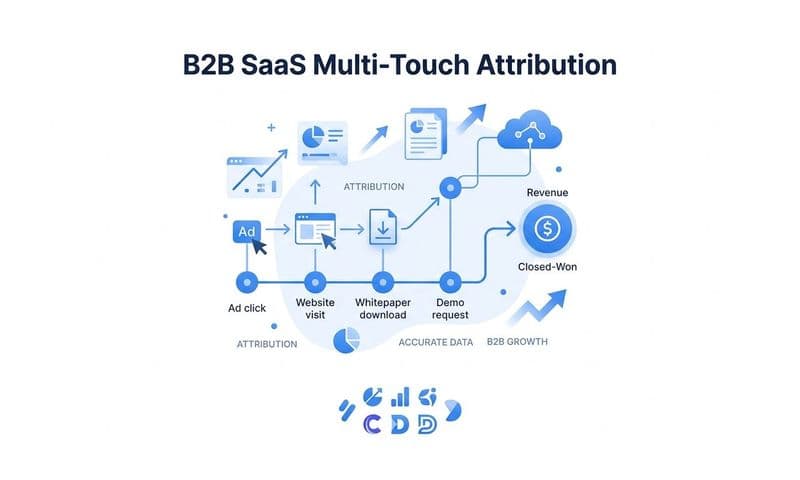
What likely happened is that your Google Search conversions were not happening in isolation. Buyers were seeing your Meta ads first, reading a retargeting ad on YouTube, and then finally searching for your brand name and clicking a Google ad right before converting. Last-click gave Google Search all the credit for a journey that involved four other touchpoints. When you cut those earlier channels, the pipeline dried up.
This is the core problem with last-click attribution. It gives 100 percent of the credit to the final touchpoint and ignores every ad or channel that influenced the buyer earlier in their journey. For short, simple sales cycles, it is often acceptable. For anything more complex, it actively misleads your budget decisions. Understanding how to properly handle tracking conversions across multiple touchpoints is essential to solving this.
Multi-touch attribution models distribute credit across all the touchpoints in a customer journey. The most common models work like this:
Linear: Credit is split equally across every touchpoint. Useful when you want to understand the full channel mix without overweighting any single interaction.
Time-decay: More credit goes to touchpoints that occurred closer to the conversion. This works well for longer sales cycles where recent interactions carry more influence.
Position-based (U-shaped): More credit goes to the first and last touchpoints, with the remaining credit distributed across the middle. This is a good fit when you want to value both acquisition and closing interactions.
The right model depends on your sales cycle length and channel mix. A business with a one-day purchase cycle has different needs than one with a 60-day enterprise sales process.
Cometly's multi-touch attribution lets you compare models side by side, so you can see how credit shifts across channels under different frameworks. Our deep dive into touchpoint tracking analytics explains how to interpret these comparisons effectively. This is particularly valuable because no single model is objectively correct. Running multiple models in parallel for a few weeks and observing where they agree and where they diverge gives you a much richer understanding of what is actually driving your conversions.
Success indicator: You can identify campaigns and channels that contribute meaningfully to conversions but were previously invisible or undervalued under last-click reporting.
Step 5: Sync Enriched Conversion Data Back to Your Ad Platforms
Most marketers think about attribution as a reporting tool. You collect data, you analyze it, and you make decisions. But there is another dimension to accurate conversion data that is easy to overlook: the feedback loop.
When you send better, more accurate conversion data back to platforms like Meta and Google, their algorithms use that data to optimize targeting and bidding more effectively. Ad platforms are running machine learning models that learn from every conversion signal you send them. The quality and completeness of those signals directly affects how well the algorithm performs on your behalf.
This is where conversion sync becomes a critical part of your tracking strategy. Instead of only using your attribution data internally for reporting, you send verified purchase or lead events with accurate values back to the ad platform's optimization engine. The platform receives cleaner signals, which improves lookalike audiences, automated bidding strategies, and overall campaign performance over time. If you are running ads across multiple networks, our guide on tracking conversions across multiple ad platforms explains how to manage this complexity.
Think about what this means in practice. If your pixel is only capturing 60 percent of your actual conversions due to browser limitations and iOS restrictions, Meta's algorithm is learning from an incomplete picture. It is optimizing for a subset of your real customers. When you close that gap with server-side data and feed it back through conversion sync, the algorithm suddenly has a much more accurate view of who is actually converting and at what value.
Cometly's Conversion Sync feature automates this entire process. It takes the enriched conversion events captured through server-side tracking and CRM integration and feeds them back to Meta, Google, and other platforms without requiring manual CSV uploads or custom API work. The data flows continuously, keeping the algorithm's learning as current as possible.
The most common pitfall here is sending partial or delayed data. If you only sync conversions once a week, or if you are filtering out certain conversion types before sending, you are weakening the signal the algorithm receives. Timely, complete data is what makes the feedback loop effective.
Success indicator: Over time, you notice improved cost-per-acquisition or return on ad spend as platform algorithms receive higher-quality conversion signals and adjust their optimization accordingly.
Step 6: Build a Regular Review Cadence to Keep Tracking Accurate
You have audited your setup, implemented server-side tracking, connected your CRM, adopted multi-touch attribution, and set up conversion sync. Your tracking is in the best shape it has ever been. Now the most important thing you can do is make sure it stays that way.
Conversion tracking is not a set-it-and-forget-it task. Website changes, new landing pages, platform updates, tag manager edits, and campaign restructuring can all break tracking silently. You will not always get an error message. The numbers will simply stop being accurate, and if you are not checking, you will not notice until the damage is done. Our article on why conversions are not tracking covers the most common culprits behind silent failures.
A practical review schedule looks like this:
Weekly spot-checks: Spend 15 to 20 minutes reviewing conversion volume for anomalies. Are your purchase or lead events reporting numbers that look consistent with recent trends? A sudden drop or spike is often the first sign of a tracking issue.
Monthly audits: Compare platform-reported conversions to your CRM or payment processor data for the previous month. Is the gap staying stable, growing, or shrinking? Growing gaps indicate something has broken or degraded in your tracking setup.
Quarterly deep dives: Review your attribution model accuracy and check whether new campaigns or channels have been added without proper tracking in place. This is also a good time to revisit which conversion events you are optimizing toward and whether they still reflect your actual business goals.
Cometly's analytics dashboard and AI-powered recommendations are built to surface anomalies and optimization opportunities proactively. Rather than waiting for you to notice something is off, the platform flags issues and highlights areas where performance is diverging from expectations, so you can catch problems before they cost you significant budget.
One practical tip that makes a real difference: assign a specific team member to own the tracking review process. When everyone is responsible, no one is. A named owner with a calendar reminder is far more reliable than a shared intention.
Success indicator: You catch and fix tracking issues within days rather than discovering them months later during a quarterly performance review.
Your Conversion Tracking Checklist and Next Steps
Improving your conversion tracking is not a single project with a finish line. It is an ongoing discipline that compounds over time. Each step you complete gives you better data, and better data leads to better decisions, which leads to better results.
Here is a quick reference checklist to keep your progress on track:
Audit complete: Every conversion event is documented, verified, and cross-referenced against backend data.
Server-side tracking live: Your highest-value conversion events are being captured via server-side APIs, not just browser pixels.
CRM and payment tools connected: Ad clicks are tied to actual revenue outcomes, and UTM parameters are flowing consistently into your CRM records.
Multi-touch attribution active: You are comparing at least two attribution models and using that view to inform channel budget decisions.
Conversion sync enabled: Enriched conversion data is flowing back to Meta, Google, and other platforms to improve algorithmic optimization.
Review cadence in place: A named team member owns weekly, monthly, and quarterly tracking reviews.
Each of these steps builds on the previous one. The audit reveals the gaps. Server-side tracking closes them. CRM integration connects activity to revenue. Multi-touch attribution shows the full picture. Conversion sync turns that picture into better algorithmic performance. And the review cadence makes sure it all stays accurate.
If you are ready to put all of this in motion without stitching together a dozen separate tools, Cometly brings the entire workflow into one platform. From server-side tracking and CRM integration to multi-touch attribution and conversion sync, it is built for marketers who need accurate, complete data to make confident decisions. Get your free demo today and start capturing every touchpoint to maximize your conversions.