
Your Facebook Ads dashboard shows 50 conversions this week. Your CRM shows 32. Your sales team closed 18 deals. Which number is real? If you're like most marketers running paid campaigns in 2026, you're staring at three different versions of reality, and none of them match. This isn't just frustrating—it's expensive. When Facebook's algorithm optimizes based on incomplete or inaccurate conversion data, you're essentially teaching it to find the wrong customers.
The tracking landscape changed fundamentally when iOS 14.5 introduced App Tracking Transparency. Suddenly, browser-based pixels that marketers relied on for years started missing significant portions of conversion activity. Ad blockers, cookie restrictions, and privacy settings created blind spots in your data. The result? Facebook sees only a fraction of your actual conversions, which means its machine learning optimizes for an incomplete picture of success.
The disconnect between what Facebook reports and what actually happens in your business creates a cascading problem. You can't confidently scale winners because you don't know which campaigns truly drive revenue. You waste budget on ads that look good in Ads Manager but deliver poor-quality leads. Your attribution becomes guesswork instead of science.
Here's what most marketers don't realize: this problem is fixable. You can dramatically improve the quality and completeness of your Facebook Ads conversion data. The solution isn't a single setting or tool—it's a systematic approach that combines server-side tracking, proper event configuration, customer data enrichment, and CRM integration. When implemented correctly, these steps give Meta the accurate signals it needs to optimize your campaigns for real business outcomes.
This guide walks you through the exact process to close the gap between Facebook's view of your performance and reality. You'll learn how to audit your current setup, implement the Conversions API for reliable server-side tracking, enrich your events with data that improves match quality, connect your full sales pipeline, and configure attribution settings that reflect your actual customer journey. By the end, you'll have a complete roadmap for feeding better data back to Facebook—which translates directly into better campaign performance and more confident scaling decisions.
Step 1: Audit Your Current Conversion Tracking Setup
Before you can improve your conversion data, you need to understand exactly where the problems exist. Start by opening Facebook Events Manager and reviewing which events are currently firing from your website or app. Look at the events overview for the past 30 days and note the volume of each event type—page views, add to cart, initiate checkout, purchase, and any custom events you've configured.
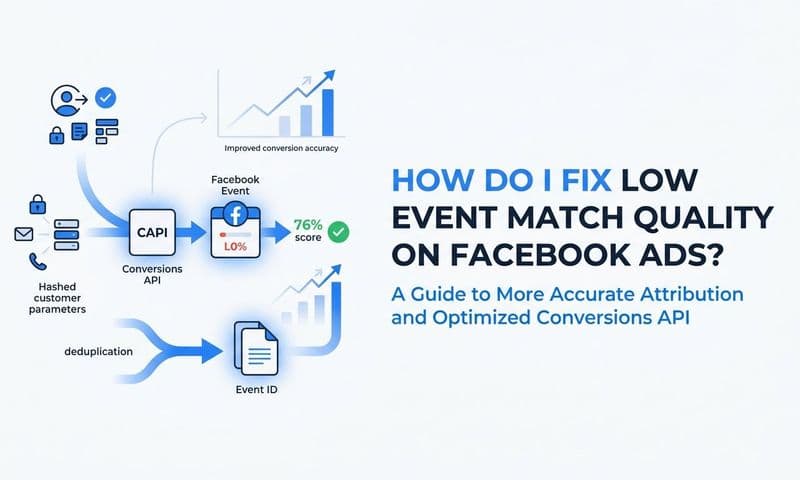
Pay close attention to the event match quality score for each conversion event. This metric, which ranges from 0 to 10, indicates how well the customer parameters you're sending match Facebook users. If your purchase events show a match quality of 3.2, that's a red flag. You're sending minimal customer information, which limits Facebook's ability to attribute conversions accurately and optimize delivery. Scores below 6.0 suggest significant room for improvement.
Next, compare Facebook-reported conversions against your actual backend data. Pull your conversion numbers from Facebook Ads Manager for the past month. Then pull the same metrics from your source of truth—whether that's Google Analytics, your e-commerce platform, your CRM, or your payment processor. Calculate the discrepancy percentage. If Facebook reports 200 purchases but your Shopify store processed 280, you have a 28% tracking gap. Document this baseline number because you'll use it to measure improvement.
Check for common technical issues that create data quality problems. Duplicate events are surprisingly common—they happen when both your pixel and Conversions API send the same event without proper deduplication, inflating your numbers artificially. Look for sudden spikes in event volume that don't match actual business activity. Review your pixel implementation to ensure it's firing on the correct pages and not triggering multiple times per page load. Understanding why Facebook Ads not tracking conversions can help you identify the root causes of these issues.
Missing parameters are another frequent culprit. Open the event details in Events Manager and examine what data you're actually sending with each conversion. Are you capturing email addresses? Phone numbers? Transaction values? Product categories? If your purchase events only include the event name without any customer identifiers or value data, you're leaving significant optimization potential on the table.
Browser-blocking issues affect more conversions than most marketers realize. Use the Facebook Pixel Helper browser extension to test your pixel on different browsers and devices. Try it with common ad blockers enabled to see what gets through. Many privacy-focused browsers and extensions now block Facebook pixels by default, creating invisible gaps in your tracking. If your pixel doesn't fire at all in these scenarios, you're missing data from privacy-conscious users who may represent a significant portion of your audience.
Document everything you find in this audit. Create a spreadsheet that lists each conversion event, its current match quality score, the tracking gap percentage compared to your backend data, and any technical issues you identified. This baseline becomes your benchmark for measuring improvement as you implement the remaining steps. It also helps you prioritize which fixes will have the biggest impact on data quality.
Step 2: Implement the Conversions API for Server-Side Tracking
Browser-based pixel tracking alone no longer provides the data quality Facebook's algorithm needs to optimize effectively. When a user has tracking prevention enabled, uses an ad blocker, or doesn't consent to cookies, your pixel simply doesn't fire. Those conversions happen in the real world but remain invisible to Facebook. The Conversions API solves this problem by sending conversion events directly from your server to Facebook, bypassing browser limitations entirely.
Think of it this way: the pixel relies on the user's browser cooperating. The Conversions API doesn't care about browser settings because it operates on your server. When someone completes a purchase, your server sends that conversion event to Facebook regardless of whether the pixel fired. This creates redundancy that dramatically improves data completeness. Learning how to sync conversion data to Facebook Ads is essential for maintaining accurate reporting.
Setting up the Conversions API requires technical implementation, but the process is straightforward. If you use a major e-commerce platform like Shopify, WooCommerce, or BigCommerce, start by checking for native integrations or official plugins. Many platforms now offer one-click Conversions API setup that handles the technical details automatically. For custom websites or applications, you'll need to implement the API using Facebook's server-side SDK or by making direct HTTP requests to the Conversions API endpoint.
The core concept is simple: when a conversion event happens on your site, your server sends a POST request to Facebook with the event data. This includes the event name (like "Purchase"), the timestamp, customer identifiers, and any relevant parameters. Facebook provides SDKs for common programming languages including PHP, Node.js, Python, and Java that simplify the implementation.
Event deduplication is critical when you run both pixel and Conversions API. Without it, you'll count the same conversion twice—once from the browser pixel and once from your server. Facebook uses an event_id parameter to deduplicate. When both your pixel and server send the same event with matching event_id values, Facebook recognizes them as the same conversion and counts it only once. Generate a unique identifier for each conversion on your server, send it with both the pixel event and the API event, and Facebook handles the rest.
After implementing the Conversions API, verify that your server events are reaching Facebook correctly. Go to Events Manager and select your pixel. Look for the "Server" indicator next to your events—this confirms that Facebook is receiving server-side data. Click on any event to see the event details and verify that the parameters you're sending are being received accurately.
Check the "Overview" tab in Events Manager to see the proportion of events coming from browser versus server. A healthy implementation typically shows events from both sources, with server events filling gaps where the pixel didn't fire. If you see only browser events after implementing the API, something went wrong in your setup. Review your server code, check for errors in your API requests, and verify that you're using the correct access token and pixel ID.
The Conversions API also enables you to send events that happen offline or outside the browser entirely. Phone orders, in-person sales, or conversions that happen in your CRM days after the initial click can all be sent through the API. This gives Facebook a complete picture of your customer journey, not just the browser-visible portion.
Step 3: Enrich Your Conversion Events with Customer Data
Event match quality directly impacts how well Facebook can attribute conversions and optimize your campaigns. When you send a conversion event with minimal information—just the event name and timestamp—Facebook struggles to match it to the right user. Add customer identifiers like email, phone number, and external IDs, and suddenly Facebook can confidently connect that conversion to the person who clicked your ad.
The more customer parameters you include, the higher your match quality score. Facebook uses these identifiers to match conversion events to user profiles in its system. Email addresses and phone numbers are particularly valuable because they're unique and stable identifiers. First name, last name, city, state, and country provide additional matching signals. The external_id parameter lets you send your own customer IDs, which is especially useful for tracking logged-in users.
Privacy compliance is non-negotiable when sending customer data. Facebook requires that you hash sensitive information like email addresses and phone numbers before transmission. Hashing is a one-way encryption process that converts the original data into a fixed-length string. Facebook can match hashed emails against its hashed user database, but the original email address isn't exposed in transit or storage. Implementing first party data tracking for ads ensures you maintain compliance while maximizing data quality.
Use SHA-256 hashing for all customer identifiers. Most programming languages have built-in functions for this. Before hashing email addresses, normalize them by converting to lowercase and removing spaces. For phone numbers, include the country code and remove any formatting characters like parentheses or dashes. Hash each parameter separately—don't combine them before hashing.
Beyond customer identifiers, include transaction and product data that helps Meta optimize. The value parameter tells Facebook the monetary value of each conversion, enabling value-based optimization. If you sell products at different price points, this parameter is essential—it teaches the algorithm to find customers who make higher-value purchases, not just any purchase.
Add the content_ids parameter to specify which products were purchased. Include content_category to indicate the product type. If you run a clothing store, knowing that someone bought from your "winter jackets" category versus "accessories" helps Facebook find similar shoppers. The content_name parameter provides additional context about what was purchased.
Currency matters more than you might think. Always include the currency parameter with the three-letter ISO code (USD, EUR, GBP). If you operate in multiple markets, this ensures Facebook interprets values correctly. A 100 USD purchase is very different from a 100 JPY purchase, and Facebook needs to know which you mean.
Aim for event match quality scores above 6.0 for your most important conversion events. Scores in the 7-8 range are excellent and indicate you're sending comprehensive customer data. You can check your current scores in Events Manager by clicking on any event and looking at the "Event Match Quality" section. If you're below 6.0, review which parameters you're missing and prioritize adding the most impactful ones—typically email and phone.
The quality improvement isn't just about better reporting. Higher match quality directly improves campaign performance because Facebook's algorithm can more accurately connect ad interactions to conversions. This means better optimization, more efficient spending, and campaigns that actually scale when you increase budget.
Step 4: Connect Your CRM to Track Full-Funnel Conversions
The most valuable conversions often happen days or weeks after someone clicks your ad—a qualified lead becomes a demo, a demo becomes a proposal, a proposal becomes a closed deal. If you only track the initial form submission, Facebook optimizes for leads that may never convert to revenue. Connecting your CRM to send downstream conversion events gives Meta the complete picture of what makes a valuable customer.
Start by mapping your sales pipeline stages to Facebook conversion events. If you use a CRM like HubSpot, Salesforce, or Pipedrive, identify the key milestones that indicate increasing customer value. For a B2B SaaS company, this might include stages like "Marketing Qualified Lead," "Sales Qualified Lead," "Demo Completed," "Proposal Sent," and "Closed Won." Each of these represents a conversion event you can send back to Facebook.
Create custom conversion events in Facebook for each pipeline stage that matters to your business. Go to Events Manager, click "Custom Conversions," and set up events that correspond to your CRM stages. You might create events named "SQL_Created," "Demo_Completed," or "Deal_Closed." These custom events can then be used as optimization goals in your campaigns or as signals that help Facebook's algorithm understand lead quality. Proper conversion sync for Facebook Ads ensures these events flow seamlessly between systems.
Timing is crucial for offline conversions. Facebook has attribution windows—typically 7 days for clicks and 1 day for views—and conversions must be sent within these windows to be attributed correctly. If someone clicks your ad on Monday and becomes a qualified lead on Wednesday, that's within the window. But if they close a deal 30 days later, standard Facebook attribution won't connect it to the original ad.
This is where extended attribution solutions become valuable. While Facebook's native attribution has limitations, tools like Cometly track the entire customer journey from first click through final conversion, regardless of how long the sales cycle takes. When a deal closes in your CRM, Cometly identifies which ad, campaign, and channel originally brought that customer in, then sends that enriched conversion data back to Facebook with the proper attribution.
The technical implementation involves connecting your CRM to send conversion events through the Conversions API whenever pipeline stages change. Most modern CRMs offer webhooks or API integrations that trigger when a deal moves to a new stage. You can configure these webhooks to send conversion events to Facebook with the customer's hashed email or phone number as the identifier, allowing Facebook to match the conversion to the original user.
Include the conversion value at each stage. If your average customer is worth $10,000, you might assign values like $500 for a qualified lead, $2,000 for a completed demo, and the full deal value for closed deals. This teaches Facebook which campaigns drive not just volume, but actual revenue. Over time, the algorithm learns to optimize for the campaigns and audiences that progress furthest down your funnel.
Track lead quality indicators beyond just stage progression. If your sales team qualifies leads based on company size, industry, or budget, send these as event parameters. Facebook can use this information to find more prospects that match your ideal customer profile. The more context you provide about what makes a lead valuable, the better Facebook becomes at finding similar prospects.
Step 5: Configure Attribution Settings for Your Business Model
Attribution windows determine how long after someone interacts with your ad Facebook will credit conversions. The default setting is 7-day click and 1-day view, meaning conversions are attributed if they happen within 7 days of clicking your ad or 1 day of viewing it. This works well for e-commerce with short consideration cycles, but many businesses need different settings to match their reality. Understanding Facebook Ads attribution window limitations helps you work around these constraints.
Consider your typical sales cycle when choosing attribution windows. If you sell high-ticket services where prospects research for weeks before buying, a 7-day window misses most conversions. You see ad clicks that look like they didn't convert, when in reality those people purchased three weeks later. Unfortunately, Facebook's native attribution windows max out at 7 days for clicks, which creates a fundamental limitation for longer sales cycles.
Understanding click-through versus view-through attribution helps you interpret your data correctly. Click-through attribution credits conversions to users who actually clicked your ad. View-through attribution credits conversions to users who saw your ad but didn't click, then later converted through another path. View-through can be valuable for brand awareness campaigns, but it also inflates conversion numbers if you're not careful. A user might see your ad, ignore it, and later search for your brand directly—the view-through attribution would credit the display ad even though the search likely drove the conversion.
For most direct-response campaigns, focus primarily on click-through attribution. It provides a clearer picture of which ads actually motivated action. You can adjust the attribution window in your campaign settings or when creating custom conversions. Test different windows to see which most closely matches your actual conversion patterns. Run a comparison: look at conversions with 1-day click versus 7-day click attribution and see which aligns better with your backend data.
Conversion value optimization changes how Facebook's algorithm approaches bidding. Instead of optimizing for the most conversions at the lowest cost, it optimizes for the highest total conversion value. If you have variable transaction amounts—some customers buy $50 products while others buy $500 products—this setting helps Facebook find the higher-value customers. Enable it in your campaign settings by choosing "Maximize value of conversions" as your bid strategy.
Different attribution models show different perspectives on your customer journey. Facebook's default model is last-click attribution, crediting the final ad interaction before conversion. But customers often interact with multiple ads across different campaigns before converting. While Facebook's native reporting doesn't offer sophisticated multi-touch attribution, understanding that your customer journey likely involves multiple touchpoints helps you interpret the data more accurately. Exploring the Facebook Ads attribution model in depth can clarify how conversions are credited.
The attribution setting that matters most is the one that reflects your actual business model. If you're a local service business where most customers call within a day of seeing your ad, 1-day click attribution makes sense. If you're a B2B software company with a 60-day sales cycle, you need attribution solutions that track beyond Facebook's native windows to see the complete picture.
Step 6: Validate and Monitor Your Data Quality Ongoing
Improving your conversion data isn't a one-time project—it's an ongoing process that requires regular monitoring and refinement. Create a weekly reconciliation routine where you compare Facebook's reported conversions against your source of truth. Pull the numbers from Ads Manager and your backend system for the same date range, then calculate the discrepancy percentage. Track this metric over time to ensure your improvements are holding and to catch any new issues quickly.
Set up alerts for sudden changes in data quality. In Events Manager, monitor your event match quality scores weekly. If your purchase event match quality drops from 7.5 to 4.2 overnight, something broke—maybe a developer changed your checkout flow and removed the email capture, or your Conversions API integration stopped working. Catching these issues within days instead of weeks prevents significant data loss and wasted ad spend. Addressing inaccurate conversion data Facebook reports quickly is critical for maintaining campaign performance.
Conversion volume anomalies also warrant investigation. If your typical purchase event volume is 100-150 per day and you suddenly see 50, check whether the pixel or Conversions API stopped firing. Conversely, if you see 300 purchases when your actual sales were 150, you likely have a deduplication problem where events are being counted twice. Events Manager provides diagnostic tools that show event activity over time and flag potential issues.
Review your Aggregated Event Measurement configuration regularly. This iOS 14.5+ limitation restricts you to 8 prioritized conversion events per domain. Facebook uses this priority ranking to determine which events to report when users have limited tracking. Make sure your most valuable conversion events—typically purchase, lead, or other revenue-driving actions—are ranked highest. Lower-priority events like page views or content views should be at the bottom.
Stay current with Facebook's evolving tracking requirements and features. Meta regularly releases updates to the Conversions API, introduces new event parameters, and changes best practices for data quality. Subscribe to the Facebook Business blog and check the Events Manager regularly for notifications about new features or required changes. What works today might need adjustment in six months as the platform evolves.
Test new tracking enhancements before fully deploying them. If Facebook introduces a new customer parameter that could improve match quality, implement it on a small portion of your traffic first. Monitor whether it actually improves your match quality score and doesn't create unintended issues. Once validated, roll it out across all conversion events. Using reliable conversion tracking tools for Facebook Ads can streamline this testing process.
Document your tracking setup comprehensively. Create a reference document that lists every conversion event you're tracking, where it fires, what parameters it includes, and how it connects to your business outcomes. When team members change or you need to troubleshoot issues, this documentation saves hours of investigation. Include details about your Conversions API implementation, deduplication approach, and any custom integrations with your CRM or other systems.
Your Roadmap to Better Facebook Ads Performance
Improving your Facebook Ads conversion data transforms campaign performance in ways that compound over time. Better data means better optimization, which means better results, which means more confident scaling. The steps outlined in this guide—auditing your setup, implementing server-side tracking, enriching events, connecting your CRM, configuring attribution, and monitoring quality—work together to give Meta the signals it needs to find your best customers.
Use this checklist to track your implementation progress. First, complete your tracking audit and document your baseline metrics. Second, get the Conversions API live and verify server events are flowing. Third, enrich your events with customer data until match quality exceeds 6.0. Fourth, connect your CRM to track full-funnel conversions. Fifth, configure attribution settings that match your sales cycle. Sixth, establish ongoing monitoring and reconciliation processes.
Each step builds on the previous ones. The Conversions API ensures events reach Facebook reliably. Event enrichment ensures those events contain actionable data. CRM integration ensures Facebook sees the conversions that matter most to your business. Proper attribution ensures you're measuring the right timeframe. Ongoing monitoring ensures everything keeps working as your business and the platform evolve.
The impact shows up in multiple ways. Your campaign reporting becomes more accurate, giving you confidence in which campaigns actually drive results. Facebook's algorithm optimizes more effectively because it's learning from complete, high-quality data. Your cost per acquisition often improves as the algorithm gets better at finding prospects who convert. You can scale winning campaigns with confidence because you know the data is reliable.
For marketers looking to streamline this entire process, Cometly automates the connection between your ad platforms, website, and CRM to ensure accurate conversion data flows back to Facebook in real time. From ad clicks to CRM events, Cometly tracks every touchpoint and provides AI-powered recommendations to identify high-performing campaigns across every channel. The platform sends enriched, conversion-ready events back to Meta, improving targeting, optimization, and ad ROI without requiring extensive technical implementation.
Start with step one today. Audit your current tracking setup and quantify your data gap. Once you know where you stand, you can prioritize the improvements that will have the biggest impact on your specific situation. Within weeks, you'll see clearer reporting, better campaign performance, and the confidence to make data-driven decisions about where to invest your ad budget. Ready to elevate your marketing game with precision and confidence? Discover how Cometly's AI-driven recommendations can transform your ad strategy—Get your free demo today and start capturing every touchpoint to maximize your conversions.